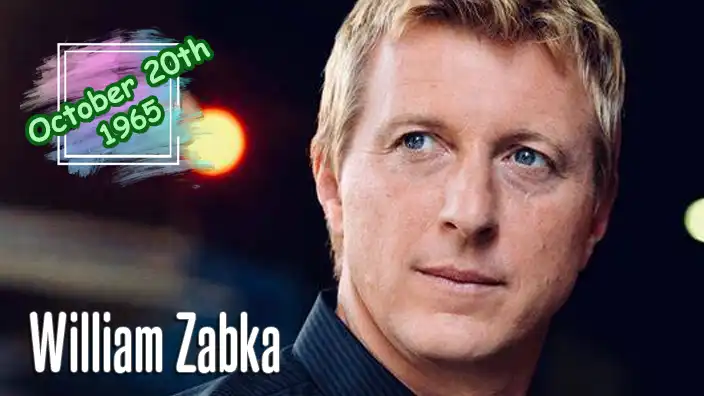
October 20, 1965, in New York City


Born William Michael Zabka on October 20, 1965, in New York City, he grew up in a family with strong connections to the entertainment industry. His father, Stanley William Zabka, worked as a director, writer, composer, and production manager, while his mother, Nancy, was involved in production and business activities within the entertainment world. These family connections introduced William to the practical workings of film and television from an early age. Unlike many aspiring actors who first encountered Hollywood through glamorous premieres and magazine photographs, Zabka understood that successful productions depended upon a considerable amount of work behind the camera.
During his childhood, Zabka lived on Long Island before his family relocated to California's San Fernando Valley. Growing up near Los Angeles placed him close to the entertainment industry and provided opportunities to explore acting, filmmaking, and other creative interests. He attended El Camino Real High School and developed an enthusiasm for athletics, particularly wrestling. His athletic background would eventually prove extremely useful when he was cast in a film centered on martial arts, although wrestling and karate are hardly interchangeable. Fortunately, the casting director apparently wasn't conducting a black-belt examination.
Zabka also developed an interest in filmmaking, influenced partly by his father's professional activities. He briefly attended California State University, Northridge, where he studied film, but his growing acting opportunities eventually redirected his career. His early experiences included television appearances and commercial work, providing an introduction to the demands of performing before cameras. These assignments helped him develop the confidence and technical understanding required for professional acting, although nothing could have fully prepared him for the extraordinary opportunity that arrived in 1984.
That opportunity was The Karate Kid, directed by John G. Avildsen and written by Robert Mark Kamen. The film starred Ralph Macchio as Daniel LaRusso, a teenager who moves to California with his mother and struggles to adjust to his new surroundings. Daniel becomes the target of a group of karate students led by Johnny Lawrence, portrayed by Zabka. The film also introduced Pat Morita as Mr. Miyagi, the wise and unconventional martial arts instructor who teaches Daniel that karate involves considerably more than punching opponents and shouting loudly.
Zabka's casting as Johnny Lawrence proved inspired, particularly because he had no substantial karate training before joining the production. His background in wrestling provided physical confidence and athletic coordination, but he needed to learn the techniques required to portray an experienced martial artist. Working with professional instructors and stunt coordinators, he developed the movements, fighting positions, and controlled aggression necessary to make Johnny appear convincing. The preparation was demanding, especially because the character was supposed to be one of the most accomplished young karate competitors in the story. There is nothing quite like being hired to portray an expert in something you haven't actually learned yet.
Johnny Lawrence quickly became one of the defining teenage antagonists of 1980s cinema. As the leading student of the Cobra Kai dojo, he followed the aggressive philosophy taught by his instructor, John Kreese, played by Martin Kove. Kreese encouraged his students to show little mercy and treat competition as an opportunity to dominate opponents. Johnny's relationship with Daniel became increasingly hostile, particularly because of their mutual interest in Ali Mills, portrayed by Elisabeth Shue. Their rivalry provided the central conflict of the film, combining teenage jealousy, social pressure, and martial arts competition into a story that would become a beloved American movie classic.
Although Johnny was initially presented as an intimidating bully, Zabka's performance included moments suggesting that the character was more complicated than his behavior indicated. Johnny appeared confident and aggressive when surrounded by his Cobra Kai friends, but his interactions with Kreese revealed the pressure he experienced from an authoritarian instructor. The relationship suggested that Johnny's behavior was influenced by his desire for approval and his belief that winning justified almost any action. These subtle elements would become especially important decades later when Cobra Kai revisited the character from a different perspective.
The climactic All Valley Karate Tournament became one of the most memorable sequences in The Karate Kid. Daniel, trained by Mr. Miyagi, faces Johnny in a dramatic championship match that culminates in the famous crane kick. The scene became an enduring part of popular culture, inspiring countless imitations, references, and enthusiastic attempts by children who probably should have moved the living room furniture first. Zabka's convincing portrayal of Johnny helped make Daniel's victory emotionally satisfying, while Johnny's respectful acknowledgment of his opponent at the conclusion suggested that the character possessed qualities beyond his earlier hostility.
Released in June 1984, The Karate Kid became a major commercial success and established Ralph Macchio, Pat Morita, and William Zabka as recognizable figures in popular entertainment. The film's combination of humor, friendship, mentorship, and determination appealed to audiences across generations. Its success also demonstrated the enduring appeal of stories about underdogs confronting seemingly overwhelming challenges. For Zabka, however, the achievement came with an unusual consequence: he became so convincing as a teenage bully that audiences occasionally struggled to separate the actor from the fictional character.
Zabka later recalled that some viewers reacted negatively toward him in public because of Johnny Lawrence's behavior in the film. Although such reactions reflected the effectiveness of his performance, they also illustrated the challenges of becoming closely associated with an unpopular fictional character. Playing a memorable villain can provide tremendous professional opportunities, but it can also create expectations that influence subsequent casting decisions. In Zabka's case, Hollywood quickly discovered that he was particularly good at portraying confident young men whose personalities left considerable room for improvement.
In 1985, Zabka appeared in the teen comedy Just One of the Guys, portraying Greg Tolan, an arrogant high school athlete whose behavior contributes to the film's conflicts. The movie followed a teenage girl who disguises herself as a boy to investigate gender discrimination and prove her abilities as a journalist. Zabka's character reinforced his growing reputation for playing intimidating or unpleasant young men, although his performance also demonstrated his ability to incorporate humor into antagonistic roles. His confident screen presence made him a natural choice for characters who believed that popularity, athletic ability, and a carefully maintained hairstyle entitled them to special treatment.
That same year, Zabka appeared in National Lampoon's European Vacation, the second installment in the popular comedy film series starring Chevy Chase and Beverly D'Angelo. He portrayed Jack, the boyfriend of Audrey Griswold, played by Dana Hill. Although his role was relatively small, the production introduced him to another successful Hollywood franchise and demonstrated his ability to work in broad comedy. The film's exaggerated family misadventures provided a different environment from the martial arts rivalry of The Karate Kid, although Zabka continued portraying characters associated with the familiar teenage social world of the 1980s.
In 1986, Zabka reprised Johnny Lawrence in the opening sequence of The Karate Kid Part II. The sequel began immediately after the events of the original film, showing Johnny's confrontation with Kreese following his tournament defeat. When Kreese reacts violently toward his student, Mr. Miyagi intervenes, revealing the abusive nature of the instructor's relationship with Johnny. Although Zabka's appearance was brief, the scene became important to the character's development because it demonstrated that Johnny had also been a victim of Kreese's destructive philosophy. This moment would later provide valuable background for the storytelling in Cobra Kai.
Also in 1986, Zabka appeared in the comedy Back to School, starring Rodney Dangerfield as Thornton Melon, a wealthy businessman who enrolls in college to support his struggling son. Zabka portrayed Chas Osborne, an arrogant diving-team member whose unpleasant behavior makes him an obstacle to the film's younger characters. His performance again demonstrated his ability to portray an athletic antagonist, this time in a college environment rather than a high school karate dojo. The film became a popular comedy of the decade, and Zabka's contribution added another recognizable character to his growing collection of cinematic troublemakers.
Zabka's repeated casting as antagonistic young men became a distinctive feature of his early career. His blond hair, athletic appearance, and confident manner made him an effective screen rival for sympathetic leading characters. However, the association also risked limiting the range of roles available to him. Audiences recognized his face immediately, but filmmakers frequently imagined him as another variation of Johnny Lawrence. For an actor interested in exploring different characters and creative opportunities, such success could become both a professional advantage and an obstacle.
During the latter part of the 1980s, Zabka appeared in the television crime drama The Equalizer, starring Edward Woodward as Robert McCall, a former intelligence operative who helps people facing dangerous circumstances. Zabka portrayed Scott McCall, the protagonist's son, in a recurring role. The series allowed him to explore more serious dramatic material and participate in stories involving family relationships, crime, and moral responsibility. Working alongside Woodward also provided an opportunity to develop his acting skills in a television environment considerably different from the teenage comedies and action films that had established his reputation.
As the 1990s progressed, Zabka continued acting while increasingly pursuing independent productions and filmmaking opportunities. His credits included action-oriented projects such as Shootfighter: Fight to the Death, released in 1993, and its sequel Shootfighter II in 1996. These films allowed him to draw upon the physical training and screen-fighting experience he had developed earlier in his career. Although they did not achieve the mainstream recognition of The Karate Kid, they contributed to his professional experience and helped maintain his involvement in the entertainment industry.
Zabka also appeared in films including High Voltage in 1997 and Python in 2000, demonstrating his willingness to work across different genres and production budgets. Independent filmmaking provided opportunities to explore creative responsibilities that were not always available within major studio productions. His growing interest in writing, producing, and directing reflected the influence of his family's entertainment background and his early ambition to understand the filmmaking process beyond acting. Rather than waiting indefinitely for Hollywood to offer another iconic role, Zabka began developing projects that allowed him to exercise greater creative control.
One of the most significant achievements of Zabka's career came through his involvement in the short film Most, also known as The Bridge. Released in 2003 and directed by Bobby Garabedian, the film tells an emotionally powerful story about a railroad bridge operator, his young son, and a devastating moral decision. Zabka co-wrote and produced the project, which was filmed in the Czech Republic and Poland. The production explored themes of sacrifice, love, responsibility, and the consequences of impossible choices, presenting material far removed from the teenage rivalries that had defined his early acting career.
Most received considerable recognition on the international film festival circuit, earning awards and attracting critical attention for its storytelling and emotional impact. In 2004, the film received an Academy Award nomination for Best Live Action Short Film, with Zabka and Garabedian recognized for their work. The nomination represented an important professional milestone, demonstrating that Zabka possessed substantial creative abilities beyond his familiar screen performances. It also introduced a surprising fact to audiences who primarily remembered him as Johnny Lawrence: the actor who once terrorized Daniel LaRusso had become an Oscar-nominated filmmaker.
Zabka's success with Most encouraged further work behind the camera, particularly directing music videos. His filmmaking interests allowed him to combine visual storytelling, performance, and music in projects that differed from conventional narrative films. He directed videos for several recording artists, including country group Rascal Flatts, demonstrating his ability to adapt his directing style to different musical genres and creative requirements. Music video production also provided opportunities to experiment with pacing, editing, visual symbolism, and the relationship between sound and imagery.
One of his most entertaining directing projects was the music video for "Sweep the Leg," a 2007 song by the band No More Kings. The video humorously revisited The Karate Kid, with Zabka appearing as a fictionalized version of himself and embracing the enduring popularity of Johnny Lawrence. Other performers associated with the original film also participated, creating an affectionate parody of the movie's famous characters and tournament sequences. The project demonstrated Zabka's willingness to laugh at his own screen image and recognize the lasting affection audiences felt for the original film. It also suggested that, after years of being associated with the villain, he had developed a healthy sense of humor about the whole business.
In 2010, Zabka appeared in the science-fiction comedy Hot Tub Time Machine, a film that combined contemporary humor with an affectionate examination of 1980s popular culture. The story followed a group of friends who unexpectedly travel backward in time after using a malfunctioning hot tub. Zabka's appearance contributed to the film's collection of nostalgic references and familiar personalities associated with the decade. The production demonstrated how strongly his early career remained connected to popular memories of 1980s cinema, while allowing him to participate in a comedy that openly celebrated the absurdities of the period.
Another important step toward his eventual return as Johnny Lawrence came through the television sitcom How I Met Your Mother. Beginning in 2013, Zabka appeared as a fictionalized version of himself in episodes featuring Barney Stinson, played by Neil Patrick Harris. Barney famously argued that Johnny Lawrence was the real hero of The Karate Kid, while Daniel LaRusso was the character who had disrupted his life. The joke reversed the traditional interpretation of the movie and provided a humorous new perspective on the familiar rivalry. Zabka embraced the opportunity, demonstrating his comic timing and willingness to participate in affectionate self-parody.
The How I Met Your Mother appearances helped introduce Zabka to younger television audiences who might not have experienced the original release of The Karate Kid. They also demonstrated the entertainment potential of reconsidering Johnny Lawrence's story from a different perspective. Although the sitcom treated the idea primarily as a joke, the concept contained an intriguing dramatic possibility: what if the original movie's antagonist had spent decades struggling with the consequences of his youthful mistakes? What if Johnny's life had not turned out as he expected, and what if he eventually received an opportunity to change?
That possibility became the foundation of Cobra Kai, the comedy-drama series created by Josh Heald, Jon Hurwitz, and Hayden Schlossberg. Premiering in 2018 on YouTube Red, later known as YouTube Premium, the series reunited William Zabka and Ralph Macchio in their iconic roles as Johnny Lawrence and Daniel LaRusso. Set decades after the original film, the story initially followed Johnny as a struggling adult whose life had become a collection of disappointments, failed relationships, and missed opportunities. Daniel, meanwhile, had become a successful automobile dealership owner with a family and a comfortable lifestyle. The contrast provided an entertaining reversal of their original circumstances.
Zabka's portrayal of the adult Johnny Lawrence became one of the central attractions of Cobra Kai. The character remained stubborn, impulsive, and frequently bewildered by modern technology, but he also possessed a surprising capacity for loyalty, humor, and personal growth. Johnny's attempts to rebuild his life by reopening the Cobra Kai dojo introduced new generations of students to his unconventional teaching methods. His relationship with Miguel Diaz, played by Xolo Maridueña, became especially important, allowing Johnny to develop as a mentor while confronting the mistakes of his own past.
The relationship between Johnny and Miguel provided much of the emotional foundation for the early seasons of Cobra Kai. Johnny initially approached teaching karate through the aggressive philosophy he had learned from Kreese, but his growing affection for Miguel encouraged him to question those methods. His efforts to become a better instructor frequently produced comic disasters, particularly when his understanding of contemporary parenting, education, and technology proved spectacularly outdated. Nevertheless, the character's determination to improve gave the series considerable emotional depth and helped audiences appreciate the difference between Johnny's intentions and his often disastrous execution.
The renewed rivalry between Johnny Lawrence and Daniel LaRusso became another defining feature of Cobra Kai. Although both characters had matured since their teenage years, their unresolved disagreements frequently resurfaced with remarkable intensity. Daniel continued to embrace the defensive philosophy taught by Mr. Miyagi, while Johnny initially favored the aggressive methods associated with Cobra Kai. Their conflicting approaches to karate reflected broader differences in personality, family relationships, and attitudes toward responsibility. The series repeatedly demonstrated that neither character possessed a complete understanding of the other's experiences, creating opportunities for both comedy and meaningful character development.
One of the most appealing qualities of Cobra Kai was its willingness to reconsider familiar characters without simply reversing their original roles. Johnny did not become an uncomplicated hero, nor did Daniel suddenly become a villain. Instead, the series explored how personal experiences, misunderstandings, and changing circumstances influence the way individuals interpret their past. Zabka's performance was essential to this approach because he allowed Johnny to remain recognizably connected to the arrogant teenager audiences remembered while gradually revealing his vulnerability and capacity for change.
The series also reunited Zabka with Martin Kove, who returned as John Kreese, and later incorporated other performers and characters from the original Karate Kid films. These appearances strengthened the connection between the movies and the television series while providing opportunities to explore unresolved relationships. Johnny's complicated history with Kreese became particularly important, revealing the lasting effects of his former instructor's manipulative and abusive teaching methods. Zabka's portrayal allowed viewers to understand how those experiences had influenced Johnny's adult behavior without excusing his mistakes.
Following its successful debut, Cobra Kai developed a devoted audience and received widespread attention for its combination of nostalgia, action, humor, and character-driven storytelling. The series moved to Netflix in 2020, introducing the production to a substantially larger international audience. Its popularity demonstrated that a continuation of a familiar movie franchise could succeed by developing its characters rather than merely repeating the original story. The show also attracted younger viewers through its new generation of karate students, creating a connection between audiences who remembered the 1984 film and those discovering its characters for the first time.
Zabka's performance earned particular praise for its balance of comedy and drama. Johnny Lawrence's outdated vocabulary, enthusiasm for classic rock, and frequent confusion about modern social conventions became recurring sources of humor. His attempts to navigate smartphones, the internet, and contemporary relationships frequently ended in frustration, usually accompanied by a colorful complaint about how much simpler everything had been during the 1980s. Yet beneath the comedy, Zabka portrayed a man struggling to become a better father, teacher, friend, and partner. This combination made Johnny one of the series' most compelling personalities.
The character's relationship with his estranged son, Robby Keene, played by Tanner Buchanan, became another important part of the story. Johnny's failures as a father contributed to Robby's resentment and complicated their efforts to reconnect. The series explored the difficulties of rebuilding trust after years of disappointment, presenting family reconciliation as a gradual process rather than a problem solved by a single heartfelt conversation. Zabka's performance brought emotional credibility to these scenes, demonstrating that the actor who once specialized in portraying intimidating teenagers could deliver thoughtful performances about regret, responsibility, and forgiveness.
Zabka also became involved in the production of Cobra Kai as a co-executive producer, working alongside Ralph Macchio and the show's creative team. His understanding of Johnny Lawrence and the original films provided valuable continuity as the series developed new storylines. The production required careful coordination between established characters and younger performers, as well as elaborate martial arts sequences that became increasingly ambitious throughout its run. Zabka's combination of acting experience, filmmaking knowledge, and personal connection to the franchise made him an important contributor to the show's creative identity.
The success of Cobra Kai brought renewed professional recognition to Zabka and his fellow performers. The series received multiple Primetime Emmy Award nominations, including recognition for Outstanding Comedy Series. Its achievements reflected the popularity of a production that successfully combined established characters with contemporary storytelling. For Zabka, the recognition was especially satisfying because it demonstrated that Johnny Lawrence could support a complex television narrative decades after his original appearance. The former teenage antagonist had become a leading character whose personal development provided much of the show's emotional appeal.
As the series progressed, Johnny's understanding of karate and mentorship continued evolving. He increasingly recognized that aggression alone could not provide the foundation for responsible teaching, while Daniel gradually acknowledged that his own methods were not universally appropriate. Their uneasy cooperation created some of the show's funniest moments, particularly when their competing personalities turned ordinary training sessions into arguments about philosophy, discipline, and whose dojo deserved the larger sign. Their growing mutual respect also provided an important theme, suggesting that individuals with very different experiences could learn from one another when they were willing to reconsider longstanding assumptions.
Cobra Kai ultimately ran for six seasons, concluding in 2025. Its final season brought together the major relationships and conflicts that had developed throughout the series, providing a conclusion to Johnny Lawrence's extended journey from troubled former champion to a more responsible adult. The production's success confirmed the enduring popularity of The Karate Kid franchise while establishing a distinct identity for the television continuation. Zabka's performance became an important example of how an actor could revisit an iconic character and develop it into something considerably richer than audiences originally imagined.
In 2025, Zabka also returned briefly as Johnny Lawrence in Karate Kid: Legends, a feature film that connected elements of the original Karate Kid films with the later cinematic story featuring Jackie Chan. The film starred Ben Wang as a young martial arts student and brought together Ralph Macchio's Daniel LaRusso and Chan's Mr. Han. Zabka's appearance reinforced the continuing place of Johnny Lawrence within the broader franchise and demonstrated how a character introduced in 1984 remained recognizable across different generations of audiences.
Beyond his professional achievements, Zabka has maintained a relatively private family life. He married Stacie Lynn Doss in 2008, and the couple have two children. Despite the renewed publicity surrounding Cobra Kai, he has generally avoided making his family the center of his public identity. His personal interests have included outdoor activities, sports, and filmmaking, reflecting the combination of athletic enthusiasm and creative curiosity that has accompanied him throughout his career.
One particularly interesting aspect of Zabka's professional journey is his relationship with martial arts. Although he began The Karate Kid without extensive karate experience, he continued studying martial arts after the film and developed genuine respect for the discipline. His training helped him understand the physical and philosophical demands of the activity, while his return to the franchise required renewed preparation for action sequences. The experience demonstrated how an acting assignment could develop into a lasting personal interest, even when the original motivation had simply been to look convincing while attempting to defeat Ralph Macchio.
Zabka's career also reflects the changing relationship between cinema, television, and popular culture. During the 1980s, actors who became strongly associated with a particular character sometimes struggled to escape typecasting. However, the growth of streaming services and renewed interest in familiar entertainment properties created opportunities to revisit established stories with greater complexity. Cobra Kai demonstrated that audiences were willing to reconsider characters they had known for decades, particularly when the new material respected the original while introducing fresh perspectives.
The enduring appeal of Johnny Lawrence also illustrates the importance of character development in popular storytelling. In the original film, Johnny served primarily as an obstacle for Daniel LaRusso to overcome. In Cobra Kai, he became a central figure whose personal history, failures, relationships, and attempts at improvement provided the foundation for an extended narrative. Zabka's ability to preserve the recognizable characteristics of Johnny while introducing new emotional dimensions helped make the transformation convincing. Audiences could still recognize the arrogant teenager from the 1980s, but they could also understand the disappointed adult attempting to rebuild his life.
William Zabka's achievements extend considerably beyond his association with The Karate Kid. His work in independent filmmaking, his Academy Award nomination for Most, his music video directing, and his performances across film and television demonstrate a versatile professional career. Although Johnny Lawrence remains his most recognizable role, his creative accomplishments reveal an artist interested in storytelling from multiple perspectives. His journey also demonstrates the value of persistence in an industry where opportunities can change dramatically and professional success rarely follows a predictable path.
The cultural influence of The Karate Kid and Cobra Kai has ensured that Zabka remains an important figure in American entertainment. The original film introduced audiences to memorable characters and enduring themes of perseverance, mentorship, and personal growth, while the television series expanded those ideas through a more complicated examination of rivalry and redemption. Zabka's contribution to both productions helped create a character whose story has remained meaningful across generations. Few actors have experienced the unusual opportunity to return to a famous role after several decades and discover that audiences are even more interested in the character than before.
William Zabka's career is ultimately a story about reinvention, creative determination, and the unexpected possibilities of returning to familiar territory with a different perspective. From his breakthrough performance as Johnny Lawrence to his achievements as a filmmaker and his acclaimed return in Cobra Kai, he has demonstrated that a memorable Hollywood career can develop in surprising directions. His performances have entertained generations of moviegoers and television viewers, while his work behind the camera has revealed talents that extend far beyond his familiar screen image. And perhaps the greatest irony of all is that the actor who became famous for playing the bully in The Karate Kid eventually helped audiences understand why Johnny Lawrence deserved a second chance. After all those years, the Cobra Kai philosophy may still insist on striking first, but William Zabka has proved that sometimes the greatest victory comes from learning when not to throw the punch.