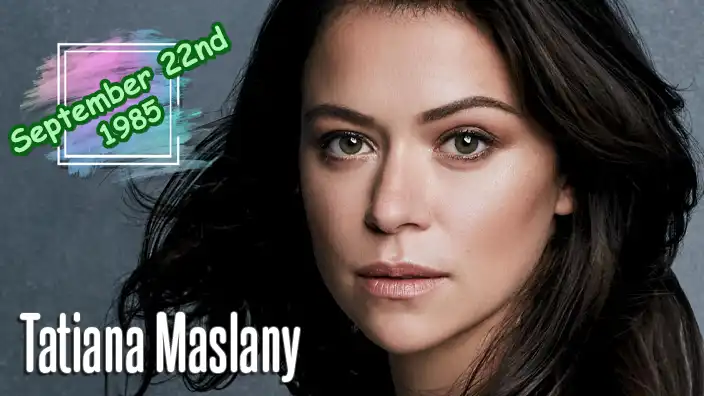
September 22, 1985, in Regina, Canada
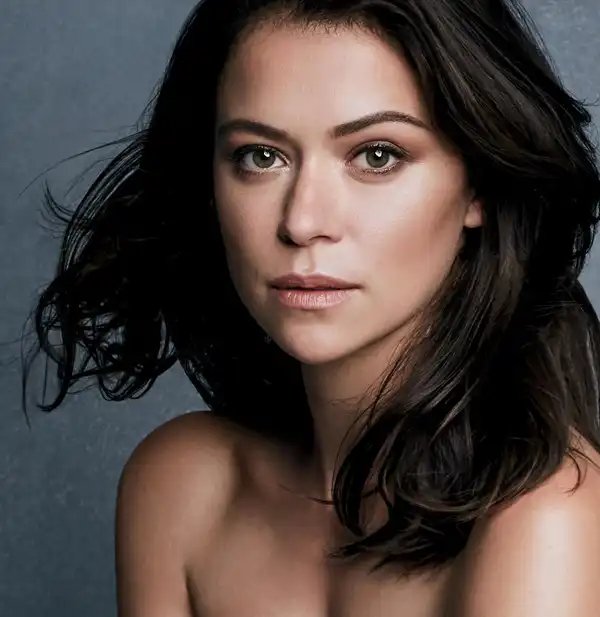
Tatiana Gabrielle Maslany was born on September 22, 1985, in Regina, Saskatchewan, Canada, the daughter of Renate, a translator, and Dan Maslany, a woodworker. Growing up in Regina, she became involved in performance early, participating in school productions and developing the improvisational skills that would eventually become one of the foundations of her acting career. Maslany spent years performing improv and participated in the Canadian Improv Games, an experience that encouraged the quick thinking, character invention and willingness to leap enthusiastically into the unknown that would later prove exceptionally useful when somebody decided she should play an alarming percentage of the population of Orphan Black.
Maslany began working professionally while still young, accumulating Canadian television and film credits long before international audiences knew her name. Early appearances included the television series 2030 CE and the television movie Booky Makes Her Mark, while she also appeared in such productions as Instant Star, Heartland, Being Erica and The Nativity. She steadily developed a reputation as a versatile performer rather than arriving through a single overnight success. Her early career also included film work, among it a supporting appearance in David Cronenberg's Eastern Promises and a role in the romantic drama The Vow, starring Rachel McAdams and Channing Tatum.
Those years of improvisation and character work were excellent preparation for the role that changed everything. In 2013, Maslany began starring in the BBC America science-fiction thriller Orphan Black as Sarah Manning, a troubled young woman who witnesses the suicide of another woman who looks exactly like her. Sarah initially assumes the dead woman's identity, hoping to solve some immediate problems, only to discover that Beth Childs was not merely an extraordinary lookalike. She was one of a group of genetically identical human clones, and Sarah had just stumbled into a conspiracy involving biotechnology, scientific experimentation, identity and ownership of the human body.
That premise handed Maslany one of television's most formidable acting assignments. She did not simply play Sarah and occasionally put on a different wig. She created a growing collection of distinct human beings who shared the same basic appearance but possessed different nationalities, accents, personalities, histories, occupations, mannerisms and emotional lives. Among them were brilliant scientist Cosima Niehaus, tightly wound suburban mother Alison Hendrix, deeply damaged Ukrainian assassin Helena, calculating corporate executive Rachel Duncan, mysterious M.K., glamorous Krystal Goderitch and police detective Beth Childs. By the end of the series, the Television Academy would credit Maslany with portraying an extraordinary collection of clone characters.
The remarkable part was how quickly audiences stopped seeing them as Tatiana Maslany in different costumes. Cosima felt like Cosima. Alison was unmistakably Alison. Helena could enter a scene and completely alter its atmosphere before saying very much at all. Rachel carried herself differently from Sarah, spoke differently and seemed to occupy physical space differently. The characters developed such individual identities that scenes involving several clones could make it surprisingly easy to forget there was only one principal actress underneath them all. Maslany was effectively creating chemistry with herself, which at least had the advantage of making arguments over who received top billing relatively straightforward.
Making those scenes was considerably more complicated than watching them. When multiple clones appeared together, the production used sophisticated motion-control camera techniques that allowed precisely repeated camera movements. Maslany would perform one character opposite acting doubles, then change character and repeat the scene from another position while responding to previously recorded dialogue through an earpiece. Marks, eyelines and timing had to be carefully maintained so the separately filmed performances could later be combined into a convincing single shot. Sometimes she was effectively performing opposite tennis balls or markers representing characters she had already played—or was about to play.
Then Orphan Black made the assignment even more delightfully absurd. Maslany sometimes had to portray one clone pretending to be another clone. That meant she could not simply perform as Alison, for example; she might have to play Sarah attempting to behave like Alison, preserving enough of Sarah's characteristics beneath an imperfect imitation of Alison for the audience to understand exactly who was really standing there. It was acting layered upon acting, with the additional inconvenience that the performer had to remember which version of herself was currently pretending to be which other version of herself. Most people have difficulty remembering why they walked into the kitchen.
Critical recognition followed. Maslany received three Primetime Emmy nominations for Outstanding Lead Actress in a Drama Series for Orphan Black, winning the award in 2016. The Television Academy credited her winning performance that year as Sarah, Alison, Cosima, Helena, Rachel, M.K. and Krystal. She also received honors including Critics' Choice Television Awards, Television Critics Association recognition and Canadian Screen Awards. The Emmy victory was particularly significant: the Television Academy identifies Maslany as the first Canadian actor from a Canadian series to win an Emmy in a major dramatic acting category.
Orphan Black concluded its five-season run in 2017, but Maslany had already continued developing a film career alongside it. In Woman in Gold, she portrayed the younger Maria Altmann, the character played in later life by Helen Mirren. She appeared opposite Jake Gyllenhaal in Stronger, the drama based on the story of Boston Marathon bombing survivor Jeff Bauman, playing Erin Hurley. Maslany's performance required an entirely different kind of emotional realism from the heightened science-fiction world of Orphan Black, demonstrating that her versatility did not depend upon cloning technology and an industrial supply of wigs.
Other film work has included The Other Half, Destroyer and Pink Wall, while Maslany has also continued working onstage. In 2018 she appeared in Tracy Letts' Mary Page Marlowe in New York, in which several actresses portrayed the title character at different stages of her life. There was a certain pleasing reversal in seeing an actress famous for playing numerous people participate in a production where numerous actresses shared one person.
Television soon provided another striking role. In HBO's Perry Mason, Maslany played Sister Alice McKeegan, a charismatic religious leader whose passionate sermons and public persona place her at the center of the drama surrounding a sensational murder case in Depression-era Los Angeles. The character allowed Maslany to employ a different sort of transformation, relying not upon visual effects but upon the theatrical power and emotional intensity of a woman capable of commanding an enormous congregation.
Then Marvel called, presumably having looked at Orphan Black and concluded that an actress capable of playing an entire genetic experiment could probably handle two versions of the same lawyer. Maslany was cast as Jennifer Walters in the Disney+ series She-Hulk: Attorney at Law, which premiered in 2022. Jennifer is a successful attorney who acquires Hulk-like abilities after her blood is accidentally contaminated by that of her cousin, Bruce Banner. Unlike Bruce's historically difficult relationship with his enormous green alter ego, Jennifer retains considerably more control over herself when transformed.
The series approached the Marvel Cinematic Universe from a deliberately comedic angle. Jennifer had to balance legal work, dating, family, unwanted public attention and superhero complications while regularly acknowledging that she was appearing in a television show. Maslany played Jennifer Walters while performance-capture and visual-effects technology transformed the character into the towering green She-Hulk. The result required yet another unusual acting technique, although after Orphan Black, being asked to portray only two versions of herself probably seemed like management had finally approved some vacation time.
She-Hulk: Attorney at Law also gave Maslany an opportunity to lean heavily into comedy, something her improvisational background made particularly appropriate. The show mixed superhero action with workplace comedy and legal satire while introducing characters ranging from obscure superhumans to established Marvel figures. Mark Ruffalo appeared as Bruce Banner, Tim Roth returned as Emil Blonsky, and Charlie Cox reprised Matt Murdock, better known as Daredevil. At the center of the increasingly peculiar proceedings was Maslany's Jennifer, frequently more concerned with surviving work and relationships than saving the universe before lunch.
Maslany has continued to pursue projects outside established franchises rather than simply settling into superhero territory. Her more recent screen work has included the horror film Keeper, and in 2026 the Television Academy highlighted her starring role in the television series Maximum Pleasure Guaranteed. In that darkly comic thriller she plays Paula, a fact-checker and recently divorced mother whose life begins spiraling into increasingly dangerous territory. It is another character far removed from Sarah Manning or Jennifer Walters and another indication of Maslany's preference for roles offering something unusual to explore.
The extraordinary achievement of Orphan Black, however, remains impossible to separate from any discussion of her career. The special effects that placed multiple clones into the same frame were technically impressive, but technology alone could never have made those characters convincing. The illusion worked because Maslany supplied each woman with recognizable physical behavior, speech patterns, emotional rhythms and personality. Remove the visual trickery and there was still a remarkable collection of individual performances underneath it.
That ability to disappear into characters explains why Tatiana Maslany has moved comfortably between science fiction, drama, comedy, superhero spectacle, independent film and theater. Many performers spend their careers demonstrating range by playing different characters in different productions. Maslany famously demonstrated hers by playing different characters in the same scene—and occasionally one of those characters pretending to be another one. Hollywood normally needs several trailers and a substantial payroll to accomplish that. Orphan Black merely needed Tatiana Maslany to turn up for work.