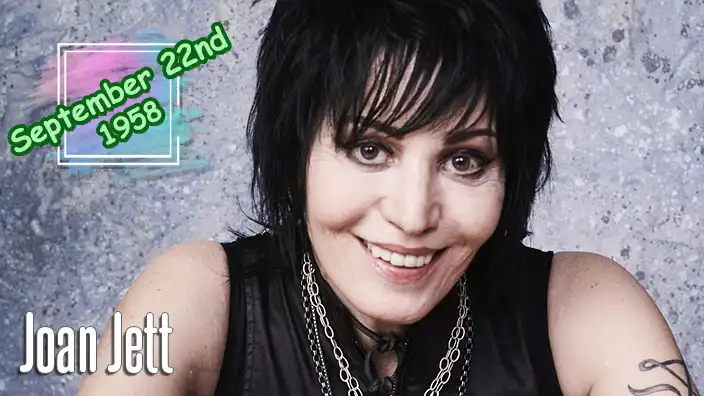
September 22, 1958, in Wynnewood, Pennsylvania
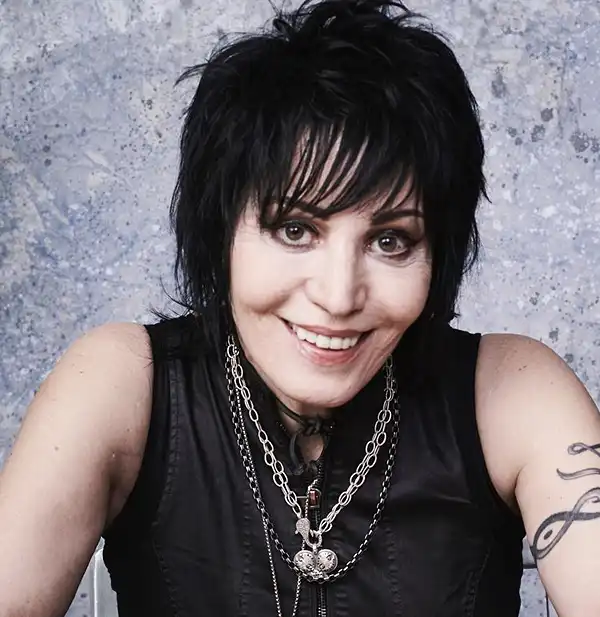
Joan Jett was born Joan Marie Larkin on September 22, 1958, in Wynnewood, Pennsylvania, and developed an interest in music while still young. She received her first guitar as a teenager and quickly discovered that merely owning one was not enough; she wanted to play rock ’n’ roll, and she wanted to play it seriously. After her family moved to California, she found herself close to the Los Angeles music scene at precisely the right moment. Glam rock, punk and hard rock were colliding, established rules were being questioned, and Jett was ready to contribute a few loud questions of her own.
As a teenager, Jett became a founding member of The Runaways, the pioneering all-female rock band assembled in Los Angeles during the mid-1970s. The classic lineup came to include Jett on rhythm guitar and vocals, Cherie Currie as lead singer, Lita Ford on lead guitar, Jackie Fox on bass and Sandy West on drums. At a time when young women in popular music were still routinely expected to occupy carefully prescribed roles, The Runaways arrived playing aggressive guitar-driven rock and displaying little interest in asking whether anybody thought they should.
The band's signature song, "Cherry Bomb," became its enduring calling card. Written by Jett and manager Kim Fowley, the song announced The Runaways with all the subtlety of its title. Although the group never achieved enormous commercial success in the United States during its original existence, it developed an enthusiastic following overseas, particularly in Japan, where The Runaways became major attractions. Their influence ultimately proved much larger than their initial American record sales suggested.
Life inside The Runaways was not especially tranquil. The band experienced personnel changes, disagreements over musical direction and the pressures created by young musicians working inside a difficult industry. Currie departed, and Jett increasingly assumed lead-vocal duties while continuing to play guitar. By 1979, The Runaways had broken up. Jett was barely into adulthood and already had several albums, international touring and the demise of a notable rock band behind her. Most people at that stage are still trying to work out where they left their car keys.
The end of The Runaways could easily have been the end of Jett's recording career. Instead, it became the beginning of the part that would make her internationally famous. She traveled to England and recorded material with musicians including Paul Cook and Steve Jones of the Sex Pistols, then returned to Los Angeles and began working with songwriter and producer Kenny Laguna. That partnership became central to the rest of her career.
Jett recorded a solo album, but obtaining a conventional American record deal proved remarkably difficult. Major labels repeatedly rejected the record. Rather than accept the industry's judgment, Jett and Laguna created Blackheart Records and released the music themselves. The album initially appeared independently as Joan Jett before being reissued as Bad Reputation. Blackheart Records became one of the earliest independent record labels founded by a female artist, turning rejection into an unusually productive business decision.
The title song, "Bad Reputation," became a declaration of purpose. Its pounding rhythm and defiant lyrics suited Jett's public identity so completely that it became difficult to determine whether the song described the singer or the singer had simply decided to live inside the song. Although it was not originally the enormous chart hit some of her later recordings became, "Bad Reputation" developed into one of Jett's defining tracks and has been used extensively in movies, television and popular culture.
Jett and Laguna then assembled Joan Jett & the Blackhearts. The band's breakthrough arrived with a song Jett had first encountered years earlier: "I Love Rock ’n’ Roll." The song was written by Alan Merrill and Jake Hooker of the British group the Arrows, who recorded the original version in 1975. Jett saw the Arrows perform it on British television while touring England with The Runaways and recognized something in it that she never forgot.
She initially recorded "I Love Rock ’n’ Roll" with Cook and Jones in 1979, but the definitive version came later with the Blackhearts. Released from the 1981 album also titled I Love Rock ’n’ Roll, Jett's recording became enormous. It reached number one on the Billboard Hot 100 in 1982 and remained there for seven weeks. Its combination of a brutally simple guitar riff, handclaps, swagger and a chorus apparently designed to be shouted by everyone within hearing distance made it one of the most recognizable rock singles of the decade.
The accompanying music video helped establish Jett as an early MTV presence: black hair, leather, guitar and a visual style requiring no complicated explanation. The performance was direct and unfussy. Jett did not appear to be trying to manufacture a rock-star persona because the persona already seemed fully assembled. The record's success transformed Joan Jett & the Blackhearts into major stars and permanently attached Jett's voice to one of rock music's great communal declarations.
The hits continued. Jett's version of Tommy James and the Shondells' "Crimson and Clover" became another major success, demonstrating her particular ability to take songs associated with other performers and make them sound thoroughly at home in her own musical world. "Do You Wanna Touch Me (Oh Yeah)" also became a hit, while original and cover material comfortably coexisted throughout her catalog.
In 1988, Jett enjoyed another major success with "I Hate Myself for Loving You," written by Jett and Desmond Child. The song reached the Billboard Top 10 and later earned a Grammy nomination. Its muscular guitar riff and enormous chorus provided Jett with another enduring anthem years after "I Love Rock ’n’ Roll" had established her as a star. The song was later adapted for NBC's Sunday Night Football as "Waiting All Day for Sunday Night," further extending the reach of a melody already familiar to rock audiences.
And, as promised, there is that Happy Days connection. In 1982, with "I Love Rock ’n’ Roll" dominating American popular music, Joan Jett & the Blackhearts appeared on Happy Days in the episode "Fonzie, Rock Entrepreneur." Jett appeared as herself, bringing contemporary early-1980s rock into a sitcom whose fictional world had begun decades earlier in the 1950s. By that stage Happy Days had long since allowed its timeline to progress, but the sight of Joan Jett sharing television space with Fonzie still represents a magnificent collision of leather-jacket authority.
Jett also pursued acting. She appeared opposite Michael J. Fox and Gena Rowlands in the 1987 film Light of Day, directed by Paul Schrader. Jett played Patti Rasnick, a musician and single mother performing in a rock band with her brother, played by Fox. The role allowed Jett to combine acting with a world she understood intimately, and the film's title song was written by Bruce Springsteen. She later accumulated additional film and television appearances while remaining primarily identified with music.
Her influence became increasingly obvious as subsequent generations of female rock musicians cited The Runaways and Jett as important predecessors. The Runaways had demonstrated that teenage women could form a hard-rock band, play their own instruments and occupy a musical space commonly treated as male territory. Jett then demonstrated something equally important after the group dissolved: a female guitarist and singer could lead a hard-rock band, build an independent label and maintain control of a career even after the established recording industry had declined to cooperate.
That independent streak helped Blackheart Records become an important part of her legacy. What began as a practical solution to record-company rejection developed into a lasting label operation associated not only with Jett's releases but with other artists. Long before artists routinely discussed bypassing traditional gatekeepers, Jett and Laguna were pressing records and selling them independently because the gatekeepers had already said no.
The story of The Runaways reached movie screens in 2010 with The Runaways, directed by Floria Sigismondi. Kristen Stewart portrayed Jett, while Dakota Fanning played Cherie Currie. Jett served as an executive producer, helping bring the story of the groundbreaking band to audiences who may have known "I Love Rock ’n’ Roll" without realizing that its singer had already been making noise as a teenage guitarist several years earlier.
Jett's broader story was explored further in the 2018 documentary Bad Reputation, directed by Kevin Kerslake. The film traced her career from The Runaways through the creation of the Blackhearts and Blackheart Records, placing particular emphasis on the persistence required to continue after industry rejection. The title could hardly have been anything else. After several decades, "Bad Reputation" had become both a song and a convenient shorthand for Jett's refusal to adjust herself to other people's expectations.
In 2015, Joan Jett & the Blackhearts were inducted into the Rock and Roll Hall of Fame. The honor formally recognized a career whose influence had been apparent for years. Jett had helped open space for women playing loud guitar-driven rock, survived the collapse of her first band, endured rejection from record labels, co-founded her own label and eventually sold millions of records. Being told "no" repeatedly turned out to be a fairly ineffective method of stopping her.
Her influence also crosses musical boundaries. Punk musicians recognize her stripped-down aggression, hard-rock audiences recognize the riffs and attitude, pop listeners know the choruses, and generations who never owned one of her albums still recognize "I Love Rock ’n’ Roll" within seconds. Jett has toured with artists from numerous corners of rock music and remained a fixture of live performance long after many of her contemporaries left the road.
There is an appealing simplicity to Joan Jett's musical identity. She never needed elaborate progressive-rock arrangements, twenty-minute solos or a stage filled with unnecessary machinery. A distorted guitar, pounding drums, a memorable chorus and sufficient volume generally did the job. That apparent simplicity should not be confused with accident. Creating a riff that people recognize after two seconds is considerably harder than creating one that requires an explanatory pamphlet.
From The Runaways to the Blackhearts, Joan Jett built a career by repeatedly refusing to accept the roles other people considered appropriate for her. She became a guitarist when girls with guitars were still treated as novelties, started a label when record companies rejected her, turned other people's songs into records unmistakably associated with her and helped provide a model for generations of women who followed her onto rock stages.
The "Queen of Rock ’n’ Roll" description therefore fits for reasons extending beyond a handful of famous singles. Joan Jett did not merely sing about loving rock ’n’ roll; she spent her life insisting upon her place within it. The music industry had several opportunities to get in her way. It tried. She turned up the amplifier.