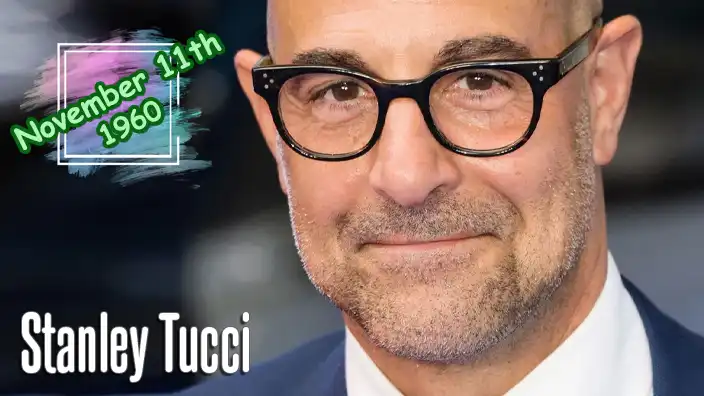
November 11, 1960, in Peekskill, New York

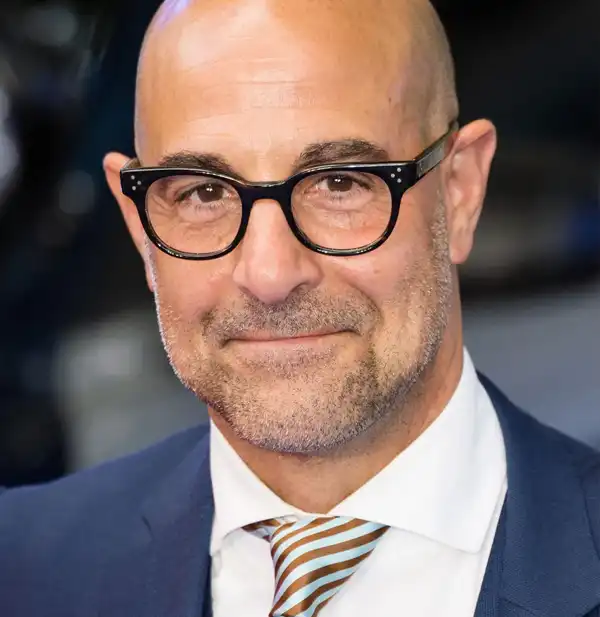
Stanley Tucci is an American actor, director, producer, author, and culinary enthusiast who has mastered the art of making almost everything look effortlessly sophisticated. Whether he's terrifying audiences in The Lovely Bones, stealing scenes in The Devil Wears Prada, or exploring Italy with a plate of pasta and a glass of wine, Tucci brings intelligence, humor, and unmistakable charm to his work. With an extraordinary career spanning theater, film, television, and food documentaries, he has become one of Hollywood's most versatile performers. And unlike most actors, he can probably tell you exactly what to cook while you're watching his movies.
Stanley Tucci Jr. was born on November 11, 1960, in Peekskill, New York, and grew up in nearby Katonah, in Westchester County. His parents, Joan and Stanley Tucci Sr., were both involved in education, with his mother working as a secretary and writer and his father teaching art at Horace Greeley High School. His family was proud of its Italian heritage, and food, art, storytelling, and family gatherings played important roles in his upbringing. Tucci developed an appreciation for Italian cooking at an early age, learning that meals were about considerably more than simply satisfying hunger. In the Tucci household, food was an important expression of family, culture, and affection, and the kitchen was frequently the center of domestic activity.
During his childhood, Tucci spent approximately a year living in Florence, Italy, when his father took a sabbatical from teaching. The experience exposed him to Italian art, architecture, language, and regional cooking traditions, leaving a lasting impression on his understanding of his family's cultural heritage. Florence provided a remarkable environment for a young person interested in creativity, with Renaissance masterpieces, historic buildings, and traditional markets offering daily opportunities for exploration. Although he would eventually become internationally famous for his acting, this early experience helped establish the culinary interests that would become an important part of his later career. Some children return from overseas adventures with postcards and souvenirs; Tucci apparently returned with a lifelong determination to appreciate excellent pasta.
Tucci attended John Jay High School in Cross River, New York, where he developed an interest in acting alongside fellow student Campbell Scott, who would later become an accomplished actor and director. Their friendship eventually developed into a professional partnership, demonstrating that high school acquaintances can occasionally produce something more enduring than embarrassing yearbook photographs. After graduating, Tucci enrolled at the State University of New York at Purchase, where he studied acting in the university's Conservatory of Theatre Arts. He graduated in 1982 with a Bachelor of Fine Arts degree, having developed a strong foundation in classical performance, character interpretation, and theatrical technique.
His professional acting career began on the stage, where he gained valuable experience performing before live audiences. In 1982, Tucci made his Broadway debut in the play The Queen and the Rebels, appearing alongside Colleen Dewhurst. The opportunity was particularly significant because Dewhurst was the mother of his friend Campbell Scott, providing an early connection between his personal relationships and professional career. Theater demanded discipline, adaptability, and the ability to communicate complex emotions without the assistance of camera close-ups or elaborate editing. These skills would become important throughout Tucci's career, allowing him to move comfortably between understated dramatic performances and extravagant comic characters.
Tucci made his feature film debut in the 1985 crime drama Prizzi's Honor, directed by John Huston and starring Jack Nicholson, Kathleen Turner, and Anjelica Huston. Although his role was relatively small, appearing in a major Hollywood production provided an important introduction to professional filmmaking. The film's combination of organized crime, dark comedy, and complicated personal relationships offered an appropriate beginning for an actor who would later become known for portraying morally ambiguous characters. His early screen career continued with supporting appearances in productions including Who's That Girl in 1987, Slaves of New York in 1989, and Billy Bathgate in 1991.
Throughout the late 1980s and early 1990s, Tucci steadily developed a reputation as a dependable character actor capable of making even relatively small roles memorable. He appeared in films such as Beethoven, The Pelican Brief, and It Could Happen to You, demonstrating his ability to move between family entertainment, political thrillers, and romantic comedy. His distinctive appearance, expressive voice, and precise delivery made him particularly effective in portraying intelligent, ambitious, eccentric, or occasionally unpleasant individuals. Rather than pursuing conventional leading-man roles exclusively, Tucci embraced the opportunities offered by character acting, building an extensive filmography that would eventually make him one of those performers audiences recognized immediately, even when they struggled to remember where they had seen him before.
A particularly memorable early performance came in the 1993 television film Winchell, in which Tucci portrayed the influential and controversial American gossip columnist Walter Winchell. Released in 1998, the HBO production explored Winchell's rise to prominence, his influence over American journalism, and the personal consequences of his increasingly combative public persona. Tucci's performance earned him a Golden Globe Award for Best Actor in a Miniseries or Motion Picture Made for Television, as well as a Primetime Emmy Award. His portrayal demonstrated an ability to inhabit a complicated historical figure without simplifying the character's personality or motivations. Playing a man who made a career out of exposing other people's secrets was particularly appropriate preparation for Hollywood, where privacy has occasionally been treated as an optional extra.
One of Tucci's most personally significant projects was the 1996 independent film Big Night, which he co-wrote with his cousin Joseph Tropiano and co-directed with Campbell Scott. Tucci also starred as Secondo, one of two Italian immigrant brothers struggling to operate a restaurant on the New Jersey shore during the 1950s. Tony Shalhoub portrayed his brother Primo, a gifted chef whose devotion to authentic Italian cuisine frequently conflicts with the commercial realities of running a restaurant. The film explored family relationships, cultural identity, artistic integrity, and the emotional importance of food, themes that would remain central to Tucci's later creative work. Its carefully constructed culinary scenes became particularly celebrated, especially the preparation of an elaborate Italian dish called timpano, a baked pasta creation requiring considerable patience and an alarming amount of kitchen equipment.
Big Night received widespread critical acclaim and became an enduring favorite among food enthusiasts and independent film audiences. Tucci and Tropiano won the Independent Spirit Award for Best First Screenplay, while the film received additional recognition from critics and film organizations. Its success demonstrated that Tucci possessed considerable creative abilities beyond acting, including writing, directing, and producing. More importantly, the film presented Italian-American food culture with affection and authenticity, avoiding the exaggerated stereotypes frequently associated with cinematic portrayals of Italian families. The story's emotional power came from its recognition that preparing a meal can represent love, pride, frustration, and personal sacrifice. It also demonstrated that a disastrous restaurant business can still produce an absolutely magnificent dinner.
Tucci continued exploring filmmaking with The Impostors, a 1998 comedy that he wrote, directed, and starred in alongside Oliver Platt. Set during the 1930s, the film follows two struggling actors who accidentally become involved in an increasingly ridiculous series of adventures aboard an ocean liner. Its ensemble cast included numerous accomplished performers, and the production reflected Tucci's appreciation for classic Hollywood comedy, theatrical farce, and elaborate misunderstandings. Although the film did not achieve the commercial success of major studio productions, it demonstrated his willingness to experiment creatively and develop projects outside conventional Hollywood expectations.
Another notable directing project was the 2000 drama Joe Gould's Secret, based on the relationship between journalist Joseph Mitchell and eccentric Greenwich Village personality Joe Gould. Tucci directed the film and portrayed Mitchell, while Ian Holm played Gould. The story explored the complexities of artistic ambition, personal identity, and the sometimes uncomfortable relationship between writers and their subjects. Its thoughtful approach to character and storytelling reflected Tucci's interest in unusual personalities and the complicated motivations that influence human behavior. The film also reinforced his reputation as a filmmaker drawn to intimate stories rather than relying exclusively on spectacle or commercial formulas.
Tucci's television career received another major boost with his performance in the 2001 HBO film Conspiracy, which dramatized the 1942 Wannsee Conference, where senior Nazi officials coordinated plans for the systematic murder of Europe's Jewish population. Tucci portrayed SS officer Adolf Eichmann, delivering a chilling performance that emphasized the bureaucratic nature of the meeting and the horrifying consequences of its decisions. The role earned him another Golden Globe Award and an Emmy nomination. His portrayal was particularly disturbing because it avoided exaggerated villainy, instead presenting a calculating official participating in extraordinary crimes through apparently ordinary administrative procedures. The performance demonstrated Tucci's ability to portray deeply unsettling historical figures with restraint and precision.
Throughout the early 2000s, Tucci appeared in a wide variety of films, including Road to Perdition, The Terminal, and Shall We Dance?. In Road to Perdition, directed by Sam Mendes, he portrayed Chicago mob boss Frank Nitti alongside Tom Hanks and Paul Newman. In The Terminal, directed by Steven Spielberg, he played airport official Frank Dixon, whose determination to enforce bureaucratic regulations complicates the life of a stranded international traveler. His performances demonstrated his talent for portraying authority figures whose outward confidence sometimes concealed insecurity, ambition, or questionable judgment. Tucci could make a character entertaining even when that character's principal occupation appeared to be making everyone else's life unnecessarily difficult.
In 2006, Tucci delivered one of his most beloved performances as Nigel Kipling in the fashion comedy-drama The Devil Wears Prada, directed by David Frankel. The film starred Meryl Streep as formidable fashion magazine editor Miranda Priestly, Anne Hathaway as aspiring journalist Andy Sachs, and Emily Blunt as Miranda's ambitious assistant. Tucci portrayed Nigel, the magazine's knowledgeable and sharply dressed art director, whose sarcastic humor and professional expertise help Andy navigate the intimidating world of high fashion. His character became an audience favorite because he combined cutting remarks with genuine compassion, offering practical advice while maintaining the weary expression of someone who had witnessed far too many questionable fashion decisions.
The success of The Devil Wears Prada introduced Tucci to an even broader international audience and helped establish Nigel as one of his most recognizable characters. His scenes with Anne Hathaway provided some of the film's funniest moments, while his relationship with Miranda Priestly revealed the complicated loyalties and professional sacrifices involved in the fashion industry. Tucci's performance demonstrated his ability to create a fully developed character within an ensemble dominated by major stars. His comic timing was particularly effective because Nigel rarely needed to raise his voice to deliver a devastating observation. A carefully chosen sentence, accompanied by an expression of exhausted disbelief, was usually sufficient to reduce an entire wardrobe to rubble.
Tucci's career continued with appearances in films such as Julie & Julia, the 2009 culinary comedy-drama directed by Nora Ephron. The film starred Meryl Streep as legendary television chef Julia Child and Amy Adams as writer Julie Powell, whose attempt to cook every recipe in Child's famous cookbook becomes an unexpected personal adventure. Tucci portrayed Paul Child, Julia's devoted husband, bringing warmth, humor, and emotional depth to their relationship. His performance emphasized Paul's unwavering encouragement of his wife's culinary ambitions, creating a convincing partnership that became one of the film's most appealing elements. The production reunited Tucci with Streep and provided another opportunity to combine two of his greatest professional interests: acting and food.
That same year, Tucci delivered a dramatically different performance in The Lovely Bones, directed by Peter Jackson and adapted from Alice Sebold's novel. He portrayed George Harvey, a seemingly ordinary neighbor who is revealed to be responsible for the murder of a young girl. The disturbing role required Tucci to abandon the charm and humor associated with many of his previous characters, presenting a deeply sinister personality through restrained behavior and carefully controlled expressions. His performance earned an Academy Award nomination for Best Supporting Actor, along with nominations from the Golden Globes and BAFTA. The role was emotionally demanding, but it demonstrated the extraordinary range that had made Tucci one of Hollywood's most respected character actors.
In 2010, Tucci appeared in the teen comedy Easy A, portraying Dill Penderghast, the affectionate and hilariously supportive father of Emma Stone's character, Olive. Alongside Patricia Clarkson, who played Olive's mother, Tucci helped create one of the most entertaining parental partnerships in contemporary teen comedy. Their characters approached family discussions with humor, warmth, and an impressive willingness to embarrass their children through excessive openness. Tucci's performance provided a welcome contrast to his darker dramatic roles, reminding audiences that he could be equally convincing as a loving father whose greatest apparent pleasure was making his daughter roll her eyes.
Tucci became part of another major film franchise when he was cast as Caesar Flickerman in The Hunger Games, released in 2012. Based on Suzanne Collins's bestselling novels, the dystopian adventure series starred Jennifer Lawrence as Katniss Everdeen, a young woman forced to participate in a brutal televised competition controlled by an authoritarian government. Tucci portrayed the flamboyant television host responsible for interviewing contestants and presenting the Games as entertainment. With brightly colored hair, extravagant clothing, and an unnervingly enthusiastic personality, Caesar represented the disturbing combination of celebrity culture, political propaganda, and public spectacle at the center of the fictional society of Panem.
Tucci reprised the role in The Hunger Games: Catching Fire and both installments of The Hunger Games: Mockingjay – Part 1, completing his appearances in the original four-film series with Mockingjay – Part 2 in 2015. His portrayal of Caesar Flickerman became memorable because the character's cheerful television personality concealed his participation in a deeply oppressive political system. Tucci's ability to combine theatrical flamboyance with subtle menace made Caesar simultaneously entertaining and unsettling. The performance also demonstrated his willingness to embrace elaborate costumes and exaggerated characterizations, proving that a distinguished dramatic actor could still have enormous fun wearing a spectacularly ridiculous wig.
During this period, Tucci also appeared in major fantasy and adventure productions, including Jack the Giant Slayer, Percy Jackson: Sea of Monsters, and Transformers: Age of Extinction. In the Percy Jackson film, he portrayed Dionysus, the Greek god associated with wine and celebration, an amusing casting choice considering Tucci's enthusiasm for culinary pleasures. In Transformers: Age of Extinction, he played Joshua Joyce, an ambitious technology executive whose efforts to exploit alien machinery create predictably catastrophic complications. These projects introduced him to younger audiences and demonstrated his ability to move between intimate dramas and enormous Hollywood productions featuring computer-generated creatures determined to destroy expensive scenery.
Tucci's involvement in the Transformers franchise continued with Transformers: The Last Knight in 2017, in which he portrayed the legendary magician Merlin. The role provided another opportunity to explore fantasy storytelling and historical comedy within a major action franchise. That same year, he directed and co-wrote Final Portrait, a biographical drama starring Geoffrey Rush as Swiss artist Alberto Giacometti and Armie Hammer as American writer James Lord. Set in Paris in 1964, the film follows Giacometti's attempt to paint Lord's portrait, a project that becomes increasingly complicated by the artist's perfectionism and unpredictable behavior. Tucci's direction reflected his longstanding interest in art, creativity, and the often frustrating relationship between artistic ambition and practical reality.
His television work continued with acclaimed performances in productions including Feud: Bette and Joan, the 2017 FX anthology series exploring the rivalry between Hollywood actresses Bette Davis and Joan Crawford. Tucci portrayed studio executive Jack L. Warner, bringing a mixture of authority, ambition, and unpleasant humor to the role. The series examined the entertainment industry's treatment of aging actresses and the professional rivalries encouraged by powerful studio figures. His performance earned a Primetime Emmy Award nomination, reinforcing his reputation as a versatile performer capable of bringing historical personalities to life.
In 2018, Tucci starred in the British television drama Fortitude, portraying Michael Lennox during the show's third season. He also appeared in the 2019 supernatural thriller The Silence and the 2020 family fantasy The Witches, directed by Robert Zemeckis. In The Witches, he portrayed the hotel manager Mr. Stringer, working alongside Anne Hathaway and Octavia Spencer in an adaptation of Roald Dahl's famous children's novel. His character's attempts to maintain order in a luxurious hotel become increasingly difficult when supernatural events threaten the establishment's reputation. For an actor who had previously portrayed airport officials, mobsters, and fashion executives, managing a hotel full of witches was simply another unusual day at work.
In 2020, Tucci appeared alongside Colin Firth in the intimate romantic drama Supernova, directed by Harry Macqueen. The film follows Sam and Tusker, a longtime couple traveling through England as they confront the devastating effects of Tusker's early-onset dementia. Tucci portrayed Tusker, a writer struggling with the gradual loss of his memory and independence, while Firth played his devoted partner. Their performances received widespread critical praise for their emotional restraint and authenticity. Rather than relying upon exaggerated sentimentality, the film explored love, dignity, fear, and personal choice through quiet conversations and carefully observed moments. Tucci's performance demonstrated his exceptional ability to communicate profound emotion without theatrical excess.
Alongside his acting career, Tucci increasingly developed a public reputation as an enthusiastic advocate for Italian food and cooking. In 2012, he published The Tucci Cookbook, a collection of family recipes celebrating the culinary traditions of his Italian heritage. The book featured contributions from relatives and reflected his belief that cooking provides an important connection between generations. He followed it with The Tucci Table in 2014, co-written with his wife, Felicity Blunt, offering recipes influenced by Italian and British family traditions. These publications demonstrated that Tucci's interest in food extended far beyond celebrity endorsements or occasional television appearances. He genuinely enjoyed cooking, understood traditional techniques, and appreciated the stories behind familiar dishes.
Tucci's culinary enthusiasm became an unexpected internet sensation in 2020 when a video of him preparing a Negroni cocktail attracted widespread attention on social media. Filmed at home, the short demonstration featured Tucci calmly explaining how to combine gin, sweet vermouth, and Campari while maintaining the relaxed confidence of a man who had never experienced a poorly organized kitchen. The video became enormously popular, inspiring affectionate commentary about his sophisticated manner and understated charm. Although Tucci had spent decades building an impressive acting career, millions of viewers suddenly seemed equally fascinated by his ability to prepare a drink without making a mess. Hollywood had discovered a new form of entertainment: watching Stanley Tucci operate a cocktail shaker.
His culinary television career reached new heights in 2021 with the CNN documentary series Stanley Tucci: Searching for Italy. The program followed Tucci as he traveled through different Italian regions, exploring traditional dishes, regional ingredients, historic markets, and the people responsible for preserving local food cultures. Rather than presenting Italian cuisine as a single collection of familiar pasta dishes, the series emphasized the enormous diversity of cooking traditions found throughout the country. Episodes explored destinations including Naples, Rome, Bologna, Milan, Florence, Sicily, and other regions, highlighting the connections between geography, history, agriculture, and culinary identity.
Stanley Tucci: Searching for Italy became a critical and audience success, earning two consecutive Primetime Emmy Awards for Outstanding Hosted Nonfiction Series or Special. Viewers responded enthusiastically to Tucci's genuine curiosity, knowledgeable commentary, and obvious enjoyment of the food he encountered. His conversations with chefs, farmers, restaurant owners, and local families demonstrated that cuisine could provide a fascinating introduction to regional history and cultural traditions. The program also introduced international audiences to Italian specialties beyond the dishes commonly associated with Italian-American restaurants. Tucci's ability to make viewers hungry while simultaneously teaching them about history proved remarkably effective, although watching the series immediately before bedtime was probably unwise for anyone attempting to avoid a midnight visit to the refrigerator.
The success of the television series was accompanied by the publication of Tucci's 2021 memoir Taste: My Life Through Food, which explored his personal experiences through memories of meals, family relationships, and culinary discoveries. The book combined humor, autobiography, and food writing, offering readers a personal account of how cooking and eating had shaped his understanding of life. Tucci also discussed his experience with cancer of the tongue, which had been diagnosed in 2017 and required extensive treatment. The illness temporarily affected his ability to taste and swallow food, making the experience particularly difficult for someone whose personal and professional interests were so closely connected to cooking.
Tucci's treatment involved radiation and chemotherapy, and he subsequently discussed the physical and emotional challenges associated with his recovery. His experience gave additional meaning to his appreciation of food, transforming ordinary meals into reminders of abilities that illness had temporarily threatened. By sharing his experiences publicly, he helped raise awareness of the difficulties faced by patients undergoing treatment for head and neck cancers. His recovery also allowed him to return to the culinary activities he loved, although his relationship with food had understandably become more complicated. For a man who had spent much of his life celebrating the pleasures of eating, regaining those experiences represented an important personal achievement.
In 2024, Tucci published another food-centered book, What I Ate in One Year (and Related Thoughts), documenting meals, travels, conversations, and everyday experiences through a series of personal reflections. The book continued his exploration of the relationship between food and memory, emphasizing that even seemingly ordinary meals can become meaningful when connected to family, friendship, and important life events. His writing combined culinary enthusiasm with humor and observations about human behavior, reflecting the same approachable personality that had made his television travel programs successful. Readers discovered that Tucci could make a simple lunch sound almost as interesting as a Hollywood production, although the lunch generally involved fewer explosions and considerably better table manners.
Tucci returned to culinary television in 2025 with Tucci in Italy, a National Geographic documentary series distributed through Disney+ and Hulu. The five-part program continued his exploration of Italian regional food traditions, introducing viewers to local communities, historical influences, and distinctive ingredients. The series visited Tuscany, Lombardy, Trentino-Alto Adige, Abruzzo, and Lazio, examining the ways geography and cultural history influence regional cooking. Tucci's enthusiasm for meeting local producers and discovering traditional recipes remained central to the program's appeal. His approach emphasized the people behind the food, presenting cooking as an expression of cultural identity rather than simply a collection of instructions for preparing dinner.
In addition to his culinary projects, Tucci continued appearing in major film and television productions. In 2024, he starred in the political thriller Conclave, directed by Edward Berger and adapted from Robert Harris's novel. The film follows the secretive process of electing a new pope following the death of the previous pontiff. Tucci portrayed Cardinal Aldo Bellini, a prominent candidate whose position within the Vatican's complicated political environment creates significant personal and institutional tensions. Appearing alongside Ralph Fiennes, John Lithgow, and Isabella Rossellini, Tucci delivered a restrained performance that contributed to the film's atmosphere of intrigue and moral uncertainty. The production received widespread critical acclaim and multiple Academy Award nominations, including Best Picture.
Tucci also appeared in the 2025 Netflix science-fiction thriller The Electric State, directed by Anthony and Joe Russo. Based on Simon Stålenhag's illustrated novel, the film starred Millie Bobby Brown and Chris Pratt in an alternate version of the 1990s where advanced robotics and technological developments have transformed American society. Tucci portrayed Ethan Skate, a powerful technology executive whose ambitions influence the film's central conflict. The production provided another opportunity for him to portray a confident authority figure operating within a morally complicated environment. His ability to communicate intelligence, charm, and underlying menace made him particularly effective in such roles, even when surrounded by futuristic machines and elaborate visual effects.
Away from his professional achievements, Tucci has experienced both personal tragedy and renewed happiness. He married social worker Kathryn Spath in 1995, and the couple had three children together. Kathryn died from breast cancer in 2009, leaving Tucci and their family facing an enormous personal loss. He later developed a relationship with Felicity Blunt, a literary agent and the sister of actress Emily Blunt, whom he had worked with on The Devil Wears Prada. Tucci and Felicity married in 2012 and subsequently welcomed two children. His experiences with marriage, parenthood, bereavement, and rebuilding family life have influenced his writing and public reflections, contributing to the emotional honesty that audiences increasingly associate with his work.
Throughout his career, Tucci has received numerous professional honors, including Golden Globe Awards, Primetime Emmy Awards, Screen Actors Guild recognition, and an Academy Award nomination. His accomplishments reflect an unusual combination of commercial success, critical recognition, and creative independence. Unlike performers whose careers are defined by a single type of character, Tucci has demonstrated an extraordinary ability to move between comedy, drama, historical biography, fantasy, and documentary presentation. His distinctive voice, expressive manner, and attention to character detail have made him one of the entertainment industry's most recognizable supporting and leading performers.
Stanley Tucci's remarkable career demonstrates that artistic success does not require remaining within a single professional category. As an actor, he has portrayed villains, devoted husbands, eccentric professionals, historical figures, and unforgettable comic personalities. As a filmmaker, he has explored personal relationships, artistic ambition, and cultural identity. As an author and television presenter, he has introduced audiences to the pleasures and traditions of Italian cooking while demonstrating that food can provide an extraordinary connection to family and history. Whether he's delivering a perfectly timed insult in The Devil Wears Prada, captivating audiences in The Hunger Games, or explaining the importance of properly prepared pasta, Tucci approaches his work with intelligence, enthusiasm, and unmistakable style. And while Hollywood has produced countless talented actors, relatively few could convincingly portray a sinister murderer in one film and then persuade millions of viewers to make risotto for dinner.
References & Sources