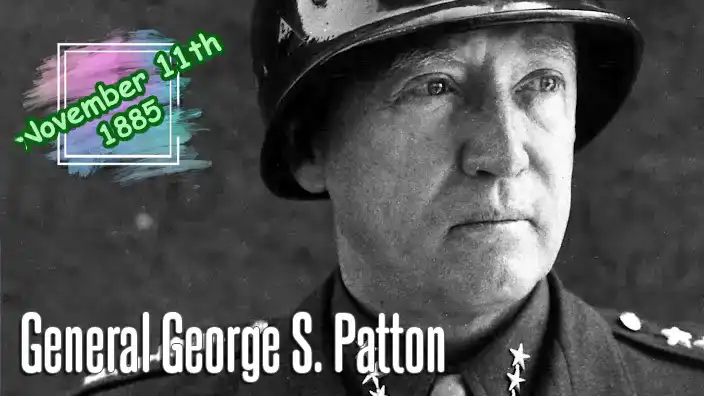
November 11, 1885, in San Gabriel, California
 December 21, 1945, in Heidelberg, Germany

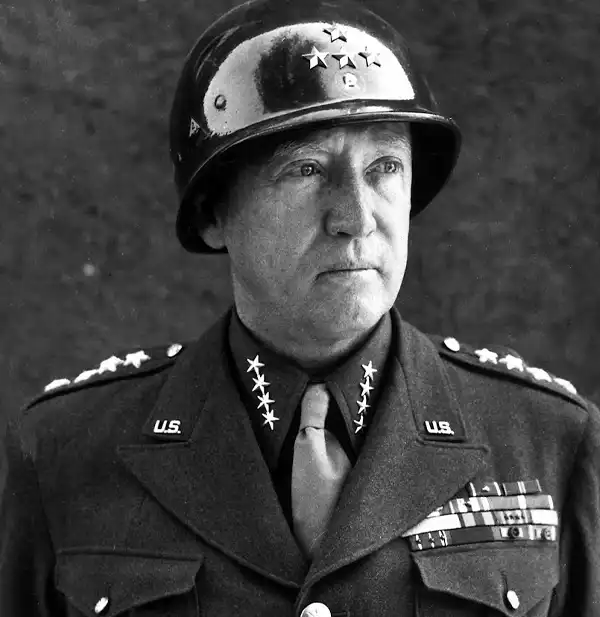
General George S. Patton was one of America's most famous and formidable military commanders, a man who believed in discipline, aggressive tactics, and occasionally expressing himself in language that would make a seasoned sailor blush. Known as "Old Blood and Guts," Patton helped lead Allied forces to victory during World War II, earning a reputation for battlefield brilliance, relentless determination, and a personality about as subtle as a tank driving through a garden party. His soldiers respected his leadership, his enemies feared his armies, and his superiors occasionally wished he would discover the benefits of keeping his opinions to himself.
George Smith Patton Jr. was born on November 11, 1885, in San Gabriel, California, into a prosperous family with a strong military heritage. His father was a lawyer, and several relatives had served in the Confederate Army during the American Civil War. Growing up, Patton developed a fascination with military history, particularly the campaigns of ancient generals such as Alexander the Great and Napoleon Bonaparte. He believed that military leadership required courage, determination, physical endurance, and an understanding of history. These interests helped shape his ambition to become a professional soldier, although his childhood struggles with reading and spelling presented educational challenges that required considerable persistence to overcome.
Patton initially attended the Virginia Military Institute before receiving an appointment to the United States Military Academy at West Point in 1904. His time at West Point was not without difficulty, particularly in mathematics, and he was required to repeat his first year after failing the subject. Nevertheless, his determination, athletic ability, and growing leadership skills helped him succeed, and he graduated in 1909. Commissioned as a second lieutenant in the cavalry, Patton entered an Army still heavily dependent on horses, traditional military formations, and tactics developed long before the arrival of modern mechanized warfare. Within a few decades, he would become one of the world's most recognized advocates of armored combat, demonstrating that even the most enthusiastic horseman could eventually appreciate a machine with considerably more horsepower.
Patton's athletic abilities were evident throughout his early military career. He was an accomplished horseman, fencer, and marksman who believed physical fitness was essential to military leadership. In 1912, he represented the United States in the first modern Olympic pentathlon competition at the Stockholm Summer Olympics. The event consisted of pistol shooting, fencing, swimming, horseback riding, and cross-country running, a demanding combination designed to test the abilities of a well-rounded military officer. Patton finished fifth overall, an impressive achievement against international competition. His performance was particularly notable because he combined Olympic participation with an already demanding military career, apparently finding ordinary physical training insufficiently entertaining.
Following the Olympics, Patton continued developing his interest in swordsmanship and cavalry tactics. He studied fencing techniques in France and designed a new cavalry saber that was adopted by the United States Army in 1913. Officially designated the Model 1913 Cavalry Saber, the weapon became widely known as the "Patton Saber." Its straight blade was designed primarily for thrusting rather than slashing, reflecting Patton's belief that cavalry combat required direct, decisive action. Although mechanized warfare would soon reduce the military importance of mounted cavalry, the saber remained an interesting example of Patton's willingness to challenge established practices when he believed a more effective approach was available.
Patton gained valuable combat experience during the 1916 Mexican Punitive Expedition, when he served under General John J. Pershing during operations against the revolutionary leader Pancho Villa. The campaign followed Villa's attack on Columbus, New Mexico, and involved American troops pursuing his forces across northern Mexico. During the expedition, Patton participated in an armed encounter with several of Villa's men, an engagement that helped establish his reputation as an aggressive young officer. He also demonstrated an early appreciation for motorized vehicles, recognizing that automobiles offered important advantages in speed and mobility. His experience in Mexico provided practical lessons in leadership, reconnaissance, and the importance of moving troops rapidly across difficult terrain.
When the United States entered World War I in 1917, Patton accompanied General Pershing to France as part of the American Expeditionary Forces. Recognizing the military potential of the newly developed tank, he became one of the earliest American officers to specialize in armored warfare. Patton helped establish the American tank school in France, organized training programs, and developed tactics for coordinating tanks with infantry. He subsequently commanded the 304th Tank Brigade during major American offensives, including the Saint-Mihiel and Meuse-Argonne campaigns. In September 1918, he was wounded by machine-gun fire while directing operations near the front lines. His experiences convinced him that future military success would depend increasingly upon mobility, coordination, and the aggressive employment of mechanized forces.
During the years between the world wars, Patton continued studying military strategy and advocating improvements in armored warfare. Although the United States Army faced financial limitations and institutional resistance to major changes, he remained convinced that tanks would play a decisive role in future conflicts. He studied military history extensively, examining the campaigns of famous commanders and considering how their principles might apply to modern warfare. Patton also developed a distinctive public image, frequently wearing polished helmets, riding boots, and ivory-handled revolvers. The pistols became particularly recognizable symbols of his personality, although Patton reportedly disliked having their grips described as pearl, considering that material entirely unsuitable for a serious soldier.
With the outbreak of World War II in Europe in 1939, Patton's long-standing interest in armored warfare became increasingly relevant. German military successes demonstrated the effectiveness of coordinated tank, infantry, artillery, and air operations, reinforcing many of the principles Patton had championed. He assumed command of the 2nd Armored Division in 1941 and became an important figure in preparing American mechanized forces for combat. His demanding training methods emphasized speed, discipline, physical endurance, and aggressive leadership. Soldiers serving under Patton quickly discovered that their commanding officer expected equipment to be maintained properly, uniforms to be worn correctly, and orders to be executed without unnecessary delay. His inspections could be memorable experiences, particularly for anyone unfortunate enough to have neglected the shine on a pair of boots.
Patton's first major World War II command came during Operation Torch, the Allied invasion of French North Africa in November 1942. He commanded the Western Task Force, which landed near Casablanca, Morocco, helping establish an Allied foothold in the region. Following American difficulties during the Tunisian campaign, particularly the defeat at Kasserine Pass, Patton assumed command of II Corps in March 1943. He introduced stricter discipline, reorganized command procedures, and worked to restore confidence among American troops. His leadership contributed to improved battlefield performance as Allied forces continued their campaign against German and Italian armies in North Africa. Patton's reputation for demanding results grew considerably, although his methods sometimes inspired almost as much apprehension among his own officers as among the enemy.
In July 1943, Patton commanded the United States Seventh Army during the Allied invasion of Sicily, known as Operation Husky. Working alongside British forces commanded by General Bernard Montgomery, he led American troops across difficult terrain against determined German and Italian resistance. Patton's aggressive advance helped secure Palermo before his forces continued toward Messina, reaching the city in August. The campaign demonstrated his ability to coordinate large formations and maintain offensive momentum, but it also revealed tensions between Allied commanders competing for strategic opportunities and recognition. Patton and Montgomery were both capable generals with considerable confidence in their own abilities, which occasionally made their professional relationship resemble two battleships attempting to occupy the same berth.
Despite his military successes in Sicily, Patton became involved in a serious controversy when he slapped two hospitalized American soldiers suffering from psychological distress and battle fatigue. Believing incorrectly that their conditions reflected cowardice, he verbally abused the men and struck them during separate incidents in August 1943. His actions were widely condemned and led to disciplinary intervention by General Dwight D. Eisenhower, who required Patton to apologize. The incidents damaged Patton's reputation and temporarily removed him from active combat command. They also exposed a significant weakness in his understanding of combat-related psychological injuries, illustrating that exceptional battlefield leadership did not necessarily translate into compassion or sound judgment in every situation.
During preparations for the Allied invasion of Normandy in 1944, Patton played an important role in an elaborate military deception operation. German intelligence regarded him as a particularly dangerous commander, and Allied planners exploited that reputation by associating him with the fictional First United States Army Group. The deception, part of Operation Fortitude, encouraged German commanders to believe that the principal Allied invasion would occur near the Pas-de-Calais rather than Normandy. Inflatable tanks, misleading radio communications, and carefully managed intelligence helped reinforce the illusion. Patton's participation demonstrated that his reputation alone could serve as a military asset, even when he was not actively commanding troops in battle. Few generals could claim to have helped deceive an enemy army while commanding a force that largely existed on paper.
Following the successful D-Day landings on June 6, 1944, Patton returned to active battlefield command when the United States Third Army became operational in France on August 1. His forces rapidly advanced through Brittany and across northern France, exploiting weaknesses in German defensive positions. Patton emphasized maintaining offensive momentum, believing that retreating enemy forces should be pursued before they could reorganize. His armored divisions covered enormous distances, liberating towns and disrupting German communications and supply lines. The advance became one of the most celebrated American military operations of the European campaign, although fuel shortages and logistical difficulties occasionally forced his forces to slow their progress. Even Patton's determination could not persuade a tank to continue moving indefinitely without gasoline.
The Third Army's advance eventually encountered stronger German resistance around the fortified city of Metz, France. The campaign demonstrated that Patton's aggressive tactics were not always sufficient to overcome well-prepared defensive positions, particularly when difficult weather and supply limitations complicated operations. Nevertheless, his forces continued pressing eastward, capturing Metz in November 1944 after prolonged fighting. Patton's ability to adapt his operational plans while maintaining pressure on German forces helped establish his reputation as one of the Allies' most effective field commanders. His leadership was characterized by confidence, rapid decision-making, and a willingness to accept calculated risks, although critics argued that his impatience sometimes produced unnecessary difficulties.
Perhaps Patton's most famous achievement occurred during the Battle of the Bulge, which began on December 16, 1944, when German forces launched a major surprise offensive through the Ardennes region of Belgium and Luxembourg. The attack threatened Allied supply routes and temporarily surrounded American troops defending the strategically important town of Bastogne. Recognizing the seriousness of the situation, Patton rapidly reorganized elements of his Third Army, redirecting forces northward from their existing operations. This remarkable change of direction required extensive logistical planning, coordinated troop movements, and extraordinary effort from soldiers operating in freezing winter conditions. His ability to transform an advancing army into a relief force demonstrated exceptional operational flexibility.
On December 26, 1944, elements of Patton's Third Army reached Bastogne, establishing contact with the besieged American defenders of the 101st Airborne Division and other units. The relief operation became one of the most celebrated moments of the Battle of the Bulge, although fighting continued for weeks before the German offensive was fully defeated. Patton's contribution was particularly significant because his forces had executed a difficult operational maneuver under severe time pressure and challenging weather conditions. The achievement strengthened his reputation for decisive leadership and became a defining episode of his military career. His soldiers had accomplished something extraordinary, and Patton, never particularly shy about expressing an opinion, made certain the world understood its importance.
During the final months of World War II in Europe, Patton continued commanding the Third Army as Allied forces crossed the Rhine River and advanced into Germany. His troops captured important cities, liberated prisoners, and helped destroy remaining German military resistance. In April 1945, Patton was promoted to the temporary rank of four-star general, recognizing his extensive service and battlefield accomplishments. His forces also entered Czechoslovakia before the German surrender in May 1945. Throughout these operations, Patton remained focused on rapid movement and decisive engagement, principles that had guided his military thinking since his earliest experiences with mechanized warfare.
Following Germany's defeat, Patton faced new responsibilities during the Allied occupation. He served as military governor of Bavaria, where his outspoken opinions and controversial handling of denazification issues created difficulties with American political and military leadership. His public statements sometimes appeared to minimize the importance of removing former Nazis from positions of influence, attracting criticism and contributing to his removal from command of the Third Army in October 1945. He was subsequently assigned command of the Fifteenth Army, which was primarily responsible for documenting the history of the European campaign. For a commander who had spent years directing fast-moving military operations, overseeing historical research was unlikely to provide quite the same excitement as commanding thousands of tanks.
Tragically, Patton's life ended only months after the conclusion of World War II. On December 9, 1945, he was seriously injured in an automobile accident near Mannheim, Germany, when the military vehicle in which he was traveling collided with an Army truck. The collision caused severe spinal injuries that left him paralyzed. Despite receiving medical treatment at an Army hospital in Heidelberg, his condition deteriorated, and he died on December 21, 1945. His death shocked Americans and Allied veterans who had followed his extraordinary military career. A commander who had survived decades of dangerous military service and major battles had ultimately been fatally injured in an ordinary road accident.
General George S. Patton was buried at the Luxembourg American Cemetery in Hamm, Luxembourg, alongside American soldiers who had fought and died during the liberation of Europe. His grave remains an important destination for visitors wishing to honor his military service and the sacrifices of the men who served under his command. The decision to bury him among American war dead reflected his strong identification with the soldiers of the Third Army and his desire to remain connected to those who had shared the dangers of combat. His grave was eventually relocated within the cemetery to accommodate the large numbers of visitors, a remarkable indication of his continuing public recognition.
Patton's extraordinary personality and military achievements have inspired numerous books, documentaries, and motion pictures. His life was famously portrayed by George C. Scott in the 1970 biographical film Patton, which won seven Academy Awards, including Best Picture and Best Actor. Scott's commanding performance introduced Patton to a new generation, particularly through the film's memorable opening scene featuring the general delivering a forceful address before an enormous American flag. Although the movie dramatized aspects of his personality and military career, it helped establish the enduring popular image of Patton as a fearless, outspoken, and intensely patriotic commander.
General George S. Patton remains one of the most studied and debated American military leaders of World War II. His achievements in North Africa, Sicily, France, and Germany demonstrated exceptional operational skill, particularly in the employment of armored forces and rapid offensive maneuvers. At the same time, his controversial behavior, harsh disciplinary methods, and occasional failures of judgment complicate any simple assessment of his character. Military historians continue examining his leadership, recognizing both his important contributions to Allied victory and the human consequences of his decisions. Patton's legacy is ultimately that of an exceptionally capable but deeply complicated commander whose influence on modern armored warfare remains significant. He may not have been the easiest general to serve under, but he certainly ensured that military history would never forget his name.
References & Sources