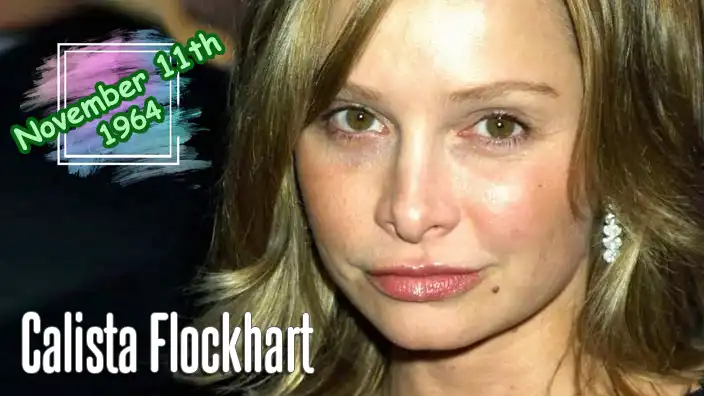
November 11, 1964, in Freeport, Illinois

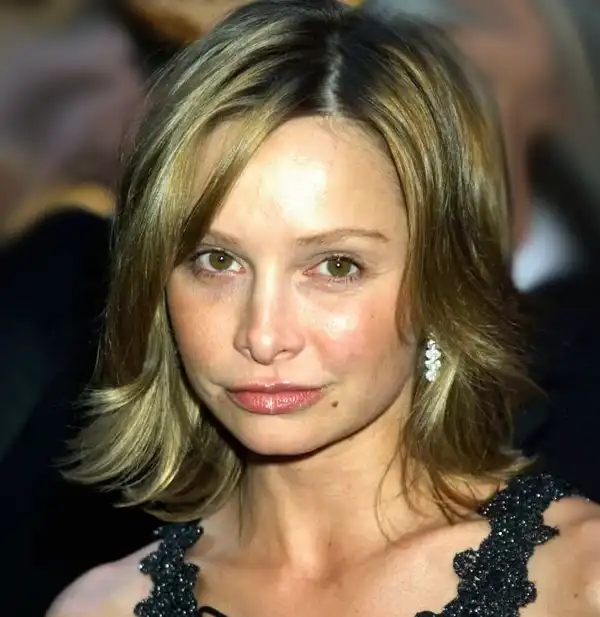
Calista Flockhart is an American actress best known for playing the wonderfully eccentric, romantically challenged, and occasionally imaginary-baby-dancing attorney Ally McBeal. With her expressive personality, impeccable comic timing, and talent for turning everyday disasters into television entertainment, Flockhart became one of the most recognizable actresses of the 1990s. From courtroom comedy to family drama and superhero adventures, she has enjoyed a remarkable Hollywood career. And, of course, she also married Harrison Ford, proving that sometimes Prince Charming arrives in a spaceship rather than on a white horse.
Calista Kay Flockhart was born on November 11, 1964, in Freeport, Illinois, to Ronald Flockhart, an executive with Kraft Foods, and Kay Flockhart, a schoolteacher. Her unusual first name was inspired by her great-grandmother, giving her a distinctive identity long before she became a familiar face on television screens around the world. Her father's career required the family to relocate several times during her childhood, including periods in Iowa, Minnesota, New Jersey, and New York. These moves exposed young Calista to different communities and experiences, although repeatedly adjusting to new schools and surroundings was not necessarily the easiest preparation for a future career in entertainment. Nevertheless, her interest in acting developed early, and she soon discovered that performing offered an appealing opportunity to explore different personalities and experiences.
Flockhart attended Shawnee High School in Medford, New Jersey, where she participated in school theatrical productions and developed a growing enthusiasm for acting. After graduating, she enrolled at Rutgers University's Mason Gross School of the Arts in New Brunswick, New Jersey, one of the country's respected university programs for aspiring performers. Her studies emphasized classical theater, dramatic interpretation, and the practical demands of professional acting. She graduated in 1988 with a Bachelor of Fine Arts degree in theater, having developed the technical skills and determination necessary to pursue a demanding career in the performing arts. Like many young actors, she left university with considerable ambition, professional training, and no guarantee that Hollywood would immediately roll out the red carpet.
Following graduation, Flockhart moved to New York City, where she began auditioning for theatrical productions and seeking opportunities in television and film. Her early professional years were characterized by the familiar challenges facing emerging performers, including intense competition, uncertain employment, and the necessity of accepting smaller roles while developing a reputation. She appeared in regional theater and Off-Broadway productions, gradually building experience and attracting attention for her ability to combine vulnerability with humor. Her stage work became an important foundation for her later television success, teaching her how to sustain a character's emotional credibility while responding naturally to other performers.
Flockhart's breakthrough on Broadway came in 1994 when she portrayed Laura Wingfield in a revival of Tennessee Williams's celebrated play The Glass Menagerie. Her sensitive portrayal of the shy, emotionally vulnerable young woman earned critical praise and brought her a Theatre World Award and a Clarence Derwent Award. The performance demonstrated her ability to communicate complex emotions through subtle gestures, carefully controlled dialogue, and understated expressions. It also established her as a serious theatrical performer capable of handling demanding dramatic material. For someone who would eventually become famous for playing a lawyer whose imagination occasionally ran riot, beginning with Tennessee Williams provided a particularly respectable theatrical foundation.
Her stage career continued with a 1997 Broadway production of Anton Chekhov's The Three Sisters, in which she portrayed Natalya Ivanovna. The production earned Flockhart a Tony Award nomination for Best Featured Actress in a Play, further strengthening her reputation within the theater community. Performing Chekhov required a different approach from the emotional intensity of Tennessee Williams, allowing her to explore social relationships, restrained comedy, and the complicated motivations of characters struggling with disappointment. These early successes demonstrated that Flockhart possessed considerable dramatic versatility before television audiences became familiar with her distinctive comedic personality.
Flockhart also began appearing in motion pictures during the early 1990s, accepting supporting roles that introduced her to film production. Her credits included Quiz Show, directed by Robert Redford, and The Birdcage, the popular comedy starring Robin Williams, Nathan Lane, and Gene Hackman. In The Birdcage, she portrayed Barbara Keeley, the young woman whose engagement to the son of a gay nightclub owner creates a spectacularly uncomfortable family gathering. The film's elaborate misunderstandings, eccentric personalities, and energetic performances provided an ideal setting for Flockhart's developing comic abilities. Her character found herself caught between two families with very different expectations, proving that wedding preparations can become complicated long before anyone starts arguing about the seating arrangements.
In 1997, Flockhart appeared in the independent drama Telling Lies in America, portraying Diney Majeski in a coming-of-age story set during the 1960s. The film starred Brad Renfro and Kevin Bacon and explored ambition, identity, and the challenges faced by a young immigrant attempting to find his place in American society. Flockhart's performance demonstrated her ability to contribute to intimate, character-driven storytelling, providing a contrast to the broad comedy of The Birdcage. Although her film career was developing steadily, an opportunity in television was about to transform her professional life and make her one of the most recognizable actresses in America.
That opportunity arrived when television producer and writer David E. Kelley selected Flockhart to star in the Fox legal comedy-drama Ally McBeal, which premiered on September 8, 1997. The series followed Ally, a young Boston attorney whose professional ambitions frequently collided with her complicated romantic life, emotional insecurities, and extraordinarily active imagination. Unlike traditional courtroom dramas, Ally McBeal combined legal cases with romantic comedy, surreal fantasy sequences, and an unusual willingness to explore the private thoughts of its central character. Flockhart's portrayal made Ally simultaneously intelligent, vulnerable, frustrating, funny, and deeply human, qualities that helped the character connect with audiences despite her occasional tendency to make spectacularly questionable personal decisions.
One of the show's most memorable features was its use of visual fantasy sequences to illustrate Ally's thoughts and emotions. These included exaggerated reactions, unexpected musical moments, and the famous computer-generated dancing baby that became an international pop-culture phenomenon. The baby, frequently associated with the song "Hooked on a Feeling," represented Ally's anxieties about relationships, motherhood, and the passage of time. Its appearance helped establish the series as one of television's most unconventional comedies, demonstrating that even a sophisticated legal drama could occasionally benefit from an animated infant performing an enthusiastic dance routine. The character became so widely recognized that the dancing baby developed a cultural identity almost independent of the program itself.
The supporting cast of Ally McBeal included Courtney Thorne-Smith, Greg Germann, Jane Krakowski, Peter MacNicol, Lisa Nicole Carson, and Gil Bellows, among other accomplished performers. Their characters worked within the eccentric law firm Cage and Fish, where professional disagreements, personal relationships, and unusual office behavior frequently created more complications than the legal cases themselves. Flockhart's performance provided the emotional center of the series, balancing the exaggerated personalities surrounding her with moments of genuine vulnerability. The program also featured memorable musical performances, particularly those associated with singer Vonda Shepard, whose appearances at the fictional bar frequented by the characters became an important part of the show's identity.
Ally McBeal quickly became a major television success, attracting enthusiastic audiences and generating widespread discussion about its portrayal of professional women, relationships, and contemporary expectations. The series was particularly notable for combining comedy and drama in ways that challenged conventional television categories. Some critics praised Ally as a relatable character whose insecurities reflected the pressures facing young professional women, while others questioned whether her emotional instability reinforced outdated stereotypes. These debates helped make the program a cultural talking point, extending its influence beyond entertainment into broader conversations about gender and identity. Flockhart's performance remained central to these discussions, although she was ultimately portraying a fictional character rather than delivering a weekly lecture on modern womanhood.
Her work on Ally McBeal earned Flockhart the Golden Globe Award for Best Actress in a Television Series – Musical or Comedy in 1998. She also received three Primetime Emmy Award nominations for Outstanding Lead Actress in a Comedy Series, recognizing her ability to handle the program's demanding mixture of humor, romance, and emotional drama. The series itself won the Golden Globe for Best Television Series – Musical or Comedy in 1998 and the Primetime Emmy Award for Outstanding Comedy Series in 1999. These achievements established Ally McBeal as one of the defining television programs of its era and confirmed Flockhart's position among the leading actresses of American television.
The enormous popularity of Ally McBeal also brought intense media attention, something Flockhart had not necessarily anticipated when pursuing her acting ambitions. Her personal appearance, relationships, and private life became frequent subjects of tabloid speculation, often overshadowing discussion of her professional achievements. The scrutiny was particularly intrusive regarding her slender physique, with entertainment publications repeatedly publishing speculation about her health. Flockhart rejected unsupported claims and expressed frustration with the attention directed toward her appearance. The experience illustrated the pressures placed upon actresses during a period when celebrity journalism frequently treated personal boundaries as optional inconveniences.
Despite the challenges of sudden fame, Flockhart continued delivering performances throughout the show's five-season run. Her character experienced romantic disappointments, professional challenges, friendships, and personal growth, providing opportunities for both dramatic and comedic storytelling. The series concluded in May 2002 after 112 episodes, leaving behind an enduring influence on television comedy-drama. Its unusual combination of fantasy, romance, workplace relationships, and emotional introspection helped establish storytelling techniques that would later appear in other popular programs. For Flockhart, the series represented an extraordinary professional achievement, although spending five seasons inside Ally McBeal's complicated imagination must occasionally have felt like an endurance event.
During her years on television, Flockhart continued accepting selected film roles, including the 1999 adaptation of William Shakespeare's A Midsummer Night's Dream. Directed by Michael Hoffman, the film featured an ensemble cast including Kevin Kline, Michelle Pfeiffer, Rupert Everett, Christian Bale, and Stanley Tucci. Flockhart portrayed Helena, one of the young lovers whose romantic misadventures become entangled with magical interference in an enchanted forest. Her performance allowed her to combine classical theatrical training with the comic timing that had made her a television star. The role also provided an amusing connection to Ally McBeal, since both characters spent considerable time pursuing complicated relationships while surrounded by people behaving in increasingly irrational ways.
Flockhart also appeared in the 2000 ensemble drama Things You Can Tell Just by Looking at Her, directed by Rodrigo García. The film explored the interconnected lives of several women experiencing loneliness, relationships, and personal uncertainty. Appearing alongside performers including Glenn Close, Holly Hunter, Cameron Diaz, and Amy Brenneman, Flockhart portrayed Christine Taylor, a woman confronting an emotionally difficult relationship. Her performance demonstrated a quieter and more restrained dramatic style than the exaggerated comedy associated with her television fame. The film received recognition at the Cannes Film Festival, contributing to Flockhart's reputation as a performer capable of handling intimate and thoughtful material.
In 2001, Flockhart adopted a son, Liam, beginning an important new chapter in her personal life. Motherhood became a significant priority, and she subsequently chose professional opportunities that allowed her to maintain a balance between acting and family responsibilities. Her decision reflected a preference for protecting her private life rather than pursuing every available Hollywood project. Although she remained a recognizable celebrity, Flockhart increasingly demonstrated that she was comfortable stepping away from constant public attention. In an industry where performers are frequently encouraged to remain visible at every opportunity, her willingness to prioritize family life represented a deliberate and personal choice.
Following the conclusion of Ally McBeal, Flockhart appeared in selected film projects, including the 2004 comedy The Last Shot and the 2005 supernatural horror film Fragile. In Fragile, directed by Jaume Balagueró, she portrayed Amy Nicholls, an American nurse working at an English children's hospital where mysterious disturbances suggest a supernatural presence. The role offered a significant departure from her familiar romantic-comedy persona, requiring her to convey fear, determination, and emotional vulnerability within a suspenseful atmosphere. It also demonstrated that Flockhart could convincingly portray someone facing far more frightening circumstances than an awkward office romance or a disastrous courtroom appearance.
In 2006, Flockhart returned to American network television with the ABC family drama Brothers & Sisters, created by Jon Robin Baitz. She portrayed Kitty Walker, a politically conservative television personality and member of the complicated Walker family. The series featured an accomplished ensemble cast including Sally Field, Rachel Griffiths, Matthew Rhys, Dave Annable, and Ron Rifkin. Its storylines explored family relationships, political disagreements, marriage, illness, and personal identity, offering a more traditionally dramatic setting than Ally McBeal. Flockhart's character was intelligent, ambitious, outspoken, and frequently involved in disagreements with her relatives, particularly her mother, Nora Walker, portrayed by Sally Field.
The relationship between Kitty and Nora became one of the show's central emotional elements, reflecting the complicated mixture of affection, frustration, and loyalty that can exist within families. Their political differences frequently generated heated discussions, while personal crises forced them to reconsider their assumptions about one another. Flockhart's performance demonstrated her ability to portray a character whose strong convictions sometimes created conflict without diminishing her underlying humanity. The series also explored Kitty's marriage to Senator Robert McCallister, portrayed by Rob Lowe, providing opportunities to examine the personal consequences of public life and political ambition. Considering the Walker family's remarkable talent for turning dinner into a verbal battlefield, Kitty's experience as a television commentator probably qualified as excellent preparation.
Brothers & Sisters ran for five seasons, concluding in 2011, and became another major television success for Flockhart. Her portrayal of Kitty Walker introduced her to a new generation of viewers while demonstrating that she could successfully move beyond the character that had originally made her famous. The show's emphasis on family relationships, emotional conflict, and ensemble storytelling required a different acting approach from the surreal comedy of Ally McBeal. Flockhart's ability to adapt helped establish her reputation as a versatile television performer rather than an actress permanently associated with a single iconic role.
Flockhart's personal life attracted considerable public interest when she began a relationship with actor Harrison Ford, famous for portraying Han Solo in Star Wars and Indiana Jones in the long-running adventure film series. The couple met at the Golden Globe Awards in 2002 and developed a relationship despite the considerable public attention surrounding their different backgrounds and established careers. They married on June 15, 2010, in Santa Fe, New Mexico, while Ford was filming Cowboys & Aliens. Ford subsequently adopted Liam, and the family maintained a comparatively private lifestyle away from the constant attention of Hollywood publicity. Their marriage united two prominent performers whose careers had produced some of entertainment's most recognizable characters, although household discussions presumably did not require a lightsaber or a courtroom objection.
In 2015, Flockhart returned to prominent television work when she joined the cast of the CBS superhero drama Supergirl. She portrayed Cat Grant, the powerful, demanding, and exceptionally sharp-tongued head of the media company CatCo Worldwide Media. The series starred Melissa Benoist as Kara Danvers, a young woman learning to balance her ordinary professional responsibilities with her extraordinary identity as Supergirl. Flockhart's character served as Kara's formidable employer and an important influence on her development, combining intimidating professional expectations with occasional moments of surprising wisdom. Cat Grant's ability to dominate a room through sheer personality made her one of the show's most memorable supporting characters.
The role of Cat Grant allowed Flockhart to demonstrate her exceptional command of sophisticated comedy and cutting dialogue. Her character frequently delivered sarcastic observations with perfect timing, maintaining an outward appearance of confidence even when confronted with extraordinary circumstances. Cat's relationship with Kara gradually revealed a more compassionate side beneath her demanding exterior, allowing Flockhart to balance humor with emotional depth. When Supergirl moved from CBS to The CW for its second season, production relocated from Los Angeles to Vancouver, and Flockhart's appearances became less frequent. Nevertheless, she returned for selected episodes, including the series finale in 2021, providing continuity for viewers who had enjoyed her character's distinctive presence.
Flockhart also maintained connections with live theater, returning to the stage in 2022 in a production of Edward Albee's Who's Afraid of Virginia Woolf? at the Geffen Playhouse in Los Angeles. She portrayed Martha, one of American theater's most demanding dramatic characters, in a production directed by Gordon Greenberg. The play explores the destructive psychological games played by a married couple and their younger guests during an increasingly confrontational evening. Flockhart's performance required considerable emotional intensity, verbal precision, and theatrical endurance, offering a powerful reminder of the classical training that had shaped her early career. Compared with Martha's complicated marriage, Ally McBeal's romantic difficulties might almost have seemed refreshingly straightforward.
In 2024, Flockhart returned to television in the FX anthology series Feud: Capote vs. The Swans, portraying socialite Lee Radziwill, the younger sister of Jacqueline Kennedy Onassis. The series explored the complicated relationship between writer Truman Capote and a group of wealthy, influential New York women whose friendship deteriorated after Capote publicly exposed details of their private lives. Flockhart appeared alongside an accomplished ensemble including Naomi Watts, Diane Lane, Demi Moore, Molly Ringwald, and Tom Hollander. Her portrayal of Radziwill required a restrained and sophisticated performance, capturing the elegance, social confidence, and emotional complexity associated with one of twentieth-century America's most recognizable society figures.
Feud: Capote vs. The Swans provided Flockhart with another opportunity to demonstrate her ability to inhabit a character very different from her previous television roles. The production's historical setting, elaborate costumes, and emotionally complicated relationships required careful attention to period detail and character development. Radziwill's position within New York high society presented an intriguing contrast to the fictional professional women Flockhart had portrayed in Ally McBeal and Brothers & Sisters. Rather than navigating imaginary dancing babies or superhero emergencies, her character confronted the considerably more realistic danger of a famous writer revealing everyone's secrets at a particularly inconvenient moment.
Flockhart continued her theatrical career in 2025 with an Off-Broadway revival of Sam Shepard's Curse of the Starving Class, appearing alongside Christian Slater and other performers. The production explored the struggles of a dysfunctional American family facing financial difficulties, personal disappointment, and competing ambitions. Her participation reinforced her longstanding commitment to serious theater and demonstrated that, despite her television fame, she remained interested in challenging dramatic material. Returning to the stage also allowed her to work directly with live audiences, reconnecting with the immediacy and unpredictability that distinguish theatrical performance from film and television.
Beyond her acting achievements, Calista Flockhart has supported charitable organizations and humanitarian causes, including efforts connected with children's welfare and medical research. She has also demonstrated a preference for maintaining a relatively private family life, rarely allowing her personal circumstances to overshadow her professional work. Her approach to celebrity reflects an understanding that public recognition does not require surrendering every aspect of one's personal identity. Despite decades of Hollywood success and international fame, Flockhart has generally avoided the constant publicity that surrounds many entertainment personalities, allowing her performances to remain the principal focus of her public reputation.
Calista Flockhart's career represents an impressive combination of theatrical achievement, television success, and professional versatility. From her award-winning Broadway performances to the cultural phenomenon of Ally McBeal, the family drama of Brothers & Sisters, and the superhero adventures of Supergirl, she has repeatedly demonstrated her ability to create memorable characters across different genres. Her Golden Globe victory, Emmy nominations, and extensive theatrical experience reflect a performer whose accomplishments extend well beyond a single successful television series. Although audiences may always associate her with the imaginative Boston attorney who occasionally encountered dancing babies, Flockhart has built a career defined by intelligence, determination, and an unmistakable talent for bringing complicated women to life. And after portraying lawyers, political commentators, media executives, and wealthy socialites, she has certainly accumulated enough fictional professional experience to produce one extremely impressive résumé.
References & Sources