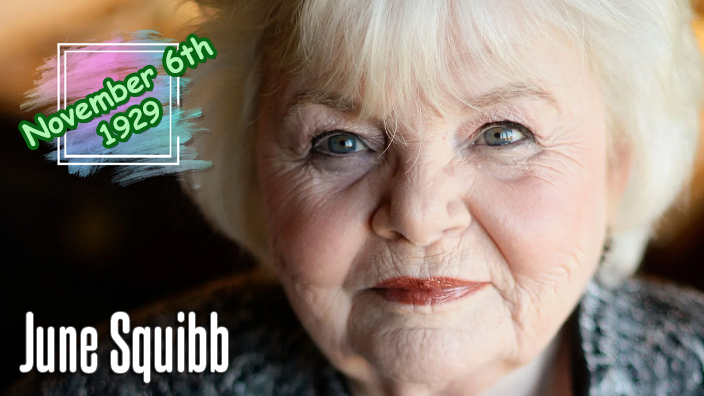
November 6, 1929, in Vandalia, Illinois

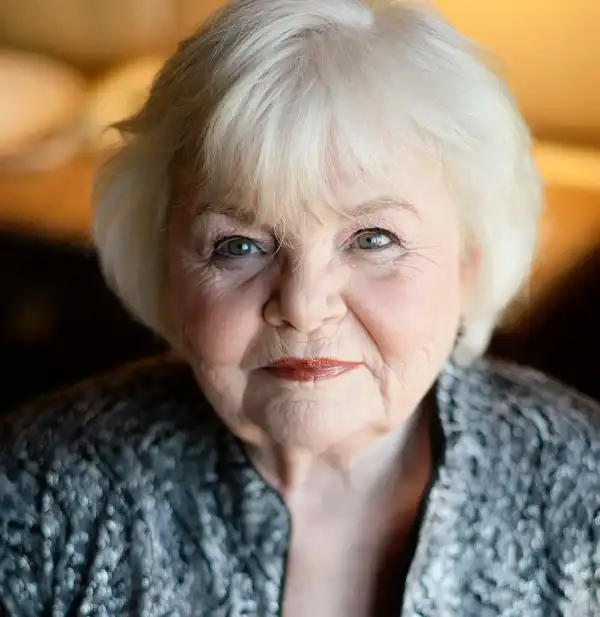
June Louise Squibb was born on November 6, 1929, in Vandalia, Illinois, and grew up in a household where music and creativity were familiar companions. Her mother, JoyBelle Force Squibb, was a pianist who had accompanied silent films, while her father, Lewis Squibb, worked in insurance. From childhood, June displayed an enthusiasm for performing that would eventually carry her from small-town Illinois to Broadway and Hollywood. She appeared in school productions, including a performance as Goldilocks, and developed an early conviction that acting was what she wanted to do with her life. Unlike youngsters who change their career ambitions every other Tuesday, Squibb found her calling and stubbornly stuck with it.
Her professional journey began in theater, where she developed the discipline, timing, and versatility that would become hallmarks of her performances. She worked at the Cleveland Play House and gained experience in stage productions before making her Broadway debut in the original production of Gypsy in 1959. The celebrated musical starred Ethel Merman, and Squibb performed as Electra, one of the show's memorable burlesque performers. Sharing a production with a powerhouse such as Merman was an extraordinary introduction to Broadway, although anyone hoping to compete with Merman's legendary voice would probably have needed industrial-strength loudspeakers.
Squibb continued building her theatrical career throughout the following decades, appearing in musicals, plays, and regional productions. Her Broadway credits included The Happy Time in 1968 and Gorey Stories in 1978. Theater offered her the opportunity to explore a wide range of characters while perfecting the subtle expressions and impeccable comic timing that would later distinguish her film performances. She became an accomplished character actress, comfortable with comedy, drama, and musical theater. Although she had not yet become a household name, she had accumulated the sort of practical acting experience that cannot be purchased with a publicity campaign or a particularly enthusiastic agent.
Her transition into motion pictures came with Woody Allen's romantic comedy Alice in 1990. The film marked Squibb's feature-film debut and introduced her talents to a different audience. During the 1990s, she appeared in several notable productions, including Scent of a Woman (1992), The Age of Innocence (1993), In & Out (1997), and Meet Joe Black (1998). Working alongside established performers and respected directors allowed her to expand her screen career without abandoning her theatrical roots. These roles were often relatively small, but Squibb possessed a remarkable ability to make even brief appearances memorable. She could deliver a single line, raise an eyebrow, and leave viewers wondering why the film hadn't given her another twenty minutes.
A particularly important collaboration began when director Alexander Payne cast Squibb as Helen Schmidt, the wife of Jack Nicholson's character, in the 2002 comedy-drama About Schmidt. Although her character's presence in the story was limited, the film introduced Squibb to Payne's distinctive approach to portraying ordinary people confronting uncomfortable realities. Her performance demonstrated an ability to combine naturalism with understated humor, making her characters believable even when their circumstances were awkward or emotionally complicated. This professional relationship would prove especially significant when Payne returned to her with another role more than a decade later.
That opportunity arrived with Nebraska in 2013, the critically acclaimed black-and-white comedy-drama starring Bruce Dern and Will Forte. Squibb portrayed Kate Grant, the outspoken wife of Dern's character, Woody Grant, who becomes convinced that he has won a million-dollar sweepstakes prize. As Woody and his son embark on a journey to Nebraska, Kate emerges as one of the film's most memorable personalities. She is blunt, fiercely protective of her family, and spectacularly uninterested in pretending that foolish behavior deserves polite encouragement. Squibb's performance gave the film much of its humor and emotional warmth, creating a character who could deliver a devastating insult and demonstrate genuine affection almost in the same breath.
Her portrayal of Kate Grant earned widespread critical acclaim and an Academy Award nomination for Best Supporting Actress at the 2014 Oscars. She also received nominations from the Golden Globes and Screen Actors Guild, along with recognition from numerous film critics' organizations. The Oscar ultimately went to Lupita Nyong'o for 12 Years a Slave, but Squibb's nomination brought international attention to an actress whose professional accomplishments already stretched across several decades. The recognition was particularly satisfying because it demonstrated that exceptional acting does not have an expiration date. Hollywood had finally discovered what theater audiences had known for years: June Squibb could steal a scene without even bothering to wear a burglar's mask.
Following the success of Nebraska, Squibb enjoyed a remarkable expansion of her film and television career. She appeared in popular television programs including Girls, Glee, The Big Bang Theory, Modern Family, Shameless, Grey's Anatomy, and Good Girls. Her appearances demonstrated considerable range, from eccentric comedy characters to emotionally complex supporting roles. Rather than allowing herself to become associated exclusively with one type of grandmotherly character, she embraced opportunities to portray women with different personalities, motivations, and occasionally questionable judgment. Casting directors discovered that Squibb could be comforting, confrontational, mischievous, or thoroughly unpredictable, sometimes within the same scene.
Her film work also continued to expand. She appeared in Table 19 (2017), Palm Springs (2020), Hubie Halloween (2020), and The Humans (2021), among other productions. She also contributed voice performances to animated features, including Pixar's Toy Story 4 (2019), in which she voiced Margaret the Store Owner, and Inside Out 2 (2024), where she portrayed Nostalgia. Voice acting offered another outlet for her distinctive personality and comic instincts, allowing her to create memorable characters without appearing physically on screen. Considering her talent for conveying entire conversations through a disapproving expression, relying exclusively on her voice might seem like an unnecessary restriction, but she handled the challenge beautifully.
One of the most extraordinary chapters in Squibb's career arrived with the 2024 action-comedy Thelma, directed by Josh Margolin. In her first leading film role, she portrayed Thelma Post, a determined grandmother who becomes the victim of a telephone scam and decides to recover her stolen money herself. Inspired by experiences involving Margolin's own grandmother, the film transforms a familiar problem affecting older Americans into an entertaining adventure. Thelma refuses to accept that being underestimated is an unavoidable part of life, setting off across Los Angeles on a motorized scooter with the assistance of her friend Ben, played by Richard Roundtree. It is not quite Mission: Impossible, although Tom Cruise might have appreciated the opportunity to compare scooter-handling techniques.
Thelma received enthusiastic attention following its premiere at the Sundance Film Festival and earned praise for Squibb's spirited central performance. The film successfully balanced comedy, suspense, and genuine emotion while addressing concerns about independence, family relationships, and financial scams targeting older adults. Squibb brought warmth and credibility to the title character without turning her into a helpless stereotype. Her Thelma is resourceful, stubborn, occasionally reckless, and determined to make her own decisions. The performance earned her an Independent Spirit Award nomination for Best Lead Performance and further demonstrated her ability to carry a feature film. After decades of supporting other stars, June Squibb had finally taken the wheel herself, even if the vehicle occasionally happened to be a mobility scooter.
Her remarkable screen career continued with Eleanor the Great (2025), the directorial debut of Scarlett Johansson. Squibb played Eleanor Morgenstein, a woman who moves to New York City following the death of a close friend and becomes involved in a complicated situation involving grief, memory, and personal identity. The film gave Squibb another substantial leading role, exploring the emotional lives of older characters with sensitivity and complexity. It also reinforced her reputation as an actress capable of anchoring stories that might otherwise receive little attention in an entertainment industry frequently preoccupied with younger protagonists.
Squibb also returned to Broadway in the revival of Marjorie Prime, portraying a woman whose experiences with memory, family, and artificial intelligence form the emotional center of Jordan Harrison's thought-provoking play. The production opened in December 2025, and her performance earned a Tony Award nomination for Best Featured Actress in a Play in 2026. Her participation in the production represented another important chapter in a theatrical career that began long before her Hollywood recognition. The return demonstrated that Broadway remained an important part of her artistic identity, even as her film career continued to flourish.
Throughout her professional life, Squibb has been admired for her dedication to acting and her willingness to accept challenging material. She has never relied solely on celebrity status or the expectation that audiences will admire her simply because she has been performing for a long time. Instead, she approaches each role as an opportunity to create a convincing human being, complete with flaws, humor, contradictions, and emotional depth. Her characters often possess an appealing independence, refusing to behave according to other people's expectations. That quality has become particularly recognizable in her later performances, where her characters frequently challenge the assumptions of those who underestimate them.
June Squibb's career offers an unusual and inspiring example of professional persistence. She spent decades developing her craft before receiving the kind of widespread recognition that many performers spend their entire careers pursuing. Her success in Nebraska, Thelma, and Eleanor the Great illustrates the value of experience and the importance of meaningful roles for performers of every generation. More importantly, her work reminds audiences that compelling stories are not limited to any particular stage of life. With her unmistakable voice, wonderful comic timing, and talent for portraying determined women, Squibb has become one of American entertainment's most beloved character actresses. And should anyone suggest that she has finally done enough, there is a very good chance she will respond with the sort of expression that made Kate Grant unforgettable.
IMDb – June Squibb Biography and Filmography: Personal information, film and television credits, and career details. June Squibb on IMDb. Academy of Motion Picture Arts and Sciences – The 86th Academy Awards: Official confirmation of Squibb's Best Supporting Actress nomination for Nebraska. 2014 Academy Awards. Internet Broadway Database – June Squibb: Official Broadway production history, theatrical credits, and awards. June Squibb on IBDB. Broadway.com – June Squibb Profile: Background on her stage career, film appearances, and television work. June Squibb Broadway Profile. Associated Press – June Squibb and Thelma: Reporting on her first leading film role and the production's Sundance premiere. June Squibb in Thelma. Los Angeles Times – June Squibb and Her Hollywood Career: Interview discussing her work in Thelma and her approach to acting. June Squibb's Action-Star Career. Playbill – June Squibb: Broadway credits, including Gypsy, Waitress, and Marjorie Prime. June Squibb on Playbill.References & Sources