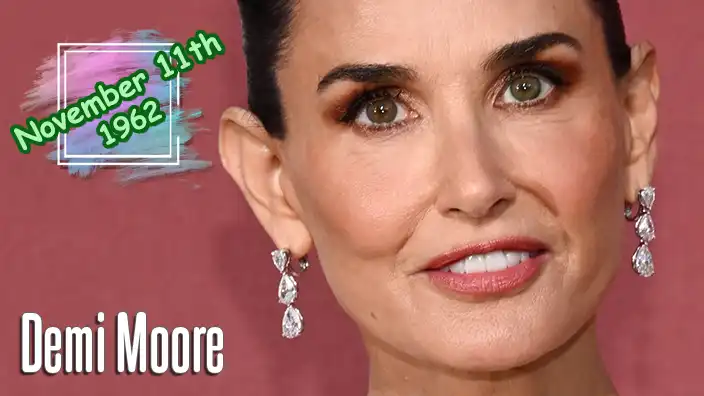
November 11, 1962, in Roswell, New Mexico

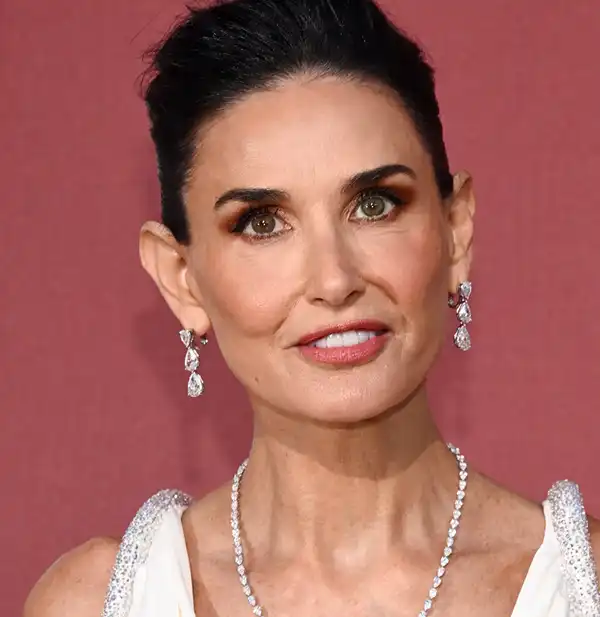
Demi Moore is the celebrated American actress who made audiences cry over a pottery wheel in Ghost, faced Jack Nicholson across a courtroom in A Few Good Men, and proved in The Substance that Hollywood's obsession with youth can become downright terrifying. From her Brat Pack beginnings to becoming one of the highest-paid actresses in Hollywood, Moore has enjoyed a career filled with memorable performances, headline-making moments, and remarkable reinventions. After decades in an industry that occasionally treats actresses as though they come with an expiration date, she returned with an Oscar-nominated performance that reminded everyone she wasn't finished. Not by a long shot.
Demi Gene Guynes, professionally known as Demi Moore, was born on November 11, 1962, in Roswell, New Mexico. Her early childhood was marked by considerable instability, including frequent family relocations and difficult relationships within her household. Her biological father, Charles Harmon Sr., separated from her mother, Virginia, before Demi was born, and she was subsequently raised by her mother and stepfather, Danny Guynes. Her family moved repeatedly as she grew up, making it difficult to establish lasting friendships or enjoy the stability commonly associated with childhood. These experiences contributed to her independence and determination, qualities that would later become important as she navigated the demanding entertainment industry.
Moore's childhood was further complicated by her parents' troubled relationship and struggles with alcohol. She has spoken openly about the emotional difficulties she experienced during these years, describing an upbringing that required her to assume responsibilities earlier than most children. Despite these challenges, she developed an interest in entertainment, fashion, and performing, eventually recognizing that acting might provide an opportunity to create a different future. Her early experiences helped shape the resilience that would become a recurring theme throughout her professional and personal life, although her path toward Hollywood success was considerably less glamorous than the magazine covers that would eventually feature her.
As a teenager, Moore moved to the Los Angeles area, where she attended Fairfax High School before leaving school to pursue employment and opportunities in entertainment. She initially worked in modeling and appeared in photographs for fashion and lifestyle publications, gradually gaining experience in front of the camera. Her distinctive appearance, expressive eyes, and husky voice helped distinguish her from other aspiring performers. Although she had little formal acting training, she possessed considerable determination and a willingness to learn through practical experience. Hollywood was hardly short of hopeful newcomers, but Moore was determined not to remain another anonymous face in the audition queue.
In 1980, Moore married musician Freddy Moore, whose surname she retained professionally after their relationship ended. During this period, she began pursuing acting opportunities more seriously, securing small roles in film and television. Her early screen appearances included the 1981 film Choices and the 1982 science-fiction horror film Parasite. These productions provided valuable experience working with professional crews and adapting to the technical requirements of filmmaking. Although neither film established her as a major star, they helped her develop the confidence and practical skills necessary for more substantial roles.
Moore's first significant television breakthrough came when she joined the long-running ABC daytime soap opera General Hospital in 1982. She portrayed Jackie Templeton, an investigative reporter whose storylines involved mystery, romance, and the complicated relationships that have kept soap opera audiences entertained for generations. Her work on the series introduced her to a national television audience and provided an intensive education in acting for the camera. Daytime dramas require performers to memorize substantial amounts of dialogue and maintain consistent character development across numerous episodes, making them valuable training grounds for emerging actors. By the time Moore left the series in 1983, she had gained both professional recognition and the experience needed to pursue larger film roles.
In 1984, Moore appeared in the romantic comedy Blame It on Rio, starring Michael Caine and Joseph Bologna. Although the film received mixed reviews, it helped introduce her to movie audiences and demonstrated her growing confidence as a screen performer. Her career took a much more significant turn the following year when she was cast in Joel Schumacher's ensemble drama St. Elmo's Fire, released in 1985. The film followed a group of recent college graduates struggling with relationships, employment, ambition, and the uncomfortable realization that adulthood does not arrive with an instruction manual.
In St. Elmo's Fire, Moore portrayed Jules Van Patten, a glamorous but troubled young woman whose outward confidence concealed serious personal difficulties. The film featured an ensemble cast including Rob Lowe, Emilio Estevez, Andrew McCarthy, Judd Nelson, Ally Sheedy, and Mare Winningham. Many of its young performers became associated with the Hollywood group known as the Brat Pack, a nickname popularized by the entertainment press during the mid-1980s. Although the label was not universally welcomed by the actors themselves, it became closely connected with a generation of films exploring young adulthood, friendship, romantic disappointment, and the transition from adolescence to professional life.
Moore's performance in St. Elmo's Fire helped establish her as one of Hollywood's promising young actresses. Her character's emotional instability and self-destructive behavior provided opportunities to demonstrate dramatic intensity beyond conventional romantic roles. The production also marked an important personal turning point, as Moore confronted substance-use problems and entered treatment during the filming period. She has subsequently discussed the significance of that experience and the professional support that encouraged her to address her difficulties. The film's success opened doors to more prominent opportunities, establishing Moore as a recognizable member of the Brat Pack generation.
Her rising popularity continued with the 1986 romantic drama About Last Night, directed by Edward Zwick and based on David Mamet's play Sexual Perversity in Chicago. Moore starred opposite Rob Lowe, portraying Debbie Sullivan, a young woman attempting to navigate the complications of a developing relationship in Chicago. The film explored commitment, emotional vulnerability, friendship, and the difficulties of maintaining independence within a romantic partnership. Moore's performance helped demonstrate her ability to portray relatable contemporary characters, while the film's success strengthened her position as a leading actress. The title itself was a useful reminder that some conversations are best postponed until everyone has finished their morning coffee.
Throughout the late 1980s, Moore appeared in films including One Crazy Summer, Wisdom, The Seventh Sign, and We're No Angels. These productions allowed her to explore comedy, romance, supernatural suspense, and crime drama while working with established performers and directors. Although not every project achieved commercial or critical success, the variety helped expand her acting range and professional experience. She was gradually moving beyond her Brat Pack identity, preparing for the film that would transform her into an international superstar.
That breakthrough arrived in 1990 with Ghost, directed by Jerry Zucker and starring Moore alongside Patrick Swayze and Whoopi Goldberg. Moore portrayed Molly Jensen, a young woman whose boyfriend, Sam Wheat, is murdered and subsequently attempts to communicate with her from the afterlife. The film combined romance, supernatural fantasy, suspense, and comedy in an unusual story that captivated audiences around the world. Moore's performance provided the emotional foundation of the film, communicating grief, vulnerability, and enduring love while sharing the screen with both a ghost and a highly unconventional psychic.
One of the most famous scenes in Ghost featured Moore and Swayze working together at a pottery wheel, accompanied by the Righteous Brothers' recording of "Unchained Melody." The sequence became one of cinema's most recognizable romantic moments, inspiring countless parodies and ensuring that pottery classes would never again be viewed as entirely innocent recreational activities. Moore's emotional performance helped make the scene memorable, while her distinctive short hairstyle became a widely imitated fashion statement. The film was a massive box-office success, earning more than $500 million worldwide and receiving five Academy Award nominations, including Best Picture.
Ghost won Academy Awards for Whoopi Goldberg's supporting performance and Bruce Joel Rubin's original screenplay. Moore received a Golden Globe nomination for Best Actress in a Motion Picture – Musical or Comedy, marking an important recognition of her growing dramatic abilities. The film's commercial success established her as one of Hollywood's most bankable actresses and dramatically expanded her international recognition. Her portrayal of Molly Jensen remained one of the defining performances of her career, combining emotional sincerity with the accessibility that made the story resonate with audiences across different generations.
In 1991, Moore starred in The Butcher's Wife, a romantic comedy in which she portrayed Marina Lemke, a young woman who believes she possesses psychic abilities. The film offered a lighter role following the emotional intensity of Ghost, allowing Moore to explore eccentric comedy and romantic fantasy. Although it did not achieve comparable commercial success, it demonstrated her willingness to experiment with different character types rather than simply repeating a successful formula. Hollywood may have preferred another romantic supernatural blockbuster, but Moore was clearly interested in exploring a broader range of material.
Her next major success came with the 1992 military courtroom drama A Few Good Men, directed by Rob Reiner and adapted from Aaron Sorkin's stage play. Moore portrayed Lieutenant Commander JoAnne Galloway, a determined Navy lawyer investigating the circumstances surrounding the death of a Marine at the United States naval base in Guantánamo Bay, Cuba. The film starred Tom Cruise as Lieutenant Daniel Kaffee and Jack Nicholson as Colonel Nathan Jessup, with supporting performances from Kevin Bacon, Kevin Pollak, and Kiefer Sutherland. Moore's character provided an important moral perspective, insisting that the case deserved a thorough investigation despite institutional pressure and professional resistance.
A Few Good Men became one of the most celebrated courtroom dramas of the 1990s, particularly remembered for its explosive courtroom confrontation between Cruise and Nicholson. Moore's performance as Galloway contributed significantly to the film's tension, portraying a principled officer determined to uncover the truth. Her character challenged the complacency of her colleagues and refused to accept convenient explanations when serious questions remained unanswered. The film received four Academy Award nominations, including Best Picture, and further established Moore's reputation as a leading dramatic actress capable of holding her own alongside some of Hollywood's most formidable performers. It also demonstrated that military courtroom proceedings could become surprisingly entertaining, although actual Navy legal departments probably prefer considerably less shouting.
In 1993, Moore starred opposite Robert Redford and Woody Harrelson in Indecent Proposal, directed by Adrian Lyne. The provocative romantic drama followed a married couple experiencing financial difficulties who are offered one million dollars by a wealthy businessman in exchange for a night with the wife. Moore portrayed Diana Murphy, whose relationship with her husband is tested by the extraordinary proposition and its emotional consequences. The film generated widespread public debate about marriage, loyalty, money, and personal boundaries, becoming one of the year's most commercially successful releases despite mixed critical reviews.
Indecent Proposal reinforced Moore's reputation as an actress willing to tackle controversial material and complicated relationships. The film's central moral dilemma encouraged audiences to consider whether financial security could justify decisions that threatened emotional trust. Its success demonstrated Moore's considerable box-office appeal, while the surrounding publicity reflected Hollywood's growing fascination with her personal image. Although critics disagreed about the film's artistic merits, its cultural impact was undeniable. It also supplied couples everywhere with a hypothetical question that was almost guaranteed to ruin an otherwise pleasant dinner.
Moore continued exploring provocative contemporary subjects in the 1994 thriller Disclosure, directed by Barry Levinson and adapted from Michael Crichton's novel. She starred opposite Michael Douglas, portraying Meredith Johnson, a powerful corporate executive whose inappropriate conduct toward a male subordinate triggers a complicated sexual harassment dispute. The film reversed conventional gender expectations surrounding workplace harassment, generating debate about power, professional relationships, and institutional accountability. Moore's portrayal of an ambitious and manipulative executive demonstrated her ability to play morally ambiguous characters rather than relying exclusively on sympathetic leading roles.
The commercial successes of Ghost, A Few Good Men, Indecent Proposal, and Disclosure helped make Moore one of Hollywood's highest-paid actresses during the 1990s. Her negotiating power reflected both her proven box-office appeal and her willingness to pursue leading roles traditionally associated with male stars. At a time when major studios frequently offered actresses fewer opportunities to headline expensive productions, Moore's financial success represented a significant shift in industry expectations. Nevertheless, her growing prominence also brought increasingly intrusive media scrutiny, particularly concerning her appearance, relationships, and salary negotiations.
In 1995, Moore starred in The Scarlet Letter, a loose adaptation of Nathaniel Hawthorne's classic novel. She portrayed Hester Prynne, a woman condemned by her Puritan community after an extramarital relationship. The production attempted to reinterpret the familiar literary story through a more romantic and commercially accessible approach, but it received largely negative reviews and struggled at the box office. Moore's involvement demonstrated her continued willingness to accept ambitious leading roles, although the film's reception illustrated the risks associated with dramatically revising a widely studied literary work. Generations of English teachers had spent years explaining Hawthorne's novel, and Hollywood had apparently decided they needed something new to argue about.
The following year, Moore starred in Striptease, directed by Andrew Bergman and adapted from Carl Hiaasen's novel. She portrayed Erin Grant, a former FBI secretary who becomes an exotic dancer while attempting to regain custody of her daughter. The film attracted enormous publicity, partly because Moore reportedly received $12.5 million for the role, a record-setting salary for an actress at the time. Despite the attention, Striptease received overwhelmingly negative reviews and became associated with debates about celebrity salaries, female sexuality, and Hollywood's treatment of actresses. Moore's willingness to undertake the role nevertheless reflected her determination to exercise control over her career and pursue material that challenged conventional expectations.
Also in 1996, Moore served as an executive producer and appeared in the HBO anthology film If These Walls Could Talk, alongside Sissy Spacek and Cher. The production examined abortion and reproductive choices through three stories set in different decades, illustrating the changing legal, medical, and social circumstances surrounding the issue. Moore portrayed Claire Donnelly in the segment set in the 1950s, delivering a dramatic performance that emphasized the difficult personal circumstances faced by her character. The film received considerable attention and earned Moore Golden Globe nominations for both acting and producing, along with a Primetime Emmy nomination as a producer. The project demonstrated her interest in socially significant storytelling and her growing involvement behind the camera.
In 1997, Moore starred in Ridley Scott's military drama G.I. Jane, portraying Lieutenant Jordan O'Neil, a fictional Navy intelligence officer selected for an experimental program involving elite military training. The film followed her character's attempts to overcome institutional resistance, physical challenges, and deeply entrenched assumptions about women serving in demanding military roles. Moore underwent intensive physical preparation and famously shaved her head for the production, creating one of the most widely discussed transformations of her career. The film attracted controversy and mixed reviews, but her commitment to the demanding role was evident throughout the production.
G.I. Jane explored themes of perseverance, institutional change, equality, and the relationship between individual determination and military tradition. Although its fictional training program did not accurately reproduce every aspect of actual military procedures, the film generated discussion about women's opportunities within the armed forces. Moore's performance required considerable physical endurance, providing a dramatic contrast to the romantic roles that had previously defined much of her career. For an actress already accustomed to intense media scrutiny, shaving her head and crawling through military obstacle courses represented a particularly direct response to anyone suggesting she was interested only in glamorous appearances.
Following the enormous demands of her 1990s career, Moore reduced her professional workload to concentrate on raising her children and maintaining her family life. She had married actor Bruce Willis in November 1987, and the couple welcomed three daughters: Rumer, Scout, and Tallulah. Their marriage attracted considerable public attention because both were major Hollywood stars, but Moore increasingly emphasized the importance of providing a stable family environment. The couple separated in 1998 and divorced in 2000, yet maintained a cooperative relationship while raising their children. Their ability to remain connected as parents later became an important aspect of their public family identity.
Moore returned to major commercial filmmaking in 2003 with Charlie's Angels: Full Throttle, starring Cameron Diaz, Drew Barrymore, and Lucy Liu. She portrayed Madison Lee, a former Angel who becomes an antagonist to the film's central heroines. The action-comedy allowed Moore to embrace a glamorous, physically demanding role while demonstrating her willingness to play against her earlier heroic image. Her performance attracted significant attention and introduced her to younger audiences familiar with the popular franchise. After several years away from major Hollywood productions, the film demonstrated that Moore retained the ability to command attention in a high-profile ensemble.
Her subsequent film appearances included Bobby, directed by Emilio Estevez, which explored the lives of people present at the Ambassador Hotel in Los Angeles on the day Senator Robert F. Kennedy was assassinated in 1968. Moore portrayed Virginia Fallon, an alcoholic singer whose personal difficulties unfold against the backdrop of a major historical event. The ensemble cast included Anthony Hopkins, Sharon Stone, William H. Macy, and numerous other performers. The film's emphasis on intersecting personal stories allowed Moore to contribute to a broader examination of American society during a period of political and cultural upheaval.
In 2007, Moore appeared in the psychological thriller Mr. Brooks, starring Kevin Costner as a businessman concealing a murderous double life. She portrayed Detective Tracy Atwood, an investigator attempting to uncover the identity of a serial killer while confronting personal complications of her own. The film offered another opportunity to portray an intelligent, determined professional navigating a dangerous situation. That same year, she appeared opposite Michael Caine in Flawless, a crime drama set in 1960s London involving a carefully planned diamond theft. These projects demonstrated her continued interest in suspenseful, character-driven stories.
Moore's personal life again attracted considerable attention when she married actor Ashton Kutcher in September 2005. Their relationship became a frequent subject of celebrity journalism, partly because of their differing career histories and the public fascination surrounding their marriage. The couple separated in 2011, and their divorce was finalized in 2013. Although the relationship received extensive media coverage, Moore later discussed the emotional challenges she experienced during this period and the importance of rebuilding her sense of independence. Her reflections would eventually become an important part of her autobiographical writing.
In 2011, Moore appeared in the acclaimed financial drama Margin Call, directed by J. C. Chandor. The film explored the early stages of a financial crisis within a major investment firm, portraying the ethical and professional decisions made by employees confronting potentially catastrophic losses. Moore played Sarah Robertson, a senior risk management executive navigating the consequences of institutional failures. The ensemble cast included Kevin Spacey, Jeremy Irons, Paul Bettany, Zachary Quinto, and Stanley Tucci. The film received strong critical reviews and an Academy Award nomination for Best Original Screenplay, providing Moore with another opportunity to participate in sophisticated ensemble storytelling.
Her later television work included a recurring role in the musical drama Empire, where she portrayed Claudia, a nurse whose involvement with the Lyon family develops into a disturbing storyline. Moore's appearances during the show's fourth season introduced her to a different television audience and allowed her to explore a psychologically complicated character. She also appeared in films including Rough Night, Love Sonia, and Corporate Animals, demonstrating her continued willingness to alternate between mainstream entertainment and smaller independent productions.
In 2019, Moore published her memoir Inside Out, offering a candid account of her childhood, professional success, marriages, motherhood, and personal struggles. The book became a New York Times bestseller and attracted considerable attention for its openness about experiences that had previously been discussed primarily through tabloid speculation. Moore explored the challenges of growing up in an unstable household, the pressures associated with Hollywood fame, and the complicated relationship between public success and private happiness. Her memoir provided an opportunity to present her own experiences in her own words, rather than allowing entertainment headlines to define her personal history.
Moore also became increasingly involved in charitable and humanitarian work, particularly efforts to combat human trafficking and the sexual exploitation of children. In 2010, she and Ashton Kutcher established the Demi and Ashton Foundation, later renamed Thorn, an organization focused on using technology to protect children from sexual abuse and exploitation. Moore has continued to support humanitarian initiatives and organizations addressing the needs of vulnerable people. Her charitable involvement demonstrates that her public influence extends beyond entertainment, although she has generally preferred to let the work of these organizations remain more important than celebrity recognition.
In 2024, Moore appeared in the FX anthology series Feud: Capote vs. The Swans, portraying Ann Woodward, a prominent New York socialite whose life became entangled in scandal and controversy. The series examined writer Truman Capote's complicated relationships with wealthy and influential women in New York society. Moore appeared alongside Naomi Watts, Diane Lane, Calista Flockhart, Molly Ringwald, and Tom Hollander, contributing to an ensemble that explored social ambition, betrayal, and the destructive consequences of public humiliation. The role offered Moore another opportunity to portray a complicated historical figure whose personal circumstances became the subject of widespread public fascination.
That same year, Moore appeared in the Paramount+ drama Landman, created by Taylor Sheridan and Christian Wallace. The series explored the modern oil industry in West Texas, examining the business, personal relationships, and conflicts surrounding petroleum production. Moore portrayed Cami Miller, the wife of powerful oil executive Monty Miller, played by Jon Hamm. The cast also included Billy Bob Thornton and Ali Larter. Her involvement in the series demonstrated her continued prominence in contemporary television and introduced her to audiences interested in Sheridan's distinctive style of American drama.
However, the most significant turning point in Moore's later career arrived with the 2024 body-horror film The Substance, written and directed by French filmmaker Coralie Fargeat. Moore portrayed Elisabeth Sparkle, a once-famous actress and television fitness personality whose career is threatened by an entertainment industry obsessed with youth and physical appearance. After losing her television position, Elisabeth discovers a mysterious substance that promises to create a younger, supposedly superior version of herself. The procedure produces Sue, portrayed by Margaret Qualley, but the arrangement soon becomes increasingly disturbing as the two identities struggle for control.
The Substance combined psychological horror, grotesque physical transformations, and dark satire to explore aging, celebrity culture, beauty standards, and the pressures placed upon women in entertainment. Moore's performance required extraordinary emotional vulnerability and a willingness to confront themes closely associated with her own experiences in Hollywood. Rather than presenting Elisabeth as a simple victim of vanity, Moore portrayed a woman whose self-worth had become dangerously dependent upon public approval and professional relevance. The film's graphic imagery and unsettling narrative divided some audiences, but its central message generated extensive discussion about the entertainment industry's treatment of women.
The film premiered at the Cannes Film Festival in May 2024, where it received considerable attention and earned Fargeat the award for Best Screenplay. Moore's performance was widely praised as one of the strongest of her career, with critics recognizing the emotional intensity and courage required by the role. Her willingness to participate in such an unconventional and physically demanding production challenged assumptions about the types of characters available to established actresses. After decades of being judged by Hollywood's changing expectations, Moore had taken a role that confronted those expectations directly—and with considerably more blood and disturbing special effects than anyone was likely to encounter at an ordinary beauty salon.
In January 2025, Moore won the Golden Globe Award for Best Actress in a Motion Picture – Musical or Comedy for The Substance, marking her first competitive Golden Globe victory. Her emotional acceptance speech became one of the ceremony's most discussed moments, particularly when she recalled being dismissed earlier in her career as a performer associated primarily with commercial entertainment. She explained that the opportunity to appear in The Substance had helped renew her belief in her professional abilities. The award represented a major recognition of her acting achievements and demonstrated that a career extending across several decades could still produce unexpected artistic breakthroughs.
Moore's acclaimed performance also earned her a Screen Actors Guild Award for Outstanding Performance by a Female Actor in a Leading Role and her first Academy Award nomination for Best Actress at the 2025 Oscars. She additionally received a BAFTA nomination and numerous critics' awards, establishing The Substance as one of the most important films of her career. Although she did not win the Academy Award, the nomination represented a significant milestone and renewed international appreciation for her abilities. Her success provided an encouraging example of an established performer receiving major recognition for a challenging role rather than relying exclusively upon earlier commercial achievements.
The renewed attention surrounding Moore's career also encouraged a reassessment of her influence on Hollywood during the 1980s and 1990s. Her willingness to negotiate substantial salaries, accept controversial roles, and challenge traditional expectations helped expand discussions about opportunities available to leading actresses. Although some of her earlier films received harsh criticism, her later achievements demonstrated the limitations of judging an entire career through individual commercial disappointments. Her work in The Substance was particularly meaningful because its themes directly addressed the pressures that had accompanied her rise to fame decades earlier.
Beyond acting, Moore has remained closely connected with her three daughters and her extended family. Her continuing friendship with former husband Bruce Willis has attracted positive attention, particularly as the family has publicly supported him following his diagnosis of frontotemporal dementia. Moore has emphasized the importance of maintaining family relationships despite changes in marriage and personal circumstances. Her approach to family life reflects the value she places upon emotional connections and stability, qualities that have become increasingly important throughout her personal journey.
Demi Moore's career is a remarkable story of ambition, resilience, controversy, reinvention, and enduring artistic achievement. From her early television work on General Hospital and her Brat Pack breakthrough in St. Elmo's Fire to the enormous success of Ghost, the military drama of A Few Good Men, and the disturbing psychological intensity of The Substance, she has repeatedly demonstrated her willingness to challenge expectations. Her achievements as an actress, producer, author, and humanitarian reflect a career that extends far beyond the glamorous magazine covers and celebrity headlines that once dominated her public image. After more than four decades in entertainment, Moore has shown that professional success is not confined to youth, and that some of an artist's most significant work can arrive long after Hollywood has decided it knows the whole story. If The Substance proved anything, it's that Demi Moore certainly doesn't need a mysterious Hollywood miracle treatment to remain a formidable presence on screen.
References & Sources