September 24, 1969, in Des Moines, Iowa
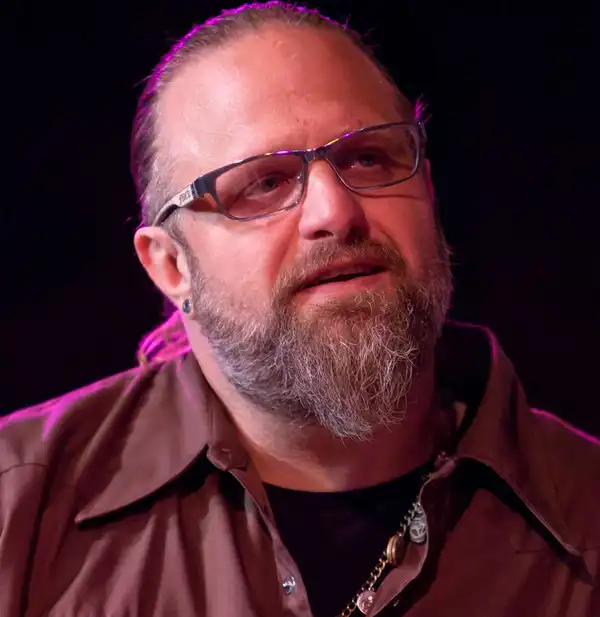
Michael Shawn Crahan, better known throughout the heavy metal world as Shawn “Clown” Crahan, is a musician, filmmaker, photographer and visual artist whose career has been inseparable from Slipknot since the band's earliest days. As a co-founder and percussionist, Crahan helped establish not only the thunderous sound of Slipknot but also much of the unsettling visual identity that transformed a group of musicians from Des Moines, Iowa, into an international phenomenon. Masks, boiler suits, numbers, chaotic stage performances and an almost theatrical approach to aggression became part of the package, and Crahan was one of the principal architects behind it.
Born in Des Moines, Iowa, Crahan developed an interest in music and art long before Slipknot existed. Drums became an important creative outlet, but his imagination was never confined to conventional musicianship. Visual art, photography, filmmaking and performance fascinated him as well, interests that would eventually make him considerably more than the fellow assigned to hit additional percussion whenever Slipknot needed to become even louder. Crahan has repeatedly described creativity as something extending across different media, and his career bears that out. Music may have made him famous, but cameras, photographs, paintings and films have occupied a substantial amount of his creative life.
The origins of his famous “Clown” identity go back well before Slipknot. As a teenager, Crahan encountered a clown mask in a store and was immediately fascinated by the transformation it produced when he put it on. He kept the original mask, and years later a clown mask became his defining visual signature when Slipknot emerged. The idea was considerably more meaningful to Crahan than simply choosing something frightening to wear on stage. For him, masks offered anonymity, transformation and an opportunity to reveal something different about the person underneath. That concept eventually became fundamental to Slipknot, where masks evolved alongside the musicians and changed from one album cycle to another.
Slipknot began taking shape in Des Moines during the mid-1990s, with Crahan among the musicians responsible for establishing the band. Bassist Paul Gray and vocalist Anders Colsefni were also central to the early lineup, which changed repeatedly before eventually developing into the nine-member configuration that became internationally famous. Crahan adopted the number 6, another component of the numbered identities used by the classic lineup. Within a few years, the members would become almost as recognizable by masks and numbers as by their names, an impressive achievement considering that disguising everybody would normally be regarded as a fairly inefficient method of becoming famous.
Crahan's musical role helped distinguish Slipknot from more conventional metal bands. In addition to the standard drum kit, Slipknot employed extra percussionists, including Crahan, creating a dense rhythmic attack that became an important part of the band's sound. His equipment has included custom percussion rigs, drums and metal objects, and Slipknot concerts became notorious for the physical intensity with which the percussion was performed. Crahan was never merely standing politely at the back keeping time. A Slipknot stage could resemble an industrial accident that had somehow acquired a record contract, and Clown was frequently somewhere near the center of the commotion.
The band's independent release Mate. Feed. Kill. Repeat. appeared in 1996, but Slipknot's major breakthrough came after signing with Roadrunner Records and releasing its self-titled album in 1999. Produced by Ross Robinson, Slipknot introduced a much wider audience to a band whose combination of extreme metal, rhythmic experimentation, turntables, samples, multiple percussionists and furious performances was difficult to confuse with anybody else. Songs including “Wait and Bleed” and “Spit It Out” helped build an enormous following, while appearances on Ozzfest brought the spectacle of Slipknot directly to concert audiences across America.
The band's second major album, Iowa, arrived in 2001 and pushed the intensity even further. Recorded during an infamously difficult period for the musicians, the album became one of Slipknot's defining releases. Rather than softening the approach after commercial success, the band produced something darker, heavier and more abrasive. Crahan has spoken extensively over the years about the emotional environment surrounding Slipknot's early records and the complicated relationships among its members. That volatility could be destructive, but it also contributed to music that sounded as though everybody involved considered the recording studio a place where feelings should be settled with heavy machinery.
Slipknot continued evolving with Vol. 3: (The Subliminal Verses) in 2004, an album that expanded the band's musical vocabulary and included tracks such as “Duality,” “Before I Forget” and “Vermilion.” “Before I Forget” earned Slipknot the Grammy Award for Best Metal Performance, giving the masked outsiders from Iowa one of the music industry's most recognizable honors. Subsequent albums including All Hope Is Gone, .5: The Gray Chapter, We Are Not Your Kind and The End, So Far demonstrated the band's ability to survive lineup changes, internal difficulties and devastating personal losses while continuing to attract audiences around the world.
One of those losses was particularly significant to Crahan and the history of Slipknot. Founding bassist Paul Gray died in 2010. Gray had been instrumental in the formation and development of the band, and his death profoundly affected the surviving members. Slipknot eventually continued, but Gray's absence became part of the band's story rather than something its members attempted to erase. Crahan has frequently spoken about Slipknot in terms of brotherhood, shared experience and the enormous portion of their lives invested in the group. Behind the frightening masks and theatrical violence is a band whose history contains very real friendships, disagreements, triumphs and grief.
Crahan's influence on Slipknot extends considerably beyond percussion. He has played an important role in shaping the band's visual presentation and has directed or co-directed numerous Slipknot videos and other visual projects. His fascination with cameras became especially evident in Voliminal: Inside the Nine, the 2006 DVD project offering an unconventional look inside the band's world. Rather than presenting a straightforward documentary assembled from talking-head interviews and concert footage, Crahan approached the material as an experimental visual work, reflecting his tendency to regard Slipknot as an artistic project extending far beyond recorded music.
Photography became another major part of his work. Crahan has spent years documenting his surroundings, fellow musicians and experiences on the road, often favoring imagery that is distorted, atmospheric or deliberately uncomfortable. His visual interests fit naturally with Slipknot's aesthetic but are not limited to the band. He has exhibited artwork and photography and has spoken repeatedly about his desire to create regardless of the medium involved. For Crahan, the distinction between musician, photographer and filmmaker appears considerably less important than the act of making something.
That philosophy eventually carried him into feature filmmaking. Crahan made his feature directorial debut with Officer Downe, released in 2016 and adapted from the graphic novel created by Joe Casey and Chris Burnham. The film starred Kim Coates as an extraordinarily difficult-to-kill Los Angeles police officer who is repeatedly resurrected to continue fighting crime. It was not exactly The Sound of Music, but nobody familiar with Clown's artistic preferences was likely to arrive expecting singing nuns on an Alpine hillside. The production allowed Crahan to transfer years of experience directing music videos and creating visual material into a full-length narrative film.
Crahan also pursued music outside Slipknot. His projects have included To My Surprise, whose self-titled album was released through Roadrunner Records in 2003, and Dirty Little Rabbits, a more experimental rock project featuring vocalist Stella Katsoudas. These ventures demonstrated another side of a musician commonly associated with Slipknot's punishing heaviness. Rather than endlessly reproducing the same formula away from his main band, Crahan used side projects to explore different sounds and creative relationships.
Throughout his career, Crahan has resisted treating Slipknot merely as a conventional musical act. The band has always incorporated symbolism, imagery, performance and deliberate mystery, with the masks becoming perhaps the most obvious example. Although masks could easily have deteriorated into a marketing gimmick, Slipknot repeatedly redesigned them and treated their changing appearance as an extension of each member's personality and circumstances. Crahan's own Clown mask has undergone numerous transformations, sometimes becoming grotesque, metallic, fragmented or disturbingly minimalist while remaining recognizably connected to the identity he established decades earlier.
The remarkable part of Crahan's story is that the theatrical presentation never prevented Slipknot from achieving enormous mainstream success. A group originating in Iowa, featuring nine members dressed in matching industrial clothing and individualized horror masks, hardly resembles a plan designed by a cautious record-company marketing department. Yet Slipknot developed an international following, topped major album charts, won a Grammy and built a touring career capable of filling arenas and headlining festivals. What initially appeared extreme became unmistakable branding, and what might have been dismissed as novelty survived because there was substantial music underneath it.
Crahan's place within that history is particularly important because he remains closely tied to the original concept of Slipknot. Band membership has changed over the decades, but Clown has remained a central creative figure, protecting the group's identity while encouraging it to evolve. He has also increasingly become one of Slipknot's public voices, discussing the band's history, artistic direction and future in interviews while continuing to oversee visual projects.
The man behind Clown is consequently rather more complicated than the mask suggests. Shawn Crahan helped create one of modern metal's most distinctive bands, but he has also spent his career exploring photography, filmmaking, directing and other forms of visual art. Slipknot gave those interests an enormous stage, while Crahan's artistic instincts helped give Slipknot an identity that could be recognized before the band played a single note.
Perhaps that is the most appropriate way to understand Shawn “Clown” Crahan. He is a percussionist, certainly, and watching him perform leaves little doubt that he takes hitting things very seriously. But the percussion is only one component of a much larger creative life. From an inexpensive clown mask discovered during his youth to albums, concert stages, photographs, music videos and feature films, Crahan has spent decades turning strange ideas into tangible things. Somewhere along the way, the clown stopped being merely a man behind a mask and became one of heavy metal's most enduring visual identities.