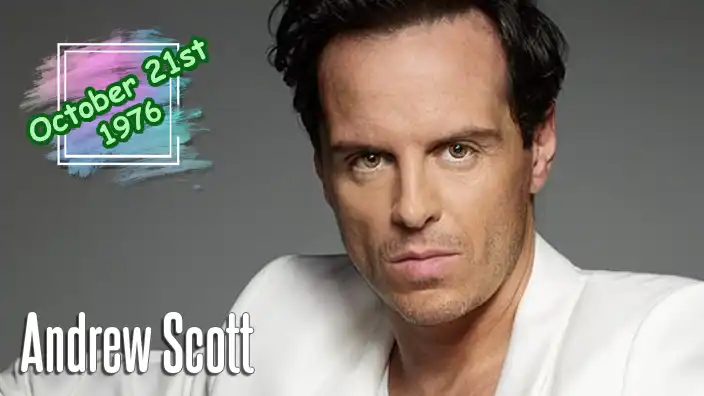
October 21, 1976, in Dublin, Ireland

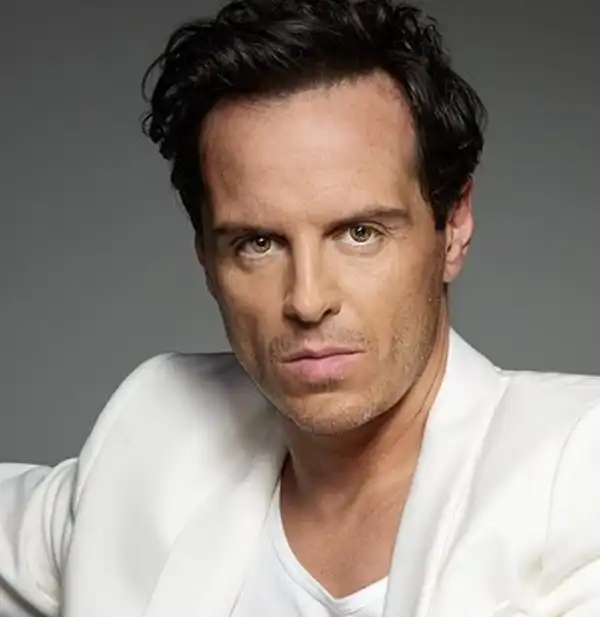
Andrew Scott was born on October 21, 1976, in Dublin, Ireland, and has become one of the most respected and versatile actors of his generation. Celebrated for his extraordinary emotional range, expressive performances, and ability to portray complicated characters, Scott has achieved international recognition through television, film, and theater. His most famous roles include the brilliant but terrifying Jim Moriarty in the BBC series Sherlock, the unexpectedly romantic priest in Fleabag, and the calculating con artist Tom Ripley in Netflix's Ripley. Alongside these memorable performances, he has earned widespread acclaim for his theatrical work, including interpretations of Shakespeare and other major dramatists. His career demonstrates an unusual ability to make audiences sympathize with characters whose behavior ranges from mildly questionable to spectacularly criminal. Whether portraying a romantic idealist, a troubled outsider, or a villain who considers murder an acceptable career advancement strategy, Scott brings remarkable intelligence and humanity to his performances.
Growing up in Dublin, Andrew Scott developed an interest in acting at an early age. His mother, Nora, was an art teacher, while his father, Jim, worked in recruitment. He was raised alongside two sisters, Sarah and Hannah, in a family that encouraged creativity and education. Scott attended Gonzaga College, a Jesuit school in Dublin, and participated in weekend drama classes at Ann Kavanagh's Young People's Theatre in Rathfarnham. His earliest television experience came through advertisements, including a commercial for porridge when he was a young child. Although appearing in a breakfast advertisement hardly guaranteed a future career in international entertainment, it introduced him to the experience of performing before cameras. Apparently, the journey from selling porridge to terrifying Sherlock Holmes was simply a matter of professional development.
As a teenager, Scott became increasingly serious about acting, participating in theatrical productions and developing the skills that would eventually establish his reputation. At seventeen, he secured a leading role in the Irish film Korea, directed by Cathal Black and released in 1995. The film, set in rural Ireland, explored family tensions, emigration, and the social consequences of economic hardship. Scott's performance demonstrated considerable promise and introduced him to the demands of professional filmmaking. Although he received an opportunity to pursue art studies, he instead enrolled in drama at Trinity College Dublin. His university education proved brief, however, as he left after approximately six months to join the Abbey Theatre, Ireland's celebrated national theater. It was an unconventional academic decision, but Scott evidently preferred learning his profession on stage rather than spending several years discussing how he might eventually do so.
The Abbey Theatre provided Scott with invaluable opportunities to develop his craft within Ireland's distinguished theatrical tradition. Working alongside experienced actors and directors, he gained practical knowledge of dramatic performance, character development, and the demands of live theater. Ireland has produced an extraordinary collection of playwrights and performers, including Oscar Wilde, George Bernard Shaw, Samuel Beckett, and numerous contemporary artists. Scott's early involvement in this environment helped establish his appreciation for sophisticated writing and emotionally demanding roles. His theatrical experience also encouraged the expressive physicality and precise vocal control that would later become distinguishing characteristics of his screen performances. Unlike television, where an unsuccessful scene can be recorded again, live theater requires performers to deliver their work in front of an audience that has already paid for its tickets and generally expects the actors to remember their lines.
Scott's early screen career included a small appearance in Steven Spielberg's acclaimed 1998 war film Saving Private Ryan. Although his role was limited, the production provided valuable experience within a major international film project. He also appeared in the television miniseries Longitude in 2000 and the acclaimed HBO production Band of Brothers in 2001. These projects helped establish his professional credentials beyond Ireland, introducing him to British and American audiences. Meanwhile, his theatrical career continued developing through challenging productions, including Eugene O'Neill's Long Day's Journey into Night at Dublin's Gate Theatre. His performance as Edmund Tyrone attracted considerable attention, demonstrating an ability to handle psychologically demanding material with maturity and emotional depth. The combination of screen appearances and substantial theatrical roles allowed Scott to develop his reputation gradually, building a career through demanding performances rather than relying upon immediate celebrity.
After moving to London, Scott continued working extensively in theater, appearing in productions that demonstrated his versatility and growing artistic confidence. His performance in Conor McPherson's Dublin Carol at the Royal Court Theatre in 2000 marked an important stage in his development, while subsequent work brought opportunities in both classical and contemporary drama. In 2005, he received the Laurence Olivier Award for Outstanding Achievement in an Affiliate Theatre for his performance in A Girl in a Car with a Man at the Royal Court. The award represented significant recognition from Britain's theatrical establishment and confirmed his standing as an exceptional stage performer. Scott's approach to acting emphasized emotional honesty, detailed character interpretation, and the ability to communicate complicated feelings through apparently simple gestures. These qualities would become particularly important when television eventually introduced him to a much larger audience.
His film career also developed steadily during the early 2000s. In 2003, Scott appeared in the Irish thriller Dead Bodies, portraying Tommy McGann, a young man whose life becomes increasingly complicated after a disturbing discovery. His performance earned him the Irish Film and Television Award for Best Actor in a Leading Role, providing another important recognition of his talent. The film demonstrated his ability to portray troubled and morally uncertain characters without reducing them to straightforward villains or heroes. Scott also appeared in the BBC comedy series My Life in Film in 2004, revealing a lighter side of his acting abilities. The series followed an aspiring filmmaker whose everyday experiences frequently resembled familiar movie situations, allowing Scott to explore comedy and self-conscious absurdity. Such variety proved valuable preparation for a career in which he would eventually move between psychological thrillers, romantic dramas, historical productions, and comedy with remarkable ease.
Andrew Scott's international breakthrough arrived in 2010 when he was cast as James Moriarty in the BBC television series Sherlock, starring Benedict Cumberbatch as Sherlock Holmes and Martin Freeman as Dr. John Watson. Created by Steven Moffat and Mark Gatiss, the series transported Arthur Conan Doyle's famous detective stories into contemporary London, combining modern technology with the intellectual puzzles and eccentric characters of the original fiction. Scott's Moriarty was introduced as a criminal mastermind whose intelligence rivaled that of Sherlock Holmes, but his interpretation departed significantly from conventional portrayals of sophisticated villains. Instead of presenting Moriarty as a reserved and calculating gentleman, Scott created an unpredictable, theatrical, and frequently unsettling character whose playful manner concealed extraordinary cruelty. His performance transformed the detective's famous adversary into one of modern television's most memorable villains.
Scott's interpretation of Moriarty became especially famous for its sudden changes in mood, distinctive vocal delivery, and unnerving combination of humor and menace. One moment, the character appeared almost childishly amused by his own schemes; the next, he could become genuinely terrifying. This unpredictability made Moriarty an ideal opponent for Sherlock Holmes, whose confidence in his own intelligence was repeatedly challenged by the criminal's elaborate manipulations. Their confrontations became some of the series' most celebrated moments, particularly during the dramatic second-season finale, "The Reichenbach Fall." Scott's performance earned him the BAFTA Television Award for Best Supporting Actor in 2012, establishing him as an internationally recognized television star. For viewers, his Moriarty was proof that a villain does not need an elaborate costume, a secret underground headquarters, or a collection of mechanical sharks to be frightening. Sometimes an unsettling smile and a mobile phone are more than sufficient.
The success of Sherlock introduced Scott to audiences around the world and created opportunities for increasingly prominent film and television roles. However, he remained determined to avoid becoming permanently associated with a single character. His subsequent performances demonstrated a willingness to explore different personalities, genres, and dramatic situations. In 2013, he provided a voice performance in the acclaimed film Locke, starring Tom Hardy, while 2014 brought a particularly memorable role in the British comedy-drama Pride. Based on historical events, the film followed a group of lesbian and gay activists who raised money to support striking miners during the 1984–1985 British miners' strike. Scott portrayed Gethin Roberts, a Welsh-born gay man whose personal experiences reflected the social tensions and prejudices of the period. His sensitive performance contributed to the film's combination of humor, political history, and emotional storytelling.
Pride became an important film in Scott's career because it allowed him to portray a character whose vulnerability and compassion contrasted sharply with the theatrical cruelty of Moriarty. The film explored solidarity between communities that initially appeared to have little in common, demonstrating how shared experiences of discrimination could encourage unexpected friendships. Scott's performance helped communicate the personal consequences of prejudice while contributing to the film's broader message of cooperation and dignity. The ensemble cast included Bill Nighy, Imelda Staunton, Dominic West, and George MacKay, and the production received widespread critical praise. For Scott, the film represented another opportunity to participate in a story that combined strong characterization with meaningful social themes. It also provided a welcome reminder that British cinema could explore difficult historical subjects without requiring every character to spend the entire running time looking thoroughly miserable.
In 2015, Scott entered the world of James Bond with a role in Spectre, starring Daniel Craig as the famous British secret agent. He portrayed Max Denbigh, a senior intelligence official known by the nickname C, whose plans to restructure Britain's intelligence services become central to the film's conspiracy. The character initially presents himself as a confident modern administrator, advocating sophisticated surveillance systems and institutional reform. However, his ambitions conceal considerably more troubling intentions. Scott's performance brought controlled arrogance and understated menace to the role, demonstrating his ability to portray dangerous individuals without relying entirely upon the flamboyant behavior associated with Moriarty. His involvement in a major Bond production introduced him to another enormous international audience. By this point, casting directors had evidently concluded that Scott possessed a particularly convincing expression for someone who should never be entrusted with confidential information.
Alongside his expanding screen career, Scott continued accepting challenging theatrical roles. In 2017, he starred as the title character in a celebrated production of William Shakespeare's Hamlet, directed by Robert Icke at London's Almeida Theatre before transferring to the West End. His interpretation of the troubled Danish prince attracted widespread critical acclaim for its emotional immediacy, conversational delivery, and psychological complexity. Rather than presenting Hamlet as a distant literary figure, Scott emphasized the character's vulnerability, intelligence, grief, and uncertainty. His performance demonstrated how Shakespeare's language could feel immediate and accessible when delivered with genuine emotional understanding. The production earned Scott a Laurence Olivier Award nomination for Best Actor and reinforced his reputation as one of Britain's most accomplished theatrical performers. Playing Hamlet is widely regarded as one of the most demanding assignments in classical theater, although Scott's earlier experience with Moriarty probably provided useful preparation for dealing with complicated family relationships and an unusually high body count.
Another defining moment in Scott's career arrived in 2019 when he joined the second season of Phoebe Waller-Bridge's acclaimed comedy-drama Fleabag. He portrayed an unnamed Catholic priest who develops a complicated romantic connection with the show's central character, played by Waller-Bridge. The priest's humor, intelligence, emotional vulnerability, and unexpected chemistry with Fleabag quickly made him a favorite among viewers. Audiences affectionately nicknamed the character the "Hot Priest," a title that probably caused a few raised eyebrows among people accustomed to more conventional descriptions of the clergy. Scott's performance combined warmth, charm, and genuine emotional conflict, creating a character whose religious commitments and personal feelings pull him in different directions. His interactions with Fleabag became central to the series' exploration of love, loneliness, faith, and the difficulty of forming meaningful human connections.
The extraordinary popularity of Scott's performance in Fleabag demonstrated his ability to create a memorable character through subtle emotional details rather than elaborate dramatic gestures. One of the series' most celebrated elements involved the priest's unusual awareness of Fleabag's habit of addressing the audience directly, an inventive storytelling device that emphasized their emotional connection. Scott's chemistry with Waller-Bridge helped transform the relationship into one of contemporary television's most discussed romances. His performance earned the Critics' Choice Television Award for Best Supporting Actor in a Comedy Series and a Golden Globe nomination. The role also expanded his popularity among audiences who had previously known him primarily as Sherlock Holmes's criminal adversary. It was a remarkable transformation: the man who once threatened to destroy Sherlock's life was now making viewers question whether a priest could reasonably be persuaded to reconsider his career.
Scott enjoyed an especially productive year in 2019, appearing in several acclaimed productions that demonstrated his impressive range. In the fifth season of the Netflix anthology series Black Mirror, he starred in the episode "Smithereens" as Chris Gillhaney, a rideshare driver whose personal tragedy leads him into a desperate confrontation with a powerful technology company. The performance explored grief, guilt, and the potentially destructive influence of social media, earning Scott a Primetime Emmy Award nomination for Outstanding Guest Actor in a Drama Series. He also appeared in Sam Mendes's acclaimed First World War film 1917, portraying Lieutenant Leslie, a battle-weary officer encountered by the film's central characters during their dangerous mission. Although his screen time was limited, Scott created a memorable impression through his character's exhausted humor and grim understanding of warfare. These performances demonstrated his ability to communicate complex emotions within both intimate television dramas and large-scale cinematic productions.
His remarkable theatrical achievements continued in 2019 with a starring role in Noël Coward's comedy Present Laughter at London's Old Vic Theatre. Scott portrayed Garry Essendine, a charismatic and self-absorbed actor whose personal and professional relationships become increasingly chaotic. The production, directed by Matthew Warchus, offered a fresh interpretation of Coward's celebrated comedy, allowing Scott to demonstrate his gift for sophisticated humor and theatrical timing. His performance earned the Laurence Olivier Award for Best Actor in 2020, providing another major recognition of his work on stage. The role contrasted sharply with the psychological intensity of Black Mirror and the romantic vulnerability of Fleabag, further illustrating the extraordinary range of his abilities. Having already portrayed a criminal mastermind and a romantically troubled priest, Scott apparently decided that an egotistical actor surrounded by emotional complications would be a pleasant change of pace.
Scott also appeared in the television adaptation of Philip Pullman's fantasy trilogy His Dark Materials, portraying Colonel John Parry, also known as Stanislaus Grumman. The character is an explorer and scholar whose mysterious disappearance becomes important to the story's larger conflict. His performance contributed to a production featuring elaborate fantasy settings, complex mythology, and an impressive ensemble cast. Scott subsequently appeared in the BBC adaptation of Nancy Mitford's The Pursuit of Love in 2021 and the medieval comedy Catherine Called Birdy in 2022, directed by Lena Dunham. In the latter, he portrayed Lord Rollo, the financially troubled father of a spirited young noblewoman played by Bella Ramsey. These roles allowed him to explore different historical settings and storytelling styles, reinforcing his reputation as an actor who could move comfortably between fantasy, comedy, and serious drama.
In 2023, Scott delivered one of his most emotionally powerful screen performances in All of Us Strangers, written and directed by Andrew Haigh. Based loosely on Taichi Yamada's Japanese novel Strangers, the film follows Adam, a lonely London screenwriter who begins a relationship with his neighbor Harry, portrayed by Paul Mescal. At the same time, Adam experiences mysterious encounters with his parents, played by Claire Foy and Jamie Bell, who died when he was a child. The film explores grief, memory, loneliness, sexuality, and the enduring emotional influence of family relationships. Scott's performance received extraordinary praise for its vulnerability and emotional authenticity, capturing the character's longing for connection while gradually revealing the unresolved pain of his past. The role demonstrated his ability to communicate profound emotional experiences through quiet expressions and restrained dialogue, creating a performance that resonated deeply with audiences.
All of Us Strangers earned Scott a Golden Globe nomination for Best Actor in a Motion Picture – Drama, along with other major awards recognition. Critics particularly praised his chemistry with Paul Mescal and his sensitive portrayal of a man struggling to reconcile childhood memories with adult identity. The film's unusual combination of romance, psychological drama, and supernatural elements required a delicate balance, which Scott achieved through an emotionally grounded performance. His portrayal emphasized the universal human desire for acceptance and the complicated relationships between memory, love, and loss. The film also demonstrated his commitment to stories exploring the experiences of LGBTQ+ individuals without reducing their identities to simple stereotypes. Although the subject matter was often heartbreaking, Scott's performance included moments of tenderness and humor that made the character feel convincingly human.
The same period brought another extraordinary theatrical achievement with Vanya, a radical adaptation of Anton Chekhov's Uncle Vanya by playwright Simon Stephens, directed by Sam Yates. In this ambitious one-person production, Scott portrayed all eight characters, shifting between personalities, relationships, and emotional perspectives without the assistance of a conventional ensemble cast. The performance required remarkable concentration, physical control, vocal versatility, and an intimate understanding of Chekhov's complicated characters. Rather than relying upon elaborate costume changes or exaggerated impersonations, Scott distinguished the characters through subtle adjustments in movement, expression, and speech. The production received widespread acclaim and was subsequently filmed for cinema audiences. Performing an entire Chekhov drama alone is an impressive achievement, particularly when the cast includes enough complicated personalities to make an ordinary family reunion seem pleasantly straightforward.
In 2024, Andrew Scott took on another defining role as Tom Ripley in the Netflix psychological thriller Ripley, created, written, and directed by Steven Zaillian. Based on Patricia Highsmith's celebrated novel The Talented Mr. Ripley, the eight-part series follows an American con artist who travels to Italy and becomes entangled in a dangerous world of deception, identity theft, and murder. Filmed in striking black and white, the production emphasizes atmospheric locations, meticulous visual composition, and the disturbing psychology of its central character. Scott's portrayal of Ripley is controlled, calculating, and frequently unsettling, presenting a man whose desire for wealth and social acceptance gradually leads him toward increasingly desperate actions. The series also features Dakota Fanning as Marge Sherwood and Johnny Flynn as Dickie Greenleaf, whose lives become entangled with Ripley's elaborate schemes.
Scott's performance in Ripley earned widespread critical acclaim and nominations for both a Primetime Emmy Award and a Golden Globe Award. His interpretation differed from earlier screen portrayals of the character, including Matt Damon's performance in the 1999 film The Talented Mr. Ripley. Rather than emphasizing youthful charm, Scott presented Ripley as an emotionally detached opportunist whose intelligence and determination conceal a profound emptiness. The deliberate pacing and sophisticated visual style of the Netflix adaptation allowed him to develop the character through carefully controlled gestures, silences, and expressions. The result was a psychologically compelling performance that reinforced his reputation for portraying morally complicated individuals. Between Moriarty and Ripley, Scott has now played enough dangerous men that anyone offering him a spare bedroom should probably insist upon seeing some references first.
His work continued expanding through major film productions in 2025. In Richard Linklater's Blue Moon, Scott portrayed the celebrated American composer Richard Rodgers opposite Ethan Hawke as lyricist Lorenz Hart. The film explores a pivotal period in American musical theater history, focusing on the complicated professional relationship between Rodgers and Hart as Rodgers begins a successful partnership with Oscar Hammerstein II. Scott's performance earned him the Silver Bear for Best Supporting Performance at the 2025 Berlin International Film Festival, another significant international honor. He also appeared in Wake Up Dead Man: A Knives Out Mystery, the third installment in Rian Johnson's popular detective film series, starring Daniel Craig as investigator Benoit Blanc. Scott portrayed Lee Ross, joining an ensemble that included Glenn Close, Josh Brolin, Mila Kunis, and several other prominent performers. His involvement in these productions demonstrated his continuing ability to move between intimate character studies and high-profile ensemble films.
Among his 2026 projects is Pressure, a historical drama exploring the crucial decisions surrounding the Allied invasion of Normandy during the Second World War. Scott portrays British meteorologist James Stagg, whose weather forecasts played an important role in determining the timing of the D-Day landings. The film, featuring Brendan Fraser as General Dwight D. Eisenhower, examines the extraordinary responsibility placed upon military planners and scientists during one of history's most consequential operations. Scott has also taken on the role of Scottish actor Ian Charleson in Elsinore, a drama exploring Charleson's life and his celebrated portrayal of Hamlet during the final period of his career. These projects continue Scott's interest in historical figures, psychologically demanding characters, and stories in which personal decisions carry considerable emotional or historical consequences.
Beyond his professional achievements, Scott has spoken openly about the importance of authenticity, representation, and allowing actors to portray a wide range of human experiences. He publicly discussed his sexuality in a 2013 interview with The Independent, explaining that he did not regard being gay as something that should define or limit his professional identity. Throughout his career, he has supported greater opportunities for LGBTQ+ performers and more thoughtful representation within film, television, and theater. His work in productions such as Pride and All of Us Strangers has contributed to wider conversations about identity, acceptance, and the importance of telling stories that reflect diverse experiences. At the same time, Scott has generally maintained a relatively private personal life, preferring to concentrate public attention on his performances rather than the constant publicity that often accompanies international celebrity.
One of the most distinctive characteristics of Scott's acting is his ability to shift rapidly between humor, tenderness, anger, and menace while maintaining a convincing emotional connection with the audience. His expressive eyes, distinctive voice, and precise physical movements allow him to communicate thoughts that are not always spoken aloud. Directors have frequently praised his instinctive understanding of character psychology, while fellow performers have noted his generosity and responsiveness during collaborative work. These qualities are particularly important in theater, where actors must maintain emotional continuity throughout an entire performance, but they also contribute to the intimate quality of his screen work. Whether appearing in a large-scale Hollywood production or a small independent drama, Scott approaches his characters with an attention to detail that makes even brief appearances memorable.
His career also illustrates the continuing importance of theatrical training in an entertainment industry increasingly dominated by television franchises, streaming platforms, and digital technology. Although Sherlock, Fleabag, and Ripley introduced Scott to enormous international audiences, his foundations were established through years of demanding stage work. His performances in Hamlet, Present Laughter, and Vanya demonstrate a commitment to the discipline and artistic possibilities of live theater. Rather than treating the stage merely as preparation for film and television, Scott has continued regarding it as an essential part of his professional identity. This dedication has allowed him to develop an unusually broad range of skills, from classical dramatic interpretation to contemporary comedy and psychological realism. It also means that, unlike actors who depend upon several camera angles and a sympathetic editor, Scott can hold an audience's attention without anyone shouting "Cut!"
Andrew Scott has received numerous awards and nominations throughout his career, including two Laurence Olivier Awards, a BAFTA Television Award, a Critics' Choice Television Award, and recognition from the Irish Film and Television Academy. His performances have also earned Golden Globe and Primetime Emmy nominations, while his work in Blue Moon brought international recognition at the Berlin Film Festival. These honors reflect the remarkable variety of his achievements, spanning classical theater, contemporary television, independent cinema, and major Hollywood productions. Yet awards alone cannot fully explain his appeal. Scott possesses the unusual ability to make complicated characters feel immediate and recognizable, encouraging audiences to understand their emotions even when their actions are difficult to defend.
From a childhood television advertisement in Dublin to internationally celebrated performances in Sherlock, Fleabag, All of Us Strangers, and Ripley, Andrew Scott has built a career distinguished by versatility, intelligence, and emotional depth. His work has demonstrated that memorable acting depends not simply upon dramatic dialogue or elaborate production, but upon an actor's ability to reveal the complicated humanity beneath a character's outward behavior. Whether portraying a brilliant villain, a conflicted priest, a grieving writer, or a calculating criminal, Scott brings originality and conviction to every role. His continuing success on stage and screen confirms his position among the most accomplished Irish actors working in contemporary entertainment. And if his remarkable collection of characters teaches us anything, it is that Andrew Scott can be absolutely charming, thoroughly heartbreaking, and genuinely terrifying—sometimes before the end of the same sentence.