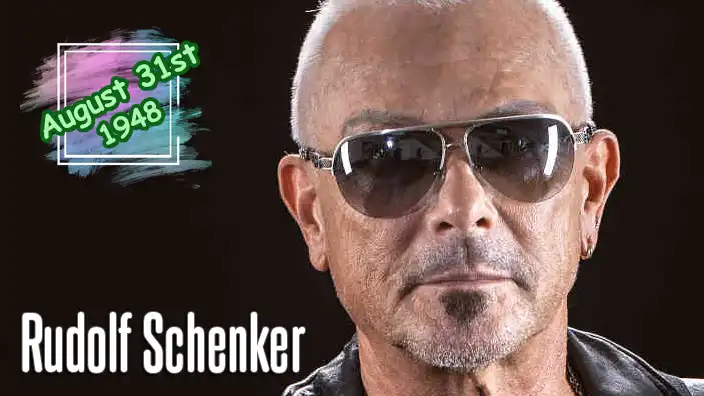
August 31, 1948, in Hildesheim, West Germany
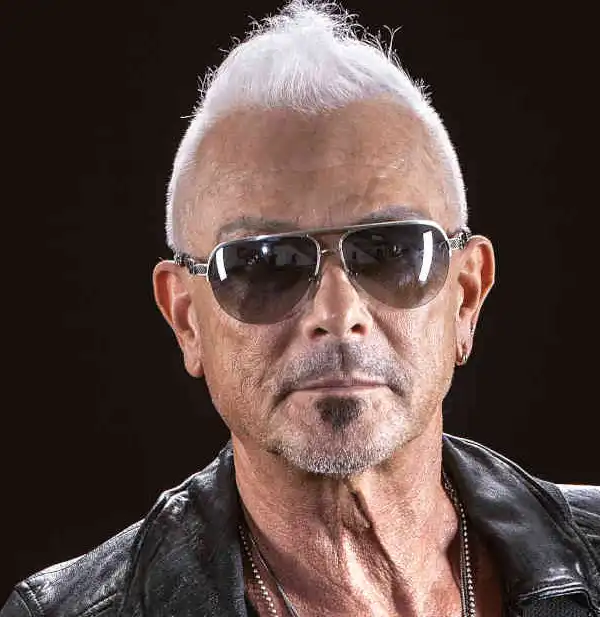
Rudolf Schenker co-founded Scorpions, plays the sort of rhythm guitar capable of rearranging nearby furniture, and has spent more than six decades helping turn a German band into an international rock institution. If you've ever attempted an air-guitar performance of “Rock You Like a Hurricane,” Rudolf deserves at least part of the blame—and unlike you, he probably remembered to plug in the guitar.
Rudolf Schenker was born on August 31, 1948, in Hildesheim, Germany, and grew up at a time when the country's postwar generation was becoming increasingly fascinated by the rock and roll arriving from Britain and the United States. Inspired by groups such as The Beatles and The Rolling Stones, Schenker became convinced that forming a band could provide something considerably more exciting than a conventional career. His mother reportedly preferred the idea of her son becoming an electrician, which certainly would have involved fewer amplifiers, fewer international tours and considerably less hair. Rudolf had other plans. As a teenager, he began building the group that would become Scorpions, founding the band in Hanover in 1965 with an ambition that already extended far beyond playing local clubs.
Music also ran through the Schenker family. Rudolf's younger brother Michael developed into an exceptional lead guitarist and would become one of hard rock's most respected players, first appearing with Scorpions and later achieving international recognition with UFO and the Michael Schenker Group. Rudolf's own role developed differently. Although an accomplished guitarist, he was less interested in becoming the virtuoso standing in the spotlight for every solo and instead concentrated on rhythm guitar, songwriting and building the band itself. That combination would ultimately make him one of the most important figures in Scorpions' history. He was not merely playing in the group; he was the organizer, musical architect and persistent driving force determined to keep it moving forward.
Singer Klaus Meine became part of the developing Scorpions lineup around the end of the 1960s, beginning one of rock music's longest-running creative partnerships. Michael Schenker also joined the band, and Scorpions released their debut album, Lonesome Crow, in 1972. The record was considerably more experimental than the tightly constructed hard rock for which they would eventually become famous, reflecting the progressive and psychedelic influences circulating through European rock at the time. The album did not make them international stars, but touring exposed the group to wider audiences and brought Michael Schenker to the attention of the British band UFO. When Michael left to join UFO, Rudolf faced the sort of setback that could easily have ended a young band. Instead, he reorganized and continued.
Guitarist Uli Jon Roth became central to the next phase of Scorpions, and during the 1970s the band steadily developed its musical identity through albums including Fly to the Rainbow, In Trance, Virgin Killer and Taken by Force. Rudolf increasingly established himself as the rhythmic foundation of the group and one of its principal composers. His style demonstrated something sometimes overlooked in guitar-centered rock music: spectacular solos may attract attention, but great rhythm guitar provides the machinery that makes those solos work. Schenker specialized in muscular, memorable riffs that could drive an entire song without becoming unnecessarily complicated. The band's growing reputation was particularly strong in Europe and Japan, and the successful 1978 Japanese tour produced the celebrated live album Tokyo Tapes.
Another important transformation occurred when Roth departed and Matthias Jabs eventually became Scorpions' permanent lead guitarist. Michael Schenker briefly returned during the transitional period surrounding the 1979 album Lovedrive, but the combination of Rudolf Schenker and Matthias Jabs became the guitar partnership that would carry the group through its greatest commercial period. Rudolf supplied the driving riffs and rhythm work while Jabs provided fluid lead guitar, all beneath the distinctive voice of Klaus Meine. Albums such as Lovedrive and Animal Magnetism demonstrated that Scorpions were becoming increasingly polished without losing their power, and the band began making significant progress in the enormously important American market.
That progress nearly suffered a devastating interruption when Klaus Meine developed serious vocal problems during preparations for Blackout. The singer feared that his career might be finished and reportedly considered leaving the group, but his bandmates encouraged him to undergo treatment and rehabilitation rather than permanently replacing him. Meine recovered, and Blackout, released in 1982, became the album that pushed Scorpions into the highest level of international hard rock. Songs including “No One Like You” received extensive American rock-radio play, while the band's increasingly energetic live performances demonstrated that a German group could compete directly with the largest British and American rock acts.
Scorpions followed Blackout with Love at First Sting in 1984, and Rudolf Schenker arrived with the musical foundation for what would become the band's most famous hard-rock anthem. “Rock You Like a Hurricane” developed from Schenker's guitar ideas, with Klaus Meine and drummer Herman Rarebell contributing the lyrics. Getting the song right was not effortless; Schenker has recalled that the lyrics went through nine versions before everyone was satisfied. The resulting recording combined a massive opening riff, an immediately memorable chorus and just enough 1980s mischief to ensure nobody mistook it for chamber music. Released as a single in 1984, it reached the Billboard Hot 100 and became Scorpions' signature American rock anthem.
The same album produced “Big City Nights” and the enormously successful ballad “Still Loving You,” demonstrating the unusual range that became another Scorpions trademark. They could spend one song attempting to shake the roof off an arena and the next convincing half the audience to fall in love. By the middle of the 1980s, the band was performing before enormous crowds around the world, and Rudolf had developed a stage presence almost as recognizable as his guitar riffs. His Flying V guitars became inseparable from his image, while standing quietly beside an amplifier apparently struck him as a terrible waste of a large stage. Schenker became famous for running, jumping, bending backward and generally treating a rock concert as though someone had combined guitar playing with an athletic event.
His association with the Gibson Flying V became particularly strong. Schenker has owned numerous examples of the distinctive instrument and used a 1958 Flying V to record “Rock You Like a Hurricane,” running it through the Marshall amplification that helped define his classic sound. His affection for the instrument went beyond its dramatic appearance. The Flying V suited the aggressive rhythm style he had developed, while also becoming a visual trademark that audiences could recognize from the far end of an arena. Long before musicians spoke endlessly about “branding,” Rudolf had managed to accomplish it with two pieces of wood arranged at a particularly enthusiastic angle.
Scorpions' career also became unexpectedly intertwined with one of the defining political transformations of the 20th century. The band had long wanted to perform behind the Iron Curtain and finally played a series of concerts in Leningrad in 1988. The following year, Scorpions appeared at the Moscow Music Peace Festival alongside major Western rock performers at a time when relations between East and West were changing with extraordinary speed. Klaus Meine's experiences in the Soviet Union helped inspire him to write “Wind of Change,” which appeared on the 1990 album Crazy World. With its unmistakable whistled introduction and hopeful lyrics, the song became internationally associated with the collapse of communist governments in Eastern Europe and the end of the Cold War.
For Rudolf Schenker, those events carried particular significance. He and Meine belonged to the generation of Germans born immediately after the Second World War, and Schenker has spoken about wanting Scorpions to represent a new Germany internationally through music rather than conflict. Performing in the Soviet Union and witnessing the political changes surrounding the fall of the Berlin Wall gave that philosophy an importance extending far beyond record sales. Scorpions had begun as teenagers imitating the rock bands they admired; a quarter-century later, they were performing before Soviet audiences while Europe was undergoing one of the most peaceful and dramatic political transformations in modern history.
Scorpions continued recording and touring throughout the 1990s and into the 21st century even as popular music changed around them. Grunge displaced much of the flamboyant hard rock that had dominated the 1980s, alternative music transformed radio, and successive generations discovered new forms of heavy music. Scorpions nevertheless retained a huge international following because their career had never depended entirely upon one country or one musical fashion. Songs including “Rock You Like a Hurricane,” “No One Like You,” “Still Loving You” and “Wind of Change” continued attracting listeners, while extensive touring introduced the band to generations born long after its earliest albums had been released.
Then, in 2010, Scorpions did something many veteran rock bands eventually do: they announced their retirement. The group released Sting in the Tail and embarked upon what was intended to be a farewell tour, apparently preparing to conclude one of rock's longest careers while everyone was still capable of remembering why they had entered the room. There was only one problem. The band discovered that it still enjoyed performing, audiences continued arriving in enormous numbers, and younger listeners were joining longtime fans at the concerts. Retirement consequently began looking considerably less attractive. Scorpions eventually abandoned the farewell plan and resumed doing what they had been doing for decades—recording albums and touring the world.
The decision proved durable. Scorpions released Return to Forever in 2015 and Rock Believer in 2022, while continuing to celebrate increasingly improbable anniversaries. The band's 50th anniversary arrived in 2015, followed by its 60th in 2025. Few musicians can claim to have founded a rock band as a teenager during the 1960s and remained at its center six decades later. Even fewer can say that the same band continued filling large venues and attracting new listeners instead of existing solely as a nostalgia attraction. Rudolf's persistence, organizational ability and belief in teamwork have been essential to that extraordinary longevity.
Schenker has occasionally handled lead vocals himself, particularly during Scorpions' earlier years, but his greatest contribution has always been the combination of composition, rhythm guitar and leadership. He has written or co-written a substantial portion of the band's music and frequently supplied the riffs around which songs were constructed. While Michael Schenker became celebrated for dazzling lead guitar and Matthias Jabs established himself as Scorpions' long-serving lead player, Rudolf built his reputation on something less flashy but equally important: creating the musical foundation upon which everyone else could perform.
That approach also reflects the philosophy Schenker has repeatedly expressed about maintaining a successful band. Rather than presenting Scorpions as a collection of individual stars fighting for attention, he has emphasized friendship, collaboration and finding musicians who can function together. Considering rock history's impressive collection of bands destroyed by arguments over money, songwriting credits, girlfriends, management, dressing rooms and whose turn it was to be photographed in the middle, keeping essentially the same musical enterprise alive for six decades may be one of Rudolf Schenker's greatest achievements.
Scorpions ultimately became one of the most internationally successful rock bands to emerge from continental Europe, opening doors for German musicians who followed and demonstrating that the global rock market did not belong exclusively to Britain and the United States. Rudolf Schenker's ambitions as a teenager had been remarkably simple and remarkably enormous: he wanted to create a band, travel the world and make music. He succeeded on a scale the teenager in Hanover could scarcely have imagined.
Rudolf Schenker may not always be the first member casual listeners identify when they hear a Scorpions recording. Klaus Meine possesses the unmistakable voice, Matthias Jabs delivers the lead guitar, and Michael Schenker's celebrated career has given the family name another prominent place in rock history. But Rudolf is the man who started Scorpions, helped write the songs, supplied the riffs and kept the machinery running through lineup changes, shifting musical fashions and more than half a century on the road. More than six decades after he first assembled the band, he can still walk onto a stage carrying a Flying V and unleash one of those enormous riffs that require only a few notes before thousands of people know exactly what is coming.
And somewhere today, somebody will hear the opening of “Rock You Like a Hurricane,” turn the volume knob considerably farther clockwise than good judgment recommends, and discover that Rudolf Schenker's original plan is still working perfectly.