August 31, AD 12, in Antium, Italy
 January 24, 41 AD, Rome, Italy
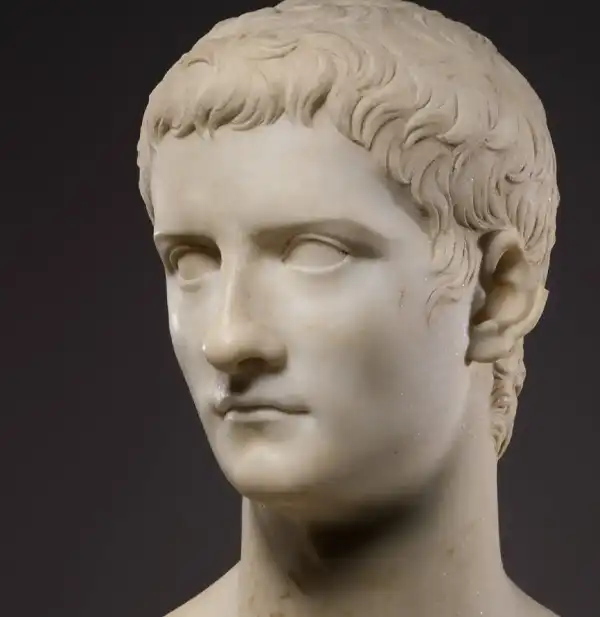
Gaius Caesar Germanicus, remembered by history as Caligula, was born on August 31, AD 12, into one of the most powerful and dangerous families in the Roman world. His father was Germanicus, an immensely popular Roman general and member of the Julio-Claudian dynasty, while his mother, Agrippina the Elder, was a granddaughter of Augustus, Rome's first emperor.
This was an extraordinary pedigree, although membership in Rome's imperial family came with a considerable occupational hazard: relatives had an unfortunate tendency to become rivals, prisoners, exiles or corpses.
Caligula spent part of his childhood accompanying his parents to military camps along the Rhine frontier. His mother dressed the little boy in a miniature soldier's outfit, including the heavy military footwear known as caligae. Soldiers affectionately nicknamed him “Caligula,” essentially meaning “Little Boots.”
It stuck.
Ironically, the adult emperor apparently disliked the childhood nickname by which practically everyone remembers him today.
Caligula's father Germanicus died at Antioch in AD 19 under suspicious circumstances. Although illness may have been responsible, rumors of poisoning spread rapidly, and many Romans suspected that Emperor Tiberius or people close to him had played some part.
Germanicus's death was devastating for his family. Caligula's mother became increasingly hostile toward Tiberius, and the struggle surrounding the imperial succession became lethal. Agrippina was eventually exiled and died in captivity. Caligula's older brothers Nero and Drusus also died after falling victim to the political struggles of Tiberius's reign.
Somehow, Caligula survived.
In AD 31, he was summoned to join Tiberius on the island of Capri. This must have been an extraordinarily uncomfortable family reunion. Caligula was living with the emperor under whose rule much of his immediate family had been destroyed, yet he apparently managed to conceal whatever anger or fear he felt.
Ancient writers later portrayed him as watching, waiting and learning how imperial power actually worked.
When Tiberius died in March AD 37, Caligula emerged as emperor.
Rome celebrated.
The new ruler was only 24 years old, the beloved son of Germanicus and a welcome contrast to the elderly, increasingly unpopular Tiberius. Crowds reportedly greeted Caligula enthusiastically, and the beginning of his reign included several popular measures.
He paid promised bonuses, honored the memory of his family, recalled some political exiles and permitted previously suppressed writings to circulate again. Imperial financial accounts were made public, and some of the harsher practices associated with the final years of Tiberius were abandoned.
For a moment, Rome appeared to have acquired exactly the emperor it wanted.
Then something changed.
Several months into his reign, Caligula became seriously ill. Ancient accounts suggest that after recovering, his behavior became dramatically more authoritarian and unpredictable. For generations, writers repeated the idea that the illness somehow caused insanity.
Modern historians are considerably more cautious.
There is no reliable way to diagnose a man who died nearly 2,000 years ago, particularly when much of the evidence comes from hostile writers who were perfectly happy to repeat sensational stories. Caligula may have suffered neurological illness, epilepsy, psychological problems or nothing that modern medicine would classify in those terms.
What is clearer is that his relationship with Rome's political establishment deteriorated badly.
Caligula increasingly asserted the overwhelming authority of the emperor and treated senators with open contempt. Rome still maintained the outward appearance of republican government, with a Senate, magistrates and traditional institutions, but Augustus and his successors had fundamentally transformed the political system.
The emperor possessed the real power.
Caligula appears to have been considerably less interested than Augustus in pretending otherwise.
That attitude placed him on a collision course with the Senate. Roman senators were willing to tolerate an emperor possessing enormous authority provided everyone continued performing the polite fiction that they remained important partners in government.
Caligula apparently had little patience for the performance.
Ancient historians describe elaborate humiliations inflicted upon senators and aristocrats. Whether every episode occurred exactly as reported is doubtful, but the broader political conflict between Caligula and Rome's elite is difficult to dispute.
His spending also became legendary.
Caligula sponsored public entertainments, games, construction projects and lavish spectacles. He completed projects begun under Tiberius and initiated others, including work on aqueducts that would later be completed during the reign of Claudius.
His most famous engineering spectacle involved the Bay of Baiae.
According to ancient accounts, Caligula ordered ships arranged side by side across the bay and covered with earth to create a temporary floating roadway stretching for miles. He then rode across it on horseback wearing elaborate military clothing.
Why?
That remains an excellent question.
One ancient explanation claimed that an astrologer had once said Caligula had no more chance of becoming emperor than of riding a horse across the Bay of Baiae. If the story is true, Caligula may have constructed one of history's most expensive responses to “You'll never do it.”
Then there was Incitatus.
Caligula's favorite horse has become almost as famous as the emperor himself. According to Suetonius, Incitatus enjoyed an elaborate stable and was provided with expensive furnishings. The emperor reportedly planned to make the horse a consul.
The important word is planned.
There is no reliable evidence that Caligula actually appointed Incitatus as consul or senator.
Some modern historians believe the entire business may have been a calculated insult directed at Rome's political establishment. By suggesting that his horse could perform a senator's duties, Caligula may effectively have been telling the Senate what he thought of them.
If that interpretation is correct, Incitatus wasn't entering politics.
He was political satire with four legs.
Another famous Caligula story involves Britain.
In AD 39 and 40, the emperor traveled north with Roman forces and apparently contemplated military action across the English Channel. Ancient accounts claim that at one point Caligula ordered his soldiers to collect seashells from the beach as “spoils of the ocean.”
It is one of the strangest episodes associated with his reign.
Unfortunately, we don't really know what happened.
The surviving descriptions may represent a garbled account of a military exercise, a punishment, preparations for an abandoned invasion or deliberate ridicule by later historians. Whatever occurred, Caligula did not conquer Britain.
His uncle Claudius would launch the successful Roman invasion in AD 43.
Caligula also became associated with increasingly extravagant claims concerning his own status. Ancient writers accused him of presenting himself as divine and appearing dressed as various gods.
Roman attitudes toward imperial divinity were complicated. Emperors could receive divine honors, particularly outside Rome, and deceased emperors could officially be declared gods. The degree to which Caligula demanded worship of himself during his lifetime remains debated, but his approach clearly alarmed many contemporaries.
This became particularly dangerous in his dealings with Jewish communities.
Caligula ordered that a statue of himself be installed in the Jewish Temple in Jerusalem, a move that threatened enormous unrest because Jewish religious law prohibited such an image within the Temple. The governor of Syria, Publius Petronius, delayed carrying out the order while attempting to persuade the emperor to reconsider.
The crisis ended without the statue being installed, and Caligula's death soon made the issue irrelevant.
His private life generated even more scandal.
Ancient writers accused Caligula of numerous sexual relationships and claimed he committed incest with his sisters, particularly Drusilla. These allegations have become an inseparable part of his popular image.
They are also highly questionable.
Sexual accusations were a standard weapon used against disliked political figures in Roman literature. Modern historians therefore approach these stories cautiously, especially because the surviving accounts of Caligula were written by authors who were generally hostile toward him.
Drusilla was nevertheless clearly extremely important to her brother.
When she died in AD 38, Caligula reportedly experienced profound grief and ordered extensive public mourning. She was subsequently deified, becoming Diva Drusilla.
Caligula married several times. His final wife was Milonia Caesonia, with whom he had a daughter, Julia Drusilla.
Meanwhile, the emperor's relationship with the men responsible for protecting him was deteriorating.
Among those men was Cassius Chaerea, an officer of the Praetorian Guard.
According to surviving accounts, Caligula repeatedly mocked and humiliated Chaerea, including making insulting remarks about his masculinity and giving him embarrassing passwords when he was on duty.
This was an extraordinarily poor way to treat a heavily armed professional soldier with access to the emperor.
By AD 41, a conspiracy had formed involving members of the Praetorian Guard and others dissatisfied with Caligula's rule.
On January 24, AD 41, Caligula attended games and theatrical performances connected with the Palatine Games. As he moved through a passageway beneath or near the imperial palace complex, the conspirators struck.
Chaerea reportedly delivered one of the first blows.
Caligula was stabbed repeatedly and killed.
He was 28 years old.
The violence did not stop with the emperor. Caesonia was killed, and their young daughter Julia Drusilla was murdered as well.
Caligula had ruled Rome for less than four years.
The assassination created an immediate political crisis. Some senators apparently hoped the Republic might be restored now that the emperor was dead.
The Praetorian Guard had other ideas.
They discovered Caligula's uncle Claudius and proclaimed him emperor.
The Roman Republic was not coming back.
Caligula's reputation, meanwhile, was only beginning its extraordinary journey.
Ancient writers such as Suetonius and Cassius Dio created a portrait of an emperor who was cruel, sexually depraved, financially reckless, megalomaniacal and insane. Their accounts supplied generations of writers, artists and filmmakers with irresistible material.
But there is a serious historical problem.
The surviving evidence for Caligula's reign is unusually difficult.
The relevant portion of Tacitus's Annals, which might have provided an important account, has been lost. Suetonius wrote decades after Caligula's death and eagerly included gossip and scandal. Cassius Dio wrote much later still.
Other evidence survives from writers including Philo, Seneca and Josephus, along with coins and inscriptions, but reconstructing exactly what happened during Caligula's short reign remains extremely difficult.
This doesn't mean Caligula was secretly a misunderstood humanitarian whose reputation suffered from bad publicity.
There is substantial reason to regard his government as increasingly autocratic, violent and politically unstable. Executions occurred, conspiracies developed, relations with the Senate deteriorated, and eventually members of his own guard decided that killing him was preferable to continuing his reign.
But separating the real Caligula from the literary monster created after his death is another matter entirely.
The horse story illustrates the problem beautifully.
Ask almost anyone who has heard of Caligula and there is a fair chance they know that he “made his horse a consul.”
Except he didn't.
A hostile ancient source said he intended to do so.
Over nearly two thousand years, the qualification disappeared while the horse received an impressive political promotion.
Caligula therefore remains one of ancient history's most fascinating characters precisely because certainty is so elusive. Behind the stories of madness, murder, divine pretensions, seashells and politically ambitious horses was a real young man born into an imperial family already poisoned by rivalry and suspicion.
He survived the destruction of much of that family, became ruler of the Roman world at just 24 and initially enjoyed enormous popularity.
Less than four years later, his own guards murdered him.
Whether Caligula was mentally ill, deliberately tyrannical, politically reckless, spectacularly arrogant or some combination of these is still debated. What cannot be disputed is that his name became shorthand for the dangers of absolute power.
Nearly two millennia later, Caligula remains one of the few Roman emperors whose name is immediately recognizable to people who couldn't pick Tiberius out of a lineup.
And Incitatus never even had to run for office.