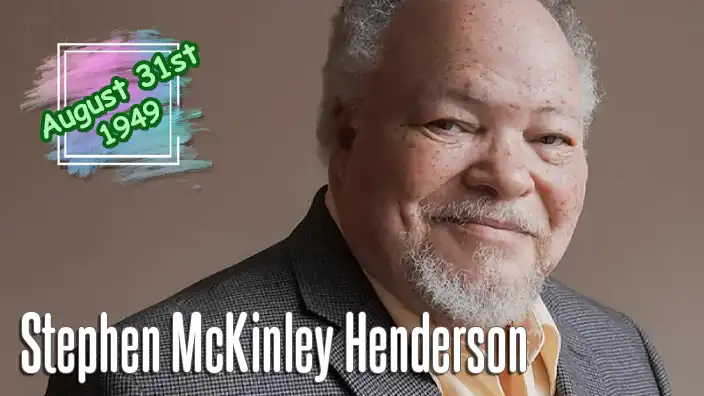
August 31, 1949, in Kansas City, Missouri
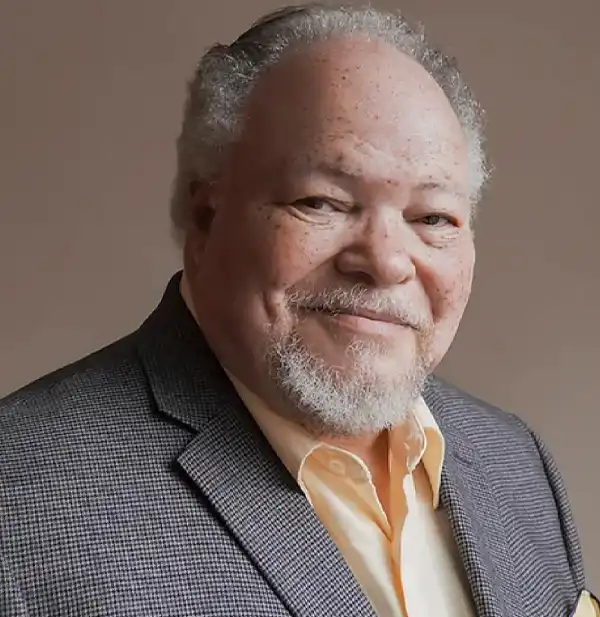
Stephen McKinley Henderson was born on August 31, 1949, in Kansas City, Missouri, and grew up on the city's East Side. His path toward acting began during his school years, when teachers recognized both his interest and his ability and encouraged him to pursue performance seriously. Henderson attended Lincoln University in Missouri before continuing his theatrical education at the Juilliard School in New York, where he was a member of the institution's first acting class. He subsequently studied at the North Carolina School of the Arts, beginning the rigorous training that would eventually support a career stretching across theater, film and television for more than half a century.
Henderson's professional identity was built primarily in the theater, and that distinction is essential to understanding his later screen career. Long before millions of moviegoers recognized his face, Henderson had established himself as an accomplished classical and contemporary stage actor. He performed extensively in regional theater and became particularly associated with the works of playwright August Wilson, whose celebrated ten-play Pittsburgh Cycle chronicles African American life across the decades of the 20th century. Henderson appeared in numerous Wilson productions and became one of the actors most closely connected with the playwright's extraordinary body of work.
His relationship with August Wilson's plays became one of the defining elements of Henderson's career. He performed in productions of Jitney, King Hedley II, Fences and other works, bringing to Wilson's characters the combination of warmth, gravity and carefully observed humanity that would become Henderson's trademark. These were not roles designed simply to deliver information and leave the stage. Wilson created complicated men shaped by family, history, work, disappointment and hope, and Henderson developed a remarkable ability to make such characters feel as though they had lived complete lives before the audience ever met them.
Broadway increasingly provided Henderson with opportunities to demonstrate that ability. He appeared in the 2001 Broadway production of King Hedley II, directed by Marion McClinton, and later joined the acclaimed 2010 Broadway revival of Fences. Denzel Washington played Troy Maxson, with Viola Davis as Rose, while Henderson portrayed Jim Bono, Troy's longtime friend and coworker. Bono is a crucial figure in the play because he knows Troy well enough to admire him without being fooled by him. Henderson's performance provided humor, loyalty and moral perspective while allowing the character's concerns about his friend to emerge naturally rather than theatrically announcing themselves.
The 2010 production of Fences became a major Broadway success, winning Tony Awards for Best Revival of a Play and for the performances of Washington and Davis. Henderson received a Tony Award nomination for Best Featured Actor in a Play for his portrayal of Bono. For an actor who had spent decades working steadily in American theater, the nomination represented significant recognition from Broadway, although Henderson had never built his career around celebrity. His reputation rested instead upon consistency, craft and the ability to become indispensable to whatever production happened to employ him.
Henderson's screen career had been developing alongside his theatrical work. He appeared in television series including Law & Order and other New York-based productions while gradually accumulating film roles. One of his important early movie appearances came in A Raisin in the Sun in 1989, but his film work expanded considerably during the 2000s. He appeared in Keane, Everyday People and Tower Heist, while continuing to work extensively onstage. His screen performances often shared the same quality that distinguished his theater work: Henderson did not need a large role to leave an impression.
One particularly memorable example came in Steven Spielberg's 2012 historical drama Lincoln. Henderson portrayed William Slade, Abraham Lincoln's valet and personal servant, in a film featuring Daniel Day-Lewis as the president. Surrounded by an enormous ensemble of distinguished actors and a story concerned with some of the largest political questions in American history, Henderson created a quiet and believable presence within Lincoln's private world. It was characteristic of his work: there was no need to fight the film for attention because careful acting would bring attention when it mattered.
Henderson returned to August Wilson when Denzel Washington directed the 2016 film adaptation of Fences. Washington and Viola Davis again portrayed Troy and Rose Maxson, while Henderson reprised the role of Jim Bono that he had played on Broadway. The transition from stage to film can expose theatrical performances that have been built for the back row of a large auditorium, but Henderson's acting translated naturally to the intimacy of the camera. Bono's affection for Troy, his growing concern about his friend's behavior and his eventual disappointment were conveyed through small reactions and carefully measured dialogue rather than unnecessary display.
Fences became a major critical and awards success, receiving four Academy Award nominations, including Best Picture, with Viola Davis winning the Academy Award for Best Supporting Actress. Henderson shared in the recognition received by the ensemble and gained considerably greater visibility among movie audiences. After decades of distinguished theatrical work, filmmakers increasingly began using him in substantial supporting roles, and Henderson entered a particularly productive period of his screen career at an age when Hollywood traditionally becomes less imaginative about what to do with actors.
In 2016, he also appeared in Kenneth Lonergan's acclaimed drama Manchester by the Sea, portraying Mr. Emery. The film starred Casey Affleck, Michelle Williams and Lucas Hedges and became one of the year's most celebrated dramas. Henderson's appearance was relatively small, but it added another major production to a growing collection of films in which directors understood the value of placing an experienced theatrical actor into an ensemble and allowing him to make a character convincing without requiring lengthy exposition.
His collaboration with director Greta Gerwig produced another memorable performance in Lady Bird in 2017. Henderson played Father Leviatch, a Catholic priest involved with the school theater program attended by Saoirse Ronan's title character. The role initially provides considerable humor, particularly as Father Leviatch throws himself enthusiastically into directing a school musical, but Henderson also reveals the character's loneliness and emotional vulnerability. What could easily have remained a comic supporting role becomes something much more human. Henderson's ability to shift between humor and sadness without dramatically changing gears is one reason his performances often linger after much larger characters have left the memory.
Henderson's increasingly prominent film career did not separate him from theater. He continued returning to the stage, including a widely praised performance in Stephen Adly Guirgis's Between Riverside and Crazy. Henderson originated the role of Walter “Pops” Washington, a retired New York City police officer living in a rent-controlled apartment and engaged in a long-running dispute with the city after being shot by another police officer. The character gave Henderson an unusually substantial role combining comedy, anger, grief, stubbornness and moral ambiguity, and his performance became another major achievement in his theatrical career.
The production eventually reached Broadway, where Henderson's portrayal of Pops earned him another Tony Award nomination. The role demonstrated why playwrights and directors had trusted him for so many years. Henderson could make a character sympathetic without pretending the man was always right, funny without turning him into comic relief, and angry without allowing anger to become the only interesting thing about him. His characters tend to contain contradictions because actual people contain contradictions, a simple principle that becomes remarkably effective when an actor has the patience to use it.
A dramatically different opportunity arrived when director Denis Villeneuve cast Henderson as Thufir Hawat in the 2021 adaptation of Frank Herbert's Dune. Hawat is the Mentat serving House Atreides, essentially a human computer trained to perform extraordinary feats of analysis in a future where advanced thinking machines have been prohibited. Henderson joined an enormous ensemble that included Timothée Chalamet, Rebecca Ferguson, Oscar Isaac, Josh Brolin, Jason Momoa, Zendaya, Javier Bardem and Stellan Skarsgård.
Moving from intimate August Wilson dramas to a production involving interstellar politics, colossal spacecraft and enormous sandworms might appear to require a substantial adjustment, but Henderson approached Hawat with the same grounded authority he brought to his stage characters. Instead of attempting to compete with the scale of Dune, he made Hawat believable as an experienced and trusted adviser whose intelligence and loyalty had been earned over decades. In a movie filled with elaborate visual effects and spectacular environments, Henderson reminded audiences that sometimes all a science-fiction epic needs is a veteran actor looking at somebody as though he has already calculated seventeen possible ways the conversation could go wrong.
His appearance in Dune introduced Henderson to another enormous international audience, particularly younger moviegoers who might never have encountered his theater work. Although the character's role was reduced from Herbert's novel and Henderson did not return for Dune: Part Two, the performance added a major science-fiction production to a career already spanning Shakespeare, August Wilson, Broadway drama, independent cinema and historical films.
Henderson continued working with prominent directors and performers. He appeared in Halle Berry's directorial debut Bruised and joined Joaquin Phoenix in Ari Aster's Beau Is Afraid. In 2024, he appeared in Alex Garland's Civil War, playing Sammy, an experienced journalist traveling with colleagues through a violently divided United States. The role again made excellent use of Henderson's natural authority. Sammy is older, physically limited and considerably more cautious than some of the journalists around him, but his experience gives him an understanding of danger that enthusiasm cannot replace.
One of the most important aspects of Henderson's career has been his commitment to teaching. In addition to performing professionally, he spent years as a professor in the Department of Theatre and Dance at the University at Buffalo, passing along the discipline and craft he had developed through decades of professional work. Henderson eventually retired from the university as a professor emeritus. His combination of teaching and performing reflects a theatrical tradition in which acting is treated not simply as fame or entertainment but as a craft learned through training, practice, observation and collaboration.
That perspective helps explain Henderson's unusual career trajectory. He did not become widely recognizable because Hollywood suddenly discovered an unknown actor late in life. Hollywood discovered an actor who had already spent decades becoming exceptionally accomplished. By the time major film directors began placing him regularly in prestigious productions, Henderson had performed Shakespeare, worked extensively with August Wilson's plays, appeared on Broadway, taught acting and accumulated the sort of practical experience that cannot be manufactured by publicity.
His work has also earned substantial recognition from the theatrical community. In addition to his Tony Award nominations, Henderson has received honors for his performances and his broader contribution to American theater. Yet awards tell only part of the story. Actors frequently describe certain colleagues as “an actor's actor,” meaning performers whose technique and reliability are particularly admired by other professionals. Henderson fits comfortably within that tradition because his performances rarely appear designed to demonstrate how hard he is acting. He listens, reacts and allows silence to perform some of the work.
That restraint has become increasingly distinctive in his film roles. Henderson possesses a warm, resonant voice and an immediately recognizable presence, but he seldom overwhelms a scene. Instead, he seems to settle into it. Whether playing Jim Bono quietly warning his friend in Fences, Father Leviatch struggling behind his cheerful exterior in Lady Bird, Thufir Hawat calculating danger in Dune, or Sammy recognizing the realities of war in Civil War, Henderson makes supporting characters feel as though their lives continue when the camera turns elsewhere.
His career is also a useful reminder of how misleading the word “success” can be in acting. Popular culture tends to celebrate the performer who arrives in Hollywood at 22 and becomes famous by 24, but the American theater has always depended upon actors who spend decades building careers through regional productions, repertory companies, Broadway, teaching and supporting roles. Henderson followed that older and considerably tougher road. When international movie recognition eventually arrived, it did not create his career. It simply allowed a much larger audience to see what theater audiences had known for years.
Stephen McKinley Henderson has therefore enjoyed something relatively unusual: a career that has become more visible as he has grown older. At an age when many performers begin receiving fewer opportunities, Henderson moved into major productions directed by filmmakers including Steven Spielberg, Denzel Washington, Greta Gerwig, Denis Villeneuve, Ari Aster and Alex Garland. He has moved comfortably between intimate family drama and enormous science fiction, between Broadway and Hollywood, and between performing and teaching without losing the quiet precision that defines his work.
For more than half a century, Henderson has demonstrated that a supporting actor does not have to dominate a production to become essential to it. Sometimes the most memorable person in the scene is simply the one who appears to have lived the longest life before the scene began. Stephen McKinley Henderson has made an extraordinary career from bringing those lives with him.
And after Fences, Lady Bird, Dune and Civil War, Hollywood finally seems to have figured out what American theater knew all along: if Stephen McKinley Henderson is available, put him in the movie.