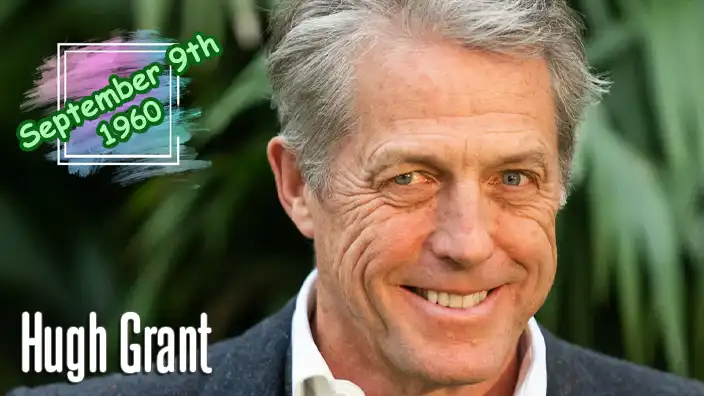
September 9, 1960, in Hammersmith, England
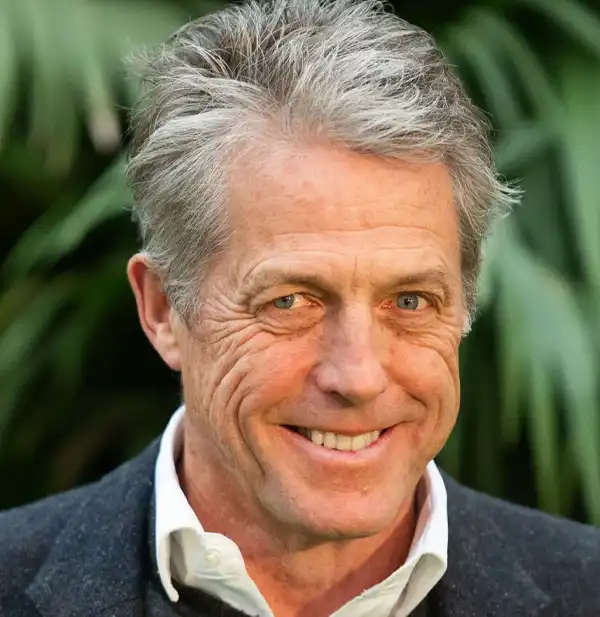
Hugh John Mungo Grant was born on September 9, 1960, in Hammersmith, London, to James Murray Grant and Fyvola Susan MacLean. His father worked as an artist and carpet salesman, while his mother was a teacher. Grant grew up in a family with strong military connections and an appreciation for art and literature. His full name, with its splendidly unexpected “Mungo,” sounds as though it ought to belong to a character in a particularly elaborate British period drama, but it is entirely genuine.
Grant attended school in London and won a scholarship to New College, Oxford, where he studied English literature. He became involved in student drama and initially considered a career in art history rather than acting. While at Oxford, he appeared in the student-produced film Privileged in 1982, directed by Michael Hoffman. The film attracted the attention of agents, and Grant eventually decided to try acting professionally. He later recalled that he had intended to give it a year, a plan that turned out to be rather optimistic once the film industry discovered his ability to look charmingly uncomfortable.
After university, Grant worked in repertory theater and took on various jobs, including writing advertising copy, while trying to establish himself as an actor. He also formed a comedy group called the Jockeys of Norfolk. These early years gave him experience in performance and comedy, although success was far from immediate. His first film roles included The Bounty and White Mischief, and he appeared in television productions such as The Last Place on Earth. He was gradually developing a reputation as a capable young actor, but the romantic-comedy phenomenon that would make him internationally famous was still some years away.
A significant breakthrough came with Maurice in 1987, directed by James Ivory and adapted from E. M. Forster’s novel. Grant played Clive Durham, a young man struggling with his sexuality and the social restrictions of Edwardian England, opposite James Wilby. The film received critical acclaim, and Grant and Wilby shared the Volpi Cup for Best Actor at the Venice Film Festival. The role demonstrated Grant’s ability to handle serious, emotionally complex material and established him as more than a promising face in British cinema.
During the late 1980s and early 1990s, Grant appeared in a variety of films, including Ken Russell’s The Lair of the White Worm, the romantic drama Impromptu, in which he portrayed composer Frédéric Chopin, and Roman Polanski’s Bitter Moon. He also appeared in The Remains of the Day and Sirens. These projects covered a broad range of styles, from historical drama to psychological thriller and eccentric horror. They also showed that Grant’s early career was considerably more varied than the romantic-comedy label that would later become attached to him.
Everything changed with Four Weddings and a Funeral in 1994. Written by Richard Curtis and directed by Mike Newell, the film starred Grant as Charles, a charming but chronically indecisive Englishman whose romantic life becomes increasingly complicated through a series of weddings and one funeral. Andie MacDowell played Carrie, the American woman who captures his attention, while the supporting cast included Kristin Scott Thomas, John Hannah, Simon Callow, and Rowan Atkinson. The film’s combination of wit, romance, and emotional sincerity became an international success, and Grant’s performance turned him into a major star. He won both a Golden Globe and a BAFTA Award for Best Actor. The role also established the familiar Hugh Grant screen persona: handsome, articulate, slightly flustered, and apparently incapable of completing a romantic sentence without first apologizing to it.
The success of Four Weddings and a Funeral opened the door to a succession of prominent roles. In 1995, Grant appeared in Sense and Sensibility, Ang Lee’s acclaimed adaptation of Jane Austen’s novel, playing Edward Ferrars opposite Emma Thompson. The film’s ensemble included Kate Winslet and Alan Rickman and received widespread critical praise. Grant also starred in Nine Months with Julianne Moore and appeared in Restoration. His career now balanced Hollywood romantic comedies with British literary adaptations, allowing him to make use of both his comic timing and his ability to portray restrained, emotionally conflicted characters.
In 1999, Grant starred opposite Julia Roberts in Notting Hill, one of the defining romantic comedies of its era. He played William Thacker, the owner of a modest travel bookshop in London’s Notting Hill neighborhood, whose ordinary life is transformed when he meets Anna Scott, an internationally famous actress. Written by Richard Curtis and directed by Roger Michell, the film combined the fantasy of an unlikely celebrity romance with the everyday awkwardness of friendship, family, and life in a London neighborhood. Grant’s performance was central to its appeal, making William’s bewilderment at suddenly dating a movie star both funny and believable. The film became a major box-office success and remains one of his most recognizable works.
Grant’s next major romantic-comedy landmark arrived with Bridget Jones’s Diary in 2001, adapted from Helen Fielding’s novel. Renée Zellweger starred as Bridget, while Grant played Daniel Cleaver, her charming, unreliable boss, and Colin Firth portrayed the more reserved Mark Darcy. Daniel was a departure from Grant’s usual sympathetic romantic lead: he was witty and attractive, but also manipulative and thoroughly unsuitable as a long-term partner. Grant clearly enjoyed the opportunity to play a man whose charm was not necessarily evidence of good character. He returned as Daniel in Bridget Jones: The Edge of Reason in 2004 and later appeared in Bridget Jones: Mad About the Boy in 2025, bringing the character back into Bridget’s life with his familiar mixture of mischief and questionable judgment.
In About a Boy in 2002, Grant played Will Freeman, a wealthy, self-absorbed bachelor whose carefully managed life is disrupted by his friendship with a young boy, played by Nicholas Hoult. Based on Nick Hornby’s novel, the film gave Grant one of his most interesting romantic-comedy-era roles, allowing him to explore a character who begins as an emotionally detached man and gradually discovers the value of human connection. The performance earned him another Golden Globe nomination and showed that his comic persona could be used to tell a story about personal growth rather than simply romantic confusion.
The same period brought Two Weeks Notice, opposite Sandra Bullock, and Love Actually in 2003. In the latter, Grant played the British Prime Minister, whose attraction to a member of his household staff creates complications both romantic and political. His dance through Downing Street became one of the film’s most memorable scenes, proving that even the highest office in the country cannot protect a man from the sudden urge to dance when nobody is supposed to be watching. The film’s large ensemble and interconnected stories helped make it a perennial holiday favorite.
Grant continued his romantic-comedy career with Music and Lyrics in 2007, opposite Drew Barrymore. He played Alex Fletcher, a former pop star attempting to revive his career by writing a song for a contemporary music sensation. The film allowed Grant to sing and perform, including the deliberately catchy fictional pop hit “Pop! Goes My Heart.” His portrayal of a once-famous musician trying to navigate a changed industry was both comic and affectionate, and the film demonstrated his willingness to make fun of the entertainment business and the peculiar indignities of celebrity.
As the years passed, Grant began moving away from the romantic-leading-man roles that had defined much of his career. He appeared in the ambitious ensemble film Cloud Atlas in 2012, playing multiple characters across different time periods and settings. The project offered an opportunity to experiment with darker and more unusual roles, and it helped mark a shift toward character acting. Grant has spoken openly about finding renewed satisfaction in playing less conventionally likable people, a development that has allowed him to explore a wider range of performances.
One of the most acclaimed examples of this reinvention came in Florence Foster Jenkins in 2016. Directed by Stephen Frears, the film starred Meryl Streep as the wealthy New York socialite and aspiring singer whose lack of musical ability was matched only by her enthusiasm. Grant played her husband and manager, St. Clair Bayfield, a man who supports and protects her while managing a complicated personal life. His performance combined humor, tenderness, and emotional restraint, earning him BAFTA and Golden Globe nominations. The role reminded audiences that Grant’s talent for portraying affection and vulnerability could be just as effective in a mature, character-driven drama as in a romantic comedy.
In 2017, Grant delivered a particularly memorable performance as Phoenix Buchanan in Paddington 2. His character, a vain and theatrical actor, becomes the film’s villain after developing an interest in a valuable pop-up book. Grant embraced the role with considerable enthusiasm, playing Buchanan as a man whose ego is almost as large as his collection of theatrical costumes. The performance received widespread praise and earned him another BAFTA nomination. It also introduced him to a new generation of viewers who may have known little about his earlier romantic-comedy career but could immediately appreciate a villain willing to commit elaborate crimes in pursuit of a comeback.
Grant’s television work also entered a new phase with A Very English Scandal in 2018. In the BBC miniseries, he portrayed Jeremy Thorpe, the former British Liberal Party leader whose political career became entangled in a major scandal. The production, directed by Stephen Frears and co-starring Ben Whishaw, received critical acclaim, and Grant earned an Emmy nomination for his performance. The role required him to portray a complex historical figure whose public charm concealed darker aspects of his private life. It was another demonstration of his ability to turn familiar qualities—politeness, wit, and social confidence—into something far more unsettling.
He followed this with The Undoing in 2020, starring opposite Nicole Kidman in the HBO psychological thriller. Grant played Jonathan Fraser, a seemingly successful and devoted husband whose life becomes the center of a murder investigation. The role relied on the audience’s familiarity with Grant’s charm, using it to create uncertainty about the character’s true nature. His performance earned another Emmy nomination and further established his reputation as an actor capable of making apparently respectable characters deeply suspicious.
Grant continued exploring unusual and villainous roles in Dungeons & Dragons: Honor Among Thieves in 2023, playing the scheming Forge Fitzwilliam, and in Wonka, where he portrayed an Oompa-Loompa opposite Timothée Chalamet. The latter role made inventive use of visual effects and Grant’s dry comic delivery, creating a character who was both tiny and thoroughly unimpressed by the world around him. He also appeared in The Regime, the political satire starring Kate Winslet, and took on a particularly sinister leading role in the horror film Heretic in 2024. As Mr. Reed, he played a seemingly polite man who traps two missionaries in a disturbing psychological ordeal. The performance earned him a Golden Globe nomination and confirmed that his later career had moved well beyond the boundaries of romantic comedy.
Outside acting, Grant has been involved in public campaigns concerning press ethics and privacy. Following the British phone-hacking scandal, he became a prominent critic of unlawful media practices and supported efforts to improve accountability in the press. He has written and spoken publicly about the issue and has been associated with the campaign group Hacked Off. His involvement reflects a more serious side of his public life, although his interviews often retain the dry humor and self-deprecating manner that have long been part of his public personality.
Grant’s personal life has also attracted considerable media attention. He had a long relationship with actress and model Elizabeth Hurley, and the two remained friends after their separation. In 2018, he married Swedish television producer Anna Eberstein. He is the father of five children and has generally sought to keep his family life more private than his professional career. Despite his reputation for playing reluctant bachelors, his life away from the screen has followed a rather different script.
Over the course of his career, Grant has received major honors including a Golden Globe Award, a BAFTA Film Award, and multiple nominations for his work in film and television. His performances have ranged from literary adaptations and romantic comedies to political drama, family entertainment, fantasy, and horror. What makes his career particularly interesting is not simply the success of his early films, but his willingness to challenge the image that made him famous. He has taken the qualities audiences associate with him and used them in new ways, turning charm into vanity, politeness into menace, and awkwardness into something considerably more complicated.
Hugh Grant remains one of Britain’s most recognizable screen performers, but his career is far more varied than the romantic-comedy label suggests. From an Oxford student who initially considered art history to an international film star and acclaimed character actor, he has followed a path marked by reinvention and a willingness to take creative risks. His birthday is an opportunity to revisit the familiar pleasures of Notting Hill and Bridget Jones’s Diary, while also appreciating the darker, stranger, and often funnier roles that have followed. The floppy-haired romantic hero may have grown into a convincing villain, but the timing, intelligence, and unmistakable Hugh Grant delivery are still very much present.