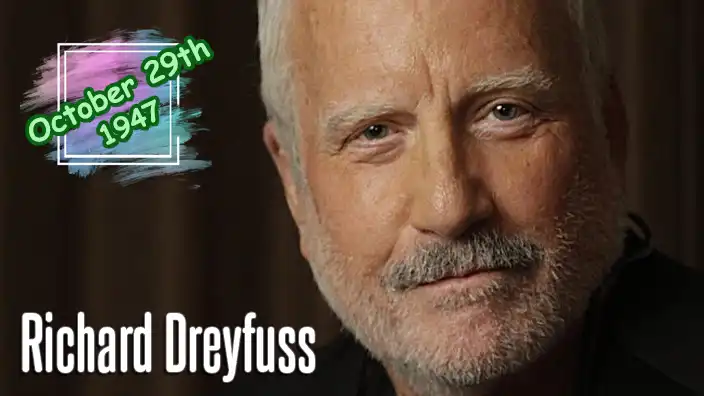
October 29, 1947, in Brooklyn, New York


Richard Dreyfuss was born Richard Stephen Dreyfus on October 29, 1947, in Brooklyn, New York, to Geraldine and Norman Dreyfus. His mother was a peace activist, while his father worked as an attorney and restaurateur. Raised in a Jewish family, Dreyfuss spent his early childhood in New York before his family relocated to California, where he developed an interest in performing. His upbringing encouraged intellectual curiosity, independence, and an appreciation for lively discussion, characteristics that would eventually become familiar elements of his screen personality. Even as a young performer, Dreyfuss demonstrated an ability to combine intelligence, nervous energy, and a certain argumentative enthusiasm, qualities that Hollywood would later discover were particularly useful when confronting sharks, aliens, and unreasonable roommates.
Dreyfuss became interested in acting during childhood and began performing at the Beverly Hills Jewish Center. His early experiences in community theater introduced him to the discipline of rehearsals, character development, and live performance. He later attended San Fernando Valley State College, now California State University, Northridge, although he did not complete a degree. During the Vietnam War, Dreyfuss registered as a conscientious objector and performed alternative service at a Los Angeles hospital. Throughout this period, he continued pursuing acting opportunities, appearing in theatrical productions and gradually developing the skills necessary for a professional career. His determination reflected a genuine commitment to acting rather than a passing interest in Hollywood celebrity.
During the 1960s, Dreyfuss began appearing in television programs, including Peyton Place, Gidget, Bewitched, and The Big Valley. These early assignments provided valuable experience in an industry where young actors frequently moved between auditions, minor roles, and temporary employment while waiting for a significant opportunity. He also appeared on stage in repertory productions and improvisational theater, developing the quick reactions and natural delivery that would later distinguish his performances. His early film credits included a brief appearance in The Graduate (1967), directed by Mike Nichols, although his contribution was hardly the sort of role that would have audiences lining up outside theaters to request autographs.
Dreyfuss achieved his first major breakthrough with George Lucas's American Graffiti (1973), a nostalgic coming-of-age comedy-drama set in California during the early 1960s. He portrayed Curt Henderson, a recent high-school graduate uncertain about leaving his hometown for college. The film followed a group of young people spending an eventful evening cruising the streets, listening to rock and roll, and confronting the uncertainties of adulthood. Appearing alongside Ron Howard, Cindy Williams, Paul Le Mat, and Charles Martin Smith, Dreyfuss delivered a performance that captured the excitement and anxiety of standing at the threshold of an unfamiliar future. American Graffiti became a major commercial and critical success, helping establish George Lucas as an important filmmaker and introducing Dreyfuss to a much wider audience.
The success of American Graffiti was followed by The Apprenticeship of Duddy Kravitz (1974), a Canadian comedy-drama directed by Ted Kotcheff and adapted from Mordecai Richler's novel. Dreyfuss portrayed Duddy Kravitz, an ambitious young man from Montreal determined to achieve financial success and social recognition. The character's relentless pursuit of opportunity frequently placed him at odds with friends, family, and his own moral judgment. Dreyfuss brought remarkable intensity to the role, balancing Duddy's charm and determination with his increasingly questionable decisions. The performance earned widespread critical attention and demonstrated that Dreyfuss could carry a demanding dramatic production as its central character.
In 1975, Dreyfuss achieved international fame with Steven Spielberg's Jaws, the suspense thriller that transformed a fictional seaside community into the last place anyone wanted to book a summer vacation. Based on Peter Benchley's bestselling novel, the film follows police chief Martin Brody, played by Roy Scheider, as he attempts to protect the residents and tourists of Amity Island from a deadly great white shark. Dreyfuss portrayed Matt Hooper, a knowledgeable marine biologist recruited to investigate the attacks. Alongside Scheider and Robert Shaw, who played the hardened shark hunter Quint, Dreyfuss formed part of one of cinema's most memorable leading trios.
Hooper's scientific expertise and occasionally argumentative personality created an entertaining contrast with Quint's practical experience and Brody's understandable reluctance to spend any unnecessary time near the ocean. Dreyfuss brought humor and nervous intelligence to the role, providing moments of comic relief within the film's escalating suspense. The production itself became famous for its technical difficulties, particularly the mechanical shark, which frequently malfunctioned during filming. These problems forced Spielberg to suggest the shark's presence through music, camera angles, and the reactions of the actors rather than constantly displaying the creature. The result was a masterclass in suspense, proving that what audiences imagine beneath the water can be considerably more frightening than what they actually see.
Jaws became a phenomenal box-office success and played a major role in establishing the modern Hollywood summer blockbuster. Its popularity transformed Spielberg into one of the industry's most sought-after directors and made Dreyfuss internationally recognizable. The film also had an unfortunate effect on beach tourism, with countless moviegoers suddenly discovering that swimming pools were perfectly respectable alternatives to the ocean. For Dreyfuss, the role of Matt Hooper became one of his most enduring performances, demonstrating his ability to hold his own alongside established actors while contributing humor, intelligence, and emotional credibility to an extraordinary adventure.
Dreyfuss reunited with Spielberg for Close Encounters of the Third Kind (1977), a science-fiction drama exploring humanity's first meaningful contact with extraterrestrial visitors. He portrayed Roy Neary, an ordinary electrical lineman whose encounter with a mysterious unidentified flying object transforms his life. Unable to explain what he has witnessed, Roy becomes increasingly obsessed with strange images and an overwhelming desire to understand their significance. His behavior places enormous strain on his family, particularly as he begins constructing elaborate models of a mysterious mountain. Dreyfuss captured the character's confusion, fascination, and emotional instability, making Roy's extraordinary experiences believable despite the film's spectacular supernatural premise.
Close Encounters of the Third Kind became another major success and demonstrated Spielberg's ability to combine science-fiction spectacle with intimate human storytelling. Unlike many earlier films that portrayed extraterrestrial visitors primarily as dangerous invaders, Close Encounters approached the possibility of alien contact with curiosity, wonder, and a sense of discovery. Dreyfuss's performance helped establish this emotional perspective, portraying a man whose fascination with the unknown gradually overwhelms his ordinary responsibilities. The film's memorable musical communication sequence and spectacular visual effects became important landmarks in science-fiction cinema. It also established that building a mountain out of mashed potatoes might indicate something considerably more interesting than dissatisfaction with dinner.
That same year, Dreyfuss starred opposite Marsha Mason in The Goodbye Girl (1977), a romantic comedy written by Neil Simon and directed by Herbert Ross. He portrayed Elliot Garfield, an aspiring actor who unexpectedly finds himself sharing a New York apartment with a struggling dancer and her young daughter. The arrangement begins with mutual irritation, misunderstandings, and a remarkable lack of enthusiasm for compromise. Gradually, however, the characters develop affection and understanding, creating a romantic story filled with Simon's characteristic wit and emotional warmth. Dreyfuss delivered a performance that combined comic timing, vulnerability, and an appealingly exasperating personality.
His work in The Goodbye Girl earned him the Academy Award for Best Actor at the 1978 ceremony, along with a Golden Globe Award for Best Actor in a Motion Picture – Musical or Comedy. He also received the BAFTA Award for Best Actor for the performance. The Oscar victory made Dreyfuss the youngest recipient of the Best Actor award at that time, a record that remained intact until Adrien Brody won for The Pianist in 2003. The achievement represented an extraordinary milestone in a career that had progressed from small television appearances to international recognition in little more than a decade. It also confirmed that Dreyfuss did not require a mechanical shark or an extraterrestrial spacecraft to command an audience's attention.
Following these successes, Dreyfuss appeared in The Big Fix (1978), portraying Moses Wine, a former political activist turned private investigator who becomes involved in a complicated mystery. He also starred in The Competition (1980), a romantic drama set within the demanding world of classical piano competitions, and Whose Life Is It Anyway? (1981), a serious drama examining medical ethics, personal autonomy, and the rights of a severely injured man. These films demonstrated his willingness to explore unconventional subjects and emotionally demanding characters, although not every production achieved the commercial success of his earlier blockbusters.
During the early 1980s, Dreyfuss experienced significant personal difficulties involving substance abuse, which affected his professional career and public reputation. Following a drug-related automobile accident in 1982, he entered treatment and began working toward recovery. He later spoke openly about his struggles with addiction and the importance of addressing personal problems rather than allowing them to destroy his life. This period represented a difficult chapter in his career, but it also preceded a professional resurgence that would introduce him to new audiences and demonstrate his continuing abilities as an actor.
Dreyfuss returned to prominence with Down and Out in Beverly Hills (1986), directed by Paul Mazursky and starring Nick Nolte and Bette Midler. He portrayed Dave Whiteman, a wealthy Beverly Hills businessman whose comfortable existence is disrupted when a homeless man enters his household. The film used comedy to examine materialism, privilege, and the contradictions of affluent American society. Dreyfuss's performance combined arrogance, insecurity, and comic desperation, allowing audiences to laugh at a character whose carefully organized world becomes increasingly chaotic. The film's success helped reestablish him as a major Hollywood performer.
That same year, Dreyfuss appeared in Stand by Me (1986), directed by Rob Reiner and adapted from Stephen King's novella The Body. He portrayed the adult version of Gordie Lachance, who narrates the story of a childhood journey undertaken by four friends in rural Oregon. Although Dreyfuss appeared primarily as the narrator and in framing scenes, his contribution helped establish the film's reflective tone. The story's exploration of friendship, growing up, loss, and the passage of time resonated with audiences and critics, eventually becoming one of the most beloved coming-of-age films of the decade. Dreyfuss's narration provided the perspective of an adult looking back upon a formative childhood experience with affection and regret.
In 1987, Dreyfuss starred alongside Emilio Estevez in Stakeout, an action comedy directed by John Badham. He portrayed Detective Chris Lecce, a police officer assigned to observe a woman whose former boyfriend has escaped from prison. The surveillance operation becomes complicated when Chris develops romantic feelings for the woman, played by Madeleine Stowe. The film combined police action, romance, and humor, with Dreyfuss and Estevez developing an entertaining partnership built upon contrasting personalities and frequent verbal disagreements. Stakeout became a commercial success and later produced a sequel, Another Stakeout (1993).
Dreyfuss continued exploring comedy with Tin Men (1987), directed by Barry Levinson, in which he starred opposite Danny DeVito as rival aluminum-siding salesmen in 1960s Baltimore. The film portrayed two stubborn businessmen whose escalating feud becomes increasingly ridiculous, demonstrating the destructive potential of wounded pride and professional competition. He also appeared in Moon Over Parador (1988), a political comedy involving an American actor recruited to impersonate a deceased Latin American dictator. These projects showcased Dreyfuss's ability to portray characters whose confidence frequently exceeds their judgment, often producing spectacularly entertaining consequences.
In 1989, Dreyfuss reunited with Steven Spielberg for Always, a romantic fantasy inspired by the 1943 film A Guy Named Joe. He portrayed Pete Sandich, an aerial firefighter whose death during a dangerous mission leads to an unusual supernatural assignment. The film starred Holly Hunter and John Goodman, with Audrey Hepburn appearing in her final film role. Although Always did not achieve the enormous popularity of Dreyfuss's earlier Spielberg collaborations, it offered a more sentimental exploration of love, sacrifice, and the difficulty of letting go. The production also demonstrated the continuing professional relationship between Dreyfuss and the director who had helped establish his international reputation.
One of Dreyfuss's most memorable comedic performances came in What About Bob? (1991), directed by Frank Oz and starring Bill Murray. Dreyfuss portrayed Dr. Leo Marvin, a successful psychiatrist whose peaceful family vacation is disrupted by Bob Wiley, an exceptionally dependent patient played by Murray. Bob's increasingly intrusive behavior gradually drives the normally composed psychiatrist toward complete emotional collapse. The comedy depends upon the contrast between Murray's cheerful persistence and Dreyfuss's mounting frustration, with both actors delivering performances that turn an ordinary doctor-patient relationship into a spectacular disaster. The film became a popular comedy and remains particularly memorable for demonstrating that even the most experienced mental health professional might eventually require a vacation from his vacation.
Dreyfuss appeared in several notable films during the early 1990s, including Once Around (1991), Lost in Yonkers (1993), and Silent Fall (1994). He also served as an executive producer of Quiz Show (1994), directed by Robert Redford, which examined the television quiz-show scandals of the 1950s. His involvement in these productions reflected an expanding interest in storytelling beyond acting, particularly projects examining complicated human relationships and ethical questions. By this stage, Dreyfuss had developed a reputation as a performer comfortable moving between broad comedy, serious drama, and character-driven storytelling.
In 1995, Dreyfuss delivered one of his most celebrated performances in Mr. Holland's Opus, directed by Stephen Herek. He portrayed Glenn Holland, a talented musician and aspiring composer who accepts a position teaching music at an Oregon high school while hoping to complete a major symphonic composition. Initially regarding teaching as a temporary occupation, Holland gradually discovers that his influence upon generations of students may be more meaningful than the musical masterpiece he originally intended to create. The film follows his professional and personal life across several decades, exploring the sacrifices, frustrations, and unexpected rewards associated with education.
Dreyfuss brought considerable emotional depth to Glenn Holland, portraying a man whose dreams evolve as he confronts the responsibilities of marriage, fatherhood, and teaching. His relationship with his deaf son, Cole, becomes a particularly important part of the story, challenging Holland's assumptions about communication, music, and personal fulfillment. The film also celebrates the lasting influence of dedicated teachers, demonstrating that their greatest achievements may not always be measured through examinations, awards, or public recognition. Dreyfuss's performance earned him another Academy Award nomination for Best Actor and a Golden Globe nomination, reinforcing his reputation as one of Hollywood's most accomplished dramatic performers.
That same year, Dreyfuss appeared in The American President (1995), directed by Rob Reiner and written by Aaron Sorkin. He portrayed Senator Bob Rumson, a political opponent of President Andrew Shepherd, played by Michael Douglas. The film combined romantic comedy with political drama, examining the challenges of maintaining a personal relationship while occupying the nation's highest office. Dreyfuss brought sharp intelligence and considerable antagonistic energy to his role, creating a convincing political adversary whose public speeches and strategic maneuvering complicated the president's professional and romantic life.
Dreyfuss continued working in film and television throughout the following decades, appearing in productions including James and the Giant Peach (1996), for which he provided the voice of the Centipede, Poseidon (2006), and W. (2008), Oliver Stone's biographical drama about President George W. Bush. In W., Dreyfuss portrayed Vice President Dick Cheney, bringing his characteristic intensity to a politically significant figure. He also appeared in the action comedy RED (2010), alongside Bruce Willis, Morgan Freeman, John Malkovich, and Helen Mirren, demonstrating that his ability to play complicated and occasionally troublesome characters remained firmly intact.
His television work included portraying financier Meyer Lansky in Lansky (1999), Secretary of State Alexander Haig in The Day Reagan Was Shot (2001), and Bernie Madoff in the ABC miniseries Madoff (2016). These roles allowed Dreyfuss to explore historical figures whose personalities, ambitions, and decisions influenced significant events. He also starred in the CBS drama The Education of Max Bickford (2001–2002), portraying a college professor navigating professional and personal challenges. His performance earned recognition from the Screen Actors Guild Awards, illustrating his ability to bring the same intensity to television that had characterized his film career.
Outside acting, Dreyfuss has devoted considerable attention to civic education and the importance of understanding American democracy. He founded the Dreyfuss Civics Initiative, an organization intended to encourage education about constitutional principles, government institutions, and responsible citizenship. His interest in civics reflects a longstanding concern that many Americans lack sufficient understanding of the political system and their responsibilities within it. Dreyfuss has argued that democratic institutions depend upon an informed population capable of participating thoughtfully in public affairs. His advocacy has occasionally generated debate, but it demonstrates an interest in issues extending beyond the entertainment industry.
Dreyfuss has also pursued writing, including collaborating with science-fiction author Harry Turtledove on the alternate-history novel The Two Georges (1996). The story imagines a world in which the American Revolution never occurred and North America remained part of the British Empire. In 2022, he published One Thought Scares Me..., a book addressing civic education and the importance of teaching democratic principles to future generations. These projects reflect his intellectual curiosity and willingness to explore subjects beyond the familiar boundaries of film and television.
His personal life has included three marriages and three children. He married writer and producer Jeramie Rain in 1983, and they had three children before divorcing in 1995. His second marriage, to Janelle Lacey, began in 1999 and ended in divorce in 2005. In 2006, he married Svetlana Erokhin. Dreyfuss has also spoken publicly about living with bipolar disorder and his experiences with addiction recovery, contributing to broader conversations about mental health and the difficulties that can accompany professional success. His willingness to discuss personal struggles has provided insight into the complicated relationship between celebrity, emotional well-being, and public expectations.
Throughout his career, Dreyfuss has received numerous honors recognizing his contributions to entertainment. In addition to his Academy Award, Golden Globe, and BAFTA victories, he received a star on the Hollywood Walk of Fame in 1996. His filmography includes some of the most influential productions of modern American cinema, particularly during the transformative period of the 1970s when directors such as Steven Spielberg, George Lucas, and Martin Scorsese helped reshape Hollywood storytelling. Dreyfuss's performances contributed to that transformation by demonstrating that leading men did not necessarily need conventional heroic appearances or personalities. Intelligence, vulnerability, humor, and an occasionally spectacular temper could be equally compelling.
Richard Dreyfuss has built an extraordinary career portraying characters who frequently find themselves overwhelmed by circumstances beyond their control. Whether confronting a deadly shark, pursuing extraterrestrial visitors, navigating romantic complications, struggling with an impossible patient, or inspiring generations of students, he has brought distinctive energy and emotional credibility to his performances. His greatest roles combine humor with humanity, allowing audiences to recognize something familiar even within extraordinary situations. From American Graffiti and Jaws to The Goodbye Girl, Close Encounters of the Third Kind, and Mr. Holland's Opus, his contributions have left a lasting impression on American cinema. And considering everything his characters have endured, perhaps his greatest achievement is that he has occasionally managed to finish a movie without being chased, shouted at, or driven completely around the bend.