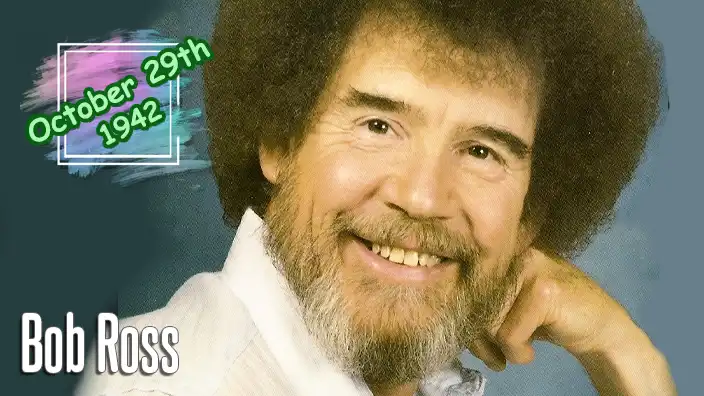
October 29, 1942, in Daytona Beach, Florida
 July 4, 1995, in Orlando, Florida


Bob Ross was born Robert Norman Ross on October 29, 1942, in Daytona Beach, Florida, to Jack and Ollie Ross. His father worked as a carpenter, while his mother was a waitress, and the family raised Bob in Orlando. Long before he became one of television's most recognizable personalities, Ross developed an appreciation for nature, wildlife, and the simple pleasures of the outdoors. His childhood was far removed from the television studios and international recognition that would eventually define his career. Instead, he grew up in a working-class household where practical skills, hard work, and an appreciation for the natural world formed important parts of everyday life. These early influences would eventually emerge in his paintings, which frequently celebrated forests, mountains, rivers, and the peaceful beauty of untouched landscapes.
As a youngster, Ross developed a particular affection for animals, often caring for injured or abandoned wildlife. His unusual collection of temporary companions reportedly included squirrels, armadillos, snakes, and even alligators, suggesting that his idea of a suitable household pet was considerably more adventurous than most people's. This fascination with animals remained with him throughout his life, and he occasionally introduced rescued creatures during episodes of The Joy of Painting. His gentle handling of wildlife reflected the same patience and affection that characterized his television personality. Long before audiences became familiar with his happy little trees, Ross had already developed a reputation for taking an interest in creatures that other people might prefer to observe from a safe distance.
Ross left school during the ninth grade and began working with his father in carpentry. During this period, he suffered an accident involving a saw that resulted in the loss of part of his left index finger. Although the injury might have complicated certain activities, it did not prevent him from developing the remarkable painting skills that later made him famous. Indeed, viewers watching his television demonstrations would rarely have noticed the missing portion of his finger, particularly because he generally held his painting palette in his left hand. The experience was one of several early challenges that helped shape his practical outlook and determination to develop a satisfying professional life.
In 1961, Ross enlisted in the United States Air Force, beginning a military career that would last twenty years. Initially trained as a medical records technician, he eventually rose to the rank of master sergeant, serving in positions that required discipline, organization, and responsibility for other personnel. His military service included an assignment at Eielson Air Force Base near Fairbanks, Alaska, where the extraordinary natural scenery made a lasting impression upon him. The towering mountains, snow-covered forests, and dramatic skies of Alaska would eventually become familiar subjects in his paintings. For a young man raised in Florida, the Alaskan landscape offered a spectacular change of scenery, although the winter temperatures probably required a rather different wardrobe.
During his military service, Ross developed an interest in painting as a way to relax after the demands of his daily responsibilities. He attended an art class at a United Service Organizations club in Anchorage, where he began exploring oil painting techniques. His early artistic efforts were influenced by the natural landscapes surrounding him, particularly the mountains and forests that would later become central features of his television demonstrations. Ross also supplemented his military income by painting Alaskan landscapes on gold-panning tins and selling them to tourists. These small works allowed him to practice his skills while developing an understanding of how quickly he could produce attractive paintings. Apparently, even before television entered the picture, Ross had discovered that tourists were perfectly happy to purchase a mountain they could fit into their luggage.
An important influence on Ross's artistic development was the German-born painter and television instructor William Alexander, who hosted The Magic of Oil Painting. Alexander popularized a rapid painting technique known as wet-on-wet, or alla prima, in which layers of oil paint are applied before the previous layers have dried. Unlike traditional methods that may require considerable drying time between stages, wet-on-wet painting allows an artist to complete a picture in a single session. Ross recognized the technique's potential for producing landscapes efficiently and began studying Alexander's methods. He eventually developed his own approach, combining rapid brushwork, specialized painting tools, and simple instructions that ordinary viewers could follow without extensive artistic training.
The wet-on-wet technique became the foundation of Ross's professional identity. By applying a thin layer of specially prepared liquid base to the canvas, he could blend colors directly on the painting surface, creating skies, mountains, clouds, trees, and reflections with remarkable speed. His preferred equipment included large landscape brushes, fan brushes, palette knives, and a relatively limited selection of oil paints. Rather than carefully drawing every detail beforehand, Ross built his landscapes through a sequence of confident movements, allowing shapes and textures to emerge naturally. His approach made painting appear accessible, replacing the intimidating atmosphere sometimes associated with formal art instruction with an encouraging invitation to experiment.
Ross's military career also influenced the personality that audiences would later associate with him. As a senior noncommissioned officer, he was responsible for maintaining discipline and ensuring that personnel followed military procedures. He later recalled that his duties frequently required him to raise his voice and enforce regulations, responsibilities he did not particularly enjoy. After leaving the Air Force, he resolved to adopt a gentler approach to life, preferring encouragement and patience over confrontation. The contrast between the demanding master sergeant and the softly spoken television painter became one of the most fascinating aspects of his biography. The man who once ordered airmen to clean their quarters would eventually become famous for reassuring millions of viewers that their crooked trees were perfectly acceptable.
Ross retired from the Air Force in 1981 and devoted himself to painting and teaching. He initially worked with William Alexander's painting instruction business, traveling to demonstrate techniques and introduce students to wet-on-wet oil painting. During this period, he met Annette Kowalski, who attended one of his classes while dealing with the emotional aftermath of a family tragedy. Kowalski was deeply impressed by Ross's calming personality and teaching ability, recognizing that his approach could appeal to a much wider audience. Together with her husband, Walt Kowalski, she helped Ross establish a business dedicated to painting instruction, art supplies, and educational materials. Their partnership would eventually lead to one of the most recognizable instructional programs in television history.
In 1983, The Joy of Painting premiered on American public television, introducing audiences to a soft-spoken instructor with an enormous curly hairstyle, a friendly smile, and an extraordinary ability to produce landscapes in approximately half an hour. The series was produced at WIPB in Muncie, Indiana, and distributed through the public television system. Its straightforward format featured Ross standing beside a blank canvas, explaining his materials, and gradually creating a complete painting while speaking directly to viewers. There were no elaborate special effects, dramatic competitions, or celebrity judges. The principal attraction was simply a man with a paintbrush explaining how to make a mountain look convincing without becoming unnecessarily distressed about the details.
Each episode of The Joy of Painting followed a reassuringly familiar pattern. Ross began by introducing the colors he would use, then covered portions of the canvas with broad strokes to establish the sky, water, or background. Mountains emerged through carefully controlled palette-knife movements, while clouds appeared through gentle blending and sweeping brushwork. Trees, bushes, rocks, and reflections gradually completed the scene, often accompanied by his cheerful observations about the personalities of the landscape's imaginary inhabitants. His descriptions transformed ordinary artistic elements into friendly companions, creating an atmosphere in which even a solitary tree seemed to deserve a neighbor.
One of Ross's most recognizable expressions involved his affection for happy little trees. Rather than presenting trees as complicated collections of branches, shadows, and foliage, he encouraged viewers to build them through simple movements and variations in pressure. His cheerful language helped remove the fear of making mistakes, particularly among beginners who might otherwise feel intimidated by a blank canvas. Ross frequently reminded viewers that artistic decisions belonged to them, encouraging individual interpretation rather than demanding exact copies of his demonstrations. If a mountain looked different from his example, that was perfectly acceptable. If a tree leaned slightly to one side, perhaps it simply had an interesting personality.
Another central element of Ross's teaching philosophy was his belief in happy accidents. He understood that beginners frequently become discouraged when a brushstroke produces an unexpected result or a carefully planned shape fails to appear. Rather than treating such moments as failures, he encouraged students to incorporate them into the painting and discover new possibilities. A misplaced patch of color might become a bush, an irregular line could transform into a rocky shoreline, and an accidental shadow might provide additional depth. This approach encouraged creativity and reduced the pressure to achieve perfection. It also offered a useful philosophy for everyday life, although accidentally spilling coffee across the kitchen table remains considerably harder to describe as an artistic breakthrough.
Ross's distinctive appearance became almost as famous as his painting technique. His large, rounded hairstyle was the result of a permanent wave, originally adopted as a practical way to reduce the expense of regular haircuts while he was establishing his painting business. Ironically, the hairstyle became so closely associated with his public identity that changing it became professionally inconvenient. The image of Ross with his enormous curls, neatly trimmed beard, and casual clothing appeared on promotional materials, instructional products, and eventually an extraordinary assortment of merchandise. What began as a money-saving decision became one of the most recognizable hairstyles in American television history. Few people have ever managed to turn avoiding the barber into such a successful branding strategy.
The success of The Joy of Painting depended heavily upon Ross's personality. His quiet voice, gentle humor, and unhurried delivery created an atmosphere unlike most television programming. Viewers did not need to understand artistic terminology or possess expensive equipment to appreciate the program. Many watched simply because they enjoyed his reassuring manner and the gradual transformation of a blank canvas into a peaceful landscape. The program offered an escape from the noise and complications of everyday life, replacing arguments and dramatic confrontations with mountains, trees, streams, and friendly clouds. Ross demonstrated that television could hold an audience's attention without shouting, manufactured conflict, or constant excitement.
One of the show's most entertaining traditions involved cleaning paintbrushes. After rinsing a brush in odorless thinner, Ross would strike it against the legs of his easel or a nearby container to remove excess liquid. He jokingly referred to this vigorous cleaning routine as beating the devil out of the brush, often breaking into a delighted grin as he performed the familiar ritual. The contrast between his otherwise gentle personality and the enthusiastic treatment of his painting equipment became a favorite moment for viewers. It was perhaps the only occasion during an episode when the quiet instructor appeared genuinely determined to give something a thorough hiding.
Although Ross made painting appear effortless, his demonstrations required considerable preparation and technical skill. He typically created a reference painting before recording an episode, allowing him to plan the composition and anticipate the steps needed to complete the televised version. During filming, he produced another painting while explaining his techniques to viewers. A third, more detailed version was often prepared afterward for instructional books and photographic reference. This method ensured consistency while preserving the relaxed atmosphere that audiences enjoyed. His apparent spontaneity was therefore supported by careful planning, extensive practice, and an understanding of how to communicate complicated techniques through simple instructions.
Over its eleven-year television run, The Joy of Painting produced 31 seasons and 403 episodes, establishing itself as one of the most enduring instructional art programs in American broadcasting. The series reached millions of viewers through public television stations and became internationally recognized through additional broadcasts and educational distribution. Ross's popularity helped support a business offering painting supplies, instructional books, videos, workshops, and certified instructors trained in his methods. His approach created opportunities for people who had previously believed that painting required years of formal education or exceptional natural talent.
Ross himself did not receive a conventional salary for hosting The Joy of Painting. Instead, the program helped promote his instructional business and related products, creating a commercial foundation for his teaching activities. This arrangement reflected the educational purpose of the series and its relationship with public television. His books and painting supplies allowed interested viewers to explore the techniques demonstrated on screen, while workshops offered more direct instruction. The resulting business became highly successful, although Ross's television personality remained focused on encouragement rather than aggressive salesmanship.
Despite his popularity, Ross's artistic approach was not universally admired within the professional art world. Some critics regarded his landscapes as formulaic or overly sentimental, arguing that his rapid methods placed greater emphasis on decorative results than artistic experimentation. Ross, however, was primarily concerned with making painting accessible to ordinary people rather than satisfying the expectations of galleries or academic institutions. His objective was to encourage creativity and provide viewers with a rewarding activity they could enjoy at home. The distinction between fine art and recreational painting mattered considerably less to someone who had never previously believed they could produce a recognizable landscape.
His paintings frequently featured mountains, lakes, forests, waterfalls, cabins, and dramatic skies, subjects that reflected his affection for natural scenery. Alaska remained a particularly important influence, with its snow-covered peaks and wilderness landscapes appearing repeatedly throughout his work. Ross often invented his compositions rather than copying specific locations, creating imaginary environments that combined familiar natural features into peaceful scenes. His paintings rarely included people, busy streets, or modern buildings, emphasizing instead the tranquility of landscapes seemingly untouched by the complications of contemporary society. A typical Bob Ross painting offered a place where the weather was agreeable, the mountains were magnificent, and nobody had remembered to install a parking meter.
Ross's affection for animals occasionally interrupted the painting lessons in the most delightful ways. He sometimes introduced rescued squirrels and other creatures to viewers, speaking about them with the same warmth he displayed toward his imaginary landscape inhabitants. One particularly memorable squirrel, Peapod, became a familiar part of the show's personality. These appearances revealed his genuine interest in wildlife and reinforced the connection between his artistic subjects and his appreciation of nature. They also demonstrated that a television program could successfully combine painting instruction with an unexpected visit from a small animal that had absolutely no intention of following the script.
Ross's family life included three marriages. His first marriage, to Vivian Ridge, ended in divorce, while his second wife, Jane, died of cancer in 1992. He married Lynda Brown in 1995. His son Steve Ross also became an accomplished painter and appeared on The Joy of Painting, demonstrating techniques and occasionally presenting lessons. Steve shared his father's interest in landscape painting and helped continue the family's association with art instruction. These family connections provided another dimension to Ross's life, although he generally maintained considerable privacy regarding his personal affairs.
During the early 1990s, Ross experienced serious health problems, including lymphoma, a cancer affecting the lymphatic system. His illness eventually forced him to reduce his professional activities, and production of The Joy of Painting concluded in 1994. Despite his declining health, the program's extensive collection of recorded episodes ensured that his teaching would remain available to viewers. Bob Ross died on July 4, 1995, in Orlando, Florida, leaving behind an extraordinary legacy of instructional television, artwork, and encouragement. His death brought an end to a remarkable career, but the reassuring voice and familiar landscapes that had made him famous continued reaching audiences through reruns and recordings.
Following his death, The Joy of Painting remained popular on public television, introducing his methods to viewers who had never watched the original broadcasts. The growth of online video platforms eventually brought an entirely new audience to his work, with episodes appearing on YouTube and other digital services. Younger generations discovered the same gentle humor and accessible instruction that had attracted viewers during the 1980s and 1990s. His calm delivery also appealed to people seeking relaxing entertainment, making the program popular among viewers who enjoyed watching the painting process even if they had no intention of purchasing a canvas.
Ross became an unexpected cultural phenomenon in the digital age, inspiring internet memes, affectionate parodies, clothing, collectibles, and countless references in popular entertainment. His distinctive hairstyle and gentle expressions became instantly recognizable symbols of creativity and reassurance. Online communities celebrated his optimistic philosophy, while artists and hobbyists shared paintings inspired by his methods. The continued popularity of his television appearances demonstrated that his appeal extended beyond nostalgia. In an increasingly noisy world, a friendly instructor quietly explaining how to paint a tree offered something refreshingly uncomplicated.
His influence also extended into discussions about creativity, education, and emotional well-being. Many viewers described his programs as comforting or relaxing, while others credited him with inspiring their first attempts at painting. His emphasis on experimentation and acceptance encouraged people to approach creative activities without excessive concern about mistakes or professional standards. Although Ross was not a mental health professional and did not present his program as therapy, the calming atmosphere of his lessons became an important part of their appeal. His philosophy suggested that creativity could provide satisfaction regardless of whether the finished painting ever appeared in a gallery.
In 2021, the documentary Bob Ross: Happy Accidents, Betrayal & Greed examined his career, personal relationships, and disputes involving the commercial rights to his name and artistic legacy. The film brought renewed attention to the business arrangements surrounding his work, particularly disagreements between members of his family and former business associates. These controversies revealed a more complicated story behind the cheerful television personality, illustrating the challenges that can arise when artistic achievement becomes a valuable commercial property. Nevertheless, the disputes did not diminish the affection many viewers continued to feel for Ross or the encouragement they had received from his programs.
In 2022, Ross was inducted into the Florida Artists Hall of Fame, recognizing his contributions to the state's artistic and cultural heritage. The honor acknowledged his role in encouraging millions of people to explore painting and his continuing influence upon art education and popular culture. Although his television work was produced in Indiana and his landscapes frequently reflected the scenery of Alaska, his Florida roots remained an important part of his personal history. The recognition demonstrated that his achievements extended beyond television entertainment to include a lasting contribution to public appreciation of the arts.
Bob Ross's enduring popularity rests upon a remarkably simple idea: creativity should be enjoyable rather than intimidating. He approached painting with patience, humor, and a genuine belief that ordinary people could learn to produce something beautiful. His landscapes offered peaceful escapes, but his greatest achievement may have been convincing viewers to attempt something they previously considered beyond their abilities. Through hundreds of television episodes, he transformed the blank canvas from an object of anxiety into an invitation to experiment, explore, and discover.
The legacy of Bob Ross continues through his paintings, instructional recordings, certified instructors, and the countless people who have picked up a brush because of his encouragement. His influence reaches far beyond the landscapes he created, reflecting a philosophy built upon kindness, patience, and the acceptance of imperfection. Whether remembered for his magnificent hairstyle, his happy little trees, his enthusiastic brush cleaning, or his extraordinary ability to make painting seem effortless, Ross remains one of television's most warmly remembered personalities. And somewhere, on a canvas that began as a complete disaster, there is probably a slightly crooked tree standing proudly beside a mountain, looking perfectly content with the world. Bob would undoubtedly have approved.