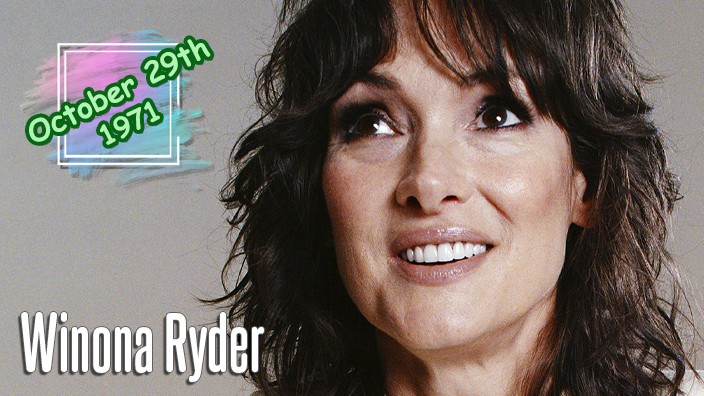
October 29, 1971, in Winona, Minnesota


Winona Ryder was born Winona Laura Horowitz on October 29, 1971, in Winona, Minnesota, a town that conveniently supplied her with a first name before she had any say in the matter. Her parents, Michael Horowitz and Cynthia Palmer, were writers and editors associated with the counterculture and literary communities of the 1960s and 1970s. Her father worked as an author, publisher, and bookseller, while her mother was involved in writing and video production. Growing up surrounded by books, unconventional thinkers, and creative personalities, Ryder developed an early appreciation for literature, film, and the arts. Her godfather was the celebrated psychologist and writer Timothy Leary, which gives some indication that her childhood was hardly a conventional suburban affair.
During her childhood, Ryder's family lived for several years in a rural commune in Northern California, where electricity and television were limited or unavailable. Rather than spending her evenings watching sitcoms, she discovered literature and developed an interest in storytelling. The family later moved to Petaluma, California, where Ryder experienced bullying at school, partly because of her distinctive appearance and short haircut. Acting provided an outlet for her creativity, and she began studying at the American Conservatory Theater in San Francisco. Her early experiences helped shape the sensitivity and individuality that would eventually become defining characteristics of her screen performances.
Ryder made her feature-film debut in Lucas (1986), a coming-of-age drama starring Corey Haim, Charlie Sheen, and Kerri Green. Although her role was relatively small, the film introduced audiences to an actress capable of conveying vulnerability and intelligence without relying on exaggerated performances. She followed it with Square Dance (1987), appearing alongside Rob Lowe and Jason Robards. These early projects demonstrated her potential, but her breakthrough was just around the corner, accompanied by striped suits, supernatural mischief, and a director with a particularly unusual imagination.
In 1988, director Tim Burton cast Ryder as Lydia Deetz in Beetlejuice, a supernatural comedy starring Michael Keaton, Alec Baldwin, and Geena Davis. Lydia was a gloomy, intelligent teenager fascinated by death and the paranormal, making her considerably more comfortable with the ghosts inhabiting her new home than with most of the living people around her. Ryder's deadpan delivery, distinctive appearance, and ability to balance humor with genuine emotion helped make Lydia one of the film's most memorable characters. Beetlejuice became a major success and established Ryder as a recognizable young Hollywood star. It also proved that dressing entirely in black could be a perfectly reasonable career decision.
The following year, Ryder starred in Heathers (1989), a dark comedy that transformed the familiar American high-school movie into a savage satire of popularity, social hierarchy, and teenage cruelty. Playing Veronica Sawyer opposite Christian Slater, Ryder portrayed a student increasingly horrified by the behavior of her fashionable but vicious classmates and her dangerous boyfriend. Although Heathers was not a major box-office success upon its original release, it developed a devoted following and became a cult classic. Ryder's performance captured the frustration, sarcasm, and moral confusion of adolescence, helping establish her reputation for choosing unconventional roles rather than simply following Hollywood's preferred formula for young actresses.
Her collaboration with Tim Burton continued in Edward Scissorhands (1990), a romantic fantasy starring Johnny Depp as a gentle artificial man whose hands consist of sharp metal blades. Ryder played Kim Boggs, a young woman who gradually recognizes the kindness beneath Edward's frightening appearance. The film combined fairy-tale romance with social commentary, exploring prejudice, conformity, and the treatment of outsiders. Ryder's sympathetic performance helped ground the extraordinary story in recognizable human emotions. Her off-screen relationship with Depp also attracted considerable media attention, making them one of Hollywood's most discussed young couples during the early 1990s.
Ryder demonstrated her versatility in Mermaids (1990), appearing alongside Cher and Christina Ricci. She played Charlotte Flax, a teenager struggling with religious aspirations, romantic curiosity, and the unpredictable behavior of her free-spirited mother. The performance earned Ryder a Golden Globe nomination for Best Supporting Actress and demonstrated that she could hold her own alongside established performers. She subsequently appeared in Francis Ford Coppola's Bram Stoker's Dracula (1992), portraying Mina Murray in an elaborate Gothic adaptation featuring Gary Oldman, Anthony Hopkins, and Keanu Reeves. The film allowed Ryder to explore another emotionally demanding character within a visually extravagant production.
One of Ryder's most acclaimed performances came in Martin Scorsese's The Age of Innocence (1993), adapted from Edith Wharton's Pulitzer Prize-winning novel. Playing May Welland opposite Daniel Day-Lewis and Michelle Pfeiffer, Ryder portrayed a seemingly innocent young woman navigating the restrictive social conventions of nineteenth-century New York. Her carefully controlled performance revealed layers of intelligence and determination beneath May's polished manners. Ryder received the Golden Globe Award for Best Supporting Actress and an Academy Award nomination in the same category, confirming that her dramatic abilities extended far beyond teenage rebellion and supernatural adventures.
Ryder followed that achievement with Little Women (1994), directed by Gillian Armstrong and adapted from Louisa May Alcott's beloved novel. She portrayed Jo March, the independent, ambitious, and outspoken aspiring writer whose determination to build a meaningful life challenges the expectations placed upon women in nineteenth-century America. Appearing alongside Susan Sarandon, Kirsten Dunst, Claire Danes, and Christian Bale, Ryder delivered a performance that captured Jo's imagination, stubbornness, affection, and occasional spectacular lack of patience. The role earned her an Academy Award nomination for Best Actress and remains among her most celebrated performances. For audiences who had previously associated Ryder with black clothing and haunted houses, Jo March offered a reminder that rebellion could also involve books, ink, and a thoroughly determined personality.
Throughout the remainder of the 1990s, Ryder continued appearing in films that combined emotional complexity with distinctive storytelling. She starred in Reality Bites (1994), directed by Ben Stiller, portraying a young filmmaker attempting to navigate friendship, romance, and professional uncertainty after college. The film became closely associated with Generation X and its anxieties about adulthood. Ryder also appeared in How to Make an American Quilt (1995), The Crucible (1996), and Alien Resurrection (1997), moving comfortably between intimate drama, historical conflict, and science-fiction horror. Her willingness to experiment with different genres made her filmography unusually varied, even by Hollywood standards.
In Girl, Interrupted (1999), Ryder played Susanna Kaysen, a young woman admitted to a psychiatric hospital during the 1960s. Based on Kaysen's memoir, the film examined mental illness, identity, friendship, and the complicated process of understanding oneself. Ryder also served as an executive producer, demonstrating an interest in shaping projects beyond her performances. The ensemble included Angelina Jolie, Brittany Murphy, Whoopi Goldberg, and Vanessa Redgrave. Jolie received an Academy Award for her supporting performance, while Ryder's restrained portrayal provided the emotional center of the story.
Ryder's career encountered difficulties during the early 2000s, particularly following her widely publicized 2001 shoplifting arrest in Beverly Hills. In 2002, she was convicted of grand theft and vandalism, while being acquitted of burglary. The resulting publicity overshadowed much of her professional work, and she subsequently stepped away from major Hollywood productions for a period. Ryder later discussed the experience and the intense public scrutiny surrounding it. Although the incident became a persistent subject of tabloid attention, it did not erase her earlier achievements or prevent her from eventually rebuilding a successful screen career.
During the following years, Ryder appeared selectively in independent films and supporting roles. Her projects included A Scanner Darkly (2006), Richard Linklater's animated science-fiction adaptation of Philip K. Dick's novel, and The Private Lives of Pippa Lee (2009). She also appeared in Darren Aronofsky's psychological thriller Black Swan (2010), portraying Beth MacIntyre, a ballet dancer facing the painful realization that her position in a prestigious company is slipping away. Although her screen time was limited, Ryder brought considerable emotional intensity to the role, contributing to the film's unsettling atmosphere.
A particularly fitting reunion arrived with Tim Burton's Frankenweenie (2012), an animated fantasy in which Ryder voiced Elsa Van Helsing. The film reunited her with the director whose imaginative storytelling had helped establish her career. By this point, Ryder had become closely associated with several generations of unconventional characters, from disillusioned teenagers to literary heroines and Gothic outsiders. Her performances often explored people who felt uncomfortable with society's expectations, a theme that continued to resonate with audiences who appreciated characters that did not fit neatly into traditional Hollywood categories.
Ryder experienced a major career resurgence in 2016 when she joined the Netflix science-fiction horror series Stranger Things, created by Matt and Ross Duffer. Set in the fictional town of Hawkins, Indiana, during the 1980s, the series follows a group of children and adults confronting mysterious disappearances, secret government experiments, and supernatural threats originating from a parallel dimension known as the Upside Down. Ryder portrayed Joyce Byers, a working-class single mother whose determination to find her missing son, Will, places her at the center of increasingly extraordinary events.
Joyce quickly became one of the show's most compelling characters, combining maternal devotion, emotional vulnerability, and an almost supernatural ability to recognize when something was terribly wrong. In the first season, she famously uses Christmas lights and painted letters to communicate with her missing son, producing one of the series' most recognizable images. While other residents of Hawkins struggle to accept the existence of supernatural forces, Joyce refuses to abandon her convictions, even when her behavior appears irrational to everyone around her. Ryder's performance gives the character emotional credibility, transforming what might otherwise have been an exaggerated horror-film mother into a believable and deeply sympathetic figure.
Stranger Things introduced Ryder to a new generation of viewers while reminding longtime fans of her ability to portray outsiders confronting extraordinary circumstances. The series became an international success, drawing praise for its performances, suspense, nostalgic 1980s atmosphere, and mixture of science fiction and horror. Ryder received a Golden Globe nomination for Best Actress in a Television Series – Drama and shared in the cast's Screen Actors Guild Award for Outstanding Performance by an Ensemble in a Drama Series. Her partnership with David Harbour, who plays Hawkins police chief Jim Hopper, became another important element of the show's appeal.
In 2024, Ryder returned to one of her most recognizable roles in Beetlejuice Beetlejuice, Tim Burton's long-awaited sequel to the original 1988 film. Reprising Lydia Deetz more than three decades after her first appearance, she joined returning cast members Michael Keaton and Catherine O'Hara, alongside Jenna Ortega, who portrayed Lydia's daughter, Astrid. The sequel explored a new generation of the Deetz family while retaining the eccentric supernatural humor that made the original film so memorable. Ryder's return connected two eras of her career and demonstrated the lasting popularity of a character who had helped define her early success.
Beyond her acting career, Ryder has maintained a reputation for privacy, literary interests, and a distinctive personal style. Her affection for books and classic cinema has frequently influenced her professional choices, while her collaborations with directors such as Tim Burton, Martin Scorsese, Francis Ford Coppola, and Gillian Armstrong reflect an interest in filmmakers with recognizable artistic visions. Although she has experienced the extraordinary pressures of fame, she has generally preferred to let her performances speak for themselves rather than cultivate a constant public presence.
Winona Ryder's enduring appeal comes partly from her ability to make unusual characters feel recognizably human. Whether portraying a rebellious teenager, an ambitious nineteenth-century writer, a woman confronting psychological uncertainty, or a mother battling monsters from another dimension, she brings sincerity and emotional depth to stories that might otherwise seem improbable. Her career has crossed independent cinema, major Hollywood productions, period dramas, Gothic fantasies, and streaming television, introducing her work to successive generations of audiences. And if Hollywood ever encounters an actual supernatural emergency, Ryder would seem an excellent person to consult. After all, she's spent much of her professional life dealing with ghosts, vampires, mysterious creatures, and the occasional difficult teenager.