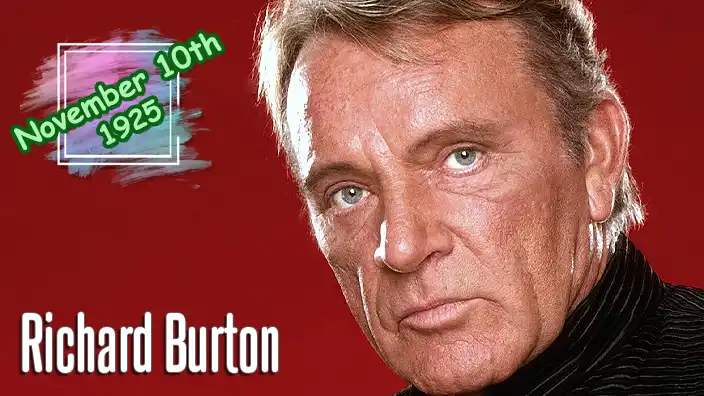
November 10, 1925, in Pontrhydyfen, South Wales
 August 5, 1984, in Geneva, Switzerland

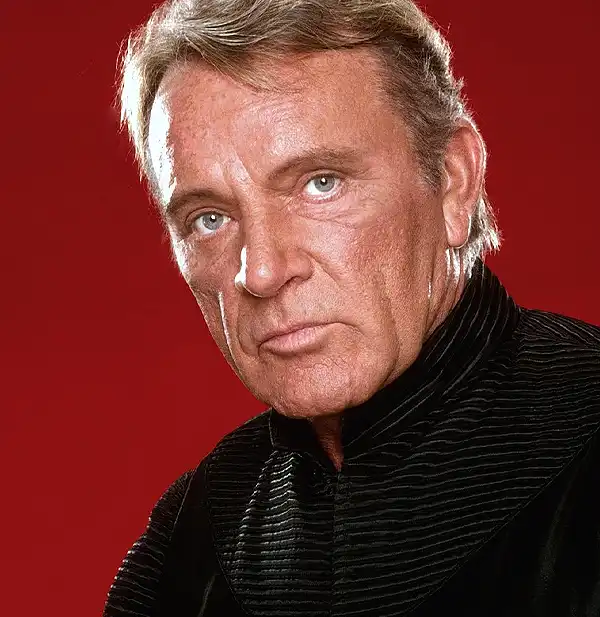
Richard Burton was a legendary Welsh stage and film actor whose commanding baritone voice, extraordinary Shakespearean performances, and unforgettable screen presence made him one of the most celebrated performers of the twentieth century. Famous for Cleopatra, Becket, The Spy Who Came in from the Cold, Who's Afraid of Virginia Woolf?, and Where Eagles Dare, Burton could deliver a Shakespearean speech with such authority that even the furniture seemed inclined to listen. His passionate, turbulent romance with Elizabeth Taylor made them Hollywood's most famous couple, while his seven Academy Award nominations established him as one of cinema's greatest actors never to win an Oscar. From a Welsh mining village to international superstardom, Burton's life contained enough drama, romance, ambition, and scandal to keep several film studios busy for decades.
Richard Walter Jenkins was born on November 10, 1925, in Pontrhydyfen, a small village in the Afan Valley of South Wales. He was the twelfth of thirteen children born to Richard Walter Jenkins Sr., a coal miner, and his wife, Edith Thomas. The family lived in modest circumstances, and young Richard grew up surrounded by the industrial landscape, working-class traditions, and Welsh-speaking communities of the region. His father was known for his drinking and strong personality, while his mother provided much of the family's stability until her death when Richard was only two. The loss profoundly affected his childhood, and he was subsequently raised by his older sister Cecilia and her husband, Elfed James, in nearby Taibach, Port Talbot. It was an unlikely beginning for someone who would eventually become one of the world's highest-paid actors, although the Welsh valleys had already supplied him with something Hollywood could never manufacture: that magnificent voice.
Growing up in South Wales, Burton developed a lifelong connection to Welsh language, literature, music, and culture. His childhood surroundings were filled with the sounds of industrial communities, chapel singing, and conversations delivered in the distinctive rhythms of Welsh speech. These influences helped shape the rich vocal qualities that would later become his professional trademark. Burton possessed a remarkable natural speaking voice, but its eventual power and precision resulted from considerable training and discipline. He learned to appreciate poetry and dramatic language, developing an ability to communicate emotion through carefully controlled pronunciation, rhythm, and emphasis. His voice became so closely associated with his identity that audiences could recognize him almost immediately, even when he was speaking from behind a radio microphone rather than appearing on a cinema screen.
Burton attended Port Talbot Secondary School, where his academic and theatrical abilities attracted the attention of teachers who recognized his unusual potential. Among the most important figures in his life was Philip Burton, a schoolteacher and amateur theatrical director who encouraged the young student's interest in literature, drama, and public speaking. Philip became Richard's mentor, helping him develop his voice, improve his pronunciation, and understand the demands of classical acting. Their relationship eventually became so important that Philip became Richard's legal guardian, and the aspiring actor adopted his surname professionally. Without this remarkable teacher, the world might have known him as Richard Jenkins, although it seems doubtful that changing the name would have made his Shakespearean speeches any less impressive.
Philip Burton's influence extended beyond acting lessons. He encouraged Richard to read widely, study classical literature, develop intellectual curiosity, and pursue opportunities that might otherwise have seemed inaccessible to a young man from a mining family. Burton became an enthusiastic reader, developing a particular affection for poetry, Shakespeare, and the works of Welsh poet Dylan Thomas. His education introduced him to a world considerably removed from the industrial environment of his childhood, although he never completely abandoned his Welsh identity. The combination of working-class roots, intellectual ambition, and theatrical training created a performer whose personality could appear simultaneously sophisticated and defiantly unpolished.
Burton's professional acting career began in 1943 when he appeared in the stage production The Druid's Rest, written by Welsh playwright Emlyn Williams. His performance attracted attention and provided an early opportunity to work within professional theatre. During the Second World War, Burton continued his education and briefly attended Exeter College, Oxford, before undertaking military service in the Royal Air Force. His time at Oxford was relatively short, but the experience contributed to his developing interest in literature and classical performance. His RAF service, meanwhile, interrupted his theatrical ambitions without extinguishing them. Unlike some actors who discovered their talents through wartime entertainment, Burton had already begun establishing himself before entering military life.
Following his discharge from the RAF, Burton returned to acting and began building a reputation on the British stage. He appeared in productions in London and elsewhere, gradually attracting attention for his commanding presence and exceptional vocal delivery. His early performances demonstrated a particular aptitude for classical drama, especially Shakespeare, whose elaborate language suited Burton's ability to communicate complicated emotions through speech. Critics increasingly recognized him as a promising young actor capable of combining physical intensity with remarkable verbal precision. His performances also revealed a distinctive confidence that could sometimes approach arrogance, although in theatrical circles that particular quality has rarely prevented anyone from becoming successful.
Burton made his film debut in the British drama The Last Days of Dolwyn (1949), written and directed by Emlyn Williams. Set in a Welsh village threatened by the construction of a reservoir, the film explored themes of community, identity, and the emotional consequences of industrial development. Burton portrayed Gareth, a young man involved in the unfolding conflict, and his performance introduced his talents to cinema audiences. The production was particularly meaningful because it connected his emerging acting career with the Welsh communities and landscapes that had shaped his upbringing. During filming, Burton met Welsh actress Sybil Williams, whom he married in February 1949. Their marriage would continue through his early rise to international fame.
As Burton's theatrical reputation developed, he attracted increasing attention for his performances in Shakespearean productions. His appearances at Stratford-upon-Avon during the early 1950s included memorable interpretations of Prince Hal and King Henry V, demonstrating his ability to portray characters whose personal ambitions and political responsibilities created complicated dramatic conflicts. His performances earned praise for their energy, vocal authority, and emotional intensity. Shakespeare's historical characters frequently required actors to communicate power, doubt, ambition, and moral uncertainty through extended speeches, and Burton possessed the extraordinary ability to make such passages sound immediate rather than distant or ceremonial.
Burton's association with London's Old Vic theatre further established his reputation as one of Britain's most promising classical actors. His performances in Shakespearean productions attracted enthusiastic reviews, and many critics believed he possessed the potential to become one of the great stage performers of his generation. His ability to deliver demanding dramatic passages with apparently effortless authority made him particularly effective in roles requiring intellectual confidence and emotional turbulence. For Burton, Shakespeare represented both an artistic challenge and an opportunity to demonstrate the extraordinary power of spoken language. Unfortunately for theatrical purists, Hollywood soon discovered that the same voice could sell an impressive number of cinema tickets.
His major Hollywood breakthrough came with the romantic mystery My Cousin Rachel (1952), based on the novel by Daphne du Maurier. Burton starred opposite Olivia de Havilland, portraying Philip Ashley, a young man whose suspicions about a mysterious woman become complicated by his growing attraction to her. The film required him to balance romantic vulnerability with jealousy, suspicion, and emotional uncertainty. His performance attracted considerable critical praise and earned him an Academy Award nomination for Best Supporting Actor, marking the beginning of a remarkable series of Oscar nominations. The recognition established Burton as a rising international film star and demonstrated that his theatrical intensity could translate successfully to the cinema screen.
Burton followed My Cousin Rachel with The Robe (1953), a major biblical epic that became historically significant as the first film released in CinemaScope. He portrayed Marcellus Gallio, a Roman military tribune whose involvement in the crucifixion of Jesus leads to a profound spiritual transformation. The production featured elaborate sets, large-scale historical scenes, and the widescreen presentation that Hollywood hoped would encourage audiences to return to cinemas during the growing popularity of television. Burton's performance earned him an Academy Award nomination for Best Actor, confirming his status as one of the industry's most promising leading men. His commanding voice and classical training made him particularly well suited to historical epics, where characters were frequently expected to deliver lengthy speeches while wearing elaborate costumes and looking impressively troubled.
Throughout the 1950s, Burton appeared in a variety of films, including The Desert Rats (1953), Prince of Players (1955), Alexander the Great (1956), and Look Back in Anger (1959). These productions allowed him to explore historical drama, military adventure, biography, and contemporary social conflict. In Prince of Players, he portrayed nineteenth-century American actor Edwin Booth, while Alexander the Great cast him as the famous Macedonian conqueror. His performance in Look Back in Anger, adapted from John Osborne's influential play, demonstrated his ability to portray the frustrations and emotional volatility of modern British characters. The film's central figure, Jimmy Porter, represented a new generation of disillusioned young men, providing Burton with material considerably removed from the grandeur of Roman tribunes and ancient kings.
Burton's theatrical career remained important despite his growing success in Hollywood. In 1960, he starred as King Arthur in the original Broadway production of the musical Camelot, alongside Julie Andrews and Robert Goulet. The production featured music by Frederick Loewe and lyrics by Alan Jay Lerner, introducing songs that would become closely associated with the legendary Arthurian kingdom. Burton's performance earned him the Tony Award for Best Actor in a Musical in 1961, demonstrating that his commanding stage presence could succeed within musical theatre as effectively as classical drama. Although he was not primarily known as a singer, his distinctive speaking voice and dramatic authority helped make King Arthur a memorable character.
Camelot became one of Burton's most celebrated stage achievements, combining romance, political idealism, and tragedy within a lavish Broadway production. His portrayal of King Arthur emphasized the character's intelligence, emotional vulnerability, and growing awareness that even the noblest ambitions can be undermined by human weakness. The role provided an opportunity to explore themes of loyalty, leadership, and personal sacrifice, subjects that frequently appeared throughout Burton's career. His performance also reinforced his reputation as an actor capable of commanding a theatre through the power of his voice and personality. Anyone sitting in the back row probably felt they had received a private audience with King Arthur himself.
The production that transformed Burton's personal life and international celebrity status was Cleopatra (1963), the enormous historical epic starring Elizabeth Taylor as the Egyptian queen. Burton portrayed Mark Antony, the Roman general whose passionate relationship with Cleopatra becomes central to the film's dramatic storyline. Directed by Joseph L. Mankiewicz, the production became notorious for its extraordinary budget, elaborate sets, production delays, and complicated filming arrangements. Originally intended as a major historical spectacle, Cleopatra became one of Hollywood's most expensive productions, attracting enormous public attention long before audiences finally saw the completed film.
During the filming of Cleopatra in Rome, Burton and Elizabeth Taylor began a passionate affair that quickly became an international scandal. Both actors were married to other people at the time, and their relationship attracted intense attention from newspapers, photographers, and television commentators. The affair became particularly controversial because of the public prominence of both performers and the highly visible circumstances surrounding the production. Their relationship was discussed by religious leaders, entertainment journalists, and political figures, transforming a private romance into an extraordinary public spectacle. Hollywood had certainly experienced celebrity scandals before, but Burton and Taylor managed to turn one into a worldwide event that threatened to overshadow the very expensive film they were supposed to be making.
Burton and Taylor's relationship became one of the defining celebrity romances of the twentieth century. Following their respective divorces, they married in Montreal on March 15, 1964, beginning a marriage characterized by passionate affection, extravagant spending, professional collaboration, and frequent disagreements. Their extraordinary fame made them constant subjects of media attention, with photographers following their movements across Europe and the United States. The couple became associated with luxurious homes, expensive jewelry, international travel, and an apparently unlimited ability to attract newspaper headlines. Their relationship was so intensely publicized that simply going out for dinner could become an international entertainment story.
Despite the enormous attention surrounding their romance, Burton and Taylor also developed a remarkable professional partnership. They appeared together in eleven films, creating an on-screen chemistry that frequently reflected the emotional intensity of their personal relationship. Their collaborations included The V.I.P.s (1963), The Sandpiper (1965), Who's Afraid of Virginia Woolf? (1966), The Taming of the Shrew (1967), and The Comedians (1967). Their performances often involved characters experiencing romantic conflict, jealousy, or complicated personal relationships, allowing audiences to observe fictional versions of emotions that newspapers were already discussing in connection with the actors themselves.
One of Burton's finest performances came in Becket (1964), the historical drama directed by Peter Glenville and based on Jean Anouilh's play. Burton portrayed Thomas Becket, the Archbishop of Canterbury, opposite Peter O'Toole as King Henry II of England. The film explored the friendship and eventual conflict between the two men as Becket's religious responsibilities increasingly clashed with the king's political ambitions. Burton's performance combined intellectual authority, emotional restraint, and moral conviction, creating a character whose personal transformation becomes central to the story. His exchanges with O'Toole were particularly memorable, featuring two accomplished actors delivering elaborate dramatic dialogue with extraordinary intensity.
Becket earned Burton another Academy Award nomination for Best Actor, while O'Toole also received a nomination for his performance as Henry II. The film attracted considerable critical praise and became one of the most respected historical dramas of the decade. Burton's portrayal demonstrated the qualities that had made him a celebrated Shakespearean performer, particularly his ability to communicate complicated questions of loyalty, duty, and personal conscience through carefully controlled language. His performance also reinforced his reputation as an actor whose theatrical training could elevate historical cinema beyond elaborate costumes and impressive scenery.
Burton returned to Broadway in 1964 to portray Hamlet in a production directed by Sir John Gielgud. The production became a major theatrical event, attracting audiences eager to see one of Britain's most celebrated actors perform Shakespeare's troubled Danish prince. Gielgud adopted a relatively minimalist staging approach, emphasizing the actors and language rather than elaborate historical scenery. Burton's performance attracted enormous attention, with his distinctive voice and intense emotional interpretation becoming central features of the production. The engagement was commercially successful and reinforced his reputation as a major Shakespearean actor, even as his increasingly demanding Hollywood career limited his opportunities to perform classical theatre regularly.
In 1965, Burton delivered another outstanding screen performance in The Spy Who Came in from the Cold, adapted from John le Carré's acclaimed espionage novel. He portrayed Alec Leamas, a weary British intelligence officer drawn into a dangerous Cold War operation involving deception, manipulation, and moral uncertainty. Unlike the glamorous espionage adventures associated with James Bond, the film presented intelligence work as an emotionally exhausting profession filled with betrayal and compromised principles. Burton's restrained performance captured the bitterness and disillusionment of a man who had spent years serving institutions whose methods increasingly troubled him.
The Spy Who Came in from the Cold earned Burton another Academy Award nomination for Best Actor and further demonstrated his ability to portray complicated modern characters. His performance was notable for its controlled intensity, avoiding the elaborate theatrical gestures that might have seemed inappropriate within the film's bleak atmosphere. Burton communicated exhaustion, suspicion, and emotional vulnerability through subtle changes in expression and voice, creating one of the most convincing portrayals of Cold War disillusionment in cinema. The film remains a significant example of serious espionage storytelling, emphasizing the psychological consequences of intelligence operations rather than relying primarily on spectacular action sequences.
Perhaps Burton's most famous dramatic film performance came in Who's Afraid of Virginia Woolf? (1966), directed by Mike Nichols and adapted from Edward Albee's acclaimed stage play. Burton starred opposite Elizabeth Taylor as George and Martha, a deeply troubled married couple whose evening with two younger guests descends into an increasingly brutal confrontation involving alcohol, resentment, emotional manipulation, and painful personal revelations. The film provided an extraordinary opportunity for the real-life couple to portray a fictional marriage collapsing under the weight of years of disappointment and hostility. Audiences were fascinated by the intensity of their performances, particularly because Burton and Taylor's own relationship was already famous for its passionate disagreements.
Burton portrayed George, a university professor whose intellectual wit and emotional bitterness conceal profound personal disappointment. Taylor played Martha, his outspoken and frequently cruel wife, whose confrontational behavior masks her own insecurities and frustrations. Their performances created an atmosphere of extraordinary tension, with the characters repeatedly attacking one another through elaborate verbal exchanges. Burton's ability to communicate sarcasm, wounded pride, and emotional vulnerability proved particularly effective, allowing George to emerge as a complicated individual rather than simply an embittered husband. The film demonstrated that two actors could create extraordinary dramatic intensity through dialogue alone, although their characters certainly gave the impression that a peaceful evening at home was entirely beyond their capabilities.
Who's Afraid of Virginia Woolf? received thirteen Academy Award nominations and won five Oscars, including Best Actress for Elizabeth Taylor. Burton received another nomination for Best Actor but once again failed to win. The film became a landmark in American cinema, particularly because of its frank language, mature subject matter, and uncompromising portrayal of marital conflict. Its success helped challenge traditional Hollywood restrictions on adult dramatic content and demonstrated the commercial potential of serious theatrical adaptations. Burton and Taylor's performances remain among the most celebrated examples of on-screen dramatic partnership, even if the fictional couple they portrayed would have benefited enormously from separate hotel rooms.
In 1967, Burton and Taylor appeared together in Franco Zeffirelli's film adaptation of Shakespeare's The Taming of the Shrew. Burton portrayed Petruchio, the confident and confrontational suitor who attempts to win the affection of the equally strong-willed Katherina, played by Taylor. The production combined Shakespearean dialogue with colorful costumes, energetic physical comedy, and the unmistakable chemistry between its stars. Their performances emphasized the battle of personalities at the center of the play, creating an entertaining interpretation that attracted audiences familiar with the couple's famously turbulent relationship. The casting seemed particularly appropriate, as Burton and Taylor hardly needed lessons in portraying two strong personalities who refused to surrender an argument.
Burton also appeared in the psychological drama The Night of the Iguana (1964), directed by John Huston and adapted from Tennessee Williams's play. He portrayed the Reverend T. Lawrence Shannon, a troubled former clergyman working as a tour guide in Mexico while struggling with personal guilt, emotional instability, and complicated relationships. The film also starred Ava Gardner, Deborah Kerr, and Sue Lyon, creating an ensemble of characters whose personal difficulties unfold within an isolated coastal setting. Burton's performance combined theatrical intensity with emotional vulnerability, demonstrating his ability to portray a man whose public confidence concealed profound personal uncertainty.
His range extended into military action cinema with Where Eagles Dare (1968), the popular Second World War adventure directed by Brian G. Hutton. Burton starred alongside Clint Eastwood as Major John Smith, a British officer leading a dangerous mission to rescue an American general from a heavily guarded German fortress in the Bavarian Alps. The film combined espionage, elaborate deception, dramatic mountain scenery, and spectacular action sequences. Burton's character relied heavily on intelligence, manipulation, and carefully delivered dialogue, while Eastwood provided a more restrained and physically direct presence. Their contrasting styles created an entertaining partnership that contributed significantly to the film's enduring popularity.
Where Eagles Dare became one of Burton's most commercially successful films and remains a favorite among audiences who enjoy traditional wartime adventure stories. Its elaborate plot involves secret identities, double agents, unexpected betrayals, and enough complicated intelligence operations to make viewers wonder whether anyone involved actually knows whose side they are on. Burton's commanding performance helped anchor the increasingly elaborate storyline, while his exchanges with Eastwood provided an appealing contrast between British theatrical sophistication and American action-hero understatement. The film demonstrated that Burton could succeed in action-oriented entertainment without abandoning the vocal authority and dramatic presence that had established his reputation.
Burton's personal and professional life became increasingly complicated during the late 1960s and early 1970s. His marriage to Elizabeth Taylor attracted constant media scrutiny, while his drinking developed into a serious problem affecting his health, relationships, and professional responsibilities. Burton had struggled with alcohol for many years, and the pressures associated with international celebrity, demanding film schedules, and personal difficulties contributed to increasingly destructive behavior. His extraordinary talent remained evident, but critics sometimes expressed frustration that his choice of film projects did not consistently reflect his abilities. The tension between artistic ambition and commercial success became a recurring theme throughout his career.
A particularly painful event occurred in 1968 when Burton's older brother Ivor suffered a serious accident that left him paralyzed. Ivor had played an important role in Richard's life, providing companionship and support during his rise to fame. The accident deeply affected Burton, and Ivor's death in 1972 contributed to an increasingly difficult period marked by grief and personal instability. Burton's relationships with family members were often complicated by the demands of his career and the public attention surrounding his marriage, but his connections to Wales and his relatives remained emotionally significant.
Burton and Taylor divorced in June 1974, ending their first marriage after a decade together. Their separation attracted enormous attention, with newspapers speculating about the circumstances and the possibility of reconciliation. In October 1975, the couple remarried in Botswana, briefly renewing one of Hollywood's most famous relationships. However, their second marriage lasted less than a year, and they divorced again in July 1976. The extraordinary cycle of romance, separation, reconciliation, and renewed conflict became central to their public image, reinforcing the perception that their relationship contained enough passion for several ordinary marriages but perhaps not quite enough peace and quiet for one.
Despite their turbulent personal history, Burton and Taylor retained a complicated affection for one another. Their correspondence and public statements revealed the emotional intensity of a relationship that continued to influence both performers long after their divorces. Their shared professional achievements remained significant, particularly their performances in Who's Afraid of Virginia Woolf? and The Taming of the Shrew. Although their relationship frequently overshadowed their individual careers in popular entertainment coverage, their artistic collaboration produced several important films and helped establish them as one of cinema's most recognizable screen partnerships.
Burton's later film career included Equus (1977), adapted from Peter Shaffer's acclaimed stage play. He portrayed psychiatrist Martin Dysart, who investigates the disturbing behavior of a young man obsessed with horses and gradually begins questioning his own emotional limitations. The role required Burton to explore complicated psychological and philosophical questions, providing material well suited to his dramatic abilities. His performance earned him a seventh Academy Award nomination, again for Best Actor, but the Oscar continued to elude him. The nomination confirmed his enduring professional reputation, even as his career became increasingly associated with uneven film choices and personal difficulties.
The absence of an Academy Award victory became one of the most frequently discussed aspects of Burton's career. Seven nominations without a win represented an extraordinary record for an actor whose performances had earned widespread critical admiration. His nominated films included My Cousin Rachel, The Robe, Becket, The Spy Who Came in from the Cold, Who's Afraid of Virginia Woolf?, Anne of the Thousand Days, and Equus. Although the Academy never awarded him a competitive Oscar, his achievements included a Tony Award, Golden Globe recognition, BAFTA honors, and considerable international acclaim. For Burton, the lack of an Oscar did not diminish the power of his performances, although it certainly provided film historians with an enduring subject for debate.
In 1978, Burton starred in the British action film The Wild Geese, portraying Colonel Allen Faulkner, a mercenary commander recruited to lead a dangerous military operation in Africa. The film featured an ensemble including Roger Moore, Richard Harris, and Hardy Krüger, combining traditional military adventure with themes of loyalty, political manipulation, and betrayal. Burton's performance drew upon his established ability to portray commanding authority figures, while the film's action-oriented storyline appealed to audiences who enjoyed elaborate military adventures. The production became a notable entry in British action cinema and reinforced his continuing popularity among viewers attracted to traditional adventure films.
Burton also appeared in the ambitious television miniseries Wagner (1983), portraying the German composer Richard Wagner. The production explored the composer's life, artistic ambitions, personal relationships, and involvement with influential political and cultural figures. The role required Burton to portray a complicated historical personality whose musical achievements were accompanied by significant personal controversies. His performance provided another opportunity to explore the emotional and intellectual contradictions of a major historical figure, continuing a tradition established through his earlier portrayals of kings, military leaders, and religious authorities.
During the production of Wagner, Burton met Sally Hay, who worked behind the scenes on the project. The couple developed a relationship and married in July 1983, beginning the final marriage of Burton's life. He had previously married model and socialite Suzy Hunt in 1976, following his second divorce from Elizabeth Taylor. Although his personal relationships remained complicated, Burton continued working despite declining health and the cumulative effects of years of heavy drinking. His determination to perform reflected the importance of acting to his identity, even as physical difficulties increasingly limited his professional opportunities.
In 1983, Burton reunited professionally with Elizabeth Taylor for a Broadway production of Noël Coward's Private Lives. The play follows a divorced couple who unexpectedly encounter one another while honeymooning with their new spouses, creating a situation filled with romantic tension, witty dialogue, and complicated personal history. Casting Burton and Taylor as the former spouses provided an irresistible attraction for audiences familiar with their real-life relationship. The production attracted enormous public interest, although critical responses were mixed. Its commercial appeal demonstrated the continuing fascination surrounding the couple, whose personal history had become inseparable from their public identities.
Burton's final completed feature film was Nineteen Eighty-Four (1984), adapted from George Orwell's dystopian novel. He portrayed O'Brien, a powerful official involved in the psychological manipulation and torture of Winston Smith, played by John Hurt. The role required Burton to communicate authority, intellectual control, and chilling emotional detachment, qualities that suited his distinctive voice and commanding presence. His performance was particularly effective because O'Brien's calm, measured delivery made his cruelty more disturbing. Rather than portraying a conventional villain who depended on shouting or physical intimidation, Burton created a character whose quiet confidence suggested that resistance was entirely futile.
The film's bleak atmosphere and examination of authoritarian power provided an appropriate final major screen role for an actor whose career had frequently explored authority, morality, and the complicated relationship between individuals and institutions. Burton's performance demonstrated that his vocal abilities remained formidable despite his declining health. His portrayal of O'Brien became one of the memorable elements of the adaptation, reinforcing his reputation for creating characters whose words could be as powerful as physical action. It was a striking conclusion to a career that had begun with classical theatre and developed through historical epics, psychological dramas, and international celebrity.
Richard Burton died on August 5, 1984, after suffering a cerebral hemorrhage at his home in Céligny, Switzerland. His death brought an end to one of the most extraordinary acting careers of the twentieth century. He was buried in the cemetery at Céligny, far from the Welsh mining community where his life had begun. His passing prompted tributes from fellow performers, theatre critics, filmmakers, and admirers who remembered his remarkable voice, Shakespearean achievements, and commanding screen presence. Although his personal difficulties and famous romance had frequently dominated newspaper coverage, his death encouraged renewed appreciation of the extraordinary talent that had made him internationally celebrated.
Burton's legacy extends beyond his film performances through his contributions to theatre, radio, and recorded literature. His celebrated association with Dylan Thomas's Under Milk Wood remains particularly important, as his rich voice proved ideally suited to the Welsh poet's lyrical language. Burton participated in the original BBC radio production in 1954, portraying the First Voice, and later appeared in the 1972 film adaptation alongside Elizabeth Taylor and Peter O'Toole. His delivery helped establish the work as one of the most memorable examples of dramatic poetry performed for radio audiences. The recording remains an important part of his artistic legacy, demonstrating the extraordinary expressive power of spoken language.
His distinctive voice also made him a celebrated narrator, particularly through recordings of poetry and dramatic literature. Burton's ability to communicate complex emotions through rhythm, pronunciation, and vocal emphasis reflected years of classical training and an instinctive appreciation of language. His performances of Shakespeare and Dylan Thomas remain especially admired because they demonstrate the relationship between technical skill and emotional expression. Unlike actors whose reputations depend primarily on physical appearance or cinematic spectacle, Burton possessed a voice capable of creating an entire dramatic world without requiring audiences to see him.
Burton's private diaries, published posthumously as The Richard Burton Diaries, provided additional insight into his personality, relationships, professional frustrations, and intellectual interests. The writings revealed a man of considerable curiosity who read extensively, reflected on his personal experiences, and maintained strong emotional connections to his Welsh upbringing. They also documented the contradictions between his artistic ambitions and the demands of celebrity life. His diaries demonstrated that the public image of an extravagant Hollywood star represented only one aspect of a more complicated personality, shaped by literature, family relationships, personal insecurity, and the constant tension between ambition and self-destruction.
His daughter Kate Burton followed him into acting, developing a successful career in theatre, television, and film. Her performances have included prominent roles in Grey's Anatomy, Scandal, and numerous stage productions, continuing the family's association with dramatic performance. Burton's influence also remains visible through the work of younger Welsh actors who have acknowledged the importance of his achievements in demonstrating that performers from Wales could establish major international careers. His success helped bring greater attention to Welsh theatrical traditions and the distinctive cultural identity of the country where he was born.
In 2013, Burton received a posthumous star on the Hollywood Walk of Fame, placed near Elizabeth Taylor's star. The ceremony was attended by admirers and representatives of the entertainment industry, with fellow Welsh actor Michael Sheen participating in the tribute. The placement provided a fitting reminder of the couple's extraordinary connection, while also recognizing Burton's individual achievements as one of cinema's most celebrated performers. His legacy is additionally preserved through theatrical institutions, archives, and cultural organizations in Wales, including the Richard Burton Company at the Royal Welsh College of Music & Drama.
The centenary of Burton's birth in 2025 brought renewed attention to his remarkable life and career, with exhibitions, performances, and commemorative events celebrating his contribution to Welsh culture and international entertainment. Organizations including Amgueddfa Cymru – Museum Wales explored his personal history, artistic achievements, and enduring influence. These commemorations emphasized the extraordinary journey of a young boy from an industrial Welsh community who developed into a performer recognized around the world. They also encouraged audiences to look beyond the sensational headlines surrounding his personal life and appreciate the theatrical achievements that originally established his reputation.
Richard Burton's career remains a fascinating combination of extraordinary talent, artistic ambition, international celebrity, and personal contradiction. He possessed one of the most recognizable voices in entertainment history, delivered acclaimed Shakespearean performances, earned seven Academy Award nominations, and appeared in some of the most memorable films of his generation. His passionate relationship with Elizabeth Taylor created a celebrity phenomenon that frequently overshadowed his professional achievements, while his struggles with alcohol and personal difficulties complicated an already demanding life. Yet his performances continue to demonstrate the remarkable abilities that first attracted attention in the theatres of Britain.
From the coal-mining valleys of South Wales to the grand stages of London, the bright lights of Broadway, and the enormous film sets of Hollywood, Richard Burton lived a life filled with ambition, romance, tragedy, and remarkable artistic achievement. His voice could command an audience, his performances could transform complicated characters into unforgettable personalities, and his personal life could generate enough headlines to keep the international press permanently employed. Although he never received the Oscar that many believed his talent deserved, his place in theatrical and cinematic history remains secure. And perhaps that is the most fitting conclusion to the story of Richard Burton: a Welsh miner's son who became a Hollywood legend, married Elizabeth Taylor twice, and possessed a voice so magnificent that even Shakespeare might have stopped writing for a moment just to listen.
Dictionary of Welsh Biography – Richard Burton – Detailed Welsh biography covering his upbringing, education, theatrical career, marriages, and final years. English Heritage – Richard Burton – His London home, Shakespearean career, Hollywood achievements, and relationship with Elizabeth Taylor. Richard Burton Centenary – Official Biography – His early life, Welsh heritage, acting achievements, and centenary celebrations. Wales.com – Celebrating Richard Burton – His journey from the Welsh valleys to international stardom. National Museum Wales – Becoming Richard Burton – Personal history, marriages, later performances, and final years. Biography – Richard Burton – Career milestones, Academy Award nominations, and Elizabeth Taylor. IMDb – Richard Burton – Filmography, acting credits, awards, and biographical details.References & Sources