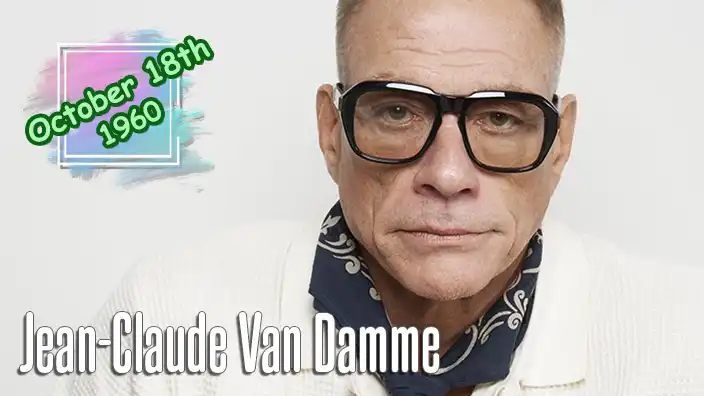
October 18, 1960, in Berchem-Sainte-Agathe, Belgium
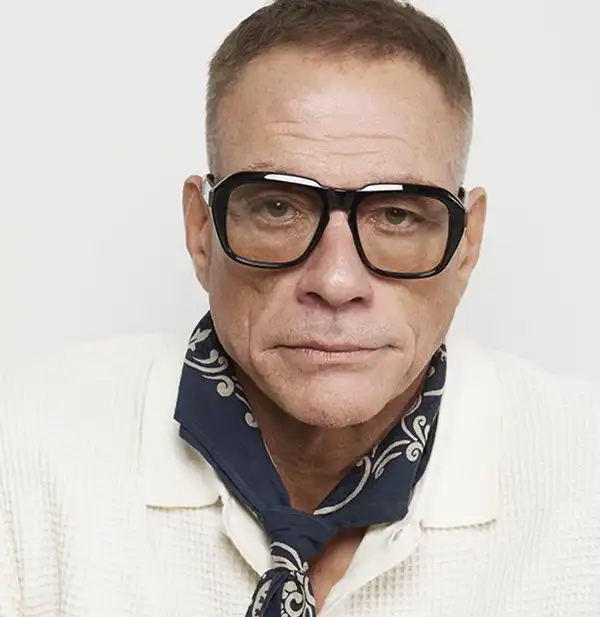
Born Jean-Claude Camille François Van Varenberg on October 18, 1960, in Berchem-Sainte-Agathe, Brussels, Belgium, Jean-Claude Van Damme would become one of the most recognizable martial arts actors in cinema history. His parents, Eugène and Eliana Van Varenberg, could hardly have imagined that their rather shy, physically slight son would eventually become an international action movie superstar. Yet through determination, discipline, and an extraordinary talent for delivering kicks at altitudes normally reserved for passing aircraft, Van Damme transformed himself into a Hollywood phenomenon. His distinctive combination of martial arts expertise, athletic flexibility, muscular physique, and surprisingly vulnerable screen presence helped define an entire generation of action films.
Van Damme's journey toward international fame began when his father enrolled him in karate lessons during childhood. Training under Belgian martial arts instructor Claude Goetz, he developed a passion for Shotokan karate and gradually transformed his physique through rigorous exercise and weightlifting. He also studied classical ballet for several years, an unusual combination that would later become one of his greatest professional advantages. Ballet developed his balance, coordination, and flexibility, while karate provided the speed, precision, and explosive power necessary for competitive fighting. The results were impressive. As a teenager, Van Damme earned recognition in European karate competitions and bodybuilding, demonstrating that the once-slight youngster had become a formidable athlete. His ability to perform spectacular splits and spinning kicks would eventually distinguish him from nearly every other action star working in Hollywood.
Before pursuing an acting career, Jean-Claude Van Damme competed in martial arts tournaments and developed a reputation for his powerful kicks and aggressive fighting style. He earned a black belt in karate and participated in both semi-contact and full-contact competitions, including events involving the Belgian national team. His competitive experience gave him something particularly valuable when he eventually entered the film industry: genuine martial arts credentials. Unlike performers who learned elaborate fight choreography exclusively for the camera, Van Damme already understood the mechanics, discipline, and physical demands of combat sports. Of course, real martial arts competitions generally discourage the sort of prolonged, dramatically illuminated confrontations that would later become his cinematic specialty. Hollywood, fortunately, had considerably more generous rules.
Determined to become an international movie star, Van Damme left Belgium for the United States in the early 1980s. Hollywood did not immediately recognize the arrival of its next great action hero. Instead, he struggled to find acting opportunities while supporting himself through ordinary jobs, including delivering pizzas, driving vehicles, and working as a nightclub bouncer. One particularly interesting connection involved fellow martial arts star Chuck Norris, whose Newport Beach establishment employed Van Damme as a bouncer. During these difficult years, he continued training, improving his English, and pursuing film industry contacts. His ambition was considerable, but so was the competition. Hollywood already had Arnold Schwarzenegger, Sylvester Stallone, and an assortment of muscular gentlemen capable of destroying entire buildings while delivering memorable one-liners.
Van Damme's early screen appearances included the martial arts film No Retreat, No Surrender, released in 1986, in which he portrayed a formidable Soviet martial artist. Although the production was modest, his athletic abilities attracted attention. His decisive breakthrough arrived with Bloodsport, the 1988 martial arts film in which he portrayed American fighter Frank Dux. Set around an underground fighting tournament in Hong Kong, the movie featured elaborate combat sequences, colorful opponents, and Van Damme's increasingly famous displays of flexibility. Produced on a relatively small budget, Bloodsport became a commercial success and developed an enthusiastic following. Its combination of tournament drama, martial arts choreography, and memorable confrontations helped establish Van Damme as a legitimate leading man. Audiences had discovered someone who could deliver a convincing performance, defeat an intimidating opponent, and perform a full split without apparently requiring medical assistance afterward.
Following the success of Bloodsport, Van Damme starred in Kickboxer, portraying Kurt Sloane, a young fighter seeking revenge after his brother suffers a devastating injury. The film combined martial arts training sequences, revenge-driven storytelling, and spectacular physical performances, becoming another defining entry in his career. Its memorable training scenes and climactic confrontation reinforced the formula that audiences had come to expect: a determined hero, a seemingly unbeatable opponent, and enough dramatic kicking to make ordinary handshakes appear terribly inefficient. The same year, Van Damme appeared in the post-apocalyptic action film Cyborg, demonstrating his willingness to explore different settings while maintaining the physical intensity that made him famous.
Throughout the early 1990s, Jean-Claude Van Damme became one of Hollywood's most bankable martial arts action stars. Films including Lionheart (1990), Double Impact (1991), and Universal Soldier (1992) expanded his international popularity. In Lionheart, he portrayed a French Foreign Legion deserter who enters underground fighting competitions to support his family, adding emotional motivation to the familiar action formula. Double Impact offered an especially entertaining challenge by casting Van Damme as twin brothers Alex and Chad Wagner, allowing audiences to enjoy two versions of their favorite martial artist for the price of one admission. The film also demonstrated his growing involvement in developing stories and characters, rather than simply appearing wherever the screenplay required another spectacular roundhouse kick.
Universal Soldier marked another important development in Van Damme's career. Starring opposite Dolph Lundgren, he portrayed Luc Deveraux, a deceased American soldier revived through an experimental military program and transformed into a technologically enhanced fighting machine. Directed by Roland Emmerich, the science-fiction action film combined futuristic military concepts with the explosive physical confrontations that audiences expected from its stars. The movie became a commercial success and eventually developed into a continuing franchise. It also proved that Van Damme could compete beyond traditional martial arts tournament films, moving comfortably into the larger-scale action productions that dominated the international box office.
Van Damme continued broadening his appeal with Hard Target, directed by celebrated Hong Kong filmmaker John Woo in his American directorial debut. Playing Chance Boudreaux, a former Marine who becomes involved in a deadly hunt targeting homeless military veterans, Van Damme delivered another physically demanding performance. The movie combined Woo's distinctive visual style with Van Damme's athletic choreography, creating elaborate action sequences involving motorcycles, firearms, and increasingly unfortunate villains. The collaboration was particularly significant because it helped introduce American audiences to the filmmaking techniques of one of Hong Kong cinema's most influential action directors.
In 1994, Van Damme starred in Timecop, one of his most commercially successful starring vehicles. Playing Max Walker, an officer responsible for preventing criminals from manipulating history through time travel, he combined science-fiction storytelling with elaborate martial arts action. The film became a major international hit and demonstrated that his popularity extended beyond the traditional martial arts audience. That same year, he portrayed Colonel William F. Guile in Street Fighter, the movie adaptation of the enormously popular video game franchise. Although critics were far from enthusiastic about the film, it developed a following among fans who appreciated its colorful characters, extravagant action, and occasionally unintentional comedy. Van Damme had now fought underground tournament champions, genetically enhanced soldiers, international criminals, and video game villains. Only a particularly aggressive parking enforcement officer remained unchallenged.
Additional films during the 1990s included Sudden Death (1995), The Quest (1996), Maximum Risk (1996), Double Team (1997), and Knock Off (1998). Sudden Death placed Van Damme in the middle of a terrorist attack during a professional hockey championship, while The Quest marked his feature-film directorial debut. These productions illustrated both his ambition and the difficulties of sustaining a long-running action movie career in an increasingly competitive industry. Although some films performed respectably, others struggled commercially or received unfavorable reviews. The action genre was changing, audience expectations were evolving, and computer-generated effects were beginning to transform the way Hollywood presented spectacular physical confrontations.
Behind the scenes, Van Damme experienced significant personal difficulties during the height of his fame. His struggles with substance abuse, relationships, and the pressures of celebrity became subjects of public discussion. His career also experienced a downturn as theatrical opportunities diminished and more productions moved directly to home video. Nevertheless, he continued working, appearing in films such as Replicant (2001), In Hell (2003), and Wake of Death (2004). These projects allowed him to explore darker characters and more emotionally demanding material. Although they did not reproduce the extraordinary commercial success of his earlier theatrical releases, they demonstrated his persistence and willingness to continue developing as an actor.
A particularly important turning point arrived with JCVD, the 2008 Belgian crime drama in which Van Damme portrayed a fictionalized version of himself. The film presented a weary action star dealing with financial troubles, family difficulties, and an unexpected hostage situation. Blending satire, drama, and self-examination, JCVD gave Van Damme an opportunity to demonstrate acting abilities that had often been overshadowed by his physical performances. Critics praised his emotional vulnerability and willingness to confront the public image that had defined his career. For audiences accustomed to watching him defeat villains with spinning kicks, the experience was something of a revelation. Apparently, the man could deliver a moving dramatic performance without first demolishing the furniture.
Van Damme subsequently returned to familiar action territory while exploring different opportunities. He reprised his role as Luc Deveraux in later Universal Soldier productions, appeared as the villain Jean Vilain in The Expendables 2, and joined an ensemble of established action stars that included Sylvester Stallone, Jason Statham, Dolph Lundgren, and Arnold Schwarzenegger. The film celebrated the exaggerated action traditions that had made its performers famous, with Van Damme enthusiastically embracing the role of a formidable antagonist. His participation introduced him to younger audiences while providing longtime fans with another opportunity to watch some of cinema's most recognizable action heroes settle their disagreements through exceptionally expensive property damage.
His career has also included voice acting, comedy, and television. Van Damme voiced Master Croc in the animated feature Kung Fu Panda 2 (2011) and Jean Clawed in Minions: The Rise of Gru (2022), demonstrating that his distinctive personality could entertain audiences even without appearing physically on screen. He also starred in the action-comedy television series Jean-Claude Van Johnson, playing a fictionalized version of himself who secretly works as an undercover operative. The production affectionately parodied his reputation, Hollywood action conventions, and the sometimes ridiculous expectations surrounding celebrity. Later films, including The Bouncer (2018), The Last Mercenary (2021), and Darkness of Man (2024), continued his association with action-oriented storytelling while allowing room for more mature and emotionally complex characters.
Outside traditional filmmaking, Van Damme achieved another extraordinary moment of international attention in 2013 through Volvo Trucks' The Epic Split advertising campaign. In the commercial, he performed an astonishing split between two moving trucks traveling backward, demonstrating the precision of Volvo's steering technology while simultaneously reminding the world of his remarkable flexibility. Accompanied by atmospheric music and filmed with striking simplicity, the advertisement became an international viral sensation. The stunt was performed under carefully controlled professional conditions, but its visual impact was undeniable. For a performer who had spent decades perfecting elaborate martial arts choreography, standing between two trucks and slowly lowering himself into a split proved that sometimes the most impressive action sequence requires remarkably little movement.
Jean-Claude Van Damme's influence extends beyond his individual films. Alongside martial arts performers such as Bruce Lee, Jackie Chan, and Chuck Norris, he helped bring martial arts action to mainstream international audiences, particularly during the late 1980s and 1990s. His combination of European martial arts training, classical ballet, bodybuilding, and cinematic choreography produced a distinctive performance style that inspired countless enthusiasts. His signature spinning kicks and splits became instantly recognizable, frequently imitated, and endlessly parodied. He also helped demonstrate that international performers could achieve Hollywood stardom without abandoning their accents or cultural identities. In an industry that often favors conventional leading men, Van Damme succeeded by being unmistakably himself.
His personal life has also remained closely connected to his family and Belgian roots. Van Damme is the father of three children, including performers Kristopher Van Varenberg and Bianca Van Damme, who have pursued careers in entertainment. His relationship with former bodybuilder Gladys Portugues has attracted considerable public attention, including their marriage, divorce, and subsequent remarriage. Despite spending much of his professional life working internationally, he remains strongly associated with Belgium, where his achievements have been recognized through public honors. In 2012, a bronze statue depicting him in a martial arts pose was unveiled in Brussels, celebrating his contribution to international cinema and his status as one of Belgium's most famous entertainment exports.
What makes Jean-Claude Van Damme particularly memorable is that his career has never depended entirely on physical strength. His success emerged from an unusual combination of ambition, athletic discipline, charisma, determination, and an ability to adapt when circumstances changed. He experienced spectacular commercial achievements, disappointing setbacks, personal struggles, and unexpected reinventions, yet continued pursuing opportunities in an industry notorious for its short memory. His willingness to acknowledge past difficulties and occasionally make fun of his own public image has added an appealing human dimension to the larger-than-life action hero audiences first encountered in Bloodsport.
Today, Jean-Claude Van Damme remains an internationally recognized figure whose name evokes the golden era of martial arts action cinema. His films continue to entertain audiences, his athletic achievements remain impressive, and his distinctive personality has secured a permanent place in popular culture. From a shy Belgian youngster learning karate to a Hollywood superstar capable of performing extraordinary feats of flexibility, his journey illustrates what determination and years of disciplined training can accomplish. And while the world has produced plenty of formidable action heroes, relatively few can claim to have defeated countless cinematic villains, starred in international blockbusters, and made two moving trucks look like perfectly reasonable exercise equipment.