September 9, 1980, in Kalispell, Montana
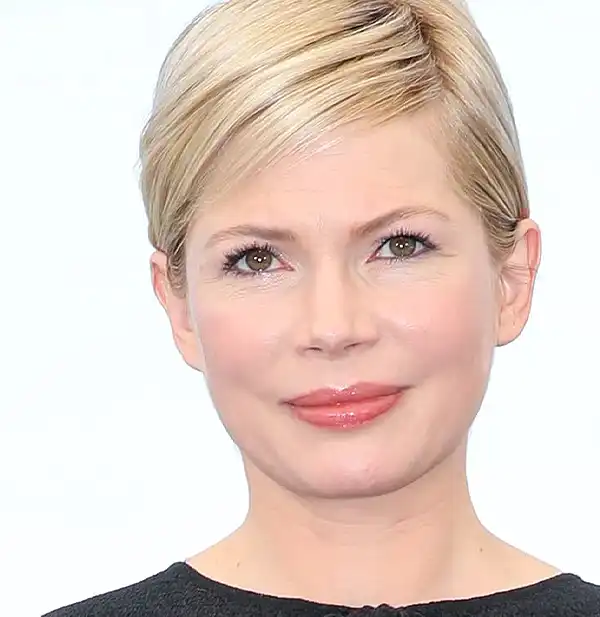
Michelle Ingrid Williams was born on September 9, 1980, in Kalispell, Montana, to Carla Ingrid Williams and Larry Richard Williams, a commodities trader and author. Her childhood began in the wide-open surroundings of Montana before the family moved to San Diego, California. Williams developed an interest in acting while still young, and her determination to pursue it would eventually take her far from the conventional path of school, college, and a sensible job with regular hours. Hollywood, of course, has never been particularly interested in sensible hours.
Williams began auditioning for professional roles as a child and made early television appearances in series such as Baywatch, Home Improvement, and Step by Step. Her first feature-film role came in Lassie in 1994, in which she played April Porter. She also appeared in the science-fiction horror film Species in 1995, portraying the younger version of the character played by Natasha Henstridge. These early credits gave her experience in both television and film, but they also required her to balance professional ambitions with the ordinary demands of adolescence. At fifteen, she became legally emancipated from her parents so that she could work as an adult performer and pursue acting opportunities more freely. It was an unusually serious decision for someone who might otherwise have been worrying about homework and whether the school cafeteria had run out of pizza.
Her major breakthrough arrived in 1998, when she was cast as Jen Lindley in the WB television drama Dawson’s Creek. Created by Kevin Williamson, the series followed a group of teenagers in the fictional town of Capeside, Massachusetts, as they navigated friendship, romance, family difficulties, and the kind of emotional conversations that seemed to require an entire afternoon and a scenic waterfront. Williams starred alongside James Van Der Beek, Katie Holmes, and Joshua Jackson, with Jen arriving from New York and bringing a more complicated personal history into the close-knit community.
Jen Lindley was initially presented as a worldly outsider whose arrival disrupted the established relationships among the central characters. As the series developed, however, Williams gave her increasing emotional depth, portraying a young woman struggling with family conflict, loneliness, identity, and the desire to be accepted. Jen’s relationship with her grandmother, Evelyn “Grams” Ryan, played by Mary Beth Peil, became one of the show’s most meaningful connections. Their evolving bond allowed the series to explore generational differences, faith, forgiveness, and the importance of family support. Williams brought a quiet vulnerability to the role that distinguished Jen from the more conventional teen-drama archetypes.
Dawson’s Creek ran for six seasons, concluding in 2003, and became one of the defining youth dramas of its era. The series helped launch the careers of its principal cast members and attracted a devoted audience through its mixture of romance, humor, and earnest discussion of teenage life. Williams later acknowledged that the show provided valuable professional experience, even though she sometimes felt limited by the demands of a long-running television role. While her character was dealing with the latest emotional crisis in Capeside, Williams was increasingly interested in the independent films and more challenging material that would shape the next stage of her career.
During her years on Dawson’s Creek, Williams continued working in film. She appeared opposite Kirsten Dunst in Dick in 1999, a comedy that reimagined the Watergate scandal through the adventures of two teenage girls who accidentally become involved in the Nixon White House. She also appeared in But I’m a Cheerleader, Prozac Nation, and The United States of Leland. These projects allowed her to explore different genres and work with filmmakers outside the mainstream Hollywood system. Her willingness to take smaller, unconventional roles became a defining feature of her career, even when those films offered less commercial visibility than a major studio production.
One of her most important early independent-film roles came in The Station Agent in 2003, directed by Tom McCarthy. The film starred Peter Dinklage as a man seeking solitude in rural New Jersey, with Williams playing Emily, a young librarian who becomes part of his small circle of acquaintances. The film received critical acclaim for its understated storytelling and performances. Williams also appeared in Imaginary Heroes and The Baxter, continuing to establish herself as an actress interested in character-driven stories rather than simply pursuing the most prominent available roles.
Her career reached a new level of recognition with Brokeback Mountain in 2005. Directed by Ang Lee and adapted from Annie Proulx’s short story, the film starred Heath Ledger and Jake Gyllenhaal as two men whose relationship develops over many years against the social restrictions of the American West. Williams played Alma Beers, the wife of Ledger’s character, Ennis Del Mar. Her performance captured the pain, confusion, and emotional isolation of a woman who gradually realizes that her marriage contains a truth she cannot fully understand or change. The role earned Williams her first Academy Award nomination, for Best Supporting Actress, and established her as one of the most promising dramatic performers of her generation.
During the production of Brokeback Mountain, Williams began a relationship with Heath Ledger. Their daughter, Matilda, was born in 2005. The couple separated in 2007, and Ledger died in January 2008. Williams has generally maintained a private approach to discussing their relationship and the years that followed, particularly in relation to their daughter. Her experiences during this period attracted intense media attention, but she continued to work and gradually built a career that allowed her to maintain a measure of independence from the publicity surrounding her personal life.
Following Brokeback Mountain, Williams appeared in films including The Hawk Is Dying, The Hottest State, and I’m Not There, Todd Haynes’s unconventional portrait of Bob Dylan. She also starred in Wendy and Lucy in 2008, directed by Kelly Reichardt. The film followed a young woman traveling to Alaska in search of work whose plans unravel after her car breaks down and she becomes separated from her dog. Williams delivered a restrained, deeply affecting performance that relied on small gestures and quiet moments rather than dramatic speeches. The film became an important example of her ability to convey emotional complexity through minimalism, and it began a particularly fruitful collaboration with Reichardt.
Williams reunited with Reichardt for Meek’s Cutoff in 2010, a Western set in the Oregon desert during the nineteenth century. She played Emily Tetherow, a woman traveling with a group of settlers whose journey becomes increasingly uncertain under the guidance of an unreliable leader. The film’s slow pace and attention to the physical realities of frontier life offered a very different perspective from the traditional Hollywood Western. Williams’s performance contributed to its atmosphere of tension and uncertainty, portraying a woman whose practical judgment becomes increasingly important as the group’s situation deteriorates.
In 2010, Williams starred opposite Ryan Gosling in Blue Valentine, directed by Derek Cianfrance. The film examined the beginning and breakdown of a marriage, moving between the couple’s early romance and the painful deterioration of their relationship. Williams played Cindy, a woman whose youthful hopes have become entangled with disappointment, responsibility, and emotional exhaustion. Her performance was widely praised for its honesty and complexity, earning her a second Academy Award nomination, this time for Best Actress. The film was particularly demanding because it required the actors to portray both the excitement of falling in love and the difficult reality of a relationship coming apart. It was not the sort of romantic movie that sends audiences home expecting a cheerful wedding sequel.
Williams followed this achievement with another major transformation in My Week with Marilyn in 2011. Directed by Simon Curtis, the film told the story of a young production assistant’s experiences during the making of The Prince and the Showgirl, starring Marilyn Monroe and Laurence Olivier. Williams portrayed Monroe, capturing both the public glamour of the Hollywood icon and the insecurity and vulnerability behind her famous image. She studied Monroe’s voice, movement, and mannerisms extensively, creating a performance that was more than a simple impersonation. The role earned her a Golden Globe Award for Best Actress in a Motion Picture – Musical or Comedy and her third Academy Award nomination.
The following year, Williams appeared as Glinda in Oz the Great and Powerful, the fantasy adventure directed by Sam Raimi. The film starred James Franco as Oscar Diggs, a magician who finds himself in the Land of Oz, with Williams playing the benevolent witch who helps guide him. The role introduced her to a large-scale fantasy production filled with visual effects and elaborate costumes, a considerable contrast to the understated independent films for which she had become known. It also gave her the opportunity to play a character whose primary responsibilities included magic, moral guidance, and looking remarkably composed while surrounded by flying monkeys.
Williams continued to balance mainstream projects with independent cinema. She appeared in Suite Française, Certain Women, and Wonderstruck, among other films. In Certain Women, released in 2016 and directed by Kelly Reichardt, she played Gina Lewis, a woman attempting to build a home while navigating tensions within her marriage and family. The film’s interconnected stories explored the lives of women in Montana, returning Williams to the landscape of her childhood in a project that emphasized quiet observation and emotional nuance.
One of the most acclaimed performances of her career came in Manchester by the Sea in 2016. Directed by Kenneth Lonergan, the film starred Casey Affleck as Lee Chandler, a man struggling with grief and guilt after a devastating family tragedy. Williams played Randi, his former wife, whose own life has been profoundly affected by the same events. Although her screen time was limited, her performance was central to the film’s emotional impact. A particularly powerful encounter between Randi and Lee became one of the most discussed scenes of the year, demonstrating Williams’s ability to communicate years of pain and unresolved feeling in a brief exchange. The role earned her a fourth Academy Award nomination, for Best Supporting Actress.
Williams also returned to the stage, an important part of her professional development. She made her Broadway debut in the 2014 revival of Cabaret, playing Sally Bowles opposite Alan Cumming. The role required her to sing, dance, and portray a character whose outward exuberance concealed considerable emotional turmoil. In 2016, she starred opposite Jeff Daniels in the Broadway revival of David Harrower’s Blackbird, a challenging drama about a woman confronting a man who had abused her when she was a child. Her performance earned a Tony Award nomination for Best Actress in a Play. The production demonstrated her willingness to take on difficult material in an intimate theatrical setting, where there are no camera angles or editing decisions to soften the demands of the performance.
In 2017, Williams appeared in The Greatest Showman, the musical drama starring Hugh Jackman as P. T. Barnum. She played Charity Barnum, his wife, and performed songs including “Tightrope.” The film became a major commercial success, and its soundtrack developed a large following. Williams’s participation allowed her to combine acting with musical performance, showing another side of her abilities. She also appeared in All the Money in the World, directed by Ridley Scott, playing Gail Harris, the mother of kidnapped teenager John Paul Getty III. The film’s production became particularly notable when Christopher Plummer replaced Kevin Spacey in the role of J. Paul Getty during extensive reshoots shortly before release. Williams’s performance earned a Golden Globe nomination and contributed to the film’s tense portrayal of a family crisis.
Her television career reached another major milestone with Fosse/Verdon in 2019. The FX miniseries explored the relationship between choreographer and director Bob Fosse, played by Sam Rockwell, and dancer and actress Gwen Verdon, portrayed by Williams. The production examined their professional partnership, complicated marriage, and influence on American musical theater. Williams underwent extensive preparation to portray Verdon, studying her dancing, voice, and mannerisms. Her performance captured both the performer’s extraordinary talent and the personal sacrifices involved in her career. She won the Primetime Emmy Award for Outstanding Lead Actress in a Limited Series or Movie, as well as a Golden Globe and a Screen Actors Guild Award.
Williams also appeared in the superhero film Venom in 2018 and its sequel, Venom: Let There Be Carnage, in 2021, playing Anne Weying opposite Tom Hardy. The films offered a different kind of acting challenge, involving comic-book action, visual effects, and a relationship with a character whose problems included an alien symbiote with a rather alarming appetite. Her participation demonstrated that she was not opposed to large commercial franchises, even while continuing to prioritize independent and character-driven projects.
In 2022, Williams starred in Steven Spielberg’s semi-autobiographical film The Fabelmans, playing Mitzi Fabelman, the mother of a young aspiring filmmaker. The character was inspired by Spielberg’s own mother, Leah Adler, and the film explored the relationship between family life, artistic ambition, and the discovery of difficult truths. Williams portrayed Mitzi as a vibrant, creative, and emotionally complicated woman whose love for her family coexists with her own unfulfilled desires. Her performance earned widespread acclaim and a fifth Academy Award nomination, for Best Actress. The film also received the Golden Globe Award for Best Motion Picture – Drama, with Williams nominated for her performance.
Williams reunited with Kelly Reichardt for Showing Up, which premiered in 2022 and received its theatrical release in 2023. She played Lizzy, a sculptor preparing for an exhibition while dealing with the ordinary frustrations of work, family, and personal relationships. The film’s understated humor and attention to the everyday realities of artistic life offered another opportunity for Williams to explore a character whose emotions are often expressed indirectly. It also demonstrated the strength of her long-running collaboration with Reichardt, whose films have repeatedly provided her with roles that challenge conventional expectations of dramatic performance.
In 2025, Williams starred in and executive-produced the FX limited series Dying for Sex, based on the podcast about Molly Kochan and her friendship with Nikki Boyer. Williams played Molly, a woman facing a terminal cancer diagnosis who decides to explore her sexuality and reclaim a sense of personal freedom, with Jenny Slate portraying her closest friend. The series combined dark humor, intimacy, grief, and friendship, allowing Williams to explore a character who refuses to let her illness define the entirety of her life. Her performance earned an Emmy nomination and won the 2026 Golden Globe for Best Actress in a Limited Series, Anthology Series, or Television Movie. She also received the Actor Award for her performance, while the series was recognized with a Peabody Award. The role added another significant achievement to her television career and demonstrated her ability to find humor and humanity within profoundly difficult material.
Williams returned to the stage in the 2025–26 production of Eugene O’Neill’s Anna Christie at St. Ann’s Warehouse in Brooklyn, starring alongside Mike Faist. The production continued her interest in demanding theatrical roles and marked another chapter in a career that has moved freely between film, television, and live performance. Her willingness to return to the stage, despite the demands of a successful screen career, reflects her commitment to acting as a craft rather than simply a route to celebrity.
Outside her professional work, Williams has generally maintained a private personal life. She married theater director Thomas Kail in 2020, and they have children together. She is also the mother of Matilda, her daughter with Heath Ledger. Williams has spoken about the importance of family and the challenges of balancing motherhood with a demanding acting career, while choosing to keep many details of her children’s lives away from public attention. Her approach has allowed her to maintain a distinction between her work as a performer and her life outside the entertainment industry.
Over the course of her career, Williams has received five Academy Award nominations, three Golden Globe Awards, a Primetime Emmy Award, and numerous other honors. Her work has been recognized by critics, film festivals, and industry organizations, but her reputation rests as much on the consistency of her performances as on the awards themselves. She has repeatedly chosen roles that require emotional honesty, careful observation, and a willingness to portray characters who are imperfect, conflicted, or difficult to understand.
Michelle Williams’s career is particularly notable for the way she has moved beyond the expectations created by early television fame. She began as a recognizable face on a popular teen drama and gradually established herself as one of the most respected actresses in contemporary cinema. Her filmography includes independent dramas, major studio productions, musicals, superhero films, and experimental television, while her stage work has added another dimension to her professional achievements. She has shown that a successful career need not follow a single formula, and that an actor can continue to grow by seeking out material that presents new challenges.
Her birthday offers an opportunity to celebrate a performer whose work has left a lasting impression on audiences and critics alike. From Jen Lindley’s complicated adolescence to Marilyn Monroe’s fragile glamour, Randi Chandler’s grief, Mitzi Fabelman’s creative spirit, and Molly Kochan’s determination to live fully, Williams has brought depth and individuality to a remarkable range of characters. She may have first become famous in a town where everyone seemed to have an exceptionally articulate explanation for their feelings, but her greatest performances have often shown that the most powerful emotions are the ones a character can barely find the words to express.