Mark The Days - July

July is the month that shows up with fireworks, sunshine, and enough humidity to steam broccoli on your front porch. It’s when grills go full throttle, flags wave like they’ve had three espressos, and someone’s always trying to convince you that hot dogs count as a food group. From independence to ice cream, and cow appreciation to hugging your mail carrier (check the holiday—don’t just go rogue), July is packed with celebrations that sizzle louder than a Fourth of July sparkler. Slather on the sunscreen and let’s dive into the month that smells like barbecue and sounds like “Oops, I forgot the potato salad.”

- Details
Picture this: you’re tossing your phone into a Champagne bucket, the TV is off, and you’re giggling at a joke in your favorite book. Meanwhile, your phone is plotting its escape from the bucket, convinced it’s missing out on the latest social media drama. But today, you’re the one winning, basking in the glory of uninterrupted relaxation and laughter. Cheers to SCUD Day, where the biggest drama is whether to read one more chapter or take a nap!
Celebrated: Annually, on July 8th
Discover the essence of National SCUD Day, a celebration of humor and relaxation. Learn how to savor the comic, unplug the drama, and recharge your mental batteries on July 8th.


- Details
Imagine your body mistaking its own moisture for an all-you-can-attack buffet. You’ve got eyes that feel like you’ve just walked through a desert sandstorm and a mouth that’s drier than a stand-up comedian's sense of humor. Your new best friends? Humidifiers, eye drops, and water bottles. Living with Sjögren’s is like hosting an endless survival show in your own body, but hey, at least it’s not boring!
Celebrated: Annually, on July 23rd
Discover World Sjögren’s Day, a time for raising awareness about the autoimmune disorder characterized by dry eyes and mouth, and more.


- Details
Imagine a world where the ultimate comfort food isn't a donut or a cookie, but a crispy, golden nugget of corny goodness. These delightful fritters might just be the love child of a pancake and a hushpuppy, bringing joy to taste buds everywhere. Whether they're sweetened with a touch of honey or spiced up with jalapeños, these little bites of bliss are proof that sometimes, the best things in life are fried.
Celebrated: Annually, on July 16th
Discover the history, making, and cultural significance of corn fritters on National Corn Fritter Day. Join the celebration of this golden and delicious treat.


- Details
In the culinary world, pecan pie is the sweet-talking Southern charmer you can't resist. It's like a buttery, nutty siren luring you in with promises of gooey goodness and toasted pecan perfection. One bite, and you'll find yourself in a deliciously sticky situation, desperately trying to convince everyone around that you're just "sampling" it... for the fifth time.
Celebrated: Annually, on July 12th
Discover the rich history and sweet allure of pecan pie, a beloved Southern dessert celebrated on National Pecan Pie Day. Dive into the nutty details with a sprinkle of humor.


- Details
Rednecks are the kind of folks who can turn a broken lawnmower into a barbecue grill and make it work better than anything you’d buy at the store. They’re the masterminds behind inventions like duct tape curtains, truck-bed swimming pools, and the art of frying just about anything edible—and some things that probably shouldn’t be. Redneck wisdom is unparalleled; they’ll fix your car, your plumbing, and your mood, all while telling you the wildest hunting story you’ve ever heard. And let’s be honest, if there’s a problem that can’t be solved with a cooler full of beer, a loyal hound, and a can-do attitude, it probably wasn’t worth solving in the first place!
Celebrated: Annually, on July 3rd
Celebrate American Redneck Day with a tribute to Southern charm and simplicity. Dive into the origins, traditions, and style of this unique slice of Americana. Happy American Redneck Day, y’all!


- Details
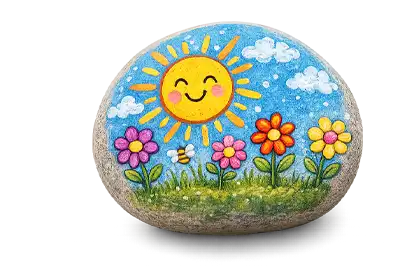
Have you ever found a brightly painted rock sitting on a park bench and wondered how it got there? Was it placed by a talented artist? A cheerful child? A secret society of highly motivated rock enthusiasts? International Drop a Rock Day encourages everyone to join the fun by painting ordinary rocks and leaving them behind to surprise complete strangers. It's one of the few occasions where abandoning rocks in public is considered an act of kindness rather than a topic for a neighborhood watch meeting.
Celebrated: Annually, on July 3rd
Celebrate International Drop a Rock Day with painted rocks, kindness, creativity, and fun community rock hunts

- Details
Winning the lottery is like finding a unicorn in your backyard – highly unlikely but utterly delightful to imagine. The odds might be laughably slim, but that doesn’t stop us from dreaming big. After all, someone has to win, right? Besides, even if you don't hit the jackpot, you can always enjoy the thrill of anticipation and the fleeting fantasies of quitting your job in a blaze of glory or buying that island you've always wanted. In the end, the lottery is less about the numbers and more about the hopeful daydreams it sparks.
Celebrated: Annually, on July 17th
Discover the allure of the lottery on National Lottery Day – a celebration of dreams, hopes, and the chance for a life-changing windfall. Explore the history, big wins, and cautionary tales of lottery players.


- Details
Crème brûlée is the James Bond of desserts—suave, sophisticated, and always prepared with a fiery touch. Picture this: a mild-mannered custard just lounging around until the torch arrives, and suddenly it transforms into a caramelized delight. One moment it's smooth and creamy, the next it's donning a crisp, sugary shell that crackles under your spoon. This dessert proves that sometimes, a little bit of fire and sugar can create the perfect alchemy, turning the ordinary into the extraordinary with just one delicious bite.
Celebrated: Annually, on July 27th
Discover the rich history and culinary allure of Crème Brûlée, a decadent dessert celebrated on National Crème Brûlée Day, July 27th. Indulge in the creamy, crunchy delight of this beloved treat.


- Details
Junk food is like that charmingly mischievous friend who always leads you astray but makes the adventure worthwhile. Whether it's the siren call of a crinkling chip bag at midnight or the irresistible allure of a donut with sprinkles, junk food knows exactly how to crash your diet with a big, unapologetic grin. It's the culinary equivalent of binge-watching your favorite guilty pleasure show—utterly delightful and completely lacking in nutritional value. So go ahead, answer that pizza's call and revel in the delicious rebellion, because sometimes, the tastiest food is the naughtiest food!
Celebrated: Annually, on July 21st
Indulge in your favorite guilty pleasures on National Junk Food Day, celebrating the joy of savoring mouth-watering treats and the science behind craving.


- Details
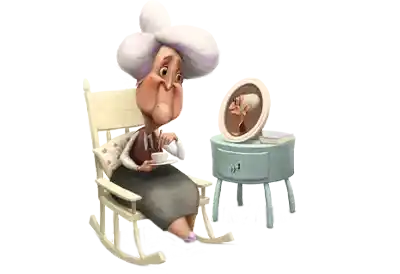
Loneliness can be a crushing weight, an invisible burden that isolates and overwhelms. It’s the quiet ache of longing for human connection, the desperate need for a kind word or a gentle touch. In the silence, loneliness grows, consuming hope and amplifying despair. Comfort, even in its smallest form, can be a lifeline—a reminder that someone cares, that you are seen, and that you are not alone in the darkness.
Celebrated: Annually, on July 11th
Learn about National Cheer Up the Lonely Day, a day dedicated to spreading compassion and connection to those feeling isolated or forgotten. Discover the impact of loneliness and ways to bring cheer to others.

- Details
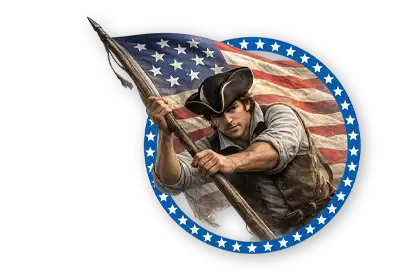
Two hundred and fifty years ago, a group of determined colonists looked at the most powerful empire on Earth and essentially said, "Thank you for your service, but we're going to try this on our own." Against all odds, the experiment worked. Since then, America has grown from thirteen colonies to fifty states, put people on the Moon, invented the internet, and somehow turned arguing about barbecue into a regional sport. As the nation celebrates its 250th Birthday—or the Semiquincentennial, if you're feeling unusually brave—we take a look at the history, people, and events that shaped the United States over the last two and a half centuries.
Discover the history of America's 250th anniversary, the Semiquincentennial, Independence Day facts, and ways to celebrate America 250

- Details
Born into the Madiba clan of the Xhosa-speaking Thembu people, a young boy from the village of Mvezo would grow to become an international symbol of resilience and justice. Despite early hardships and a 27-year imprisonment, he emerged as South Africa's first black president, championing reconciliation and human rights. His journey from rural roots to global icon inspires millions to strive for equality and make a positive impact on the world.
Celebrated: Annually, on July 18th
Learn about Nelson Mandela International Day, a day dedicated to honoring the enduring contributions of one of the world's most revered leaders and advocating for social justice and human rights.


- Details
Humanity looked up at the night sky for centuries, saw countless stars, mysterious planets, and endless cosmic wonder… and eventually decided, “You know what this needs? Rockets.” Space Exploration Day celebrates our species’ unstoppable urge to leave perfectly good gravity behind, spend staggering amounts of money on advanced engineering, and boldly go where absolutely no one can hear us complain about the Wi-Fi. From moon landings to Mars rovers, it turns out curiosity really can launch us into orbit.
Celebrated: Annually, on July 20th
Let's celebrate Space Exploration Day by exploring its history, scientific achievements, and humanity’s bold journey from the moon to the stars


- Details
Imagine you’re calmly sitting on your porch, sipping iced tea, when you notice a towering wall of dust creeping over the horizon like it’s on a mission. Before you know it, you’re in a mad dash to shut windows, seal doors, and rescue the dog’s favorite toy from the yard. Dust storms have this incredible ability to show up unannounced, like the world’s most obnoxious houseguests. They blow in with a dramatic entrance, coat everything you own in a fine layer of gritty beige, and then sweep out as if they hadn’t just redecorated your living room with half a desert. If dust storms had a personality, they’d be that relative who leaves crumbs everywhere, overstays their welcome, and then winks as they walk out the door, leaving you to clean up the mess.
Celebrated: Annually, on July 12th
Learn how to cope with sand and dust storms using innovative strategies, from greening lands to storm-proofing buildings, and uncover fascinating facts about these blustery events.


- Details
Sprinkles: the tiny, colorful party crashers that show up uninvited but are always welcome. These little confectionary wizards have the magical ability to transform even the most boring dessert into a vibrant masterpiece. Whether they're jazzing up a plain donut or turning a mundane cupcake into a rainbow explosion, sprinkles prove that sometimes, it's the smallest things in life that bring the biggest smiles. And let's be honest, who hasn't felt a little better after watching a cascade of sprinkles dance their way onto a treat? They're like edible confetti, spreading joy one sweet bite at a time.
Celebrated: Annually, on July 23rd
Working


- Details
Math is like the universe’s ultimate inside joke. Just when you think you’ve figured it out, it throws in imaginary numbers, like an invisible friend you need to explain calculus to. And don't get me started on pi—it’s an irrational number that never ends, much like your high school math teacher’s enthusiasm for it!
Celebrated: Annually, on July 8th
Discover the evolution of numbers and nerdiness on Math 2.0 Day, celebrating math's journey from counting stones to digital wonders. Embrace the harmony of numbers and technology.


- Details
National Strawberry Sundae Day is when ice cream dresses up, fruit pretends it’s the healthy choice, and nobody asks too many questions. One scoop turns into two, whipped cream somehow becomes a “light topping,” and before you know it, you’re defending your dessert like it’s a lifestyle decision. If strawberries had a publicist, this would be their big moment. Frankly, if this is wrong, it’s the kind of wrong worth celebrating.
Celebrated: Annually, on July 7th
Join us for a classic dessert of ice cream, strawberries, and whipped cream. Discover the history of the Sundae with fun facts and easy ways to enjoy it

- Details
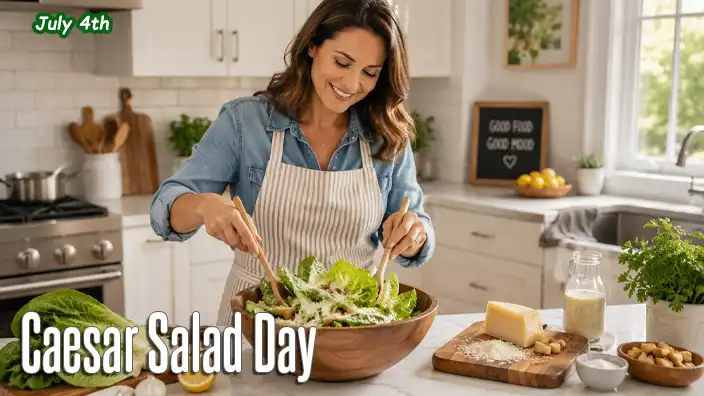
Some recipes become family favorites. Others become international celebrities with their own special day. The Caesar salad somehow managed both, proving that crisp lettuce, crunchy croutons, and a legendary dressing can achieve culinary fame without ever needing to be deep-fried. It's fresh, flavorful, and one of the few salads people order with genuine enthusiasm instead of, "I suppose I should eat something healthy."
Celebrated: Annually, on July 4th
Celebrate Caesar Salad Day on July 4 by discovering the delicious history, fun facts, recipes, and worldwide popularity of this timeless culinary classic.
From Our Marks Catelog
-

Brussels sprouts: the tiny green orbs that have been sparking dinner table debates for...
-
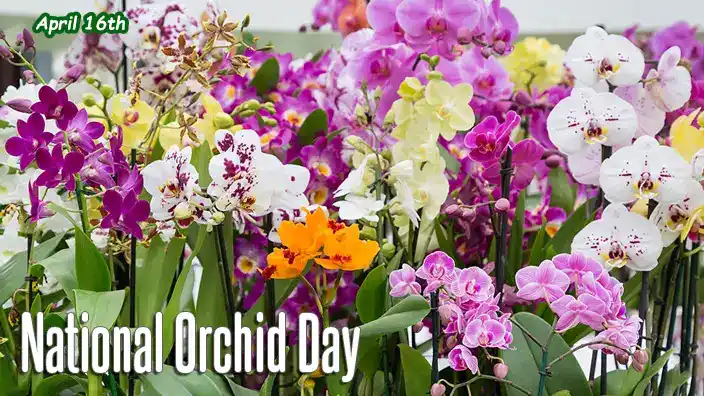
Elegance, mystery, and just the right amount of arrogance—some things demand admiration without lifting...
-
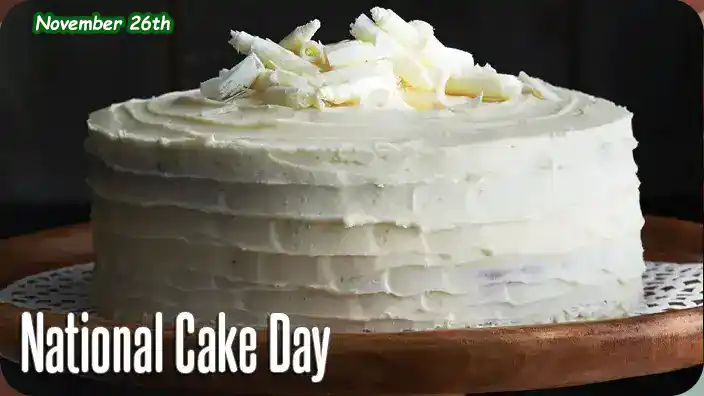
National Cake Day is the one day of the year when it's socially acceptable to have your cake and eat...
-

Forget glow-in-the-dark snack cakes and cheese that comes in a spray can—there’s something wildly...
-

If there were an Olympic event for clumsiness, someone would be rolling down the hill, missing their...
-
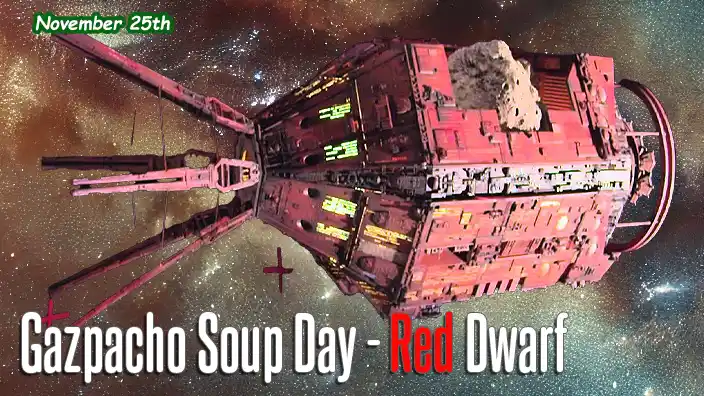
Gazpacho Soup Day isn’t just a day to honor cold tomato soup; it’s a day to revel in the absurdity of...

