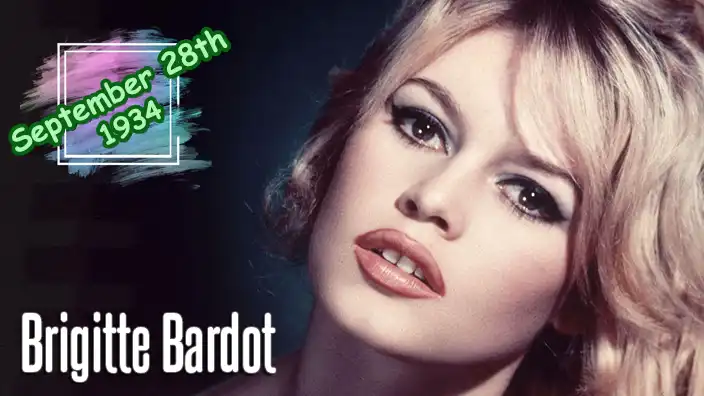
September 28, 1934, in Paris, France
 December 28, 2025, in Saint-Tropez, France
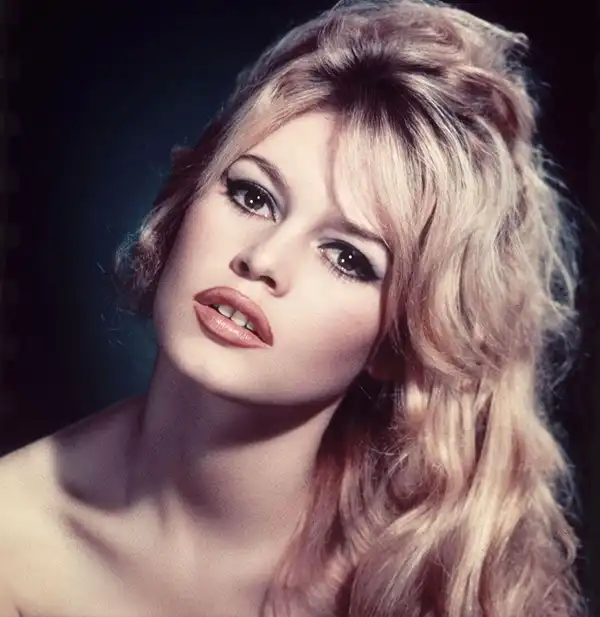
Brigitte Bardot was more than a successful French actress. During the 1950s and 1960s she became an international symbol of French cinema, changing ideas about screen sexuality, fashion and celebrity while helping turn Saint-Tropez from a Mediterranean fishing town into one of the world's most recognizable playgrounds. Her tousled blond hair, ballet flats, bikinis and apparently effortless style were imitated internationally, while her initials—BB—became sufficient identification. Yet Bardot's relationship with fame was deeply uncomfortable, and after a relatively brief but extraordinarily influential film career, she abandoned acting completely and devoted the remainder of her public life largely to animal protection.
Brigitte Anne-Marie Bardot was born on September 28, 1934, in Paris, France, into a prosperous conservative family. Her father, Louis Bardot, was an industrialist, while her mother, Anne-Marie, encouraged an interest in music and dance. Bardot studied ballet and was accepted into the Conservatoire de Paris, where she trained under Russian choreographer Boris Knyazev. Before cinema intervened, it appeared entirely possible that dance would become her profession.
Her appearance soon attracted another sort of attention. Bardot began modeling as a teenager and appeared on the cover of Elle magazine. One of those appearances caught the attention of young filmmaker Roger Vadim, who became determined to meet her. The relationship met resistance from Bardot's parents, but the couple eventually married in 1952. Vadim would become instrumental in shaping Bardot's early screen career and, eventually, in creating the film that transformed her from a French actress into an international phenomenon.
Bardot made her film debut in Crazy for Love in 1952 and appeared in a succession of French and European productions during the next several years. Her early films capitalized increasingly on her beauty and uninhibited screen presence, but it was Vadim's 1956 film And God Created Woman that altered her career dramatically. Bardot played Juliette Hardy, a sexually independent young woman in Saint-Tropez whose presence disrupts the men surrounding her. The film was provocative by contemporary standards, particularly outside France, and controversy helped propel both the picture and its star to international attention.
And God Created Woman did something considerably larger than produce a movie star. Bardot became associated with changing attitudes toward sexuality, femininity and personal freedom in postwar Europe. Her characters often seemed indifferent to the conventional expectations surrounding them, and audiences encountered a screen presence far removed from the carefully controlled glamour traditionally associated with major female stars. Bardot could appear barefoot, disheveled and spontaneous and somehow cause millions of people to conclude that perhaps everyone should immediately attempt the same thing.
The effect on popular culture was enormous. Bardot popularized fashions including the bikini, ballet flats and the wide-necked “Bardot neckline,” while her voluminous blond hairstyle became one of the defining looks of the era. The gingham dress she wore when marrying actor Jacques Charrier in 1959 helped create a fashion for the fabric. She was photographed endlessly, copied internationally and became one of the faces most strongly associated with France.
Saint-Tropez became inseparable from her image as well. Bardot purchased La Madrague, a waterfront property there, in 1958 and made the town her home. Photographs of Bardot on the beaches and waterfront helped transform Saint-Tropez in the international imagination. Tourists arrived looking for the glamorous Mediterranean world represented in her films and photographs, thereby making privacy considerably harder for the woman who had helped attract them.
Although Bardot's image sometimes overshadowed discussion of her acting, she worked with several important European filmmakers and delivered performances that demonstrated substantially more than photogenic rebellion. In Henri-Georges Clouzot's 1960 drama The Truth, she played Dominique Marceau, a young woman on trial for murdering her lover. The role allowed Bardot to move far beyond the carefree sensuality associated with much of her public image, and the film became one of the most acclaimed performances of her career.
She worked with Jean-Luc Godard in Contempt in 1963, starring opposite Michel Piccoli and Jack Palance. Godard's film examined filmmaking, marriage, commercial pressure and emotional disintegration while also confronting Bardot's status as an object of cinematic fascination. Today Contempt is widely regarded as a major work of French cinema, and Bardot's performance as Camille Javal remains among her most enduring screen appearances.
Her filmography also included La Parisienne, Babette Goes to War, Viva Maria!, Spirits of the Dead, Shalako and The Legend of Frenchie King. She worked alongside performers including Jeanne Moreau, Sean Connery, Alain Delon and Marcello Mastroianni. Bardot's films ranged from comedy and drama to westerns and adventure pictures, although the publicity surrounding her frequently ensured that whatever character she happened to be playing had to compete for attention with Brigitte Bardot herself.
Music became another substantial part of her career. Bardot recorded numerous songs during the 1960s and collaborated particularly memorably with Serge Gainsbourg. Their recordings included “Bonnie and Clyde” and an original version of “Je t'aime... moi non plus.” Bardot asked Gainsbourg not to release their recording of the latter song because she was married at the time; Gainsbourg subsequently recorded the famous version with Jane Birkin. Bardot's original recording was eventually released years later.
Among Bardot's best-known musical performances was “Harley Davidson,” written by Gainsbourg. She also recorded “La Madrague,” a song closely associated with her Saint-Tropez home. Her recording career reinforced the peculiar breadth of her celebrity. Bardot did not merely appear in films; her image circulated through records, magazines, advertisements, fashion and photography until she became something closer to an international cultural symbol.
There was, however, a darker side to being one of the world's most photographed women. Bardot's private life became relentless public property. Photographers pursued her, newspapers documented her relationships, and crowds gathered wherever she appeared. She suffered from depression and survived suicide attempts. The apparent freedom represented by the public Bardot existed alongside a private experience of celebrity that she increasingly regarded as intrusive and destructive.
Her marriages and relationships supplied constant material for the press. Bardot married four times: to Roger Vadim, Jacques Charrier, German businessman and photographer Gunter Sachs, and later Bernard d'Ormale. Her marriage to Charrier produced her only child, Nicolas-Jacques Charrier. Bardot later wrote candidly and controversially about motherhood and her personal relationships, sometimes provoking criticism with the severity of her descriptions.
Then, in 1973, Bardot did something few international stars manage to do: she stopped.
After completing The Edifying and Joyous Story of Colinot, Bardot retired from entertainment. She did not spend several years announcing farewell tours, return for a reunion special or discover that retirement meant appearing in another movie whenever the right script arrived. Her acting career was over. She had made dozens of films and was still internationally famous, but she chose another life.
Animals increasingly became that life. Bardot had shown concern about animal welfare even during her entertainment career. In 1962 she publicly campaigned for humane slaughter methods requiring animals to be stunned before slaughter. In 1977 she travelled to the Canadian Arctic to campaign against the killing of seal pups, generating enormous international publicity for the issue. The same celebrity machine that she had come to dislike could now be directed toward causes she considered important.
In 1986, she created the Brigitte Bardot Foundation for the Welfare and Protection of Animals. To raise money for the organization, Bardot auctioned jewelry and other personal possessions. The foundation received official recognition as a public-interest organization in France in 1992, after Bardot donated La Madrague to help secure its future. It expanded into an international animal-protection organization involved in rescue, shelters, campaigns and legal action.
Her commitment was not symbolic retirement philanthropy. Bardot spent decades campaigning against seal hunting, fur, animal experimentation, horse slaughter, hunting and various methods of animal slaughter. She wrote to governments and political leaders, participated in campaigns and repeatedly used the fame acquired through cinema to draw attention toward animals. The foundation ultimately developed operations extending well beyond France, and her animal advocacy became the defining work of the second half of her life.
Bardot's later public life was also marked by serious controversy. Her outspoken comments about immigration, Islam and France's Muslim population resulted in repeated convictions under French laws concerning incitement to racial hatred. She also expressed support for figures and positions associated with France's far right. These statements complicated her public legacy and drew widespread criticism, demonstrating that admiration for her cinematic influence or animal advocacy did not erase the controversies surrounding her political and social views.
That complicated legacy makes Bardot difficult to reduce to the glamorous photographs through which many people first encountered her. She was simultaneously a major figure in postwar cinema, an enormously influential fashion figure, a recording artist, a reluctant celebrity, an animal-rights campaigner and an intensely controversial public commentator. Some elements of her legacy inspired imitation and admiration; others produced condemnation.
Her influence on celebrity culture nevertheless remains unmistakable. Before international fame could be manufactured through social media, Bardot demonstrated the enormous power of an image reproduced across film screens, newspapers and magazines. Her hairstyles and clothes could produce trends. Her presence helped reshape Saint-Tropez. Her films challenged contemporary attitudes about female sexuality, and her apparent disregard for conventional respectability made her a symbol of changing social attitudes during a period when those attitudes were changing rapidly.
Perhaps the most remarkable element of Bardot's story is the division between her two public lives. Her film career lasted roughly two decades, yet the image created during those years remained recognizable for the rest of her life. Her subsequent animal advocacy lasted far longer than her acting career. She had acquired fame because the world wanted to look at Brigitte Bardot; she eventually decided that if everyone insisted upon looking, she would point their attention somewhere else.
Brigitte Bardot died on December 28, 2025, at her home in Saint-Tropez. Her death closed a life that had stretched from the restrained world of prewar Paris through the cultural revolutions of the 1950s and 1960s and into the modern age of global celebrity. The foundation bearing her name continued its animal-protection work after her death, preserving the cause to which she had devoted decades after leaving cinema behind.
For those encountering her primarily through old photographs, it can be difficult to appreciate just how enormous Brigitte Bardot once was. She belonged to the rare category of celebrity whose name, face and even initials became internationally recognizable. BB influenced movies, music, fashion, photography and popular ideas about French style before deliberately abandoning the industry that had created her.
She spent the remainder of her life proving that retirement did not necessarily mean disappearing. Bardot simply changed what she wanted people to notice. The movie cameras eventually stopped rolling, the famous blond hair became silver and generations of newer stars arrived, but BB remained unmistakably BB—occasionally inspiring, frequently controversial and absolutely impossible to confuse with anybody else.