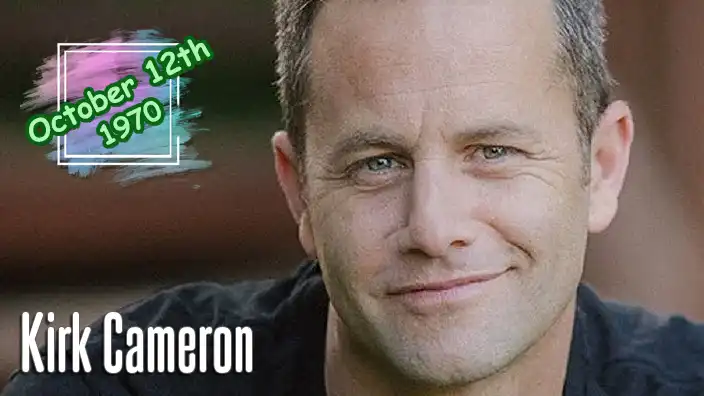
October 12, 1970, in Panorama City, California

Kirk Thomas Cameron was born on October 12, 1970, in Panorama City, California, and became one of American television's most recognizable teenage stars during the 1980s. Best remembered for portraying the mischievous Mike Seaver on the beloved ABC sitcom Growing Pains, Cameron enjoyed the kind of popularity that once required magazine posters, fan-club memberships, and a considerable amount of space on bedroom walls. His charming smile, comic timing, and ability to portray a lovable troublemaker helped make him a household name. However, his career eventually followed a different direction as he moved away from mainstream Hollywood productions and became increasingly involved in Christian filmmaking, television programs, publishing, and public speaking. His journey from teenage sitcom sensation to faith-based entertainer has made him a distinctive figure in American popular culture.
Kirk Cameron grew up in Southern California as one of four children born to Robert and Barbara Cameron. His father worked as a teacher, while his mother managed the household and supported her children's early entertainment ambitions. His younger sister, Candace Cameron Bure, would also become a familiar television personality through her portrayal of D.J. Tanner on the popular sitcom Full House. Kirk began pursuing acting as a child, reportedly encouraged by his friendship with young performer Adam Rich, who appeared on the television drama Eight Is Enough. His early professional experience included commercials for familiar products such as McDonald's, Polaroid, and Count Chocula cereal. These assignments introduced him to the entertainment business at a time when most children were primarily concerned with schoolwork, Saturday morning cartoons, and persuading their parents that another bowl of sugary cereal was perfectly reasonable.
Cameron's early television work included appearances in the family drama Two Marriages, which aired during the 1980s, along with other television projects and guest roles. Although these assignments helped him develop his acting skills, his breakthrough arrived in 1985 when he was cast as Mike Seaver in Growing Pains. Created by Neal Marlens, the ABC sitcom followed the everyday adventures of the Seaver family, whose household combined traditional family values with the changing social expectations of the decade. Alan Thicke portrayed psychiatrist Dr. Jason Seaver, while Joanna Kerns played his wife, journalist Maggie Seaver. Tracey Gold appeared as their intelligent and frequently exasperated daughter Carol, and Jeremy Miller portrayed the youngest son, Ben. Cameron's Mike quickly became one of the show's central attractions, largely because he possessed an extraordinary ability to create trouble while maintaining the innocent expression of someone who had absolutely no idea how the refrigerator ended up in the swimming pool.
Growing Pains premiered on September 24, 1985, and ran for seven seasons until April 25, 1992. The series became a familiar part of American television during an era when families regularly gathered around the living-room television to watch network sitcoms together. Its stories explored parenting, teenage relationships, sibling rivalries, school problems, and the sometimes complicated business of growing up. The show's central premise involved Jason Seaver working from home while Maggie returned to her journalism career, creating opportunities for comedy about changing family responsibilities. Although the Seavers encountered plenty of disagreements, their problems were generally resolved through conversation, understanding, and the occasional stern parental lecture. The format was comforting, predictable, and enormously popular, particularly with viewers who appreciated family entertainment that combined humor with recognizable everyday situations.
Mike Seaver became the character most closely associated with Kirk Cameron's early success. A charming but academically unenthusiastic teenager, Mike preferred dating, practical jokes, and elaborate schemes to the more demanding responsibilities of schoolwork. His attempts to avoid trouble frequently created even greater complications, much to the frustration of his parents and his academically accomplished sister, Carol. Cameron portrayed Mike with an appealing combination of confidence, humor, and vulnerability, allowing audiences to enjoy the character's questionable decisions without entirely losing sympathy for him. His comic timing and expressive reactions became essential elements of the show's popularity. Mike was the sort of teenager who could produce an excuse for almost any situation, although whether the explanation bore even a passing resemblance to the truth was another matter entirely.
As Growing Pains became a ratings success, Kirk Cameron developed into one of the most recognizable teenage heartthrobs of the late 1980s. His image appeared on magazine covers, posters, and promotional merchandise, while entertainment publications regularly featured interviews and photographs of the young actor. Publications such as Tiger Beat and Teen Beat helped sustain the celebrity culture surrounding television performers, and Cameron became a familiar favorite among teenage audiences. His popularity reflected an era before social media, when fans relied on magazines, television interviews, and carefully preserved photographs to follow their favorite stars. A bedroom wall covered with Kirk Cameron posters was once a perfectly respectable declaration of teenage devotion, although parents occasionally wondered whether there was any wallpaper left underneath.
Cameron's performance on Growing Pains earned him considerable industry recognition, including two Golden Globe nominations for Best Supporting Actor in a television production, in 1988 and 1989. He also received Young Artist Awards and other recognition for his work during the show's successful run. These honors reflected the effectiveness of his performance within a competitive television landscape that included numerous popular family sitcoms. Although Mike Seaver was often portrayed as academically careless and occasionally irresponsible, Cameron's acting required considerable discipline, particularly as the show's production schedule coincided with his own adolescence. Maintaining a leading role in a successful network series involved long working days, script preparation, rehearsals, publicity commitments, and the challenge of growing up while millions of viewers watched.
While starring in Growing Pains, Cameron expanded his career into feature films. In 1987, he appeared opposite Dudley Moore in the fantasy comedy Like Father Like Son, portraying Chris Hammond, a teenager who accidentally exchanges bodies with his father. The film explores the familiar comic premise of parents and children discovering that each other's lives are considerably more complicated than they had imagined. Cameron's performance required him to portray a young person suddenly behaving like an adult, while Moore played the bewildered father attempting to navigate teenage life. The film provided Cameron with a prominent theatrical role and introduced him to audiences beyond his television following. It also reinforced the suspicion that many teenagers secretly believe they could manage their parents' responsibilities rather better, at least until the bills arrive.
In 1989, Cameron starred in Listen to Me, a romantic drama set within the world of competitive college debating. The film featured Jami Gertz, Roy Scheider, and Amanda Peterson, with Cameron portraying Tucker Muldowney, a talented student whose involvement in debate competition intersects with personal relationships and ideological disagreements. Although the film did not achieve the commercial success of his television work, it represented an effort to explore more mature material as his career developed. Cameron also appeared in the 1990 television movie The Willies, an anthology horror-comedy featuring unusual and sometimes grotesque stories. These productions demonstrated his willingness to work outside the comfortable surroundings of the Seaver household, even if audiences continued to associate him primarily with the character who had made him famous.
During the later years of Growing Pains, Cameron's personal beliefs underwent a significant transformation. He has described becoming an evangelical Christian during his teenage years, a development that increasingly influenced his professional decisions and personal priorities. His religious conversion became an important turning point in his life, eventually shaping the kinds of productions he wished to participate in and the messages he wanted his work to communicate. Cameron has spoken openly about the challenges of reconciling his changing beliefs with the expectations of mainstream entertainment. His growing commitment to Christianity sometimes created tensions surrounding the sitcom's creative direction, and his relationship with certain colleagues became a subject of public discussion. Nevertheless, he remained with Growing Pains through its final season, completing the role that had established his television reputation.
Another important development during Growing Pains was Cameron's relationship with actress Chelsea Noble, who joined the series as Kate McDonnell, Mike Seaver's girlfriend. Their on-screen romance eventually developed into a real-life relationship, and the couple married on July 21, 1991. Their marriage became one of the enduring personal connections associated with the sitcom, demonstrating that fictional television romances occasionally produce considerably more lasting results than the writers originally anticipated. Cameron and Noble went on to raise six children, four adopted and two biological. Their family life has remained an important part of Cameron's public identity, and the couple have frequently collaborated on charitable, religious, and entertainment projects. For viewers who remember Mike Seaver's elaborate attempts to impress girls, the knowledge that he eventually married his television girlfriend provides a rather satisfying conclusion to the story.
Following the conclusion of Growing Pains in 1992, Cameron continued acting while gradually pursuing projects more closely aligned with his religious beliefs. He starred in the television sitcom Kirk, which aired on The WB from 1995 to 1997. The series featured Cameron as Kirk Hartman, a young man who unexpectedly becomes responsible for raising his younger siblings after their parents' deaths. Unlike the teenage Mike Seaver, Kirk Hartman faces adult responsibilities involving employment, family relationships, and the difficulties of caring for children. Although the program did not achieve the longevity or cultural impact of Growing Pains, it provided Cameron with another starring television role and allowed him to explore a different kind of family comedy. The experience also demonstrated that escaping the Seaver household did not necessarily mean escaping fictional family problems.
Cameron returned to his most famous character in the television reunion films The Growing Pains Movie (2000) and Growing Pains: Return of the Seavers (2004). These productions reunited several members of the original cast and revisited the family relationships that had made the sitcom popular. By this time, the characters had moved into different stages of adulthood, creating opportunities to explore marriage, parenthood, and changing family responsibilities. The reunion films appealed particularly to viewers who had grown up watching the original series and welcomed the opportunity to revisit familiar television personalities. Such productions also reflected the continuing popularity of nostalgic entertainment, particularly when audiences could reconnect with characters who had once occupied a regular place in their weekly television schedules.
One of Cameron's most significant post-sitcom roles came with Left Behind: The Movie (2000), a Christian apocalyptic thriller adapted from the bestselling novel by Tim LaHaye and Jerry B. Jenkins. Cameron portrayed Cameron "Buck" Williams, an investigative journalist attempting to understand a series of mysterious disappearances connected to the Christian interpretation of the biblical Rapture. The film combined religious themes with elements of suspense, political intrigue, and speculative fiction. Cameron reprised the role in Left Behind II: Tribulation Force (2002) and Left Behind: World at War (2005). Although the films received mixed or negative mainstream critical reviews, they attracted audiences interested in Christian fiction and contributed to the growth of faith-based home entertainment. Cameron's involvement marked a decisive shift toward productions intended primarily for religious audiences.
The Left Behind films were part of a broader movement within Christian entertainment that sought to create alternatives to conventional Hollywood productions. These projects frequently emphasized biblical narratives, moral choices, family relationships, and questions of faith. Cameron became increasingly involved in this segment of the entertainment industry, appearing in productions such as The Miracle of the Cards (2001) and supporting religious television programming. His career demonstrated that performers could build an audience outside traditional studio systems, particularly through churches, religious organizations, independent distributors, and home-video markets. While such productions often attracted less attention from mainstream film critics, they developed dedicated audiences who valued their religious messages and family-oriented themes.
In 2008, Cameron starred in Fireproof, a Christian drama directed by Alex Kendrick and produced by Sherwood Pictures. He portrayed Caleb Holt, a firefighter whose troubled marriage is approaching collapse. Encouraged by his father, Caleb undertakes a forty-day challenge intended to help him reconsider his behavior, responsibilities, and commitment to his wife. The film explores marriage, forgiveness, personal accountability, and religious faith, presenting its central message through the story of a couple attempting to rebuild their relationship. Produced on a modest budget of approximately $500,000, Fireproof became a significant commercial success, earning more than $33 million at the domestic box office. Its performance demonstrated the considerable audience for independently produced Christian films and established Cameron as a prominent performer within faith-based cinema.
Fireproof also inspired The Love Dare, a companion book built around the relationship principles explored in the film. The book became a bestseller and helped extend the production's influence beyond movie theaters. Cameron's involvement attracted attention because of his commitment to portraying marriage in accordance with his personal beliefs. During production, his wife Chelsea Noble served as a stand-in for a romantic scene involving his character, reflecting Cameron's stated preference not to kiss actresses other than his wife. The arrangement became one of the film's widely discussed behind-the-scenes details. It also offered an unusually practical solution to a filmmaking problem: when the script calls for a kiss, bring your spouse to work.
Cameron's religious activities expanded beyond filmmaking through his involvement with evangelist Ray Comfort and the Christian ministry The Way of the Master. The ministry developed television programming, educational materials, and public outreach initiatives intended to encourage Christian evangelism. Cameron co-hosted the television series The Way of the Master, which explored approaches to discussing Christian beliefs and sharing religious messages. His involvement made him a recognizable figure within evangelical Christian communities and provided a platform for public speaking, conferences, and other religious events. While some viewers continued to remember him primarily as Mike Seaver, others became familiar with Cameron through his ministry activities and faith-based productions.
His public religious advocacy has also generated controversy. Cameron has expressed conservative Christian positions on marriage, sexuality, and other social issues, sometimes drawing criticism from LGBTQ advocacy organizations and members of the entertainment industry. Particularly notable was a 2012 television interview in which his comments about homosexuality prompted widespread public debate. Supporters defended his right to express his religious convictions, while critics argued that his statements were harmful and discriminatory. These disagreements illustrate the distinction between Cameron's nostalgic television image and his later role as a prominent religious commentator. His public career has consequently attracted both enthusiastic support and substantial criticism, reflecting the broader cultural disagreements surrounding religion, social values, and public expression.
Cameron continued producing and appearing in religiously themed entertainment through projects including Monumental: In Search of America's National Treasure (2012), a documentary exploring his interpretation of America's historical and religious foundations. He also appeared in Unstoppable (2013), which examined questions of suffering, faith, and religious belief. In 2014, he starred in Saving Christmas, a holiday comedy-drama that attempted to address criticisms of familiar Christmas traditions from a Christian perspective. The film received overwhelmingly negative reviews from mainstream critics and became widely discussed for its poor reception. Nevertheless, Cameron continued developing projects intended for audiences interested in religious and family-oriented entertainment, maintaining a professional direction consistent with his stated priorities.
His later work has included Lifemark (2022), a drama inspired by a real-life adoption story. Cameron served as an executive producer and appeared in the film, which explores the emotional experiences of an adopted young man and his biological family. The production reflected Cameron's longstanding interest in adoption, a subject with personal significance because of his own family's experiences. He also produced The Homeschool Awakening (2022), a documentary examining homeschooling through the experiences of families who have chosen that educational approach. Both productions reflected his increasing emphasis on family life, parenting, and religiously informed perspectives on contemporary social issues.
In addition to film and television work, Cameron has become involved in children's publishing. His 2022 picture book As You Grow, published by Brave Books, uses an illustrated story to introduce young readers to themes involving character, personal growth, and religious values. The publication led to library appearances, public readings, and events promoting children's literacy and faith-based family activities. Cameron subsequently participated in the See You at the Library initiative, encouraging families to organize community reading events. These activities attracted both supporters and critics, particularly when discussions about library programming became connected with broader debates over religion, education, and public institutions. His involvement illustrates how his career has expanded from performing fictional family stories to participating directly in public conversations about childhood, parenting, and education.
Cameron has also hosted Takeaways with Kirk Cameron, a television program associated with Trinity Broadcasting Network. The series features conversations about family relationships, religious beliefs, personal challenges, and contemporary cultural issues. Through interviews with guests from religious, entertainment, and other professional backgrounds, Cameron has continued developing his role as a television presenter and commentator. His work now encompasses acting, producing, writing, hosting, and public speaking, demonstrating a professional identity considerably broader than the teenage sitcom character who originally made him famous.
Away from professional entertainment, Cameron and Chelsea Noble established the Firefly Foundation, which supports charitable activities benefiting children and families. Their Camp Firefly initiative provides recreational experiences for seriously ill children and their relatives, offering opportunities for families to spend time together outside the routines and pressures of medical treatment. The couple's charitable work reflects their interest in supporting families facing difficult circumstances. Cameron has frequently emphasized the importance of marriage, parenting, and family relationships in his public appearances, drawing connections between his personal experiences and the themes explored in his entertainment projects.
The continuing popularity of Growing Pains remains an important part of Cameron's legacy. The sitcom belongs to a distinctive period of American television when family comedies dominated network schedules and characters became familiar companions to millions of viewers. Alongside programs such as Family Ties, The Cosby Show, and Who's the Boss?, Growing Pains helped define the family-sitcom landscape of the 1980s. Its combination of humor, domestic disagreements, and reassuring resolutions appealed to audiences who enjoyed watching recognizable family problems unfold within a fictional household. Cameron's Mike Seaver remains one of the show's most memorable characters, and his performance continues to evoke nostalgia for an era of television when a mischievous teenager could create twenty minutes of chaos and still receive a reassuring hug before the closing credits.
The series also provided early exposure for performers who would later achieve considerable success. Leonardo DiCaprio joined Growing Pains during its final season as Luke Brower, a homeless teenager taken into the Seaver household. Long before DiCaprio became an Academy Award-winning film star, he appeared alongside Cameron and the established sitcom cast. Other performers who appeared during the show's run included Brad Pitt and Matthew Perry, adding further interest to the program's entertainment history. These connections demonstrate how successful television series can become important early stepping stones for future Hollywood performers, even when nobody watching at the time realizes that a guest star will eventually become an international movie sensation.
As Kirk Cameron celebrates his birthday on October 12, his career reflects an unusual journey through several different corners of American entertainment. From childhood commercials and teenage magazine covers to the enormous popularity of Growing Pains, he experienced the kind of early celebrity that few young performers achieve. His later decision to concentrate on Christian filmmaking, religious programming, publishing, and public speaking transformed his professional identity and introduced him to a different audience. Although his public positions have sometimes generated controversy, his place in television history remains closely connected to the character of Mike Seaver and the sitcom that made him famous. For generations of viewers who remember the Seaver family, Kirk Cameron will always be the teenager with the mischievous grin, the questionable homework habits, and an apparently unlimited supply of excuses. Some television characters simply refuse to grow old in our memories, even when the actors themselves have long since moved on to entirely different adventures.