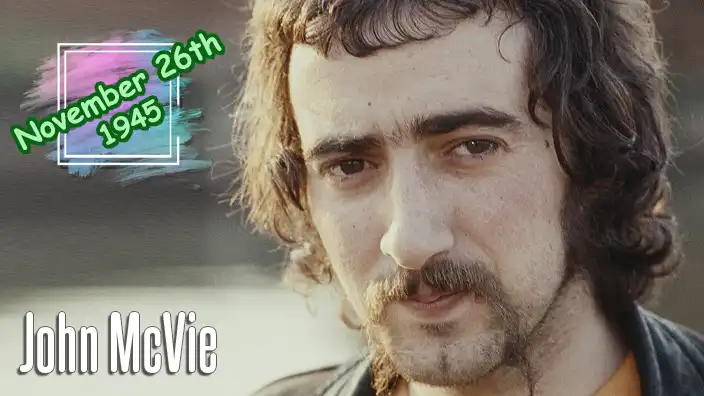
November 26, 1945, in Ealing, England


John Graham McVie is an English bass guitarist best known as a founding-era member of the legendary British-American rock band Fleetwood Mac. Recognized for his exceptional musicianship, melodic bass lines, and understated stage presence, McVie helped provide the musical foundation for one of the most commercially successful bands in rock history. From the British blues movement of the 1960s to the international success of albums such as Rumours and Tango in the Night, his distinctive playing has influenced generations of bass guitarists. While his fellow band members frequently attracted headlines concerning romantic relationships, musical disagreements, and spectacular personal upheavals, McVie generally preferred to concentrate on the music. Every successful organization needs someone who knows what they're doing while everyone else is arguing.
Born in Ealing, West London, England, McVie was the son of Reg and Dorothy McVie and attended Walpole Grammar School. His introduction to music came through playing the trumpet before developing an interest in the guitar. Recognizing that many of his friends were attempting to become lead guitarists, he decided to concentrate on the bass instead. His father encouraged his musical ambitions by purchasing a pink Fender bass guitar, similar to the instrument played by Jet Harris of the Shadows, one of McVie's early musical influences. Before becoming a professional musician, however, McVie trained as a tax inspector, an occupation considerably less glamorous than international rock stardom but presumably involving fewer arguments over album royalties.
McVie's professional musical career began during the flourishing British blues movement when he joined John Mayall & the Bluesbreakers in 1963. Mayall's band became something of a musical training establishment for future rock legends, providing opportunities for talented musicians to develop their skills and establish their reputations. During his time with the Bluesbreakers, McVie performed alongside celebrated guitarists including Eric Clapton, Peter Green, and Mick Taylor. His work appeared on influential recordings such as Blues Breakers with Eric Clapton, A Hard Road, and Crusade. These experiences helped establish his understanding of traditional blues rhythms and the importance of supporting other musicians without unnecessarily competing for attention.
The origins of Fleetwood Mac can be traced to McVie's association with guitarist Peter Green and drummer Mick Fleetwood during their time with the Bluesbreakers. In 1967, Green decided to form a new blues band and invited Fleetwood and McVie to join him. McVie initially declined, preferring the financial security of his existing employment with John Mayall. Green nevertheless named the new group Fleetwood Mac, combining the surnames of his preferred rhythm section. Temporary bassist Bob Brunning performed with the group until McVie finally joined in September 1967. It was an unusual recruitment strategy, considering that McVie already had his name on the company letterhead before agreeing to work for the company.
The early Fleetwood Mac was considerably different from the internationally famous pop-rock group that emerged during the following decade. Under Peter Green's leadership, the band concentrated on British blues and blues-rock, releasing its self-titled debut album in 1968. Early successes included songs such as Black Magic Woman, Need Your Love So Bad, Albatross, Man of the World, and Oh Well. The instrumental recording Albatross reached number one on the British singles chart, demonstrating the group's ability to produce atmospheric and commercially successful music without relying on lyrics. McVie's bass playing complemented Green's expressive guitar work, helping establish Fleetwood Mac as one of Britain's leading blues bands.
In 1968, McVie married Christine Perfect, an accomplished blues singer, pianist, and member of the British band Chicken Shack. Christine had already established an impressive reputation as a musician before officially joining Fleetwood Mac in 1970. Her songwriting, keyboard playing, and distinctive vocals would become essential components of the band's developing musical identity. During the early 1970s, Fleetwood Mac experienced numerous personnel changes, musical experiments, and periods of uncertainty following Peter Green's departure. Nevertheless, John McVie and Mick Fleetwood continued providing the rhythmic foundation that allowed the group to survive its seemingly endless reorganizations. Fleetwood Mac was beginning to resemble a railway station: musicians regularly arrived, departed, and occasionally missed their connections.
A major turning point occurred when American musicians Lindsey Buckingham and Stevie Nicks joined Fleetwood Mac at the end of 1974. Their arrival completed the band's most commercially successful lineup, alongside John McVie, Christine McVie, and Mick Fleetwood. The resulting 1975 album, Fleetwood Mac, introduced audiences to enduring favorites including Rhiannon, Landslide, Say You Love Me, and Over My Head. The album reached number one on the American Billboard 200 chart, transforming Fleetwood Mac from an established blues-rock act into an international musical powerhouse. McVie's adaptability allowed him to move comfortably between the band's traditional blues influences and its increasingly sophisticated pop-rock arrangements.
Fleetwood Mac achieved extraordinary commercial success with the release of Rumours in 1977. Recorded during a period of considerable personal turmoil, the album reflected the breakdown of John and Christine McVie's marriage, the deteriorating relationship between Stevie Nicks and Lindsey Buckingham, and difficulties in Mick Fleetwood's personal life. Rather than allowing these circumstances to destroy the band, the musicians transformed their experiences into one of the most celebrated albums in popular music history. Featuring classics such as Dreams, Don't Stop, Go Your Own Way, and You Make Loving Fun, Rumours won the Grammy Award for Album of the Year and went on to sell tens of millions of copies worldwide. Apparently, Fleetwood Mac discovered that airing one's dirty laundry could be remarkably profitable, provided it was accompanied by an excellent rhythm section.
One of John McVie's most recognizable musical contributions appears in The Chain, the only song on Rumours credited to all five members of the classic Fleetwood Mac lineup. His memorable bass passage introduces the dramatic instrumental closing section, gradually building tension before the guitars and drums produce an explosive musical finale. The passage became particularly familiar to British motorsport enthusiasts when it was adopted as the theme music for BBC television coverage of Formula One racing. Consequently, millions of people who might not immediately recognize John McVie's name can probably identify his bass playing within seconds, especially if they happen to be imagining racing cars hurtling around Silverstone.
Following the remarkable success of Rumours, Fleetwood Mac continued exploring new musical directions with the ambitious double album Tusk in 1979. Subsequent albums included Mirage in 1982 and Tango in the Night in 1987, the latter producing international hits such as Big Love, Little Lies, Everywhere, and Seven Wonders. Throughout these recordings, McVie demonstrated his remarkable ability to adapt his bass playing to changing production techniques and musical styles. His contributions rarely overwhelmed the group's arrangements, instead providing carefully constructed musical support that enhanced the performances of his fellow musicians. His playing illustrates an important principle of musicianship: knowing when not to play can be every bit as important as knowing which notes to play.
Although John and Christine McVie divorced in 1976, they maintained a professional musical relationship that continued for decades. Their ability to perform together despite the end of their marriage contributed significantly to Fleetwood Mac's longevity. John subsequently pursued a more private personal life, balancing his musical career with interests away from the recording studio and concert stage. One of his particular passions was sailing, an activity offering considerably more peace and solitude than the average Fleetwood Mac recording session. Of course, navigating unpredictable seas was probably excellent preparation for navigating the complicated relationships within the band.
Beyond Fleetwood Mac, McVie explored his own musical interests with the release of John McVie's Gotta Band with Lola Thomas in 1992. The album provided an opportunity to revisit his blues influences and demonstrate his musical abilities outside the enormously successful group with which he had become synonymous. Although his solo work never approached the commercial success of Fleetwood Mac, it reflected his continuing appreciation for the musical traditions that had originally inspired his career. Unlike many internationally recognized musicians, McVie never appeared particularly interested in establishing himself as a flamboyant solo performer. He was evidently quite content to let his bass guitar do most of the talking.
Fleetwood Mac experienced a major revival in 1997 when the classic lineup reunited for The Dance, a live album and concert production celebrating the group's extensive musical catalog. The reunion introduced their music to a new generation while reminding longtime fans of the extraordinary chemistry between the five musicians. McVie continued participating in subsequent recording projects and international concert tours, including the band's Say You Will era and later reunion with Christine McVie. His partnership with Mick Fleetwood remained a defining feature of the group's sound, demonstrating the enduring musical understanding between two musicians who had first worked together during the British blues movement.
In 1998, John McVie was inducted into the Rock and Roll Hall of Fame as a member of Fleetwood Mac, recognizing his enormous contribution to the development of blues-rock and popular music. His reputation among fellow musicians has frequently exceeded his public profile, largely because of his preference for serving the music rather than pursuing individual recognition. Rolling Stone included him in its list of the greatest bassists of all time, acknowledging his distinctive melodic approach and remarkable consistency. McVie and Mick Fleetwood were the only musicians to perform on every Fleetwood Mac studio album, an impressive achievement considering the band's extraordinary history of personnel changes.
John McVie's legacy extends well beyond the millions of albums sold by Fleetwood Mac. His musicianship represents the essential role of the bass guitarist in popular music, providing the connection between rhythm, harmony, and melody that allows other instruments and voices to flourish. Although he rarely occupied center stage, his contributions helped shape some of the most memorable recordings in rock history. From traditional British blues clubs to sold-out international arenas, McVie demonstrated that musical excellence does not necessarily require elaborate stage costumes, spectacular guitar solos, or attention-seeking behavior. Sometimes, four strings, exceptional timing, and the patience of a saint are sufficient — particularly when your colleagues are the other members of Fleetwood Mac.
AllMusic – John McVie Biography – Musical career, British blues influences, Fleetwood Mac history, and recordings. Rock and Roll Hall of Fame – Fleetwood Mac – Official induction essay, musical achievements, and historical significance. John Mayall – Official Biography – History of the Bluesbreakers and their influence on British rock music. Everything Fleetwood Mac – John McVie Biography – Early life, musical influences, personal history, and career development. Fleetwood Mac UK – A Life with Fleetwood Mac – John McVie's interview discussing his musicianship, bass guitars, and experiences with the band. AllMusic – Fleetwood Mac Biography – Band history, lineup changes, landmark albums, and commercial success.References & Sources