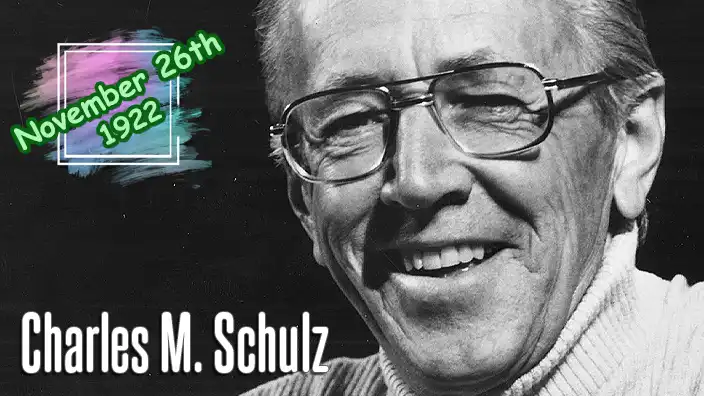
November 26, 1922, in Minneapolis, Minnesota
 February 12, 2000, in Santa Rosa, California

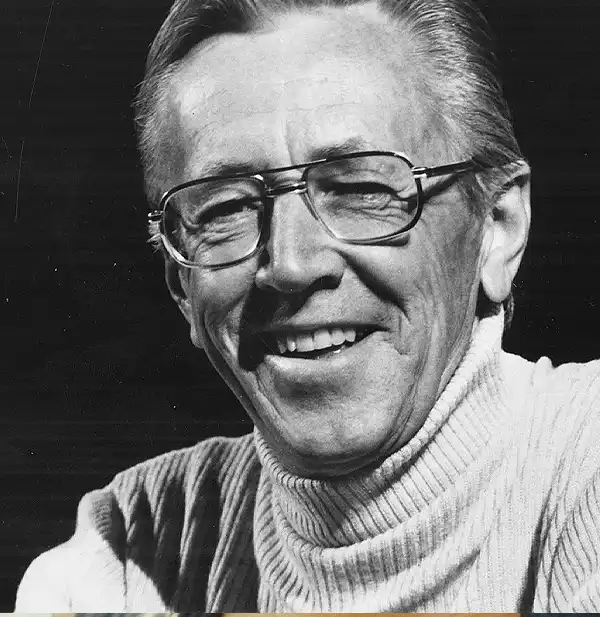
Charles Monroe Schulz was an American cartoonist, writer, and creative genius best known for creating Peanuts, one of the most successful and influential comic strips in newspaper history. Through the enduring adventures of Charlie Brown, Snoopy, Lucy, Linus, Woodstock, and their friends, Schulz transformed everyday disappointments, childhood anxieties, friendships, and philosophical observations into entertainment enjoyed by generations. His remarkable ability to communicate complicated human emotions through deceptively simple drawings earned him international recognition and a permanent place in popular culture. Few cartoonists have managed to make failure quite so entertaining, particularly when it involves a kite, a baseball game, or an uncooperative football.
Born in Minneapolis and raised in St. Paul, Minnesota, Schulz was the only child of Carl and Dena Schulz. His father worked as a barber, and the two regularly enjoyed reading the Sunday newspaper comics together. An uncle nicknamed him "Sparky," inspired by Spark Plug, a racehorse featured in the popular comic strip Barney Google. The nickname remained with him throughout his life, proving remarkably appropriate for someone destined to become a cartoonist. Schulz developed an early fascination with drawing and admired characters such as Popeye and Mickey Mouse. His first published drawing appeared in Ripley's Believe It or Not! in 1937 and depicted his family's unusually resourceful dog, Spike, who later provided inspiration for Snoopy.
Schulz's journey toward becoming a professional cartoonist was interrupted by World War II, during which he served in the United States Army with the 20th Armored Division. His military experiences, combined with the devastating loss of his mother around the beginning of his service, profoundly influenced his understanding of loneliness, uncertainty, and human vulnerability. Following his return to civilian life in 1945, Schulz worked as an art instructor and continued pursuing his ambition of becoming a syndicated cartoonist. He sold cartoons to The Saturday Evening Post and developed a weekly comic feature called Li'l Folks for the St. Paul Pioneer Press. Although success did not arrive immediately, his determination never disappeared — a quality that would later become wonderfully familiar to anyone watching Charlie Brown attempt to kick a football.
In 1950, Schulz secured a contract with United Feature Syndicate, and Peanuts made its newspaper debut on October 2 in just seven American newspapers. Interestingly, Schulz disliked the title, which had been selected by the syndicate rather than by the cartoonist himself. Despite his reservations, Peanuts gradually developed into an international phenomenon, eventually appearing in more than 2,600 newspapers worldwide. Its success demonstrated that readers did not necessarily require elaborate illustrations, spectacular adventures, or heroic victories. Sometimes, all they needed was a disappointed little boy, an opinionated friend, and a dog whose imagination considerably exceeded his owner's ambitions.
Charlie Brown became the emotional heart of the Peanuts comic strip, embodying insecurity, determination, disappointment, and the persistent belief that tomorrow might somehow be better. His inability to win baseball games, successfully fly a kite, or establish a romantic relationship with the mysterious Little Red-Haired Girl made him wonderfully relatable. Schulz understood that failure was a universal experience and that humor could make it a little easier to accept. Charlie Brown's greatest achievement was arguably his refusal to surrender, despite possessing a sporting record that would have resulted in the dismissal of virtually any professional baseball manager.
Snoopy, meanwhile, developed from an ordinary household pet into one of the most recognizable fictional dogs in the world. His extraordinary imagination allowed him to become a World War I flying ace, a struggling novelist, a sophisticated alter ego known as Joe Cool, and numerous other personalities. His independent spirit and talent for avoiding ordinary canine responsibilities made him an ideal contrast to Charlie Brown's endless worrying. Snoopy could conduct aerial warfare from the roof of a doghouse, yet apparently considered fetching a stick beneath his professional qualifications.
The supporting characters were equally important to the success of Peanuts. Lucy van Pelt offered unsolicited opinions and inexpensive psychiatric consultations, while her younger brother Linus combined philosophical wisdom with an unwavering attachment to his security blanket. Schroeder introduced generations of children to the music of Ludwig van Beethoven, Peppermint Patty approached life with athletic enthusiasm and academic confusion, and Woodstock demonstrated that meaningful communication did not necessarily require recognizable words. Schulz gave each character a distinctive personality, creating a fictional community where readers could recognize their own friends, relatives, colleagues, and occasionally themselves.
What distinguished Charles M. Schulz from many other cartoonists was his willingness to explore serious subjects through humor. Peanuts addressed loneliness, friendship, rejection, faith, prejudice, ambition, and the challenges of growing up without abandoning its gentle comic appeal. His characters often displayed emotional complexities more commonly associated with adult literature than newspaper cartoons. Schulz also introduced Franklin in 1968, bringing an African American character into the regularly appearing cast during an important period in the American civil rights movement. His approach to storytelling encouraged readers to consider important social and personal issues without turning the comic strip into a prolonged lecture.
The popularity of Peanuts expanded beyond newspapers into animated television specials, feature films, theatrical productions, books, and merchandise. The 1965 television special A Charlie Brown Christmas, featuring the memorable jazz music of Vince Guaraldi, became a beloved Christmas tradition. Other productions, including It's the Great Pumpkin, Charlie Brown, A Charlie Brown Thanksgiving, A Boy Named Charlie Brown, and Snoopy Come Home, further established the characters as entertainment icons. Schulz's work demonstrated that family entertainment could be thoughtful, occasionally melancholy, and enormously funny without requiring excessive noise, spectacular explosions, or a confused superhero wearing his underwear over his trousers.
The influence of Charles M. Schulz even extended beyond Earth. During NASA's Apollo 10 mission in 1969, the command module was named Charlie Brown and the lunar module Snoopy. The connection between NASA and the Peanuts characters became an enduring part of American space exploration history. Snoopy also became associated with NASA's Silver Snoopy Award, which recognizes outstanding contributions to astronaut safety and mission success. Not bad for a beagle whose original aviation qualifications consisted primarily of sitting on a doghouse.
Away from his drawing board, Schulz enjoyed sports, particularly ice hockey and figure skating. After moving to California, he helped establish the Redwood Empire Ice Arena in Santa Rosa, popularly known as Snoopy's Home Ice. His enthusiasm for sports frequently appeared in his cartoons, with baseball, football, tennis, hockey, and golf providing opportunities for both humor and disaster. Schulz seemingly understood that organized sports offered an almost unlimited supply of comic material, especially when Charlie Brown was placed in charge.
Throughout his extraordinary career, Schulz received numerous prestigious honors, including two Reuben Awards from the National Cartoonists Society, Emmy Awards, a Peabody Award, and a star on the Hollywood Walk of Fame. He was also posthumously awarded the Congressional Gold Medal in recognition of his contributions to American culture. His astonishing output of 17,897 original Peanuts comic strips was particularly remarkable because he personally handled the writing, drawing, inking, and lettering. In an industry where successful creators frequently employed assistants, Schulz maintained direct artistic control over his beloved characters.
Declining health eventually forced Schulz to announce his retirement in December 1999. He passed away on February 12, 2000, following complications from colon cancer, just hours before his final original Sunday comic strip appeared in newspapers. The extraordinary timing brought an emotional conclusion to nearly half a century of storytelling. The Charles M. Schulz Museum and Research Center subsequently opened in Santa Rosa, California, in 2002, preserving his artwork, personal history, and enormous contribution to the development of cartooning.
The legacy of Charles M. Schulz continues through comic strip collections, animated productions, museum exhibitions, and the enduring popularity of the Peanuts characters. His observations about human nature remain relevant because disappointment, friendship, uncertainty, hope, and imagination never go out of fashion. Schulz reminded readers that happiness could be found in simple pleasures, that imperfection was perfectly acceptable, and that even the most unsuccessful among us deserved another opportunity. He also taught generations of readers one particularly valuable lesson: never trust Lucy when she's holding a football.
Charles M. Schulz Museum – Official Biography – Personal history, artistic career, character development, and achievements. Charles M. Schulz Museum – Historical Timeline – Comprehensive chronology of his life and professional accomplishments. IMDb – Charles M. Schulz – Biography, television and film credits, awards, and trivia. California Museum – Charles M. Schulz – Cultural contributions, professional achievements, and honors. Minnesota Historical Society – Charles M. Schulz – Childhood, military service, artistic education, and early career. Charles M. Schulz Museum – Life and Art of Charles M. Schulz – Artistic influences, storytelling, and the enduring cultural significance of Peanuts.References & Sources