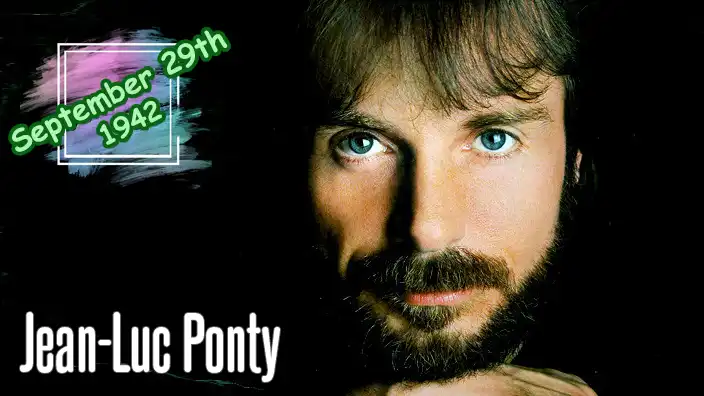
September 29, 1942, in Avranches, France
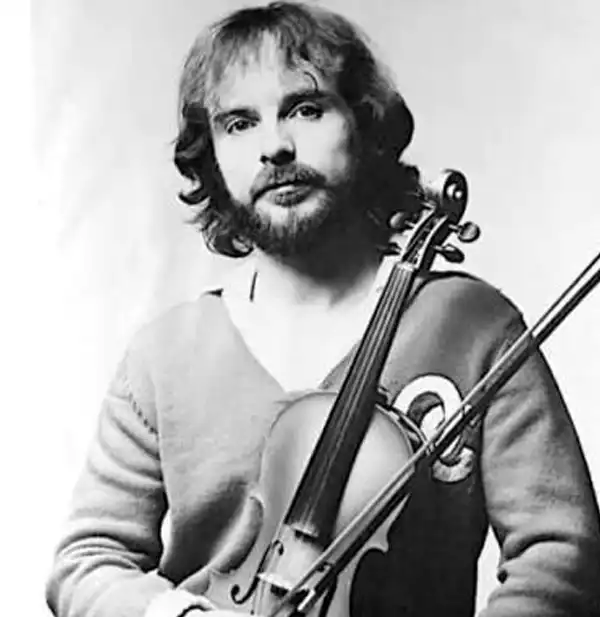
Born on September 29, 1942, in Avranches, France, Jean-Luc Ponty arrived in a family where music was less a hobby than part of the household infrastructure. His father taught violin and his mother taught piano, giving their son an unusually strong musical foundation from childhood. Ponty was admitted to the Conservatoire National Supérieur de Musique de Paris at sixteen and graduated two years later with the institution's Premier Prix, its highest award. He immediately entered professional classical music, joining the Concerts Lamoureux orchestra in Paris. It was an impressive beginning for a young violinist who, by all reasonable expectations, seemed headed toward a respectable career in classical music. Reasonable expectations, however, were about to encounter jazz.
While working as an orchestral musician, Ponty began playing clarinet with a college jazz band. He became increasingly fascinated by modern jazz, particularly the music of Miles Davis and John Coltrane, and taught himself tenor saxophone as part of his exploration. Eventually he brought his violin into the equation. That decision was crucial because Ponty was not simply attempting to reproduce the established jazz-violin traditions of players such as Stéphane Grappelli or Stuff Smith. He was absorbing bebop and the rapidly developing language of post-bop jazz, approaching the violin with ideas influenced by saxophonists and other modern improvisers. The result was an increasingly distinctive style in which classical precision and jazz improvisation ceased behaving like separate departments.
There was also a practical problem: violins were not designed to argue with drums, electric guitars and amplified keyboards. Ponty began experimenting with amplification, initially using contact microphones to make the instrument powerful enough for modern jazz settings. As technology developed, he embraced electric violins and electronic processing, ultimately using effects and expanded-range instruments to produce sounds that could sometimes seem closer to a synthesizer or electric guitar than to the violin encountered in a symphony orchestra. Electronics were not merely decorative additions to his playing; they became part of his musical vocabulary and helped make the violin viable as a lead instrument in increasingly loud and adventurous forms of jazz-rock.
Ponty's reputation grew quickly in Europe. His appearance at the Antibes Jazz Festival helped persuade him to leave the security of orchestral work and devote himself to jazz, and he recorded his first album as a leader while still a young musician. During the 1960s he performed with leading European jazz figures and attracted attention beyond France. He also worked with fellow violinists including Stéphane Grappelli, Stuff Smith and Svend Asmussen, demonstrating that he understood the instrument's jazz heritage even while he was busy extending it into considerably stranger territory.
America provided the setting for the next major stage of Ponty's career. By the late 1960s he was performing in the United States and working with musicians including George Duke. Then came Frank Zappa, which was hardly the conventional next step for a conservatory-trained French violinist but proved to be an excellent one. Ponty appeared on Zappa's influential 1969 album Hot Rats, and in 1970 released King Kong: Jean-Luc Ponty Plays the Music of Frank Zappa. Zappa's complex compositions, unusual rhythms and cheerful disregard for musical boundaries were naturally compatible with Ponty's own adventurous instincts. The association introduced Ponty to a wider audience while demonstrating that an electric violin could operate comfortably amid rock, jazz, experimental composition and whatever category anyone dared to place Zappa in that particular week.
Ponty later joined Zappa's Mothers of Invention and moved with his family to the United States. His work during this period included performances on Over-Nite Sensation and Apostrophe ('), recordings that became enduring parts of Zappa's catalog. Ponty had also contributed violin to Elton John's Honky Château, illustrating just how broad the demand for his playing had become. Within a remarkably short period, the French jazz violinist who had begun his professional life in a Paris orchestra was working with some of the most adventurous and commercially successful musicians in contemporary popular music.
Another important collaboration followed when guitarist John McLaughlin invited Ponty to join the second incarnation of the Mahavishnu Orchestra. Ponty had already admired McLaughlin's playing, and the opportunity placed him in one of jazz-rock fusion's most technically formidable ensembles. He appeared on Apocalypse and Visions of the Emerald Beyond, bringing his electric violin into music characterized by complex meters, rapid improvisation, powerful amplification and compositions that could make an ordinary four-four rhythm seem almost suspiciously easy. Mahavishnu Orchestra provided an ideal environment for Ponty's technique because virtuosity was not an occasional flourish in the band; it was practically the admission price.
By 1975, Ponty was ready to concentrate on his own music. He signed with Atlantic Records and released Upon the Wings of Music, beginning an extraordinarily productive period as a bandleader and composer. Albums including Aurora, Imaginary Voyage, Enigmatic Ocean, Cosmic Messenger and A Taste for Passion established the sound most strongly associated with Ponty's solo career. Electric violin floated over synthesizers, bass, guitar and elaborate percussion while his compositions combined jazz improvisation with progressive rock, electronic textures and carefully constructed melodic themes. Between 1975 and 1995, more than a dozen consecutive albums released under his name reached the top ten of the relevant U.S. jazz charts, evidence that this was not merely experimental music being admired by six musicians in a basement somewhere. Ponty had found a substantial international audience.
His approach to the violin continued to evolve alongside technology. Ponty became associated with five-string electric violins that extended the instrument's lower range, and he also used six-string instruments and electronic effects. His playing could retain the lyrical qualities expected of a violin one moment and then produce sustained, processed tones capable of cutting through a fusion ensemble the next. The important distinction was that technology never replaced technique. Ponty's years of classical training remained plainly audible in his intonation, speed and control, while jazz supplied the improvisational freedom and electronics greatly expanded the palette available to him.
Ponty was equally unwilling to let fusion become a fixed formula. His 1991 album Tchokola grew from extensive work with African musicians and rhythms, particularly musical traditions from West Africa. Ponty later described learning those complex overlapping rhythms as a humbling experience despite his considerable experience with intricate music. The project incorporated musicians and musical ideas that pushed him into unfamiliar rhythmic territory, demonstrating an important characteristic of his career: he repeatedly sought situations in which he still had something to learn. For a musician capable of playing passages that would make an ordinary violinist consider taking up gardening, that willingness to become a student again was significant.
In 1995 Ponty joined bassist Stanley Clarke and guitarist Al Di Meola for The Rite of Strings, an acoustic project that deliberately stripped away much of the electronic equipment associated with the three fusion stars. With Ponty on acoustic violin, Clarke on double bass and Di Meola on acoustic guitar, the trio demonstrated that their reputations did not depend upon amplifiers and effects. The album reached the upper reaches of Billboard's contemporary jazz chart and became another notable chapter in Ponty's long history of collaboration with musicians capable of frightening lesser mortals simply by beginning a sound check.
His collaborative career continued well into the following decades. Ponty joined Chick Corea, Stanley Clarke, Lenny White and Frank Gambale in Return to Forever IV for a major world tour in 2011, bringing together musicians whose individual histories were deeply connected with the development of jazz fusion. He later worked with former Yes vocalist Jon Anderson in the AndersonPonty Band. Their album Better Late Than Never, released in 2015, combined new material with rearranged Yes songs and Ponty compositions given new vocal melodies and lyrics by Anderson. It was another unlikely pairing that made considerably more sense once the musicians actually started playing.
Ponty's recorded legacy extends beyond albums carrying his own name. His violin has appeared in the work of Frank Zappa, Chick Corea, Elton John, Mahavishnu Orchestra and numerous other musicians, while his own bands have provided opportunities for accomplished instrumentalists from several generations. IMDb also records Ponty as an actor and composer in screen-related work, with credits including Miles from Home, Häxan and Take It to the Limit. His musical family tradition continued as well: his daughter Clara Ponty became a professional pianist and composer, and father and daughter have collaborated on musical projects.
What makes Jean-Luc Ponty's career particularly important is not simply that he played jazz on the violin. Jazz violin existed long before him. His contribution was helping redefine what the instrument could do within the electric music that emerged during the late 1960s and 1970s. He treated amplification, effects and extended-range instruments as legitimate extensions of a violinist's vocabulary while retaining the discipline of classical training and the improvisational demands of jazz. In doing so, he helped remove the electric violin from novelty status and established it as an instrument capable of standing alongside guitar, saxophone and keyboards at the center of a modern fusion ensemble.
Across decades of recording and performance, Ponty has moved among classical technique, bebop, jazz-rock, progressive music, electronic experimentation, acoustic ensembles and international musical traditions without surrendering the distinctive sound that identifies him almost immediately. The violin may have begun its journey with him in respectable classical surroundings in France, but Ponty clearly decided it deserved to see more of the world. He gave it amplifiers, effects pedals, complicated time signatures, Frank Zappa, African rhythms and several decades of improvisation. After all that, returning quietly to the orchestra pit was probably never going to be an option.