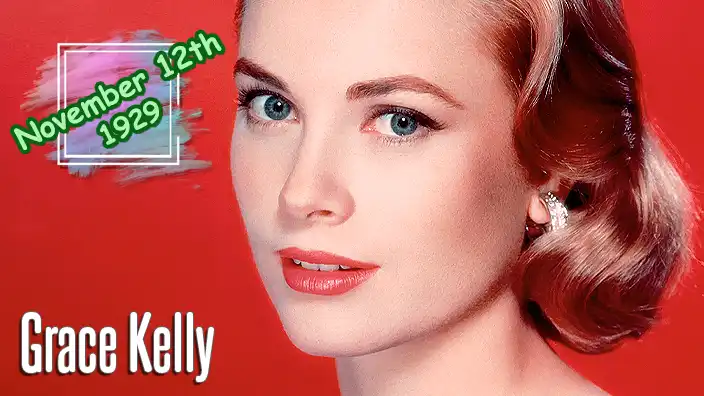
November 12, 1929, in Philadelphia, Pennsylvania
 September 14, 1982, in La Colle, Monaco

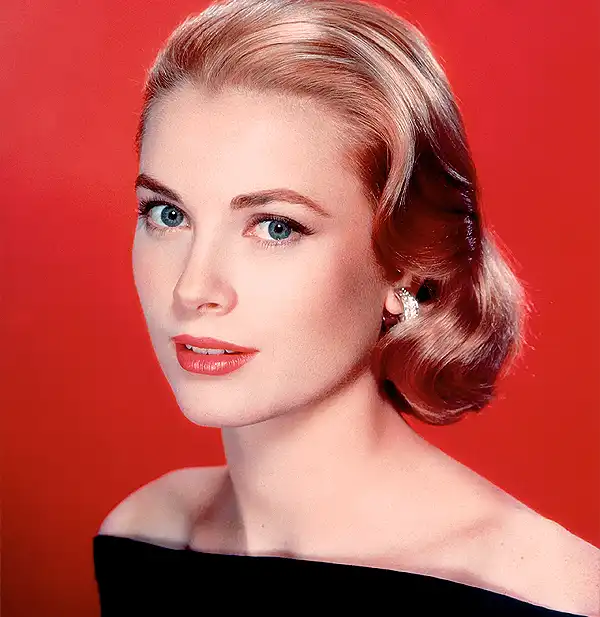
Grace Patricia Kelly was born on November 12, 1929, in Philadelphia, Pennsylvania, into a prosperous and accomplished Irish-American family. Her father, John Brendan "Jack" Kelly Sr., was a successful businessman and celebrated Olympic rower who won three gold medals representing the United States. Her mother, Margaret Majer Kelly, was a former model and an accomplished athlete who became involved in coaching women's sports. Grace grew up alongside her siblings, Peggy, John Jr., and Lizanne, in a household that valued achievement, discipline, and competition. Her family was accustomed to success, although winning Olympic medals and operating a successful construction business were rather different accomplishments from becoming an internationally famous actress. Grace would eventually surpass even her family's considerable expectations by becoming a Hollywood star and marrying into European royalty.
Despite growing up in a family known for athletic accomplishments, Grace Kelly developed a stronger interest in acting, theater, and artistic expression. She attended Ravenhill Academy and Stevens School in Philadelphia, where she participated in school theatrical productions and developed an appreciation for performance. Her father's family included several individuals connected to the entertainment industry, including her uncle George Kelly, a Pulitzer Prize-winning playwright. Another uncle, Walter C. Kelly, had worked as a vaudeville performer. These family connections helped introduce Grace to the theatrical world, although her ambitions were not universally encouraged. Her father reportedly regarded acting as a less respectable profession than the family's established business and athletic pursuits. Fortunately, Grace was determined to pursue her own interests, demonstrating an independent streak that would remain an important characteristic throughout her life.
Following her education in Philadelphia, Grace Kelly moved to New York City in 1947 to study acting at the American Academy of Dramatic Arts. The decision represented an important step toward professional independence, allowing her to develop her theatrical abilities away from the expectations of her prominent family. While studying acting, she supported herself through modeling assignments, appearing in advertisements and promotional campaigns. Her elegant appearance, natural poise, and distinctive facial features made her particularly suitable for fashion photography, and she soon attracted attention from commercial photographers. Modeling provided both financial independence and valuable experience working before cameras, although Kelly remained determined to establish herself as a serious actress rather than simply become a successful fashion model.
Grace Kelly's early professional acting experience included theatrical productions and appearances on live television, which was rapidly becoming an important entertainment medium during the late 1940s and early 1950s. She made her Broadway debut in 1949 in August Strindberg's The Father, appearing alongside Raymond Massey. Although the production had a relatively brief run, it provided Kelly with valuable professional experience and introduced her to the demands of performing before a live audience. She subsequently appeared in numerous television dramas, including productions associated with Kraft Television Theatre, Studio One, and other anthology programs. These broadcasts required actors to deliver polished performances under demanding technical conditions, often with limited opportunities to correct mistakes. For a young performer developing her craft, live television offered an excellent education in concentration, timing, and the importance of remembering one's lines.
Kelly made her feature film debut in Fourteen Hours (1951), a drama directed by Henry Hathaway and starring Richard Basehart. The film followed a police officer attempting to prevent a distressed young man from jumping from a New York City building. Kelly appeared in a small supporting role, but the experience provided her first significant exposure to Hollywood filmmaking. Although her appearance was relatively brief, she attracted attention from industry professionals who recognized her potential. Her combination of striking appearance, controlled delivery, and natural screen presence suggested that she might become a successful leading actress. Hollywood had discovered someone who could communicate considerable emotion with a subtle expression, a particularly valuable talent in an industry where some performers seemed determined to communicate everything by shouting.
Grace Kelly's major breakthrough arrived with High Noon (1952), the celebrated Western directed by Fred Zinnemann and starring Gary Cooper. Kelly portrayed Amy Fowler Kane, a newly married Quaker woman whose pacifist beliefs are challenged when her husband, a small-town marshal, must confront a dangerous group of criminals. The film explored courage, responsibility, loyalty, and the moral consequences of refusing to act when others face danger. Kelly's performance brought emotional complexity to a character torn between deeply held principles and her love for her husband. Although she was still relatively inexperienced in feature films, appearing alongside an established Hollywood star such as Gary Cooper provided an extraordinary opportunity. High Noon became one of the most acclaimed Westerns in American cinema, and Kelly's involvement helped establish her as a promising new actress.
Her reputation grew considerably with Mogambo (1953), an adventure drama directed by John Ford and filmed in Africa. The production starred Clark Gable, Ava Gardner, and Kelly in a romantic triangle set against the backdrop of an African safari. Kelly portrayed Linda Nordley, a married woman whose attraction to Gable's character creates emotional complications. Her performance demonstrated a combination of vulnerability, sophistication, and dramatic restraint that attracted considerable critical attention. She received a Golden Globe Award for Best Supporting Actress and earned her first Academy Award nomination in the same category. The recognition established Kelly as one of Hollywood's most promising performers and marked the beginning of a remarkable period in which her career advanced at an extraordinary pace.
One of the most important professional relationships in Grace Kelly's career began when she worked with legendary director Alfred Hitchcock. The British filmmaker was renowned for his psychological thrillers, carefully constructed suspense, and fascination with sophisticated female characters whose calm appearances concealed complicated emotions. Kelly's elegant manner, controlled acting style, and ability to suggest emotional intensity beneath a composed exterior made her particularly well suited to Hitchcock's approach to filmmaking. Their collaboration produced three celebrated films that remain among the most recognizable achievements of both careers. Hitchcock's admiration for Kelly's screen presence helped establish her as one of the defining actresses of the 1950s, while Kelly's performances contributed significantly to the enduring popularity of his suspense films.
Their first collaboration was Dial M for Murder (1954), a suspense thriller starring Ray Milland and Robert Cummings. Kelly portrayed Margot Wendice, a wealthy woman whose husband develops an elaborate plan to murder her after discovering her romantic involvement with another man. The film combined deception, blackmail, attempted murder, and a carefully constructed criminal plot that gradually begins to unravel. Kelly's performance balanced vulnerability with determination as her character struggled to understand the dangerous circumstances surrounding her. Hitchcock's precise direction and the film's tightly controlled setting created an atmosphere of mounting tension, while Kelly's elegant appearance contrasted sharply with the increasingly sinister events. The production demonstrated that even the most beautiful apartment can become a thoroughly unpleasant place when someone decides to arrange a murder in the living room.
Grace Kelly reunited with Hitchcock later in 1954 for Rear Window, one of the most influential suspense films in cinema history. Starring opposite James Stewart, Kelly portrayed Lisa Fremont, a sophisticated fashion consultant romantically involved with L. B. "Jeff" Jefferies, a photographer confined to his apartment after breaking his leg. With little to occupy his time, Jeff begins observing his neighbors through their windows and eventually suspects that one of them has committed murder. Lisa initially questions his suspicions but becomes increasingly involved in investigating the mysterious events. Kelly's character combines elegance, intelligence, courage, and determination, eventually taking considerable personal risks to uncover the truth. The film's exploration of curiosity, privacy, relationships, and the dangers of observation remains remarkably relevant, particularly in an age when people can investigate their neighbors without ever leaving the comfort of their smartphones.
Rear Window became a landmark achievement in Hitchcock's career and further strengthened Kelly's reputation as a major Hollywood actress. Her performance demonstrated that a glamorous leading lady could also be resourceful, courageous, and essential to the development of a suspenseful story. Costume designer Edith Head created a series of memorable outfits for Kelly, including an elegant black-and-white evening dress that became one of the most recognizable examples of classic Hollywood fashion. The costumes contributed to Lisa Fremont's identity as a sophisticated New York fashion professional, while Kelly's performance ensured that the character was remembered for more than her wardrobe. Her ability to communicate intelligence and emotional complexity beneath an apparently effortless elegance became one of her most distinctive acting qualities.
The year 1954 also brought Grace Kelly the role that would earn her an Academy Award. In The Country Girl, directed by George Seaton and based on Clifford Odets's stage play, Kelly portrayed Georgie Elgin, the long-suffering wife of an alcoholic entertainer played by Bing Crosby. William Holden appeared as a theater director attempting to revive the troubled performer's career. Unlike the glamorous characters that had helped establish Kelly's reputation, Georgie was emotionally exhausted, practical, and burdened by the consequences of her husband's destructive behavior. Kelly deliberately adopted a more subdued appearance and restrained performance style, allowing audiences to focus on the character's emotional struggles rather than her beauty. The result was a powerful dramatic portrayal that demonstrated her ability to move beyond conventional Hollywood glamour.
At the 27th Academy Awards ceremony in March 1955, Grace Kelly won the Academy Award for Best Actress for her performance in The Country Girl. The competition included Judy Garland for A Star Is Born, Audrey Hepburn for Sabrina, Dorothy Dandridge for Carmen Jones, and Jane Wyman for Magnificent Obsession. Kelly's victory was particularly notable because Garland had been widely regarded as a strong contender, and the result became one of the most discussed acting decisions of the ceremony. The award confirmed Kelly's position among Hollywood's leading performers and demonstrated that her dramatic abilities were recognized independently of her celebrated appearance. Having established herself as a major star through romantic dramas and suspense thrillers, she had now achieved the film industry's most prestigious acting honor.
Grace Kelly's third collaboration with Alfred Hitchcock came with To Catch a Thief (1955), a romantic mystery starring Cary Grant. Set along the glamorous French Riviera, the film followed John Robie, a retired jewel thief attempting to clear his name after a series of robberies resembling his former crimes. Kelly portrayed Frances Stevens, a wealthy American woman whose intelligence, confidence, and romantic curiosity make her an entertaining match for Grant's sophisticated character. Their chemistry contributed significantly to the film's appeal, while the spectacular Mediterranean scenery and luxurious costumes reinforced its atmosphere of elegance. The film also featured one of classic Hollywood's most memorable romantic exchanges, demonstrating that Hitchcock could combine suspense with humor and romance when the circumstances demanded it.
To Catch a Thief holds a particularly interesting place in Grace Kelly's life because its French Riviera setting brought her into close proximity to the principality that would eventually become her home. The film's glamorous depiction of the Mediterranean coast seemed almost to anticipate the extraordinary transformation awaiting her. Of course, Kelly had no way of knowing that her professional association with the region would soon develop into a personal connection with one of Europe's ruling families. Hollywood regularly produced fairy tales about ordinary people marrying royalty, but Kelly was about to demonstrate that real life could occasionally produce a storyline even the most imaginative screenwriter might hesitate to submit.
In May 1955, Grace Kelly attended the Cannes Film Festival in France, where she was introduced to Prince Rainier III of Monaco during a carefully arranged visit to the principality. The meeting brought together one of Hollywood's most admired actresses and the ruler of a small but internationally recognized Mediterranean state. Although their initial encounter was brief, the two subsequently began corresponding and developed a romantic relationship. Their courtship attracted enormous public attention, combining the glamour of Hollywood celebrity with the traditions of European royalty. For newspaper editors and magazine publishers, the developing romance was almost impossibly attractive: a beautiful American film star, a handsome European prince, a Mediterranean palace, and the possibility of a royal wedding. The only thing missing was a Hollywood producer demanding a rewrite of the ending.
Prince Rainier visited the United States later in 1955, meeting Kelly's family and continuing their relationship. Their engagement was announced in January 1956, creating an international sensation. The news meant that Kelly would be leaving behind a flourishing Hollywood career to assume the responsibilities of Princess of Monaco. The decision surprised many admirers because she had reached an extraordinary level of professional success in a remarkably short period. Nevertheless, Kelly chose to embrace a new life involving royal duties, public responsibilities, and the expectations associated with membership in a ruling family. Her engagement also demonstrated that the distinction between Hollywood glamour and traditional royalty was becoming increasingly blurred during the twentieth century.
Before leaving Hollywood, Grace Kelly completed High Society (1956), a musical romantic comedy directed by Charles Walters and co-starring Bing Crosby, Frank Sinatra, and Celeste Holm. Based on Philip Barry's play The Philadelphia Story, the film featured Kelly as Tracy Lord, a wealthy socialite whose approaching wedding becomes complicated by romantic misunderstandings and unexpected visitors. The production included music by Cole Porter and provided Kelly with an opportunity to demonstrate her musical abilities. She performed the duet True Love with Bing Crosby, and the recording became a popular success. The film represented an appropriate farewell to Hollywood, combining romance, sophisticated comedy, beautiful costumes, and the sort of elaborate social arrangements that Kelly would soon encounter in a considerably more official capacity.
Grace Kelly and Prince Rainier III were married in Monaco in April 1956 during ceremonies that attracted extraordinary international attention. Their civil marriage took place on April 18, followed by a religious ceremony at Saint Nicholas Cathedral on April 19. The religious wedding was broadcast to television audiences around the world and became one of the most celebrated royal events of the twentieth century. Kelly wore an elaborate wedding gown designed by Helen Rose, a costume designer at Metro-Goldwyn-Mayer, featuring delicate lace, silk, and intricate craftsmanship. The dress became one of the most influential bridal designs in modern fashion history, admired for its elegance and attention to detail. Having spent years wearing beautiful costumes for Hollywood productions, Kelly now appeared in a wedding dress that would be remembered long after many of her films had become classics.
Following her marriage, Grace Kelly became Her Serene Highness Princess Grace of Monaco, assuming a new public identity and a range of responsibilities associated with the principality's royal household. Her transition from American film star to European princess required considerable adjustment. Although she was accustomed to public attention, royal life involved diplomatic obligations, charitable activities, formal ceremonies, and the expectations of an established institution. She also faced the challenge of adapting to life in a small European principality while maintaining connections with her American family and former professional colleagues. Unlike a Hollywood production, royal life did not offer the convenience of a director announcing that an unsuccessful scene could simply be filmed again.
Princess Grace and Prince Rainier had three children: Princess Caroline, born in 1957; Prince Albert, born in 1958; and Princess Stéphanie, born in 1965. Family life became an important part of Grace's identity, and she devoted considerable attention to raising her children while fulfilling her public responsibilities. Her position as a mother within Monaco's ruling family also brought questions of royal succession and constitutional responsibility into her personal life. Albert would eventually succeed his father as Prince Albert II of Monaco in 2005, continuing the family's leadership of the principality. Through her children and grandchildren, Grace Kelly's influence became connected not only to Hollywood history but also to the continuing story of Monaco's royal family.
Although Grace Kelly retired from professional film acting following her marriage, her interest in artistic expression never disappeared. She remained connected to theater, literature, music, and the performing arts, frequently supporting cultural initiatives in Monaco and internationally. Alfred Hitchcock reportedly hoped to persuade her to return to the screen for Marnie (1964), but the proposed appearance did not materialize. Her potential return generated considerable speculation, reflecting the enduring interest in an actress who had left Hollywood at the height of her popularity. Ultimately, Grace never resumed her feature-film career, choosing instead to concentrate on her family, royal responsibilities, and cultural interests. Her decision ensured that her filmography remained relatively small, but it also preserved a remarkably concentrated collection of memorable performances.
Princess Grace became particularly active in charitable and humanitarian work, using her international recognition to support organizations concerned with children, families, health, and the arts. She served as president of the Monaco Red Cross and participated in numerous fundraising events and public initiatives. Her involvement helped draw international attention to the principality's charitable activities, while her personal commitment to humanitarian causes contributed to her reputation as an engaged and compassionate public figure. Rather than simply attending ceremonial events, she worked to establish lasting organizations and support systems that could continue benefiting people beyond her own lifetime.
One of her important cultural contributions was the establishment of the Princess Grace Foundation in Monaco in 1964. The organization supported humanitarian and cultural initiatives, including assistance for children and opportunities for artistic development. Princess Grace also encouraged theater and dance, maintaining her longstanding interest in performance despite having left professional acting. She helped establish the Monte-Carlo Ballet Festival and supported institutions that contributed to Monaco's cultural identity. Her efforts demonstrated that she had not abandoned her artistic interests but had redirected them toward encouraging other performers and strengthening cultural opportunities within her adopted country.
Princess Grace's influence on fashion also continued long after her retirement from Hollywood. Her understated elegance, carefully selected clothing, and preference for classic designs helped establish her as an enduring international style icon. She frequently wore creations by prominent fashion designers, but her personal style was characterized more by restraint and refinement than by extravagance. One of the most famous accessories associated with her was the Hermès handbag that became popularly known as the Kelly bag. Although the design existed before her association with it, photographs of Princess Grace carrying the handbag helped establish its international reputation. The bag was officially renamed in her honor, becoming one of the most recognizable luxury accessories in fashion history. Not many people can claim that a handbag became famous because they carried it, but Princess Grace managed to accomplish precisely that.
Her cultural influence extended beyond fashion into photography, cinema, and the public imagination. Grace Kelly represented a distinctive form of mid-twentieth-century elegance, combining Hollywood sophistication with the formal traditions of European royalty. Photographers frequently captured her at public events, family gatherings, and official ceremonies, helping create an enduring visual record of her life. Her appearance influenced bridal fashion, hairstyles, jewelry, and women's clothing, while her films continued introducing new audiences to her acting abilities. Although fashion trends changed considerably over subsequent decades, Kelly's preference for classic silhouettes and understated presentation remained influential among designers and admirers of traditional elegance.
In 1982, Princess Grace established the Princess Grace Foundation-USA to support emerging performers in theater, dance, and film. The foundation reflected her personal understanding of the challenges facing young artists attempting to establish professional careers. Having experienced the uncertainty of auditions, theatrical training, and early acting assignments herself, she recognized the importance of financial assistance and professional encouragement. The organization subsequently became an important part of her legacy, providing grants and other support to talented artists. Its continuing work helps preserve Grace Kelly's connection to the performing arts while creating opportunities for future generations of entertainers.
Tragically, Grace Kelly's life ended following a serious automobile accident in September 1982. While driving along a mountainous road in Monaco with her daughter Princess Stéphanie, she suffered a medical emergency and lost control of the vehicle. The car left the road and crashed down a steep embankment, causing severe injuries. Princess Stéphanie survived the accident, but Princess Grace died on September 14, 1982, at the Princess Grace Hospital Centre in Monaco. Her death shocked people around the world and brought an abrupt end to a life that had combined Hollywood achievement, royal responsibilities, and extensive humanitarian work.
The funeral of Princess Grace took place at Saint Nicholas Cathedral in Monaco, attended by members of European royal families, political representatives, Hollywood personalities, and numerous friends and admirers. The ceremony reflected her extraordinary international recognition and the affection she had inspired throughout her life. She was buried in the cathedral, where Prince Rainier III would later be laid to rest following his death in 2005. Her passing marked the loss of a woman whose life had connected two very different worlds: the glamour of American cinema and the traditions of European royalty. For Monaco, her death represented the loss of a beloved princess and public figure; for film audiences, it marked the final chapter in one of Hollywood's most remarkable personal stories.
Grace Kelly's cinematic achievements remain particularly impressive because her major film career lasted only a few years. Between High Noon, Mogambo, Dial M for Murder, Rear Window, The Country Girl, To Catch a Thief, and High Society, she created a collection of performances that helped define Hollywood cinema during the 1950s. Her collaborations with Alfred Hitchcock remain especially influential, demonstrating the importance of subtle acting, emotional restraint, and carefully developed character relationships in suspense filmmaking. Her Academy Award victory for The Country Girl further established her dramatic credibility, proving that her success was based on considerably more than her celebrated appearance.
The American Film Institute recognized Grace Kelly's contribution to cinema by placing her among the greatest female screen legends of classic Hollywood. Her films continue to be studied, screened, and appreciated by audiences who admire the craftsmanship and storytelling traditions of the period. Her performances also demonstrate the value of an acting style that relies on carefully controlled expressions and subtle emotional changes rather than excessive theatricality. Kelly possessed the unusual ability to command attention while appearing almost effortless, creating characters whose personalities emerged through small gestures, thoughtful pauses, and precisely delivered dialogue.
Grace Kelly's legacy extends far beyond the silver screen. As Princess Grace of Monaco, she helped strengthen the principality's international cultural identity, supported charitable organizations, encouraged artistic development, and raised a family whose members remain prominent in European public life. Her influence on fashion continues through designs inspired by her personal style, while organizations established in her name provide opportunities for performers and support humanitarian causes. Her life illustrates how professional success can become the foundation for an entirely different form of public service, even when the transition involves extraordinary personal and cultural adjustments.
Grace Kelly remains one of the most fascinating personalities in twentieth-century entertainment history because her real life followed a path that seemed almost impossibly cinematic. Born into an accomplished Philadelphia family, she pursued acting against conventional expectations, became an Academy Award-winning Hollywood star, worked with some of cinema's greatest directors, and then married a European prince. Yet behind the extraordinary public image was a woman who faced professional challenges, family responsibilities, cultural adjustments, and the demands of international public life. Her story continues to fascinate because it combines artistic achievement, personal determination, romance, and tragedy in a way that few fictional screenplays could equal. Hollywood gave Grace Kelly an Oscar, Monaco gave her a crown, and history gave her a lasting place among the most memorable women of her generation.
References & Sources