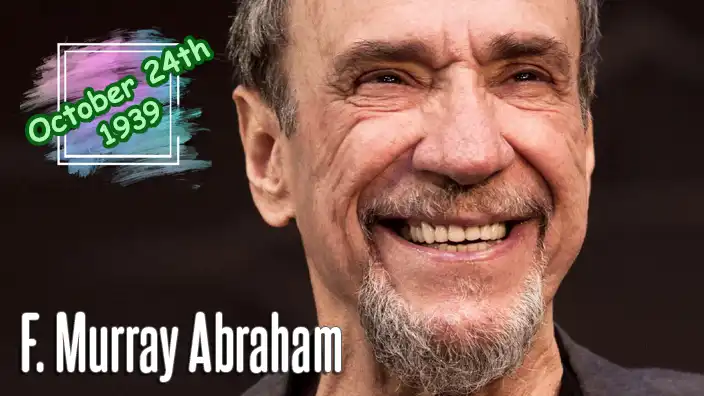
October 24, 1939, in Pittsburgh, Pennsylvania

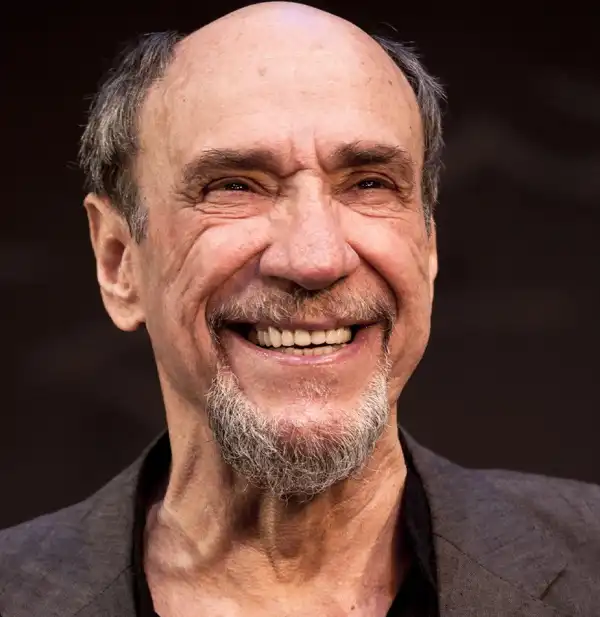
Born Murray Abraham on October 24, 1939, in Pittsburgh, Pennsylvania, F. Murray Abraham is an American actor whose distinguished career encompasses theater, motion pictures, television, and voice acting. Raised primarily in El Paso, Texas, he developed an interest in performance that eventually carried him from regional theater productions to Hollywood's most prestigious awards ceremony. His father, Frederick Abraham, was a Syrian immigrant whose family belonged to the Antiochian Orthodox Christian tradition, while his mother, Josephine Stello Abraham, was American-born and of Italian ancestry. This combination of Middle Eastern and European family influences contributed to a childhood shaped by different cultural traditions, although Abraham's greatest inheritance may have been the determination required to succeed in a profession where rejection is practically part of the employee benefits package.
Abraham's childhood in El Paso was not a straightforward preparation for a distinguished acting career. Growing up in a working-class environment, he experienced the challenges of adolescence and later acknowledged that he was not always the most disciplined student. His early years included involvement with a neighborhood gang, and he developed a reputation for being something of a troublemaker before discovering the direction that theater could provide. At El Paso High School, an interest in acting began to offer an alternative to the less productive activities competing for his attention. A teacher encouraged his theatrical abilities, helping him recognize that the energy previously devoted to getting into trouble might be more profitably employed pretending to be somebody else. It was an inspired suggestion, particularly considering that his eventual profession would allow him to threaten, deceive, and occasionally murder people without attracting the attention of the local police department.
After completing high school, Abraham pursued further education at what is now the University of Texas at El Paso and subsequently attended the University of Texas at Austin. His interest in acting continued to develop through academic study and theatrical experience, eventually leading him to Los Angeles, where he studied under renowned acting teacher Uta Hagen's contemporary Herbert Berghof and developed his understanding of professional performance. His theatrical training emphasized discipline, character development, and the importance of creating believable human behavior rather than relying on superficial dramatic gestures. These lessons became particularly valuable as he developed a performance style characterized by precise vocal delivery, commanding physical presence, and an ability to communicate complex emotions through relatively subtle expressions. He also studied with respected teachers associated with the American theater tradition, gradually building the technical foundation that would support his later achievements.
Abraham began establishing himself professionally during the 1960s, working in regional theater and smaller productions before making his Broadway debut in 1968 in The Man in the Glass Booth, a drama written by Robert Shaw and directed by Harold Pinter. The production offered an important opportunity to work within the demanding environment of New York theater, where actors were expected to deliver convincing performances night after night without the luxury of asking a director to edit out their mistakes. Abraham's early theatrical experiences helped establish his reputation as a committed and versatile performer, capable of tackling dramatic material requiring emotional intensity and intellectual sophistication. His growing familiarity with classical and contemporary theater also contributed to the commanding stage presence that would later distinguish his performances on screen.
His film career began modestly with a small appearance in the 1971 comedy-mystery They Might Be Giants, starring George C. Scott and Joanne Woodward. Abraham played an usher, a role that offered limited opportunities for dramatic glory but provided valuable experience working on a professional motion picture. Additional screen appearances followed, including a part in Sidney Lumet's acclaimed crime drama Serpico in 1973, starring Al Pacino. The film examined police corruption in New York City and became an important work of American cinema during the 1970s. Abraham's role was relatively small, but the production placed him alongside established performers and filmmakers while providing further opportunities to develop his screen acting abilities. Like many working actors, he discovered that the road to recognition frequently involves spending considerable time in the background while somebody else receives the applause.
Throughout the 1970s, Abraham continued balancing theatrical work with film and television appearances. He appeared in Alan J. Pakula's political thriller All the President's Men in 1976, a film examining the Washington Post investigation into the Watergate scandal. Although his screen role was minor, the production became one of the most celebrated political dramas in American cinema. He also appeared in television series, commercials, and other productions that helped sustain his career while he pursued more substantial theatrical opportunities. Among his more unusual professional assignments was providing the voice of the green grapes in a series of Fruit of the Loom television advertisements. For an actor who would eventually portray some of cinema's most intimidating historical and fictional characters, beginning with a talking bunch of grapes offered a wonderfully unlikely addition to his professional résumé.
His commitment to theater remained central to his career, even as film opportunities increased. Abraham performed in productions of works by William Shakespeare, Anton Chekhov, and other major playwrights, developing a reputation for approaching classical characters with intellectual curiosity and emotional intensity. His stage performances included appearances in The Threepenny Opera, Waiting for Godot, and numerous other productions requiring considerable dramatic versatility. Unlike actors who viewed theater primarily as a stepping stone toward motion-picture fame, Abraham regarded live performance as an essential artistic discipline. The immediate relationship between actor and audience appealed to his theatrical instincts, while the complexity of classical drama provided opportunities to explore characters whose motivations were rarely straightforward. Shakespeare, in particular, offered an abundance of ambitious, jealous, dishonest, and occasionally murderous individuals, making the playwright's works something of a professional playground for an actor with Abraham's abilities.
In 1983, Abraham appeared in Brian De Palma's crime drama Scarface, portraying Omar Suárez, a criminal associate of Frank Lopez who becomes involved in the violent world of Miami drug trafficking. The film starred Al Pacino as Tony Montana and eventually became one of the most recognizable gangster movies in American popular culture. Abraham's character played an important role in the early development of Montana's criminal career, although his own involvement ended rather unpleasantly. His performance demonstrated an ability to portray morally questionable characters with convincing authority, combining confidence, suspicion, and underlying menace. Although Scarface received mixed critical reactions upon its initial release, it subsequently developed an enormous cultural following, introducing Abraham's work to generations of viewers who might otherwise have encountered him first through more traditional dramatic productions.
The defining breakthrough of Abraham's screen career arrived in 1984 when director Miloš Forman cast him as Antonio Salieri in Amadeus, a lavish historical drama adapted from Peter Shaffer's acclaimed stage play. The film explored a fictionalized rivalry between the respected court composer Salieri and the extraordinarily gifted Wolfgang Amadeus Mozart, portrayed by Tom Hulce. Through Salieri's perspective, the story examined artistic jealousy, religious faith, personal ambition, and the painful recognition that genuine genius does not always arrive wrapped in dignity and good manners. Abraham's character was a disciplined, ambitious musician who believed that devotion to God and music should be rewarded with exceptional talent. Unfortunately for Salieri, Mozart possessed the genius he desperately desired while behaving with all the solemnity of an overexcited schoolboy who had discovered the wine cellar.
Abraham's performance in Amadeus became one of the most celebrated achievements of his career. His portrayal of Salieri combined bitterness, admiration, wounded pride, and psychological complexity, creating a character who was simultaneously sympathetic and deeply unsettling. Much of the film's dramatic power depended upon his ability to communicate the torment of a man who understood musical greatness well enough to recognize it in somebody else but could never achieve it himself. The role required considerable emotional range, moving between the outwardly dignified court composer and the embittered older man recounting his supposed crimes. Abraham's precise delivery, expressive face, and remarkable control of dramatic tension helped transform Salieri into one of cinema's most memorable portrayals of jealousy. It was an extraordinary performance, particularly considering that the character's central complaint was essentially that somebody else was better at his job.
Released in September 1984, Amadeus became a major critical and commercial success, receiving widespread praise for its performances, direction, production design, and use of Mozart's music. At the 57th Academy Awards in March 1985, the film received eight Oscars, including Best Picture, Best Director for Miloš Forman, and Best Actor for F. Murray Abraham. His victory was especially notable because fellow nominee Tom Hulce had also been nominated for his portrayal of Mozart, placing the film's two central performers in direct competition. Abraham additionally received the Golden Globe Award for Best Actor in a Motion Picture Drama, confirming the extraordinary recognition generated by his performance. The Academy Award transformed his professional reputation almost overnight, elevating a respected working actor into an internationally recognized star. After years of supporting roles and commercial voiceovers, the man who had once portrayed a bunch of grapes was suddenly holding Hollywood's most coveted acting trophy.
The historical relationship between Mozart and Salieri has frequently been misunderstood because of the enormous popularity of Amadeus. Although both composers were real historical figures, the film's suggestion that Salieri deliberately engineered Mozart's destruction was a dramatic invention rather than an established historical fact. The screenplay drew upon theatrical traditions that had developed around rumors of rivalry and jealousy, using the composers' relationship to explore larger questions about talent, ambition, and artistic achievement. Abraham's performance was so convincing that audiences sometimes associated the fictionalized Salieri with the historical composer, demonstrating the extraordinary influence that dramatic storytelling can have upon public perceptions of history. For Salieri's reputation, this was perhaps an unfortunate development, since being remembered as the man who envied Mozart is considerably less flattering than being remembered for one's own compositions.
Following the success of Amadeus, Abraham appeared in the 1986 historical mystery The Name of the Rose, directed by Jean-Jacques Annaud and adapted from Umberto Eco's celebrated novel. The film starred Sean Connery as William of Baskerville, a Franciscan friar investigating mysterious deaths at a medieval monastery. Abraham portrayed Bernardo Gui, a severe and politically influential inquisitor whose determination to identify heresy creates conflict with William's more rational approach to investigation. The character provided another opportunity for Abraham to portray an intimidating authority figure whose absolute certainty about his own righteousness made him particularly dangerous. His performance combined religious severity with calculated menace, creating a memorable antagonist in a film filled with intellectual debate, medieval superstition, and enough suspicious monks to make any reasonable visitor reconsider the wisdom of staying overnight.
Despite winning an Academy Award, Abraham discovered that Hollywood success did not automatically guarantee a continuous supply of outstanding leading roles. During the years following Amadeus, he appeared in a variety of films and theatrical productions, some critically successful and others considerably less distinguished. Commentators occasionally suggested that he had fallen victim to the so-called Oscar curse, the idea that winning a major acting award could be followed by disappointing professional opportunities. Abraham himself rejected the suggestion that his Academy Award had somehow damaged his career, emphasizing the recognition and opportunities it had brought him. His response reflected a practical understanding of the entertainment industry, where even exceptionally talented performers cannot control every casting decision or predict which productions will become successful. After all, blaming an Oscar for one's professional difficulties is rather like blaming a winning lottery ticket because the following Tuesday was disappointing.
During the late 1980s and early 1990s, Abraham continued appearing in films across several genres. His credits included An Innocent Man in 1989, starring Tom Selleck, and the 1991 comedy Mobsters, which explored the early careers of organized crime figures. He also appeared in Loaded Weapon 1 and the 1993 action-comedy Last Action Hero, starring Arnold Schwarzenegger. In the latter film, Abraham portrayed John Practice, a fictional police officer whose involvement in the movie's playful examination of action-film conventions provided opportunities for both comedy and menace. The production deliberately blurred the boundaries between cinematic fiction and reality, creating an unusual setting for an actor whose reputation had been established through historical drama. Abraham's willingness to participate in such varied projects demonstrated that he was not particularly interested in restricting himself to solemn characters simply because an Academy Award happened to be sitting on his shelf.
His career took another entertaining turn in 1995 when he appeared in Woody Allen's comedy Mighty Aphrodite, portraying the leader of a Greek chorus that comments upon the increasingly complicated romantic circumstances of the central characters. The film combined contemporary New York relationships with theatrical devices borrowed from classical Greek drama, creating an unusual mixture of modern comedy and ancient storytelling traditions. Abraham's theatrical background made him particularly well suited to the role, which required formal delivery, comic timing, and an appreciation for the absurdity of human behavior. His participation demonstrated that he could move comfortably between serious historical drama and sophisticated comedy, particularly when the material offered opportunities to employ his distinctive voice and commanding presence.
In 1998, Abraham entered the world of science fiction with Star Trek: Insurrection, the ninth feature film in the long-running franchise. He portrayed Ru'afo, the leader of the Son'a, a group seeking to exploit the rejuvenating properties of a planet inhabited by the peaceful Ba'ku. The film starred Patrick Stewart as Captain Jean-Luc Picard and explored questions involving forced relocation, political corruption, and the ethical responsibilities of Starfleet. Abraham's performance required elaborate makeup and prosthetics that dramatically altered his appearance, creating a villain whose obsession with reversing the effects of aging had left him physically transformed. Despite the demanding makeup process, Abraham expressed considerable enthusiasm for participating in the Star Trek universe. For a performer accustomed to playing historical figures and Shakespearean villains, commanding a technologically advanced spacecraft while looking as though one's face had been through an industrial ironing machine was certainly a change of pace.
Abraham continued working in major motion pictures with an appearance in Gus Van Sant's 2000 drama Finding Forrester, starring Sean Connery and Rob Brown. He portrayed Professor Robert Crawford, a demanding literature instructor whose attitudes toward a talented young writer become central to the film's exploration of education, prejudice, and intellectual achievement. The role allowed Abraham to employ his familiar combination of authority, skepticism, and intellectual arrogance, creating another character whose professional position did not necessarily make him the wisest person in the room. His performance complemented the film's broader examination of mentorship and creative development, demonstrating how easily academic authority can become an obstacle when pride takes precedence over understanding.
Throughout these years, Abraham remained deeply involved in theatrical performance, regularly returning to the stage for classical and contemporary productions. His Shakespearean roles included King Lear, Macbeth, Richard III, and Shylock in The Merchant of Venice, characters whose psychological complexity offered opportunities for his distinctive dramatic approach. He also performed in works by Anton Chekhov, Samuel Beckett, Harold Pinter, and other influential playwrights. His portrayal of characters in productions of Uncle Vanya and The Merchant of Venice earned Obie Awards, while his contributions to theater were recognized with additional honors, including an Obie Award for Lifetime Achievement. Abraham's continued commitment to live performance reflected his belief that theater remained an essential part of an actor's professional development, even after achieving international recognition through film.
His theatrical achievements also included performances in Angels in America, Cyrano de Bergerac, The Caretaker, and The Ride Down Mt. Morgan, among numerous other productions. He appeared in the Broadway production of Terrence McNally's It's Only a Play, a comedy that affectionately examines the insecurities, egos, and occasional absurdities of theatrical life. Abraham's ability to approach serious drama and comedy with equal conviction made him a valuable performer in productions requiring both technical skill and an understanding of human behavior. His extensive stage experience also contributed to his reputation among fellow actors as a performer who approached his work with preparation and seriousness. Considering the number of kings, villains, scholars, and assorted troublemakers he has portrayed, Abraham has probably spent more time making questionable decisions onstage than most people manage in several lifetimes.
A new generation of film audiences encountered Abraham through his appearance in the Coen brothers' 2013 drama Inside Llewyn Davis, which explored the Greenwich Village folk music scene during the early 1960s. He portrayed Bud Grossman, a music industry figure who auditions the struggling title character, played by Oscar Isaac. Although his appearance was relatively brief, Abraham delivered a memorable performance as a pragmatic professional whose assessment of the young musician's commercial prospects was less than encouraging. The scene demonstrated his ability to establish a convincing character through restrained dialogue and carefully controlled expressions, proving that a supporting role does not need extensive screen time to leave a lasting impression. Sometimes all it takes is a few sentences delivered by the right actor to make an aspiring musician reconsider every decision that led him into the room.
In 2014, Abraham appeared in Wes Anderson's critically acclaimed comedy-drama The Grand Budapest Hotel, portraying the older version of Zero Moustafa, the mysterious owner of a once-grand European hotel. The film featured an elaborate ensemble cast, including Ralph Fiennes, Tony Revolori, Saoirse Ronan, Adrien Brody, Willem Dafoe, and Tilda Swinton. Abraham's character served as an important narrator, recounting events from the hotel's earlier history and providing the emotional foundation for the film's exploration of friendship, loyalty, loss, and nostalgia. His dignified performance contrasted with the colorful absurdity surrounding the younger characters, creating a poignant connection between the film's whimsical comedy and its underlying melancholy. The production received widespread critical acclaim and won four Academy Awards, further strengthening Abraham's association with some of modern cinema's most distinctive filmmakers.
Television provided Abraham with another important opportunity when he joined the cast of Showtime's political thriller Homeland. Beginning in 2012, he portrayed Dar Adal, a veteran intelligence operative whose extensive experience and morally ambiguous methods made him one of the series' most intriguing characters. Working alongside Claire Danes, Mandy Patinkin, and other cast members, Abraham developed a character who frequently operated within the shadowy boundaries between national security, political manipulation, and personal loyalty. Dar Adal's calm manner and calculating intelligence made him particularly unsettling, since he rarely needed to raise his voice to communicate a threat. Abraham's performance earned Primetime Emmy Award nominations for Outstanding Guest Actor in a Drama Series in 2015 and 2018, demonstrating his continuing ability to command attention in a demanding television drama.
His television work also expanded into comedy with the Apple TV+ series Mythic Quest, which premiered in 2020. Abraham portrayed C.W. Longbottom, an eccentric and frequently inappropriate science-fiction writer employed by a successful video game development company. The character was a gloriously self-important literary figure whose outdated attitudes, professional insecurities, and fondness for dramatic pronouncements regularly created difficulties for his younger colleagues. The role offered Abraham opportunities to display his comic abilities in a contemporary workplace setting, demonstrating that his commanding voice and theatrical manner could be just as effective when delivering absurd dialogue as when portraying Shakespearean tragedy. He appeared in the series' first two seasons before leaving the production in 2022. The departure subsequently attracted attention when reports emerged that it followed complaints concerning inappropriate behavior on set, which Abraham addressed publicly with an apology in 2023.
Abraham's career also expanded into the Marvel Cinematic Universe when he provided the voice of Khonshu, the Egyptian moon god, in the 2022 Disney+ series Moon Knight. The production starred Oscar Isaac as a man struggling with dissociative identity disorder while becoming involved in supernatural conflicts involving ancient Egyptian deities. Abraham's distinctive voice gave Khonshu a commanding, mysterious, and frequently impatient personality, perfectly suited to a supernatural being who expected immediate obedience from his human representatives. The character's dramatic appearance, featuring a birdlike skull and elaborate robes, complemented Abraham's imposing vocal performance. His work earned a Primetime Emmy Award nomination for Outstanding Character Voice-Over Performance in 2022, confirming that even when audiences could not see his face, his voice remained capable of dominating a scene.
His vocal talents also contributed to several animated productions, including Wes Anderson's Isle of Dogs in 2018, in which he voiced Jupiter, and DreamWorks Animation's How to Train Your Dragon: The Hidden World in 2019, where he voiced the villainous dragon hunter Grimmel. The latter character provided another opportunity to portray a calculating antagonist, this time in a fantasy adventure involving dragons rather than medieval inquisitors or supernatural Egyptian gods. Abraham's ability to communicate personality through voice alone made him particularly effective in animation, where vocal performance must establish emotional credibility without the assistance of conventional facial expressions. His career in voice acting illustrated the versatility of a performer whose most recognizable qualities included not only his physical presence but also the rich, resonant voice that had distinguished his work for decades.
In 2022, Abraham received renewed critical attention for his performance in the second season of HBO's acclaimed anthology series The White Lotus. Set primarily at a luxury resort in Sicily, the season explored the complicated relationships, personal secrets, and frequently disastrous decisions of wealthy vacationers. Abraham portrayed Bert Di Grasso, an elderly American man traveling to Italy with his son Dominic, played by Michael Imperioli, and grandson Albie, played by Adam DiMarco. The family journey was intended partly to reconnect with their Sicilian ancestry, although the three generations brought enough unresolved emotional problems to make an ordinary family vacation seem like an attractive alternative. Bert's flirtatious personality, questionable remarks, and stubborn refusal to acknowledge changing social expectations created some of the season's most entertaining and uncomfortable moments.
Abraham's portrayal of Bert Di Grasso combined comedy, vulnerability, and emotional complexity, revealing a character whose inappropriate behavior frequently concealed loneliness and regret. His interactions with the younger members of the family exposed generational differences in attitudes toward marriage, relationships, masculinity, and personal responsibility. Although Bert often behaved outrageously, Abraham ensured that the character remained recognizably human rather than simply becoming a collection of offensive jokes. The performance earned him a Golden Globe nomination and a Primetime Emmy nomination for Outstanding Supporting Actor in a Drama Series in 2023. The recognition introduced Abraham to another generation of television viewers and demonstrated that his ability to create memorable characters remained undiminished. It also established that an expensive Sicilian holiday is not necessarily the ideal solution to several generations of unresolved family difficulties.
His screen work continued with appearances in the HBO political drama White House Plumbers in 2023, portraying federal judge John Sirica, a central figure in the legal proceedings surrounding the Watergate scandal. The production explored the activities of political operatives involved in the scandal that ultimately contributed to President Richard Nixon's resignation. Abraham's portrayal of Sirica allowed him to revisit the historical period associated with All the President's Men, one of his earlier film appearances. The coincidence offered an interesting connection across his career, linking two productions concerned with the same political scandal but created decades apart. His participation also demonstrated his continuing appeal for historical dramas requiring performers capable of portraying authority figures with intelligence and gravitas.
Abraham remained active in film during the middle of the 2020s, including an appearance as the Prophet in Wes Anderson's 2025 film The Phoenician Scheme. The production reunited him with a director whose distinctive visual style and ensemble storytelling had previously provided one of Abraham's most memorable later-career roles. He also appeared in the 2026 film Bookends, portraying Saul Cohen. His continuing work reflected an extraordinary professional longevity built upon adaptability, technical skill, and a willingness to accept roles across different genres and formats. Rather than allowing his Academy Award victory to define the limits of his career, Abraham continued exploring opportunities in independent cinema, major studio productions, television dramas, comedy, animation, and live theater.
His theatrical work also extended into the 2020s, including involvement in the Broadway musical The Queen of Versailles, which featured music by Stephen Schwartz and a book by Lindsey Ferrentino. The production, inspired by the documentary about the construction of an extravagant Florida mansion, brought Abraham into a musical theater environment that combined satire, ambition, wealth, and the often absurd consequences of extravagant dreams. His participation offered another example of his willingness to experiment with different theatrical forms, even after decades of experience in classical drama. The associated cast recording further expanded his professional catalog, adding musical performance to an already extensive collection of acting credits.
Away from the stage and screen, Abraham's personal life included a long marriage to Kate Hannan, whom he married in April 1962. The couple had two children and remained married until her death in November 2022. Their relationship endured through the uncertainties of a profession known for demanding schedules, extended absences, and the unpredictable fortunes of theatrical employment. Abraham has spoken about the importance of family and the support his wife provided throughout his career, particularly during the years when professional recognition was uncertain. His personal experiences also informed his understanding of relationships, loyalty, and loss, themes that frequently appeared in the characters he portrayed. Although his screen roles have included an extraordinary collection of jealous composers, scheming politicians, and dangerous villains, his real-life family story was considerably more enduring than the relationships enjoyed by many of his fictional counterparts.
Abraham's contributions to theater and film have received numerous honors beyond his Academy Award and Golden Globe victory. His theatrical achievements include Obie Awards, recognition for Shakespearean performance, and induction into the New York Theater Hall of Fame. He has also received the Sir John Gielgud Award for Excellence in Shakespeare and the Moscow Art Theatre Stanislavski Award, reflecting the international recognition of his work. His career has encompassed more than ninety stage productions and an extensive collection of film and television performances, demonstrating a commitment to acting that extends far beyond the pursuit of celebrity. His professional reputation rests upon the ability to create psychologically convincing characters, whether portraying historical figures, fictional villains, eccentric comedians, or ordinary people confronting extraordinary circumstances.
One of the defining qualities of Abraham's acting has been his refusal to treat supporting roles as unimportant. Even when appearing briefly, he frequently establishes a distinctive personality through precise dialogue delivery, controlled gestures, and an understanding of the character's place within the larger story. His performances often feature individuals whose confidence exceeds their wisdom, whose ambitions create conflict, or whose carefully maintained public identities conceal considerable emotional uncertainty. This ability to communicate contradiction has made him particularly effective in roles involving authority, jealousy, intellectual pride, and moral ambiguity. Yet his work in comedy and animation demonstrates that the same theatrical skills can produce laughter as readily as tension. Few actors can convincingly portray a murderous medieval inquisitor, a sarcastic Egyptian deity, and an inappropriate grandfather without making the audience wonder whether they are essentially watching the same man in different costumes.
From a young performer discovering theater in El Paso to an Academy Award-winning actor whose career has extended across generations, F. Murray Abraham has made an exceptional contribution to American entertainment. His portrayal of Antonio Salieri in Amadeus remains one of cinema's most memorable performances, while his later work in Homeland, The Grand Budapest Hotel, Moon Knight, and The White Lotus demonstrates his continuing versatility. His devotion to classical theater, distinctive vocal delivery, and willingness to explore challenging characters have established a legacy that extends beyond any single role or award. And although his characters have frequently been consumed by jealousy, ambition, and the occasional desire to eliminate their enemies, Abraham himself has achieved something far more admirable: a remarkable career built upon the simple but demanding business of being extraordinarily good at pretending to be somebody else.