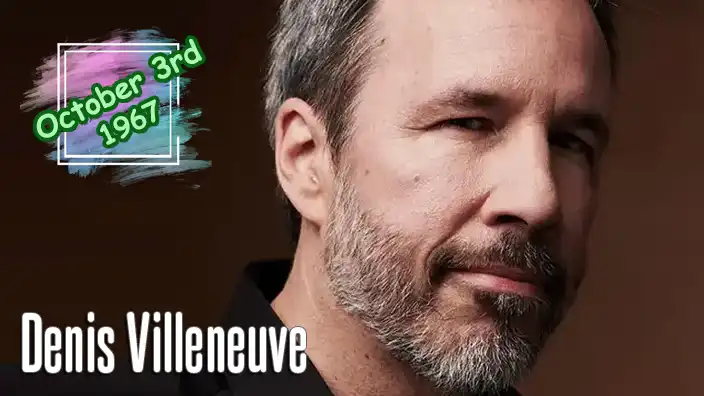
October 3, 1967, in Gentilly, Canada
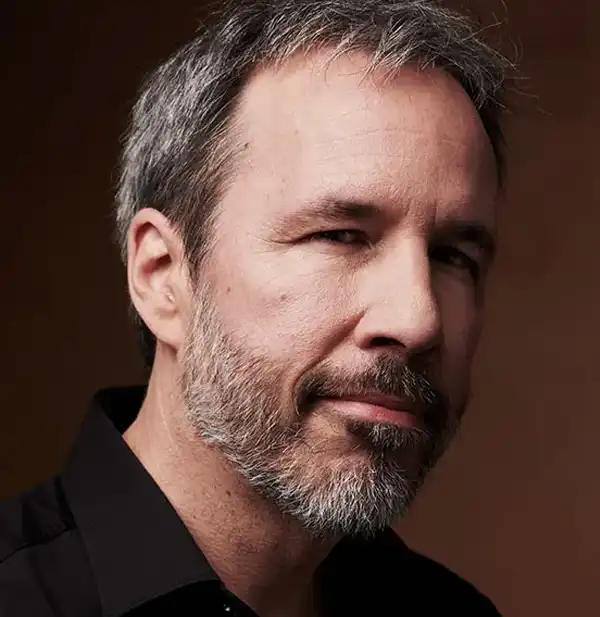
Denis Villeneuve was born on October 3, 1967, in Gentilly, Quebec, Canada. The French-Canadian filmmaker has developed from an acclaimed director within Quebec cinema into one of the world's most prominent directors of large-scale science fiction. His films include Incendies, Prisoners, Enemy, Sicario, Arrival, Blade Runner 2049, Dune and Dune: Part Two, an unusually formidable collection of movies for a director whose work frequently asks audiences to think at precisely the moment Hollywood convention suggests something should explode.
Villeneuve grew up in Quebec and developed an interest in science and storytelling during his youth. His fascination with cinema eventually became the stronger attraction, and he studied filmmaking at the Université du Québec à Montréal. An important early opportunity came through Radio-Canada's youth filmmaking competition La Course Europe-Asie, which Villeneuve won in the early 1990s. He subsequently worked with the National Film Board of Canada and began establishing himself as a filmmaker through shorts and documentaries before moving into feature films.
His first feature as director was 1998's August 32nd on Earth, originally titled Un 32 août sur terre. The film, starring Pascale Bussières and Alexis Martin, followed a woman whose survival of a car accident causes her to reconsider her life and decide that she wants a child. It was selected for the Un Certain Regard section at the Cannes Film Festival and became Canada's submission for consideration in the Academy Awards' foreign-language film category.
Villeneuve followed it with Maelström in 2000. The unusual drama centered on a woman struggling with the consequences of a hit-and-run accident and was narrated, memorably, by a talking fish awaiting execution. Anyone expecting Villeneuve's career to begin conventionally had therefore been given adequate warning. The film earned considerable acclaim in Canada, including major honors for Villeneuve's direction and screenplay, and helped establish his reputation as a filmmaker willing to combine serious subject matter with unusual storytelling techniques.
After several years away from feature filmmaking, Villeneuve returned with Polytechnique in 2009. Shot in black and white, the film dramatized the 1989 École Polytechnique massacre in Montreal, where a gunman murdered 14 women. Villeneuve approached the subject with deliberate restraint, concentrating on the victims and survivors rather than turning the killer into the center of the story. The film received significant recognition in Canada and reinforced Villeneuve's reputation for tackling extremely difficult material without relying on sensationalism.
International attention expanded dramatically with Incendies in 2010. Adapted from the play by Wajdi Mouawad, the film follows Canadian twins who travel to the Middle East after their mother's death to investigate secrets from her past. The resulting story gradually reveals a devastating history involving family, identity, war and violence. Incendies was nominated for the Academy Award for Best Foreign Language Film, giving Villeneuve an international profile considerably beyond the Canadian film industry.
Hollywood soon came calling, and Villeneuve's first major English-language production was Prisoners in 2013. Hugh Jackman starred as Keller Dover, a father whose young daughter disappears, while Jake Gyllenhaal played Detective Loki, the investigator attempting to find her. The film was a dark and morally complicated thriller that asked how far an ordinary person might go when fear, anger and desperation overwhelm normal restraints. Cinematographer Roger Deakins received an Academy Award nomination for his work on the film.
Villeneuve also directed Jake Gyllenhaal in Enemy, an adaptation of José Saramago's novel The Double. Gyllenhaal played a man who discovers another individual who appears physically identical to him. The film was deliberately mysterious, psychologically unsettling and filled with imagery that invited interpretation rather than convenient explanation. It also contains enough spiders to ensure that anyone mildly uncomfortable around eight-legged creatures will spend considerably less time worrying about the plot.
In 2015 came Sicario, starring Emily Blunt, Benicio del Toro and Josh Brolin. The film followed FBI agent Kate Macer as she joins a government task force operating along the United States-Mexico border in the escalating battle against drug cartels. Villeneuve worked again with cinematographer Roger Deakins, creating a film whose visual beauty frequently contrasted sharply with its violence and moral uncertainty. Sicario competed for the Palme d'Or at the Cannes Film Festival and received three Academy Award nominations.
Villeneuve's move into major science fiction came with Arrival in 2016, but the film was far removed from the traditional formula of aliens arriving on Earth and immediately destroying famous landmarks. Amy Adams played linguist Louise Banks, recruited by the United States military after mysterious extraterrestrial spacecraft appear around the world. Rather than defeating the visitors through firepower, Banks attempts to understand their written language and discover why they have come.
Based on Ted Chiang's novella Story of Your Life, Arrival explored language, perception, time, grief and human communication while remaining an accessible science-fiction drama. Villeneuve's direction earned him an Academy Award nomination for Best Director, while the film received eight Oscar nominations overall, including Best Picture. It demonstrated that cerebral science fiction could operate on a substantial Hollywood scale without abandoning either intelligence or emotional depth.
His next assignment carried considerably more cinematic baggage. Blade Runner 2049, released in 2017, was a sequel to Ridley Scott's enormously influential 1982 film Blade Runner. Ryan Gosling starred as K, a replicant blade runner whose investigation leads him toward Rick Deckard, again played by Harrison Ford. Attempting a sequel to one of science fiction's most revered films more than three decades later was the sort of assignment that could make a sensible director suddenly develop an urgent interest in gardening.
Villeneuve accepted the challenge. Working once again with Roger Deakins, he created a visually immense continuation of the Blade Runner world while retaining its preoccupation with memory, identity and what it means to be human. Blade Runner 2049 won Academy Awards for Best Cinematography and Best Visual Effects. For Deakins, after numerous previous nominations, it finally brought his first Oscar for cinematography.
Villeneuve then turned to a project with an equally intimidating history: Frank Herbert's Dune. Herbert's 1965 novel had long carried a reputation for being extraordinarily difficult to adapt. Alejandro Jodorowsky's ambitious attempt during the 1970s never reached production, while David Lynch's 1984 film became one of cinema's more famously troubled adaptations. Villeneuve, a longtime admirer of Herbert's novel, decided that the enormous story needed room to breathe.
Rather than attempting to compress Herbert's novel into a single film, Villeneuve divided the adaptation. Dune, released in 2021, starred Timothée Chalamet as Paul Atreides, alongside Rebecca Ferguson, Oscar Isaac, Josh Brolin, Jason Momoa, Zendaya, Javier Bardem and Stellan Skarsgård. The film introduced audiences to Arrakis, the desert planet whose spice is essential to interstellar civilization, and to the political struggle that engulfs House Atreides.
Villeneuve directed, co-wrote and produced Dune. The film received ten Academy Award nominations and won six Oscars, including awards for cinematography, production design, film editing, visual effects, original score and sound. Villeneuve himself received Academy Award nominations as a producer for Best Picture and as one of the writers for Best Adapted Screenplay.
The story continued with Dune: Part Two in 2024. The second film followed Paul Atreides as he joined Chani and the Fremen while confronting the forces responsible for the destruction of his family. Austin Butler, Florence Pugh, Christopher Walken and Léa Seydoux joined the already extensive cast. The film expanded the scale of the first installment while pushing the story toward questions of power, religious fervor, political manipulation and the dangers surrounding charismatic leaders.
Dune: Part Two became both a major commercial success and an awards contender. Villeneuve received another Academy Award nomination as one of the film's producers when it was nominated for Best Picture, while the production won Oscars for visual effects and sound. Across Dune and Dune: Part Two, Villeneuve demonstrated an ability to handle enormous budgets, complicated fictional worlds and spectacular imagery without allowing the machinery of blockbuster filmmaking to entirely consume the human story.
Despite becoming closely associated with science fiction, Villeneuve's films share characteristics that reach beyond genre. He frequently uses silence, architecture, landscapes and scale to create atmosphere. Characters are often placed in environments that dwarf them physically, while morally difficult decisions occupy the center of the story. Whether the setting is the Quebec countryside, the American-Mexican border, a futuristic Los Angeles or the deserts of Arrakis, Villeneuve tends to make the surroundings part of the storytelling rather than merely somewhere convenient to put the actors.
Sound has also become particularly important in his films. Arrival, Blade Runner 2049 and the Dune films use sound design and music not merely as accompaniment but as part of the environment experienced by the audience. His collaborations with cinematographers including Roger Deakins and Greig Fraser and composers including Jóhann Jóhannsson and Hans Zimmer have helped create the distinctive audiovisual character associated with his work.
Villeneuve's career has also completed a particularly satisfying cinematic circle. He has spoken about the importance of Ridley Scott's original Blade Runner to his youthful fascination with filmmaking. Decades later, he was entrusted with directing its sequel. Few young film enthusiasts staring at a cinema screen could reasonably expect eventually to be handed the keys to the fictional world that inspired them.
From the independent cinema of Quebec to some of the largest productions in modern Hollywood, Denis Villeneuve has followed an unusual path without abandoning the deliberate filmmaking style that first attracted attention to his work. Incendies, Prisoners, Sicario and Arrival established his ability to build tension and emotional weight, while Blade Runner 2049 and the Dune films proved that the same approach could survive budgets, sandworms and spaceships measured in miles.
Denis Villeneuve has consequently become that increasingly rare Hollywood creature: a filmmaker trusted with gigantic productions because audiences recognize the director's name as readily as many of the stars appearing in them. His movies may take viewers across galaxies, alternate perceptions of time and extremely inhospitable desert planets, but they generally remain concerned with very old human questions about family, identity, power and choice. He simply prefers asking those questions with a really, really big screen.