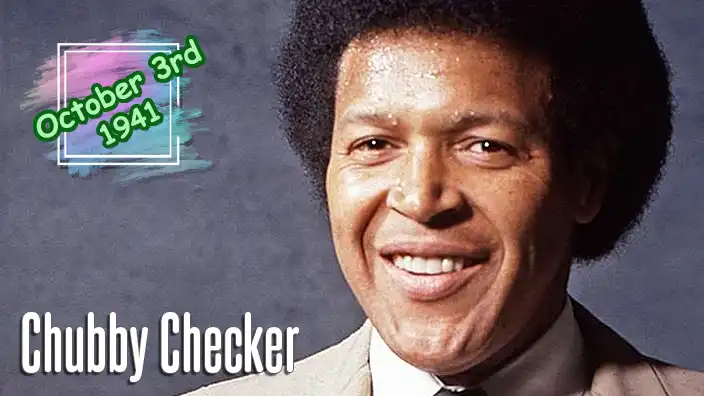
October 3, 1941, in Spring Gully, South Carolina
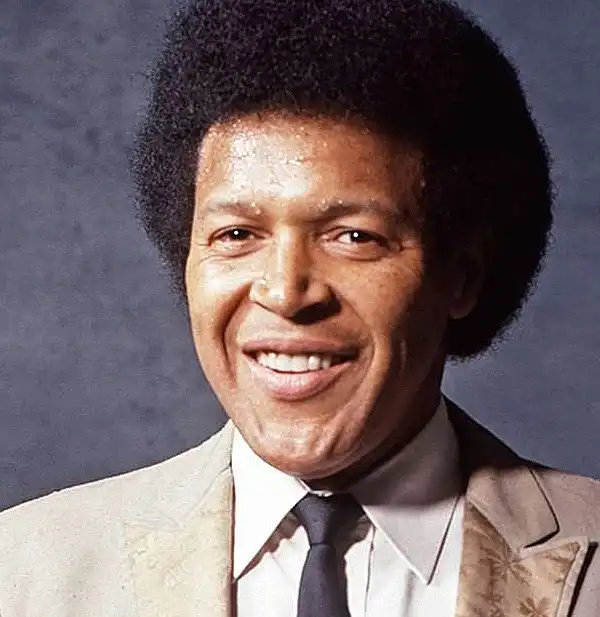
Chubby Checker was born Ernest Evans on October 3, 1941, in Spring Gully, South Carolina, and grew up in Philadelphia, Pennsylvania. A singer and entertainer whose name became inseparable from one of the greatest dance crazes in popular music history, Checker transformed Hank Ballard's song "The Twist" into an international phenomenon. His recording reached number one on the Billboard Hot 100 on two separate occasions, while the accompanying dance helped change the way young people moved to popular music.
Evans grew up in South Philadelphia and became interested in entertaining while still young. He sang on street corners and became known among friends and customers at the poultry market where he worked for singing and performing impressions of popular entertainers. His ability to imitate singers including Fats Domino attracted attention and eventually helped bring him into contact with Philadelphia television personality Dick Clark and the people surrounding the enormously influential American Bandstand.
His unusual stage name emerged during this early period. Ernest Evans became "Chubby" because of his build, while the surname "Checker" was reportedly suggested as a playful counterpart to Fats Domino. Domino and Checker — two games, two memorable stage names and, as it turned out, two important figures in early rock and roll.
Checker signed with Philadelphia's Cameo-Parkway Records, and his first single demonstrated his talent for vocal impersonation. "The Class," released in 1959, imagined various famous singers performing "Mary Had a Little Lamb." The novelty recording gave Checker his first chart success and introduced his voice to a national audience, but something considerably bigger was waiting.
"The Twist" had been written and recorded by Hank Ballard and the Midnighters. Their version appeared as the B-side of "Teardrops on Your Letter" in 1959 and developed attention of its own. The song was accompanied by a dance that differed in an important respect from many earlier popular dances: partners did not need to hold one another.
That may sound like a small distinction, but it represented an important change in social dancing. The Twist could be performed individually while still participating in a group environment. There were no complicated steps to memorize and no requirement for a partner who knew what he or she was doing. You planted your feet, moved your hips and twisted your body. Millions of people promptly concluded that this was a level of choreography they could handle.
Dick Clark recognized the potential of the song and dance for his television audience. When Hank Ballard was unavailable for an appearance, Checker was recruited to record another version. His youthful appearance, energetic delivery and ability to demonstrate the dance made him particularly well suited to television.
Chubby Checker's recording of "The Twist" was released in 1960. Appearances on programs including American Bandstand helped expose both the record and the dance to a huge national audience. Young viewers could hear the song, watch Checker demonstrate the movements and then attempt the dance themselves, presumably after moving anything breakable out of the immediate area.
The record reached number one on the Billboard Hot 100 in September 1960. That alone would have secured "The Twist" a place among the important hits of the early rock-and-roll era, but the story did not end there. The dance continued spreading beyond teenagers and entered mainstream adult culture. Celebrities were seen doing it, nightclubs promoted it and newspapers reported on the craze.
By late 1961, "The Twist" was climbing the charts again. In January 1962, Checker's recording returned to number one on the Billboard Hot 100. It became the first recording during the rock era to reach the top position in two separate chart runs, an extraordinary achievement for exactly the same recording.
The renewed success demonstrated how far the Twist had traveled culturally. What began as a youth dance associated with rhythm and blues and rock and roll became a national social phenomenon crossing generations. Adults who might previously have regarded teenage rock-and-roll dancing with considerable suspicion were suddenly twisting themselves.
Checker followed "The Twist" with a succession of dance-oriented hits. "Pony Time" reached number one in 1961, demonstrating that he was capable of topping the chart without simply rereleasing his signature song. Other recordings included "Let's Twist Again," "Slow Twistin'," "The Fly," "Limbo Rock," "Dancin' Party" and "Popeye the Hitchhiker."
"Let's Twist Again" became another major international hit and won the Grammy Award for Best Rock & Roll Recording. Its title cheerfully acknowledged that the public had apparently not yet twisted enough. Checker continued encouraging audiences to dance, providing instructions and rhythms for an expanding catalog of movements.
"Limbo Rock," released in 1962, gave Checker another enduring dance record. Based around the limbo, in which participants attempt to pass beneath a horizontal bar while bending backward, the song became closely associated with parties and social gatherings. Checker had therefore progressed from encouraging people to rotate while standing upright to encouraging them to bend backward beneath a stick. Occupational health and safety had clearly not yet taken control of rock and roll.
The significance of Checker's success extended beyond the individual records. Popular dances had existed long before rock and roll, but the Twist helped establish a model in which performers and record companies could promote a song and an associated dance simultaneously. A successful dance craze could drive record sales, television appearances and follow-up recordings, creating a cycle that the music industry enthusiastically embraced.
The dance itself also represented a broader change. Earlier social dancing commonly emphasized couples moving together through established steps. The Twist allowed people to dance separately, without physical contact and without a formal sequence. That basic concept became increasingly common in popular dancing during subsequent decades.
Checker's fame became so closely connected with dance records that it could also be limiting. Musical fashions changed rapidly during the 1960s, particularly after the arrival of the Beatles and other British groups transformed the American charts. Checker continued recording and performing, but the dance-craze era that had made him one of America's biggest stars gradually receded.
He nevertheless remained a highly recognizable figure and continued touring extensively. "The Twist" proved remarkably durable, returning repeatedly through nostalgia, films, television programs, commercials and celebrations of early rock and roll. Unlike many novelty dances whose instructions became historical curiosities, twisting required so little explanation that new generations could immediately understand the basic idea.
Checker also explored music outside the familiar dance-pop style. During the late 1960s and early 1970s, he recorded material reflecting contemporary rock and psychedelic influences, demonstrating ambitions beyond the formula with which the public most strongly associated him. Yet "The Twist" remained impossible to escape, rather like inventing the paper clip and then attempting to convince everybody that your later work in landscape painting deserves equal attention.
His signature song received an extraordinary retrospective distinction when Billboard named "The Twist" the top song in the history of its Hot 100 chart during the chart's 50th-anniversary celebrations in 2008. When Billboard later expanded its historical rankings for the Hot 100's 60th anniversary, "The Twist" retained the top position. Its unusual double run at number one and long chart performance contributed to that ranking.
Checker has also spent years arguing that his contribution to popular culture deserves greater institutional recognition, particularly from the Rock & Roll Hall of Fame. His case rests not merely on record sales but on the influence of the Twist as a cultural phenomenon. Whatever arguments surround awards and halls of fame, the historical impact of the dance itself is difficult to dispute.
"The Twist" also provides an important reminder that popular music history does not always belong solely to the person who first wrote or recorded a song. Hank Ballard created and originally recorded the number, and his role remains essential to its history. Checker's contribution was transforming another artist's composition into a mass-market phenomenon through his recording, performance and ability to demonstrate the dance on television.
That television element was particularly important. The rise of American Bandstand and similar programs meant that teenagers across the United States could encounter new records and dances simultaneously. Checker was not simply singing about twisting; viewers could watch exactly what he meant. Television turned the living room into a dance floor.
His influence can still be recognized whenever a song arrives with a dance attached to it. From later line dances to music-video choreography and dances spread through social media, the combination of a catchy recording and an easily copied movement remains extraordinarily powerful. The technology has changed enormously, but the basic principle would have looked quite familiar to Chubby Checker standing before an American Bandstand audience.
Chubby Checker's career belongs to a particular moment when rock and roll was still establishing its place in mainstream American culture. His music was energetic, accessible and designed above all to get people moving. He arrived when television could turn a regional dance into a national obsession and became the smiling, twisting figure at the center of it.
Many singers have recorded number-one hits, and many performers have inspired popular dances. Chubby Checker accomplished something more unusual: his name became permanently attached to a fundamental change in how people danced to popular music. More than six decades later, nobody needs a lengthy instruction manual when "The Twist" begins playing.
Just move your hips, pretend you're drying your back with an invisible towel, and try not to knock over the lamp.