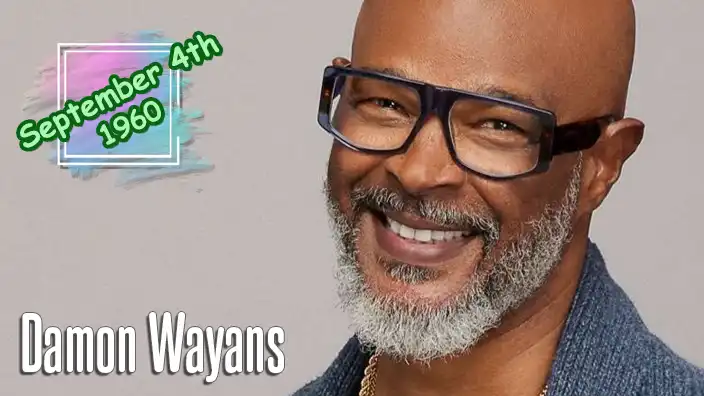
September 4, 1960, in New York City
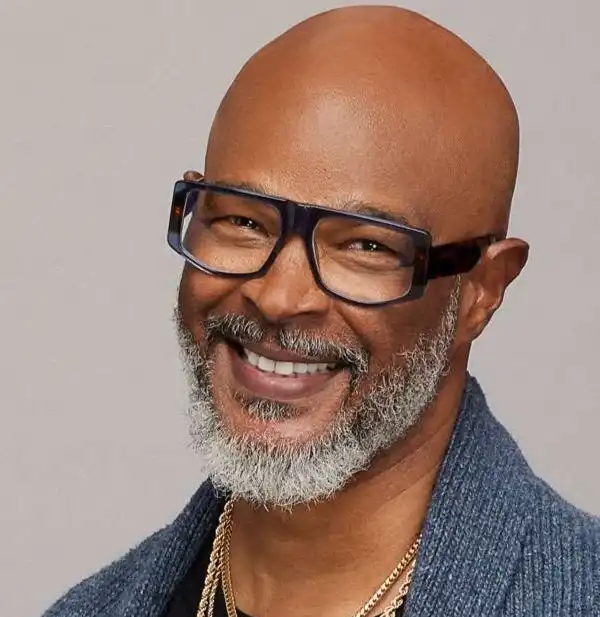
Damon Kyle Wayans Sr. was born on September 4, 1960, in New York City and grew up in the Fulton Houses in Manhattan's Chelsea neighborhood. He was one of ten children born to Howell Stouten Wayans, a supermarket manager, and Elvira Alethia Green Wayans, a homemaker and social worker. Money was not plentiful, space was presumably negotiated with the precision of an international treaty, and privacy in a household containing ten children was probably considered an interesting theoretical concept.
The Wayans children included Keenen Ivory, Dwayne, Damon, Kim, Elvira, Nadia, Vonnie, Shawn and Marlon, several of whom would eventually build successful careers in entertainment. Keenen Ivory Wayans became a writer, director and producer; Kim Wayans became an actress and comedian; Shawn and Marlon became actors, writers and producers. Later generations followed them into entertainment as well. The result is one of America's best-known show-business families, although attempting to construct a complete Wayans family entertainment résumé may require a large whiteboard and several markers.
Damon faced significant challenges during childhood. He was born with clubfoot and underwent corrective treatment. He has frequently incorporated childhood experiences into his comedy, including growing up poor in a large family and learning how humor could provide both entertainment and protection. In a household containing that many brothers and sisters, developing a quick response was probably less an artistic choice than a survival skill.
Wayans attended Murry Bergtraum High School in Manhattan but eventually left school and began pursuing work. By the early 1980s, he had entered New York's stand-up comedy scene. Like countless comedians before him, he learned his profession in clubs where an audience's verdict was immediate and unmistakable. If people laughed, the joke survived. If they stared silently, it went back to the workshop.
His first film appearance came with a small role in the 1984 Eddie Murphy comedy Beverly Hills Cop. Wayans played a hotel employee who encounters Murphy's Axel Foley. It was not a large part, but appearing in one of the decade's biggest comedies was certainly a respectable way to get a foot through Hollywood's door.
In 1985, Wayans joined the cast of Saturday Night Live. On paper, this looked like the breakthrough every young comedian wanted. In practice, his time on the program was brief and famously turbulent. Frustrated with the limited opportunities he felt he was receiving, Wayans altered the mannerisms of a character during a live sketch without approval, playing a police officer in an exaggeratedly effeminate style. He was fired from the program shortly afterward.
Most people would prefer not to have "fired from Saturday Night Live" prominently displayed near the beginning of their résumé.
For Damon Wayans, it turned out to be merely an interesting opening chapter.
He continued working in films during the late 1980s, appearing in Roxanne with Steve Martin and Colors with Sean Penn and Robert Duvall. He also appeared in Punchline, starring Sally Field and Tom Hanks, a film appropriately centered on the world of stand-up comedy.
Meanwhile, his older brother Keenen Ivory Wayans was developing something that would transform American television comedy.
In Living Color premiered on Fox in April 1990. Created by Keenen, the sketch-comedy series featured a predominantly Black cast and delivered a fast, irreverent alternative to established television comedy. The original cast included Damon Wayans, Kim Wayans, Tommy Davidson, David Alan Grier and Kelly Coffield, with other performers joining during the show's run.
Damon quickly became one of its defining stars.
His characters included Homey D. Clown, the perpetually disgruntled ex-convict forced to work as a clown as part of his parole. Homey refused to perform many traditional clown activities, particularly anything he considered demeaning, frequently punctuating his objections with the immortal declaration, "Homey don't play that!"
The character became a cultural phenomenon. Homey's battered clown costume, cynical attitude and refusal to cooperate made him instantly recognizable, while the catchphrase escaped the television screen and entered everyday conversation.
Wayans also created Blaine Edwards, one half of the flamboyant film-critic duo "Men on Film," alongside David Alan Grier's Antoine Merriweather. Their wildly enthusiastic reviews judged movies according to an entirely different set of criteria than anything likely to trouble Roger Ebert. The sketches became among the show's most popular recurring features, although some of the humor reflects attitudes and stereotypes typical of television comedy in that era and can land very differently with modern audiences.
Then there was Oswald Bates, the prison inmate whose attempts to sound intellectual produced magnificent collections of words that almost—but never quite—formed coherent sentences. Wayans' performance depended on absolute confidence. Oswald could deliver complete nonsense with the authority of a professor concluding an important lecture, proving that if you look sufficiently serious while saying something ridiculous, somebody will probably take notes.
Another memorable character was the outrageously enthusiastic Handi-Man, a disabled superhero parody. Like several In Living Color sketches, the character pushed boundaries that network television would approach much more cautiously today. Wayans has defended the character over the years, explaining that his own childhood experience with clubfoot informed his perspective and that the intention was to portray Handi-Man as heroic rather than simply as the target of the joke.
In Living Color became enormously influential. It introduced or helped establish performers including Jim Carrey, Jamie Foxx and Jennifer Lopez, who appeared as one of the show's Fly Girls dancers. The series won the Primetime Emmy Award for Outstanding Variety, Music or Comedy Series in 1990 and became an important part of Fox's emergence as a serious competitor to the established American television networks.
Wayans earned multiple Emmy nominations for his work on the program as both performer and writer. More importantly, In Living Color gave him the freedom to develop characters and comedy in ways he had never been permitted during his frustrating period at Saturday Night Live.
There is a certain satisfying symmetry there. Being fired from one legendary sketch-comedy program eventually helped place Wayans at the center of another.
While In Living Color was making him famous, Wayans expanded his film career. In 1991, he starred opposite Bruce Willis in The Last Boy Scout, an action comedy written by Shane Black and directed by Tony Scott. Wayans played Jimmy Dix, a disgraced former professional football player who joins Willis' private detective in investigating a complicated conspiracy involving professional sports and gambling.
The film allowed Wayans to balance comedy with action and drama, demonstrating that he could work effectively outside sketch television. His chemistry with Willis helped the movie develop a substantial following after its theatrical release.
Wayans then starred in and co-wrote Mo' Money in 1992 alongside his brother Marlon Wayans. He followed that with Blankman in 1994, playing an eccentric inventor who becomes a homemade superhero without the traditional advantages of wealth, superpowers or any particularly convincing evidence that this is a sensible career decision.
Then, in 1995, Damon Wayans became Major Benson Winifred Payne.
Major Payne cast Wayans as a hard-edged Marine Corps officer who finds himself without a military assignment and reluctantly accepts a position commanding a group of junior ROTC cadets at a private school. Major Payne regards childhood largely as a correctable disciplinary problem.
The film gave Wayans one of his most enduring characters. Payne speaks in a gravelly voice, has virtually no understanding of normal interaction with children and approaches schoolyard problems as though preparing recruits for an amphibious invasion. His solution to distraction is discipline. His solution to fear is discipline. His solution to discipline is apparently additional discipline.
Initially receiving mixed reviews, Major Payne developed a strong following through home video and television broadcasts. Lines and scenes from the movie continue circulating decades later, and for many viewers it remains the Damon Wayans performance they remember most fondly outside In Living Color.
Wayans continued making movies throughout the 1990s, starring in Celtic Pride with Daniel Stern and Dan Aykroyd and Bulletproof opposite Adam Sandler. In 1996, he appeared in The Great White Hype, a boxing satire featuring Samuel L. Jackson and Jeff Goldblum.
He also returned periodically to television. Damon, a sitcom starring Wayans as a Chicago police detective, premiered on Fox in 1998 but lasted only a short time. Television success, however, was waiting just a few years away.
In 2001, Wayans began starring as Michael Kyle in the ABC sitcom My Wife and Kids. He also co-created the series with television writer and producer Don Reo.
Michael Kyle is a successful businessman raising three children with his wife Jay, played by Tisha Campbell. He considers himself a modern father but frequently relies upon elaborate schemes, jokes and psychological warfare to teach his children lessons. Some fathers simply say no. Michael Kyle might construct a multi-stage operation lasting several days so the child eventually arrives at "no" independently.
The series also starred George O. Gore II as Michael Jr., Jazz Raycole and later Jennifer Freeman as Claire, and Parker McKenna Posey as Kady. Damon Wayans Jr. appeared in a recurring role as Michael Jr.'s friend John during the show's run, placing another Wayans generation on television.
My Wife and Kids ran for five seasons from 2001 until 2005 and became one of Wayans' most successful projects. The role of Michael Kyle showed a warmer side of his comedy while retaining the mischievous edge audiences expected. Much of the humor came from family dynamics rather than the more confrontational satire associated with In Living Color.
Wayans remained connected to stand-up throughout his career. His comedy frequently drew upon family, relationships, parenthood and his observations about men and women. His 1997 HBO special Damon Wayans: Still Standing showcased the direct, physical style that had first established him in comedy clubs.
He also became an author. His 1999 book Bootleg collected humorous observations and material, while his novel Red Hats was published in 2010, demonstrating an interest in writing beyond television scripts and stand-up routines.
The Wayans family legacy continued expanding around him. Damon Wayans Jr. established his own successful acting career, becoming particularly well known for Happy Endings and New Girl. The younger Wayans even appeared in the New Girl pilot before leaving for Happy Endings, then later returned as Coach.
Damon Sr. eventually returned to series television in a major role as Roger Murtaugh in Fox's Lethal Weapon, based on the famous film franchise. Beginning in 2016, he starred opposite Clayne Crawford's Martin Riggs, bringing both dramatic experience and comedy to the veteran detective originally played by Danny Glover.
The series became another television success for Wayans and introduced him to viewers who had not necessarily grown up watching Homey D. Clown or Major Payne. He remained with Lethal Weapon through its third and final season, although the production experienced highly publicized behind-the-scenes difficulties and cast changes.
More recently, Wayans returned to sitcom television alongside Damon Wayans Jr. in Poppa's House. The CBS comedy placed father and son together as series regulars, giving audiences the opportunity to watch two generations of Wayans comedy working directly opposite each other. For a family that has spent decades steadily occupying sections of the entertainment industry, it felt almost inevitable.
Wayans' influence reaches well beyond the number of television episodes or movies carrying his name. In Living Color helped change what American sketch comedy could look and sound like. It created opportunities for performers who were poorly represented elsewhere on network television, satirized Black culture and mainstream American culture from perspectives rarely given prime-time exposure, and launched an extraordinary collection of careers.
Damon Wayans was central to that success. His characters could be absurd, abrasive, politically incorrect, strangely sympathetic and occasionally all four before the commercial break. He was willing to look ridiculous, sound ridiculous and take jokes well beyond the point where more cautious performers might have applied the brakes.
His career has now stretched across more than four decades, encompassing stand-up comedy, sketch television, sitcoms, action movies, writing, producing and dramatic acting. He survived being fired from Saturday Night Live, helped create some of In Living Color's most famous characters, became a movie star and later anchored another long-running television comedy.
And through it all, the Wayans family kept growing into show business around him.
At this point, Hollywood may not actually employ the Wayans family.
It may be the other way around.