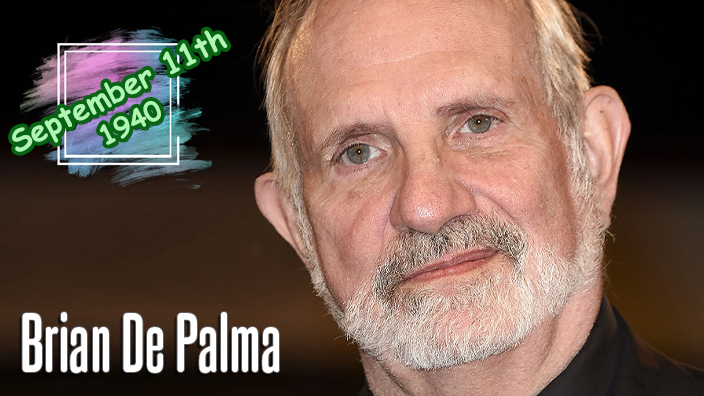
Brian Russell De Palma was born on September 11, 1940, in Newark, New Jersey, and grew up largely in Philadelphia. His father, Anthony De Palma, was an orthopedic surgeon, while his mother, Vivienne, encouraged her son's interests in science and technology. Long before cinema became his profession, young Brian appeared headed toward a very different sort of career. He was fascinated by physics, electronics and computers, won science competitions and built equipment himself. He attended Friends' Central School and later enrolled at Columbia University, initially studying physics. That scientific background never entirely disappeared. His later films frequently display the mentality of someone fascinated by mechanisms: how information is revealed, where people are positioned, what the audience can see and, more importantly, what it cannot.
Cinema gradually displaced science after De Palma became fascinated by movies during college. Among the films that made a particularly strong impression was Alfred Hitchcock's Vertigo. Hitchcock's influence would eventually become one of the most discussed aspects of De Palma's career, but De Palma was never shy about acknowledging it. Suspense, voyeurism, mistaken identity, doubles, guilt and the manipulation of audience expectations became recurring ingredients in his own films. Where another filmmaker might politely borrow a Hitchcock technique and hope nobody noticed, De Palma occasionally seemed inclined to borrow it, put spotlights around it and invite Hitchcock's ghost to opening night.
De Palma transferred his attention to filmmaking and studied at Sarah Lawrence College, where he earned a master's degree. His early work emerged from the energetic New York independent film scene of the 1960s. He made shorts and low-budget features, experimenting with satire, politics, sexuality and unconventional storytelling. Those early films also introduced him to a young actor named Robert De Niro, years before De Niro became one of the defining American actors of his generation. De Palma directed him in films including Greetings and Hi, Mom!, both of which demonstrated the director's willingness to poke at American culture rather than simply tell straightforward stories.
The early 1970s brought increasingly ambitious projects. Sisters, released in 1972, became an important turning point. Starring Margot Kidder, the psychological horror film displayed many techniques that would become associated with De Palma, including split-screen photography, voyeurism, murder and characters who cannot entirely trust what they have witnessed. The film also made his Hitchcock influence unmistakable. De Palma wasn't merely interested in frightening an audience; he was interested in making viewers aware that they were watching, spying and sometimes possessing information the characters desperately needed.
He followed with Phantom of the Paradise in 1974, a wonderfully strange combination of horror, rock music, satire, The Phantom of the Opera, Faust and the sort of 1970s visual extravagance that suggests everybody involved had been told restraint was temporarily unavailable. Initially unsuccessful in much of the United States, the film developed a passionate cult following, particularly in Winnipeg, Canada. It eventually became one of those movies whose original box-office performance matters considerably less than the devotion it inspired afterward.
Then came Carrie.
Released in 1976 and adapted from Stephen King's first published novel, Carrie transformed De Palma into a major Hollywood director. Sissy Spacek played Carrie White, a painfully shy teenager tormented by classmates and dominated at home by her fanatically religious mother, Margaret, played by Piper Laurie. Carrie's discovery that she possesses telekinetic powers would prove unfortunate for anyone foolish enough to push her beyond breaking point.
The film's prom sequence became one of the defining passages of 1970s horror. De Palma slowly constructs what appears to be Carrie's rare moment of happiness, then allows the audience to see the trap waiting above her. When the bucket of pig's blood falls, humiliation becomes catastrophe. Split-screen images, heightened sound and increasingly frantic editing turn the school gymnasium into a nightmare.
It is difficult to imagine a more convincing advertisement for skipping the prom.
Carrie became both a commercial and critical success. Spacek received an Academy Award nomination for Best Actress, while Laurie was nominated for Best Supporting Actress — unusually prestigious recognition for performances in a horror film. The movie also helped establish Stephen King as an extraordinarily valuable source for Hollywood adaptations, something the entertainment industry would spend the following decades confirming with considerable enthusiasm.
De Palma's reputation for technically elaborate thrillers continued with films such as The Fury, Dressed to Kill and Blow Out. The latter, released in 1981 and starring John Travolta and Nancy Allen, has become one of his most highly regarded films. Travolta plays Jack Terry, a sound technician recording effects one night when he accidentally captures audio evidence connected to a fatal car crash. What begins as a technical curiosity develops into political conspiracy and murder.
Blow Out demonstrates De Palma's fascination with filmmaking itself. Sound recording, editing, images and reconstruction become part of the plot. The protagonist attempts to discover truth by combining pieces of recorded reality, essentially doing what a filmmaker does in an editing room. De Palma transforms the mechanics of cinema into a suspense story.
Then, in 1983, Tony Montana arrived.
De Palma directed Scarface, written by Oliver Stone and starring Al Pacino as Cuban immigrant Tony Montana, who rises through Miami's cocaine trade with ambition, violence and an almost heroic inability to moderate his indoor voice. The film was a remake and radical reworking of Howard Hawks' 1932 gangster picture, transporting the story into the cocaine-fueled Miami underworld of the early 1980s.
Upon release, Scarface was controversial for its violence, language and excess. Some critics attacked precisely the qualities that later made the film culturally enormous. Pacino's performance is gigantic because Tony Montana himself believes everything should be gigantic: the house, the money, the drugs, the guns and preferably Tony Montana.
De Palma matched the character's appetite with an operatic visual style. The violence is brutal, the colors bold and the finale almost absurdly enormous. Tony's declaration to "say hello to my little friend" became one of the most widely recognized lines in popular cinema, while the character became an enduring cultural figure far beyond the original movie audience.
Over time, Scarface developed into one of the most influential gangster films ever made. Its imagery and dialogue became particularly prominent within hip-hop culture, where Tony Montana's rise from poverty to extraordinary wealth resonated even while his spectacular downfall provided the part some admirers occasionally seemed inclined to overlook.
De Palma moved from Miami cocaine empires to supernatural obsession with Body Double, another deliberately Hitchcockian thriller, before taking on organized crime again with The Untouchables in 1987. Written by David Mamet, the film starred Kevin Costner as federal agent Eliot Ness, Robert De Niro as Al Capone and Sean Connery as veteran police officer Jim Malone.
The film became one of De Palma's largest successes. Connery won the Academy Award for Best Supporting Actor, and Ennio Morricone's score received an Oscar nomination. De Palma also created one of his most famous sequences at Chicago's Union Station, where a baby carriage begins bouncing down a staircase during a gunfight. The scene openly echoes the Odessa Steps sequence from Sergei Eisenstein's Battleship Potemkin, another example of De Palma treating film history less as a museum and more as an extremely well-stocked toolbox.
His career was never consistently predictable. Casualties of War, released in 1989, took him into grim territory with a Vietnam War drama starring Michael J. Fox and Sean Penn. The Bonfire of the Vanities, however, became one of Hollywood's most notorious expensive disappointments. Adapted from Tom Wolfe's bestselling novel and featuring Tom Hanks, Bruce Willis and Melanie Griffith, the film was battered by critics and failed commercially.
For some directors, such a failure might have ended the major-studio invitations.
De Palma kept going.
He reunited with Al Pacino for Carlito's Way in 1993. Pacino played Carlito Brigante, a Puerto Rican criminal released from prison who genuinely wants to abandon his former life but discovers that old associations, loyalty and circumstance are remarkably effective at dragging a man back toward trouble. Sean Penn appeared almost unrecognizable as Carlito's increasingly desperate lawyer, David Kleinfeld.
Although Carlito's Way did not initially achieve the cultural impact of Scarface, its reputation grew considerably over time. The film's elaborate final chase through New York, culminating at Grand Central Terminal, displays De Palma at his most confident, stretching suspense through movement, geography and the audience's awareness that danger may be waiting around virtually every corner.
Then came Ethan Hunt.
In 1996, De Palma directed Mission: Impossible, starring Tom Cruise as Impossible Missions Force agent Ethan Hunt. The movie transformed the 1960s television series into a sleek modern espionage thriller and launched what would become one of Hollywood's most durable action franchises.
The film contains perhaps the most famous demonstration of De Palma's approach to suspense: the CIA vault sequence. Hunt must descend from the ceiling into an ultra-secure room without touching the floor, making excessive noise, raising the temperature or otherwise alerting the security system.
There are no explosions during most of the sequence. Hardly anybody speaks. Cruise simply hangs above the floor while the audience becomes increasingly concerned about sweat.
That scene is a masterclass in suspense because De Palma gives viewers all the necessary information beforehand. We understand the rules, understand what will happen if they are broken and then watch several things come perilously close to going wrong. A bead of sweat becomes as threatening as a loaded gun.
The movie was an enormous commercial success and established Ethan Hunt as a major screen character. The franchise would eventually become famous for Tom Cruise performing increasingly alarming practical stunts, but De Palma's original was more deliberately rooted in espionage, deception and paranoia. Nearly everybody is watching somebody, nearly everybody may be lying, and information is more dangerous than ammunition.
De Palma followed with Snake Eyes, starring Nicolas Cage, and then Mission to Mars, which took his visual ambitions into science fiction. Later films included Femme Fatale, The Black Dahlia, Redacted, Passion and Domino. Not all were commercially successful, and critical reactions varied enormously — something that had been true throughout much of his career.
That division is part of what makes De Palma interesting.
His admirers see a bold visual stylist who understands the grammar of cinema extraordinarily well. His critics have accused him of excessive violence, voyeurism, sensationalism and borrowing too heavily from Hitchcock and other filmmakers. De Palma has rarely seemed terribly bothered by the argument.
He has openly treated cinema as a language built by previous filmmakers. Hitchcock, Eisenstein, Antonioni and others provided techniques that could be studied, rearranged and pushed into new territory. De Palma's films frequently make the audience conscious of seeing: binoculars, cameras, mirrors, windows, surveillance equipment and screens repeatedly appear because watching itself is often part of the story.
His split-screen sequences allow audiences to observe simultaneous events. His split-diopter shots keep foreground and background subjects sharply visible at once. His extended tracking shots delay editing and force viewers to follow characters through carefully constructed spaces. Point-of-view shots make audiences unwilling participants in acts of surveillance.
These techniques influenced generations of filmmakers who followed him.
Yet De Palma has never been merely a technician. His best movies use technique to control emotion. We know the pig's blood is waiting above Carrie. We know something terrible can happen if Ethan Hunt touches the vault floor. We know Jack Terry possesses information somebody wants destroyed in Blow Out. De Palma gives the audience knowledge and then makes us suffer while waiting for the characters to catch up.
That is the old Hitchcock principle of suspense, but De Palma made it unmistakably his own through a more flamboyant visual vocabulary.
His filmography is also remarkably difficult to categorize. Horror gave us Carrie. Gangster cinema gave us Scarface and Carlito's Way. Crime drama produced The Untouchables. Political conspiracy produced Blow Out. Espionage produced Mission: Impossible. War brought Casualties of War. Science fiction produced Mission to Mars. Musical horror somehow produced Phantom of the Paradise.
Not every experiment worked.
But experimentation was rather the point.
Brian De Palma belongs to the generation of American filmmakers who emerged during the late 1960s and 1970s and transformed mainstream Hollywood cinema. His contemporaries included directors such as Martin Scorsese, Steven Spielberg, Francis Ford Coppola and George Lucas. Each developed a distinct cinematic identity, and De Palma's was among the easiest to recognize.
Watch a few minutes of the right De Palma film and you often know who is behind the camera before his name appears.
There will probably be an unusual camera movement.
Somebody may be watching somebody else.
There is a reasonable chance something terrible is about to happen.
And if Al Pacino happens to be nearby, everybody should probably move away from the staircase.
More than half a century after his earliest films, Brian De Palma's influence remains visible because he treated directing as something audiences should be able to see. The camera wasn't simply there to record actors delivering dialogue. It could mislead, reveal, conceal, stalk, float, divide the screen and occasionally make a single drop of sweat unbearably important.
From Carrie White standing beneath that bucket to Tony Montana defending his mansion and Ethan Hunt dangling silently above the CIA floor, De Palma created images that escaped their individual films and entered popular culture.
Love his excesses or argue with them, Brian De Palma made movies like a director determined that nobody should mistake them for anyone else's.
And in an industry that sometimes produces films by committee, that's quite an achievement.