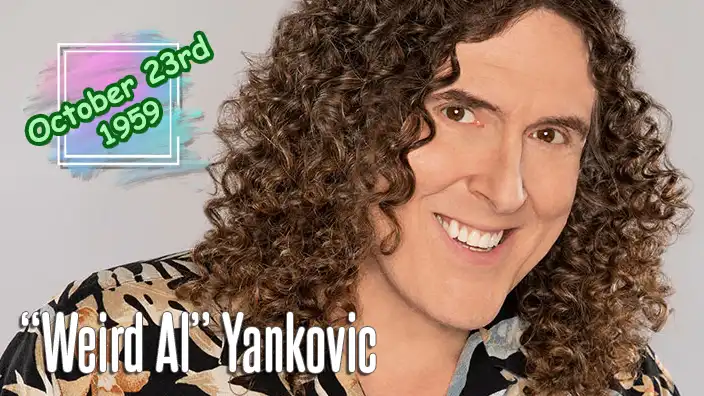
October 23, 1959, in Downey, California

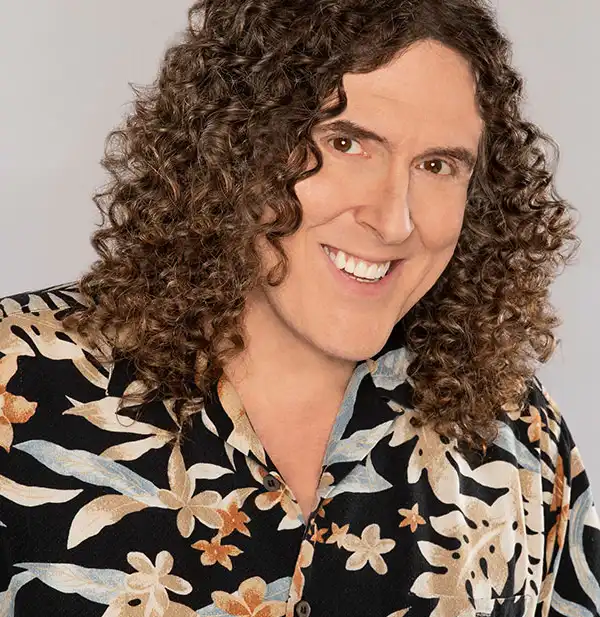
"Weird Al" Yankovic is an American musician, singer-songwriter, comedian, actor, producer, and satirist whose extraordinary career has transformed musical parody into a celebrated form of popular entertainment. Best known for creating hilarious new lyrics for familiar hit songs, he has entertained generations of listeners with his remarkable ability to combine musical talent, clever wordplay, and gloriously ridiculous subject matter. His famous recordings include "Eat It," "Like a Surgeon," "Smells Like Nirvana," "Amish Paradise," "White & Nerdy," and "Word Crimes," each demonstrating his talent for taking a recognizable musical success and sending it cheerfully off in an entirely unexpected direction. While countless musicians have devoted their careers to expressing the deepest emotions of the human experience, Yankovic has demonstrated that a song about sandwiches, grammar, or household appliances can be just as memorable when delivered with enough enthusiasm.
Born Alfred Matthew Yankovic on October 23, 1959, in Downey, California, he grew up in nearby Lynwood as the only child of Nick and Mary Yankovic. His father had Yugoslavian family roots, while his mother's ancestry included Italian and English heritage. His childhood was relatively conventional, although his developing interests in unusual music, comedy, and performance would eventually lead him toward a career that few parents could reasonably have anticipated. Young Alfred was academically gifted, curious, and interested in creative activities, but his greatest professional advantage would emerge from an instrument that most aspiring rock stars were not exactly rushing to purchase. While other children dreamed of becoming guitar heroes or glamorous singers, Yankovic discovered that an accordion could provide a surprisingly effective foundation for world domination, provided the world possessed a suitable sense of humor.
His musical education began shortly before his seventh birthday, when he received his first accordion lesson. According to Yankovic's official biography, a traveling music salesman had persuaded his parents that learning an instrument would be beneficial, and the accordion became his instrument of choice. He studied formally for several years before continuing independently, gradually developing the technical ability that would become central to his performances. Although the accordion was often associated with polkas, traditional dance music, and family celebrations, Yankovic discovered that its distinctive sound could also be used to reinterpret contemporary rock and pop music. His commitment to the instrument became one of his most recognizable trademarks, helping establish an identity that differed dramatically from the guitar-driven image of conventional popular musicians.
As a youngster, Yankovic also developed an enthusiasm for comedy recordings and novelty songs. He listened to performers such as Spike Jones, Allan Sherman, Stan Freberg, Tom Lehrer, and other entertainers who demonstrated that music could be funny without sacrificing musical quality. Their inventive arrangements, absurd lyrics, and satirical observations helped shape his understanding of comedy as a legitimate musical discipline. Another important influence was the syndicated radio program hosted by Dr. Demento, whose broadcasts introduced audiences to unusual recordings, comic songs, and wonderfully eccentric performers. For a young musician already fascinated by unconventional entertainment, the program offered something resembling a musical education conducted by people who had apparently misplaced the rulebook.
Yankovic began recording homemade comedy songs while still a teenager, using relatively simple equipment and sending his recordings to Dr. Demento in the hope of receiving radio exposure. His early efforts included original compositions and humorous interpretations of familiar songs. Dr. Demento recognized the young musician's unusual creativity and began playing his recordings, providing an important opportunity to reach listeners beyond his immediate community. The experience encouraged Yankovic to continue developing his songwriting and performance skills, establishing a relationship with the radio personality that would prove enormously important to his professional development. At a time when most aspiring musicians dreamed of attracting the attention of record company executives, Yankovic was delighted to discover that a man called Dr. Demento appreciated his accordion.
Academically, Yankovic proved equally accomplished. He attended Lynwood High School, where he excelled in his studies and graduated as valedictorian at sixteen. He subsequently enrolled at California Polytechnic State University in San Luis Obispo, studying architecture and graduating with a bachelor's degree. His university years were important not only for his education but also for the development of his professional identity. While working as a disc jockey at campus radio station KCPR, he adopted the nickname "Weird Al," a description that had previously been associated with his unconventional personality and musical interests. Rather than reject the nickname, he embraced it, transforming what might have been an unflattering label into one of the most successful entertainment identities in American popular culture. It was a rather clever decision, particularly considering how difficult it might have been to market a comedy album under the name Alfred Matthew Yankovic, Bachelor of Architecture.
One of his earliest significant recordings was "My Bologna," a parody of The Knack's 1979 hit "My Sharona." Yankovic recorded the song in a restroom at his college radio station, taking advantage of the room's acoustics to produce a distinctive sound. The recording transformed a popular rock song into an enthusiastic celebration of processed lunch meat, demonstrating the absurd humor that would become his trademark. After receiving airplay on Dr. Demento's program, the song attracted attention from the original band's lead singer, Doug Fieger, who supported Yankovic's efforts to secure a recording contract. Capitol Records subsequently released "My Bologna" as a single, providing one of the first important commercial milestones in his career. Few musicians can claim that their professional breakthrough involved recording an ode to sandwich filling in a bathroom, but Weird Al has never been particularly concerned about following conventional career advice.
Another early success came with "Another One Rides the Bus," a parody of Queen's "Another One Bites the Dust." Recorded live on the Dr. Demento radio program in 1980, the performance featured Yankovic playing accordion while Jon "Bermuda" Schwartz supplied percussion using an accordion case. The song transformed Queen's dramatic rock anthem into a comic account of overcrowded public transportation, complete with the frustrations of uncomfortable passengers and an increasingly unpleasant journey. The recording became popular among listeners and helped establish Yankovic as an inventive musical comedian. Schwartz subsequently became his longtime drummer, beginning a professional association that would continue through decades of recordings and concert performances. Their original arrangement may have lacked the elaborate equipment of a major recording studio, but it certainly demonstrated that creativity could compensate for a shortage of conventional percussion instruments.
In 1982, Yankovic signed with Scotti Brothers Records, and his self-titled debut album, "Weird Al" Yankovic, appeared in 1983. The recording featured early favorites including "Ricky," a parody of Toni Basil's "Mickey," along with "My Bologna," "Another One Rides the Bus," and "I Love Rocky Road," inspired by Joan Jett's "I Love Rock 'n Roll." The album introduced his distinctive musical approach to a wider audience and demonstrated that his comedy extended beyond simple lyrical substitutions. His arrangements incorporated polka rhythms, accordion performances, elaborate vocal imitations, and original compositions. Although the album achieved modest commercial success compared with his later recordings, it established the foundations of a career that would eventually make him the most commercially successful comedy recording artist of his generation.
Yankovic's major commercial breakthrough arrived with "Weird Al" Yankovic in 3-D in 1984. The album featured "Eat It," his famous parody of Michael Jackson's "Beat It," which transformed the original song's dramatic confrontation into a humorous argument about the importance of finishing one's dinner. The accompanying music video recreated numerous visual elements from Jackson's original production, substituting absurd food-related situations for the original's serious atmosphere. Yankovic's meticulous attention to detail made the parody particularly effective, demonstrating that he understood both the musical and visual characteristics of contemporary pop culture. "Eat It" became a major hit, reaching number twelve on the Billboard Hot 100, and earned him his first Grammy Award for Best Comedy Recording. Suddenly, the accordion-playing comedian was competing for attention with some of the biggest stars in popular music, proving that a determined entertainer could achieve remarkable things with a good joke and a convincing imitation of a red leather jacket.
The success of "Eat It" helped establish Yankovic as a familiar presence on MTV, where his imaginative music videos became essential components of his popularity. During the 1980s, music television was transforming the recording industry by giving performers an opportunity to communicate through elaborate visual productions. Yankovic recognized that parody worked especially well in this environment because audiences could immediately identify the original videos being imitated. His attention to costumes, camera angles, choreography, and visual jokes frequently matched the production standards of the original recordings. The resulting videos became entertaining productions in their own right, attracting viewers who appreciated both the musical humor and the elaborate visual references. For Yankovic, MTV provided the perfect platform: an entire television network devoted to music videos, many of which were practically begging to be made ridiculous.
His 1985 album Dare to Be Stupid further expanded his popularity and included the memorable single "Like a Surgeon," a parody of Madonna's "Like a Virgin." The song presented the misadventures of an inexperienced medical professional whose confidence exceeded his surgical abilities, an unsettling prospect for anyone who has ever entered an operating room. According to accounts of the song's creation, Madonna herself suggested the basic parody concept, which eventually reached Yankovic through mutual connections. The album also included the original title track, a stylistic tribute to the electronic rock band Devo, demonstrating his ability to imitate an artist's musical characteristics without directly parodying a particular song. This distinction became important throughout his career because Yankovic's original compositions and stylistic parodies frequently displayed as much musical sophistication as his better-known adaptations of popular hits.
In 1988, Yankovic released Even Worse, an album whose title and cover humorously referenced Michael Jackson's Bad. Its most recognizable recording was "Fat," a parody of Jackson's hit "Bad," accompanied by an elaborate music video that recreated the original's subway setting and choreography. Yankovic appeared wearing a specially constructed costume that exaggerated his physical appearance, producing a visual performance that became one of his most recognizable comedy creations. The music video won a Grammy Award for Best Concept Music Video, further establishing his reputation as a performer capable of combining musical humor with sophisticated visual production. His work demonstrated that successful parody required more than changing a few lyrics. It demanded an understanding of the original artist's presentation, the audience's expectations, and the precise moment when a serious image could be transformed into something gloriously absurd.
Although Yankovic became famous for musical parody, his creative ambitions extended into filmmaking. In 1989, he starred in and co-wrote UHF, a comedy film about an imaginative but unsuccessful dreamer who becomes responsible for operating a struggling television station. The movie featured absurd television programming, outrageous commercial parodies, and the unconventional humor associated with Yankovic's musical performances. Michael Richards, Victoria Jackson, Kevin McCarthy, and other performers appeared alongside him, helping create a film that celebrated the ridiculous possibilities of low-budget television. Although UHF performed poorly at the box office during its initial release, it gradually developed a devoted cult following through home video and repeated viewings. Its eventual popularity demonstrated that a movie's theatrical reception does not always determine its long-term cultural influence. Sometimes audiences simply need a few years to appreciate the finer artistic qualities of a television commercial featuring a particularly enthusiastic mop salesman.
Yankovic returned to major commercial success with Off the Deep End in 1992, an album featuring "Smells Like Nirvana," a parody of Nirvana's influential grunge anthem "Smells Like Teen Spirit." Rather than merely changing the song's subject, Yankovic cleverly addressed the difficulty of understanding the original recording's lyrics and the confusing conventions of alternative rock performance. The accompanying music video recreated the original's school gymnasium setting, cheerleaders, and chaotic atmosphere, adding absurd visual details that highlighted the parody. Nirvana frontman Kurt Cobain approved the adaptation, and the recording became another major success. The song also demonstrated Yankovic's ability to adapt to changing musical trends, moving comfortably from the polished pop productions of the 1980s into the grunge movement of the early 1990s without losing his distinctive comedic identity.
During the 1990s, Yankovic continued producing successful recordings that reflected the changing musical landscape. His 1993 album Alapalooza included "Jurassic Park," a parody of Richard Harris's recording of "MacArthur Park," combining the melody of a famously dramatic song with references to the blockbuster dinosaur movie. The accompanying animated music video received considerable attention for its imaginative presentation. Another popular recording, "Bedrock Anthem," combined elements of songs by the Red Hot Chili Peppers with references to The Flintstones. These creations demonstrated his ability to combine seemingly unrelated aspects of popular culture into cohesive comic performances. Whether addressing dinosaurs, prehistoric cartoon families, or contemporary rock music, Yankovic approached his subjects with a mixture of musical precision and gleeful absurdity.
One of his most commercially successful recordings of the decade was "Amish Paradise," released on the 1996 album Bad Hair Day. The song parodied Coolio's "Gangsta's Paradise," replacing its serious themes with an exaggerated portrayal of traditional Amish life. The accompanying music video featured elaborate period clothing, agricultural imagery, and carefully constructed visual jokes. However, the recording also became associated with a public disagreement concerning permission from Coolio, who initially objected to the parody. Yankovic maintained that he had believed approval had been obtained through representatives, and the disagreement was eventually resolved. The incident highlighted the sometimes complicated relationship between parody performers and the original artists whose music they reinterpret. It also reinforced Yankovic's longstanding practice of seeking permission from musicians even when certain parodies may be legally permissible without it.
Throughout his career, Yankovic has generally requested permission from original artists before releasing song parodies, demonstrating professional courtesy and respect for fellow musicians. Although American copyright law provides protections for certain forms of parody, the legal distinctions can be complex, particularly when musical compositions and commercial recordings are involved. Yankovic has frequently explained that he prefers obtaining approval rather than creating unnecessary conflicts. Some musicians have declined his requests, while others have enthusiastically welcomed the opportunity to have their songs reimagined. For many performers, becoming the subject of a Weird Al parody has developed into an unofficial indication of commercial success. After all, reaching the top of the charts is impressive, but discovering that someone has rewritten your hit about food, plumbing, or household appliances represents an entirely different level of cultural recognition.
Yankovic's 1999 album Running with Scissors included several enduring favorites, particularly "The Saga Begins," a parody of Don McLean's "American Pie" that retold the story of Star Wars: Episode I – The Phantom Menace. The song combined McLean's familiar musical structure with an elaborate summary of the science-fiction film's characters and events. Another popular recording, "It's All About the Pentiums," parodied Puff Daddy's "It's All About the Benjamins" and humorously celebrated computer technology, technical expertise, and exaggerated digital sophistication. These songs demonstrated Yankovic's increasing interest in subjects associated with science fiction, technology, and enthusiast communities. His ability to transform complicated cultural references into accessible comedy helped him develop a particularly enthusiastic following among audiences who appreciated intelligent wordplay and elaborate popular-culture references.
Beyond his recordings, Yankovic became an accomplished live performer whose concerts developed into elaborate theatrical productions. His stage shows frequently included rapid costume changes, video presentations, comic sketches, and carefully choreographed performances recreating the visual identities of his famous parodies. Accompanied by a longstanding group of talented musicians, including guitarist Jim "Kimo" West, bassist Steve Jay, and drummer Jon "Bermuda" Schwartz, he developed concerts that combined musical precision with energetic comedy. These performances required considerable preparation because individual songs often demanded different costumes, musical arrangements, and theatrical effects. While conventional rock performers might spend an entire concert wearing the same outfit, Yankovic occasionally appeared to require a backstage wardrobe department capable of outfitting a small theatrical company.
In 2003, Yankovic released Poodle Hat, an album featuring songs such as "Couch Potato," a parody of Eminem's "Lose Yourself," and "eBay," inspired by the Backstreet Boys' "I Want It That Way." The latter humorously explored the irresistible temptation to purchase unnecessary objects through online auctions, a subject that became increasingly familiar as internet shopping expanded. The album won the Grammy Award for Best Comedy Album, demonstrating Yankovic's continued commercial and critical relevance. His musical subjects increasingly reflected changing technology and consumer behavior, allowing his comedy to remain connected with contemporary experiences. Where earlier recordings had celebrated processed food and television personalities, newer songs examined computers, internet culture, and the growing collection of objects people could purchase without leaving their homes.
His 2006 album Straight Outta Lynwood produced another major success with "White & Nerdy," a parody of Chamillionaire's "Ridin'." The song humorously celebrated an exaggerated collection of stereotypically nerdy interests, including mathematics, computer programming, science fiction, and unusual hobbies. Its accompanying music video became enormously popular online, demonstrating Yankovic's ability to reach audiences through emerging digital platforms. "White & Nerdy" reached number nine on the Billboard Hot 100, becoming his highest-charting single in the United States. The achievement was particularly significant because it demonstrated that his popularity had survived major changes in the music industry. Long after his original MTV breakthrough, he was still producing hit recordings and discovering new ways to make audiences laugh.
Yankovic continued exploring contemporary musical trends with Alpocalypse in 2011, an album that included "Perform This Way," a parody of Lady Gaga's "Born This Way." The recording humorously examined extravagant stage costumes, theatrical performances, and the increasingly elaborate visual presentation of contemporary pop stars. The song's development attracted attention when initial permission difficulties were publicly discussed, but Lady Gaga ultimately approved the parody. The album also included original comedy songs and stylistic imitations, reinforcing Yankovic's reputation as a versatile composer rather than merely a performer who substitutes amusing words into familiar melodies. His musical arrangements frequently demonstrated a detailed understanding of the artists and genres being referenced, allowing his comedy to function both as entertainment and as a surprisingly sophisticated form of musical appreciation.
A particularly important milestone arrived in 2014 with the release of Mandatory Fun, Yankovic's fourteenth studio album. The recording included "Tacky," a parody of Pharrell Williams's "Happy," "Word Crimes," inspired by Robin Thicke's "Blurred Lines," and "Handy," a parody of Iggy Azalea's "Fancy." Its release was accompanied by an innovative promotional campaign featuring eight music videos unveiled over eight consecutive days. The strategy attracted enormous online attention and demonstrated Yankovic's understanding of how digital audiences discover and share entertainment. Mandatory Fun debuted at number one on the Billboard 200, becoming his first album to reach the top of the chart. The achievement was especially remarkable because comedy albums rarely occupy the highest positions in mainstream music rankings. After decades of musical mischief, Weird Al had finally reached number one by doing precisely what conventional industry wisdom might have advised him to avoid.
"Word Crimes" became one of the album's most widely discussed recordings, transforming a contemporary pop hit into a humorous examination of grammar, punctuation, spelling, and common language mistakes. The song appealed particularly to teachers, writers, editors, and anyone who has ever experienced an involuntary eye twitch after encountering an incorrectly placed apostrophe. Although its lyrics deliberately exaggerate the frustrations of language enthusiasts, the recording demonstrated Yankovic's ability to identify subjects that resonate with everyday audiences. His comedy frequently succeeds because it addresses familiar experiences through unexpected musical settings, allowing listeners to recognize their own habits and frustrations while enjoying the absurdity of the presentation.
Yankovic's achievements have earned him numerous honors throughout his career, including five Grammy Awards and multiple gold and platinum recording certifications. His Grammy-winning projects include "Eat It," "Fat," Poodle Hat, Mandatory Fun, and the comprehensive collection Squeeze Box: The Complete Works of "Weird Al" Yankovic. The latter project celebrated his extensive recorded catalog and received recognition for its elaborate packaging. His official website reports sales exceeding twelve million records, tapes, and CDs, an extraordinary achievement for an artist working primarily in musical comedy. These accomplishments demonstrate that humor can occupy a significant place within the commercial recording industry when supported by genuine musicianship, originality, and a sustained connection with audiences.
In addition to his musical career, Yankovic has appeared in numerous television programs, films, animated productions, and comedy projects. His distinctive voice and personality have made him a popular guest performer in animated entertainment, including appearances associated with The Simpsons, Futurama, My Little Pony: Friendship Is Magic, and other productions. He also served as co-host and bandleader during the final season of the television comedy series Comedy Bang! Bang! in 2016. His performances frequently involve playing exaggerated versions of himself, although he has also demonstrated a willingness to portray entirely fictional characters. The ability to move between live-action comedy, animation, music, and television hosting reflects his broad understanding of entertainment and his enthusiasm for creative experimentation.
Yankovic also developed a successful career as a children's author, publishing When I Grow Up in 2011 and My New Teacher and Me! in 2013. These illustrated books reflect his characteristic humor and imagination while encouraging young readers to embrace creativity and unconventional ideas. His writing demonstrates that the playful storytelling associated with his music can translate effectively into literature for children. The books feature absurd situations, imaginative possibilities, and the kind of cheerful nonsense that children often appreciate more readily than adults. For an entertainer whose professional career began with unusual songs and an accordion, encouraging children to pursue their own imaginative ambitions seems particularly appropriate.
In 2022, Yankovic became the subject of Weird: The Al Yankovic Story, a comedy biographical film starring Daniel Radcliffe as an exaggerated fictional version of the musician. Rather than presenting a conventional account of his life, the movie deliberately parodied the dramatic conventions of celebrity biographies, inventing outrageous incidents and transforming ordinary career developments into absurd adventures. Yankovic co-wrote the screenplay with director Eric Appel and appeared in a cameo role. The film also featured Evan Rachel Wood as Madonna and Rainn Wilson as Dr. Demento, contributing to its elaborate satire of entertainment-industry mythology. The production received enthusiastic attention and won two Primetime Emmy Awards, demonstrating that Yankovic's talent for parody could be applied just as effectively to the conventions of filmmaking as to popular songs.
One of the film's most entertaining qualities was its deliberate disregard for historical accuracy. Although inspired by recognizable aspects of Yankovic's career, the story invented dramatic rivalries, romantic complications, and spectacularly improbable events. This approach was entirely consistent with the musician's artistic identity, transforming the familiar celebrity biography into another opportunity for comic exaggeration. Viewers unfamiliar with his actual life could easily be forgiven for wondering which incidents were genuine and which had emerged from the writers' imagination. The safest assumption was that the more outrageous the incident appeared, the more enthusiastically Yankovic and his collaborators had probably enjoyed inventing it.
Despite his public reputation for eccentricity, Yankovic has generally maintained a relatively private and stable personal life. He married marketing executive Suzanne Krajewski in 2001, and the couple welcomed their daughter, Nina, in 2003. He has also spoken publicly about his decision to become a vegetarian in 1992, reflecting personal convictions that contrast amusingly with his extensive catalog of songs celebrating meat, fast food, and questionable eating habits. His private personality is frequently described as thoughtful, intelligent, and considerably more reserved than the exuberant characters featured in his performances. This distinction reinforces an important aspect of his appeal: the outrageous humor is carefully constructed entertainment rather than evidence that its creator spends every waking moment behaving like a cartoon character.
Another defining feature of Yankovic's career has been his commitment to maintaining strong professional relationships with his musicians and collaborators. His core touring band has remained remarkably consistent for decades, allowing the performers to develop the musical precision required for elaborate live arrangements and complicated comedy productions. Their versatility enables them to move rapidly between rock, pop, polka, country, rap, and numerous other musical styles. The band's technical abilities are sometimes overlooked because the performances are designed to make audiences laugh, but reproducing such a wide variety of musical arrangements requires considerable skill. Comedy may be the objective, but the musicianship behind the jokes is entirely serious.
Yankovic's influence has extended into internet culture, where musical parody, comedy videos, and humorous reinterpretations of popular songs have become widespread forms of entertainment. Long before digital platforms made it possible for aspiring performers to distribute comedy recordings instantly, Yankovic demonstrated the appeal of transforming familiar musical material into original comic creations. His success provided inspiration for later generations of musicians, comedians, and online entertainers interested in combining music with satire. However, his own career also illustrates the importance of musical craftsmanship, professional production, and originality. A funny idea may attract temporary attention, but sustaining a career across decades requires considerably more than replacing a few words in somebody else's song.
In July 2024, Yankovic released "Polkamania!," an elaborate polka medley celebrating the tenth anniversary of Mandatory Fun. The recording combined excerpts from major popular songs of the preceding decade, continuing a tradition of energetic polka arrangements that had appeared throughout his albums. Its animated music video brought together numerous visual styles and creative contributions, reflecting the collaborative spirit associated with his work. The release demonstrated that Yankovic remained enthusiastic about musical experimentation even without producing a conventional new studio album. It also reinforced one of his longest-running artistic convictions: almost any popular song can become a polka if someone is sufficiently determined and possesses the necessary accordion.
His continuing popularity was evident in the Bigger & Weirder concert tour, which began in 2025 and expanded with additional North American performances in 2026. The production featured a larger ensemble, elaborate staging, costume changes, and performances of familiar hits alongside selections from his extensive catalog. These concerts demonstrated the enduring appeal of his music across multiple generations, attracting longtime admirers as well as younger listeners who discovered his recordings through online videos, streaming services, and family introductions. His willingness to return to large-scale theatrical touring reinforced his reputation as an energetic performer whose concerts offer much more than a conventional musical recital. For audiences attending a Weird Al performance, the expectation is not merely to hear familiar songs but to experience an elaborate celebration of musical absurdity.
In 2026, Yankovic also continued exploring new creative possibilities beyond traditional recordings and concerts. A stage musical titled Dare to Be Stupid: The Weird Al Musical entered development, with Yankovic collaborating on its original story alongside Scott Brown and Anthony King. The project was conceived as a theatrical production incorporating songs from his extensive catalog, potentially introducing his music to another entertainment medium. The development reflected his continuing interest in imaginative storytelling and the adaptability of his musical creations. After decades of success in recording studios, concert halls, television, books, and movies, musical theater represented another opportunity to demonstrate that there are remarkably few artistic environments that cannot be improved by an unexpected accordion.
The enduring appeal of "Weird Al" Yankovic rests on a combination of intelligence, musical skill, originality, and an unusually generous approach to humor. His parodies generally celebrate the recognizable characteristics of popular songs rather than relying primarily on personal attacks against their performers. He understands that effective satire can be playful without becoming cruel, and his recordings frequently invite listeners to appreciate the original music while enjoying its comic transformation. This approach has helped him maintain a broad audience across generations and musical preferences, making his work accessible to people who might otherwise have little in common. Whether someone enjoys rock, pop, rap, country, or traditional polka, Yankovic has probably found a way to make that musical style entertainingly ridiculous.
From a shy California schoolboy learning the accordion to an internationally recognized performer with multiple Grammy Awards, chart-topping recordings, successful films, and an enduring concert career, "Weird Al" Yankovic has created one of the most distinctive careers in American entertainment. His achievements demonstrate that comedy and musicianship can complement each other, that originality can emerge from the most unexpected influences, and that popular culture becomes considerably more entertaining when someone is willing to examine it from a different perspective. Most importantly, he has encouraged audiences to laugh at familiar conventions, embrace their individuality, and appreciate the extraordinary possibilities of creative imagination. And if the history of popular music teaches us anything through his remarkable career, it is that no hit song is entirely safe once Weird Al gets hold of an accordion and starts thinking about lunch.