October 23, 1925, in Corning, Iowa
 January 23, 2005, in Los Angeles, California

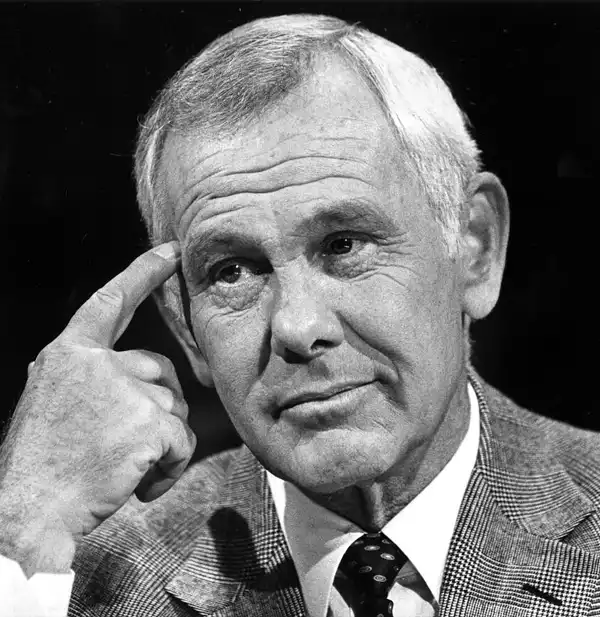
Johnny Carson was one of the most influential entertainers in American television history, a comedian, television host, writer, and performer whose extraordinary career helped define late-night entertainment. Best remembered as the longtime host of The Tonight Show Starring Johnny Carson, he transformed an evening television program into a national institution. His relaxed interviewing style, perfectly timed jokes, memorable comedy characters, and remarkable ability to connect with audiences earned him the affectionate title King of Late-Night Television. For three decades, Carson provided a familiar ending to the American day, proving that laughter was often the best way to forget the bills, the boss, and whatever Washington had managed to get wrong before dinner.
Born John William Carson on October 23, 1925, in Corning, Iowa, he was the son of Homer Lloyd Carson, a power company manager, and Ruth Elizabeth Hook Carson. His family eventually settled in Norfolk, Nebraska, a community that Carson would always consider his hometown. Growing up in the American Midwest, he developed the understated humor, conversational manner, and mischievous personality that later became his trademarks. Unlike performers who relied on elaborate costumes or exaggerated personalities, Carson discovered that a carefully delivered observation, an expressive glance, or a few seconds of silence could produce enormous laughter. Of course, mastering those techniques required years of practice, and his earliest audiences were considerably smaller than the millions who would eventually welcome him into their living rooms.
Carson's fascination with entertainment began with magic. As a youngster, he purchased a magician's kit and began practicing card tricks, sleight of hand, and other illusions. Performing under the wonderfully theatrical name The Great Carsoni, he entertained local audiences at clubs, community gatherings, and private functions. These early performances taught him how to command attention, anticipate audience reactions, and recover gracefully when something went wrong. Magic also introduced him to the importance of timing and misdirection, two skills that would serve him remarkably well in comedy. Years later, when Carson pretended to predict the contents of sealed envelopes as Carnac the Magnificent, viewers were watching a celebrated television comedian return to the magical roots of his childhood.
During World War II, Carson served in the United States Navy, eventually becoming an ensign. His service included duty aboard the battleship USS Pennsylvania in the Pacific. Even while serving his country, he maintained his enthusiasm for magic and entertainment, performing tricks for fellow servicemen whenever circumstances allowed. Military life provided valuable experiences, introduced him to people from different backgrounds, and reinforced the discipline required to perform under pressure. Although the Navy never issued an official qualification for making an entire room laugh, Carson was already developing a skill that would eventually prove more valuable to television executives than an entire warehouse of advertising slogans.
After leaving military service, Carson attended the University of Nebraska–Lincoln, graduating in 1949 with a degree in radio and speech and a minor in physics. His academic interests reflected a curious combination of technical knowledge, communication, and performance. While studying, he gained practical broadcasting experience through radio work, including writing comedy material for station KFAB. He subsequently worked at WOW in Omaha, where he developed his abilities as an announcer and entertainer. Radio demanded precise timing, quick thinking, and the ability to communicate personality through voice alone. Carson became skilled at all three, although television would eventually allow him to add the raised eyebrow, puzzled expression, and silent stare that became essential ingredients of his comedy.
As television expanded across the United States, Carson recognized the opportunities offered by the new medium. His early broadcasting work included appearances on WOW-TV in Omaha before he moved to California and joined Los Angeles television station KNXT. There, he developed Carson's Cellar, a local comedy program featuring sketches, satire, and the kind of unconventional humor that would later characterize his national career. Although the production lacked the elaborate resources of network television, it allowed Carson to experiment with characters, writing, and presentation. More importantly, it demonstrated his ability to entertain audiences without depending entirely on scripted jokes. He could create humor through personality and observation, a talent that would become particularly important when interviewing unpredictable celebrities.
A major professional breakthrough came when Carson joined The Red Skelton Show as a comedy writer. Working with the established comedian gave him valuable experience in network television and introduced his writing abilities to a wider professional audience. During one memorable incident, Red Skelton was injured shortly before a performance, and Carson stepped in to replace him. Suddenly, the young writer found himself performing before a national television audience rather than quietly supplying jokes from behind the scenes. His successful appearance demonstrated that he possessed the confidence, timing, and personality necessary for national broadcasting. It also established an important lesson: sometimes the fastest route to the spotlight begins when someone else unexpectedly becomes unavailable.
Carson continued building his television career with programs including The Johnny Carson Show, a comedy-variety series broadcast during the 1950s. Although the program did not achieve lasting success, it provided another opportunity to refine his performance style and establish professional connections. He subsequently became host of the daytime television game show Who Do You Trust?, where his natural ability to converse with ordinary contestants became one of the program's greatest attractions. Rather than treating participants merely as people answering questions, Carson encouraged spontaneous exchanges, playful remarks, and unexpected comic moments. His quick wit frequently made the conversations more entertaining than the competition itself, which was probably not the original intention of the show's producers.
It was during Who Do You Trust? that Carson developed one of the most recognizable partnerships in television history. In 1958, announcer Ed McMahon joined the program, beginning a professional relationship that would continue through Carson's extraordinary late-night career. McMahon's booming voice, infectious laughter, and enthusiastic introductions provided the perfect complement to Carson's more restrained personality. Their chemistry was immediate, combining the familiar traditions of a comedy double act with the spontaneity of live television. McMahon understood when to contribute, when to laugh, and when to allow Carson to take control of a moment. Together, they created a partnership so enduring that audiences eventually found it difficult to imagine one without the other.
On October 1, 1962, Johnny Carson officially succeeded Jack Paar as host of NBC's The Tonight Show, beginning a remarkable association that continued until May 22, 1992. Previous hosts, including Steve Allen and Paar, had established the foundations of late-night television, but Carson refined the format into something distinctly his own. His version combined an opening comedy monologue, celebrity interviews, musical performances, comedy sketches, and spontaneous conversations. The program became an essential part of American popular culture, attracting viewers who wanted entertainment without the formality of traditional variety shows. Carson's greatest accomplishment was making a carefully produced television broadcast feel like an informal gathering among friends.
Every episode began with one of television's most recognizable introductions. Ed McMahon would announce Carson's arrival with an enthusiastic "Heeeere's Johnny!", and the host would emerge from behind the curtain to enthusiastic applause. Accompanied for much of his tenure by bandleader Doc Severinsen and the Tonight Show Orchestra, Carson would deliver a topical monologue addressing politics, celebrities, current events, and the peculiarities of everyday life. His jokes could be pointed, but his delivery usually remained playful rather than openly hostile. Politicians from both major parties provided regular material, and Carson understood that public figures often supplied enough absurdity without requiring much assistance from professional comedy writers.
One of Carson's most remarkable talents was his ability to make an unsuccessful joke entertaining. When an audience responded with silence or groans, he rarely appeared embarrassed. Instead, he would pause, stare into the camera, offer a self-deprecating remark, or perform an exaggerated reaction that transformed the failure into another comic opportunity. Audiences loved these moments because they revealed the performer beneath the polished television presentation. Carson appeared to be sharing the joke with viewers rather than merely delivering it to them. His famous imaginary golf swing, frequently performed at the conclusion of his monologues, became another beloved signature, demonstrating that a simple gesture could become instantly recognizable when repeated by the right entertainer.
Beyond the opening monologue, Carson created an extraordinary collection of recurring comedy characters. Perhaps the most famous was Carnac the Magnificent, a supposedly gifted psychic who could divine answers to questions sealed inside envelopes. Wearing an elaborate turban and adopting a solemn expression, Carson would announce an answer before opening the envelope and revealing the question. The resulting jokes depended on wordplay, absurd connections, and the audience's anticipation of the inevitable punchline. Carnac's mock-serious presentation recalled Carson's childhood fascination with magic, while his deliberately ridiculous predictions demonstrated the comedian's mastery of comic timing. The character became so popular that viewers continued remembering Carnac long after the original broadcasts ended.
Other memorable creations included Art Fern, the fast-talking host of the fictional Tea Time Movie, whose hilariously confusing commercial announcements featured improbable directions and outrageous salesmanship. Carson also portrayed Aunt Blabby, an outspoken elderly woman whose sharp tongue and exaggerated personality provided opportunities for wonderfully ridiculous exchanges. His sketches frequently involved members of the Mighty Carson Art Players, a loosely organized collection of performers who helped bring his comic ideas to life. These characters revealed that Carson was much more than an interviewer or monologue comedian. He was a versatile sketch performer who understood physical comedy, parody, characterization, and the value of allowing an audience to anticipate a familiar joke.
Carson's interviewing style became another defining feature of The Tonight Show. Rather than dominating every conversation, he allowed guests to tell stories, demonstrate unusual talents, and reveal unexpected aspects of their personalities. Hollywood legends, musicians, authors, politicians, comedians, athletes, and ordinary people with extraordinary experiences all appeared on his program. Carson possessed an instinctive understanding of when to interrupt with a joke and when to remain silent. His relaxed manner encouraged guests to speak naturally, while his quick reactions often transformed ordinary anecdotes into memorable television. A successful appearance could improve a celebrity's public image, promote a new project, or introduce an unknown performer to an enormous national audience.
For aspiring comedians, appearing on The Tonight Show became one of the most important opportunities in American entertainment. Performers such as David Letterman, Jay Leno, Jerry Seinfeld, and Ellen DeGeneres benefited from exposure on Carson's program. His approval could dramatically influence a comedian's career, particularly when he laughed enthusiastically or invited the performer to sit beside him for a conversation after their routine. That invitation was widely regarded as a significant endorsement. Carson's influence extended far beyond his own performances because he helped establish the careers of entertainers who would subsequently shape television comedy for generations. In an industry filled with talent scouts, agents, and executives, one favorable reaction from Johnny Carson could accomplish an astonishing amount.
The program also produced moments that became part of American television folklore. In December 1969, Carson hosted the televised wedding of entertainer Tiny Tim and Miss Vicki, an unusual event that attracted enormous public attention. Another famous episode involved Carson's 1973 joke about an apparent toilet paper shortage, which contributed to panic buying and actual shortages in stores. The incident illustrated the extraordinary influence of his television audience and the unpredictable consequences of a well-delivered joke. Most comedians would be delighted to make millions of people laugh; Carson occasionally managed to make them rush to the supermarket as well.
In 1972, The Tonight Show moved its production from New York City to Burbank, California, bringing Carson closer to Hollywood and its enormous concentration of entertainers. The relocation helped reinforce the show's position as a central platform for celebrity interviews and entertainment promotion. Although Carson maintained a relaxed appearance on camera, he exercised considerable professional control over the program and its presentation. His popularity gave him substantial negotiating power with NBC, and his continued ratings success made him one of television's most valuable personalities. Competitors attempted repeatedly to challenge his dominance, but Carson remained the defining figure in American late-night entertainment throughout his tenure.
Despite his extraordinary public popularity, Carson was notably private and sometimes uncomfortable in social situations away from television. Friends and colleagues described a man who could command a studio audience with remarkable ease yet occasionally struggled with ordinary social encounters. This contrast fascinated observers because his on-screen personality seemed so effortlessly welcoming. Carson carefully protected his private life, preferring personal interests and trusted friends to the constant publicity surrounding many entertainers. He enjoyed magic, astronomy, tennis, sailing, and other pursuits that offered opportunities to escape the demands of television celebrity. His reserved personality also helped preserve an element of mystery around a performer whom millions of Americans felt they knew intimately.
Carson's personal life included four marriages. He married Joan Morrill Wolcott in 1949, and they had three sons, Christopher, Richard, and Cory. Following their divorce, he married Joanne Copeland in 1963, Joanna Holland in 1972, and Alexis Maas in 1987. His relationships and divorces occasionally attracted considerable media attention, particularly as his television fame increased. Carson sometimes incorporated self-deprecating jokes about marriage and alimony into his performances, demonstrating his willingness to acknowledge personal complications through humor. Nevertheless, he generally preferred to keep family matters separate from his public career, an increasingly difficult task for one of America's most recognizable television personalities.
Throughout his career, Carson received numerous prestigious honors recognizing his contribution to broadcasting and American culture. He earned six Emmy Awards, received the Television Academy's Governors Award in 1980, and was honored with a Peabody Award in 1985. In 1987, he entered the Television Academy Hall of Fame, recognizing his extraordinary influence on television entertainment. President George H. W. Bush awarded him the Presidential Medal of Freedom in 1992, and Carson received a Kennedy Center Honor in 1993. These distinctions reflected more than professional longevity. They recognized a performer who had shaped public conversation, influenced American comedy, and created a television institution that became part of the nation's cultural identity.
When Carson announced his retirement, the decision marked the approaching end of an extraordinary broadcasting era. His final Tonight Show broadcasts in May 1992 featured emotional tributes, memorable guests, and reflections on three decades of television history. During his penultimate program, Robin Williams and Bette Midler joined him for a particularly memorable evening, with Midler delivering a moving musical tribute. Carson's final broadcast on May 22 attracted an estimated 50 million viewers, an enormous audience reflecting the affection Americans felt for the departing host. Rather than ending with an elaborate comedy spectacle, he offered a personal farewell that emphasized gratitude, friendship, and the remarkable privilege of entertaining audiences for so many years.
Following his retirement, Carson largely withdrew from public entertainment, resisting opportunities to return with another regular television program. Jay Leno succeeded him as host of The Tonight Show, while David Letterman subsequently established his own influential late-night program on CBS. Carson's occasional appearances became noteworthy events precisely because he made so few of them. In 1994, he received an enthusiastic standing ovation during a surprise appearance on Letterman's Late Show. Even in retirement, he continued privately writing occasional jokes for Letterman, demonstrating that his affection for comedy remained strong long after he had surrendered the television spotlight.
Johnny Carson died on January 23, 2005, in Los Angeles, California, from complications associated with emphysema. His death prompted tributes from comedians, television personalities, journalists, and viewers who remembered the countless evenings he had brightened. His influence remained visible in the structure of late-night talk shows, the relationship between hosts and their announcers, the tradition of topical monologues, and the importance of giving emerging comedians a national platform. Although television technology, viewing habits, and entertainment styles have changed dramatically, Carson's combination of wit, restraint, spontaneity, and conversational warmth continues to provide a model for successful television hosting.
The legacy of Johnny Carson reaches beyond ratings, awards, and famous catchphrases. He demonstrated that humor could connect people across generations, that a carefully timed pause could be funnier than an elaborate joke, and that even the most celebrated entertainer occasionally needed to laugh at himself. His three decades behind the Tonight Show desk established a standard that subsequent hosts have continually studied, admired, and attempted to match. For millions of viewers, he was not simply a television personality but a familiar companion at the end of the day. And somewhere in the history of American entertainment, one can almost hear Ed McMahon announcing his arrival once again, followed by applause, laughter, and the unmistakable sound of Johnny Carson preparing to make the world smile.