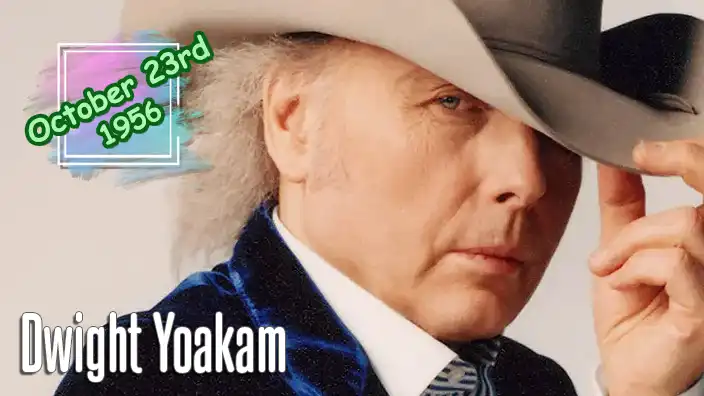
October 23, 1956, in Pikeville, Kentucky

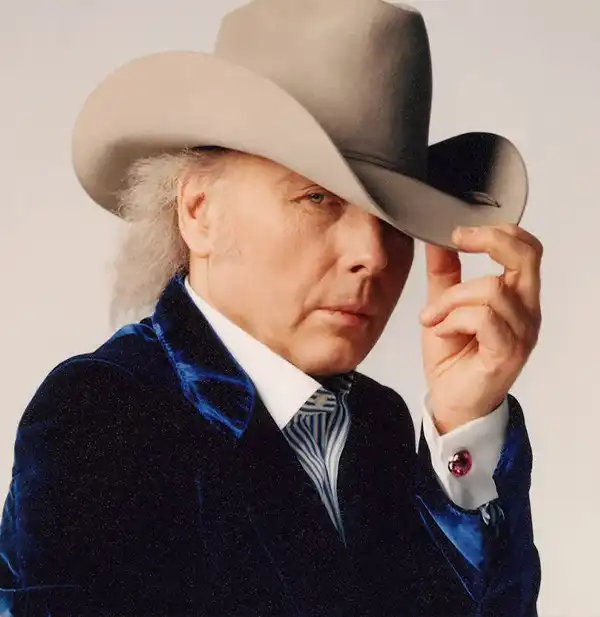
Dwight Yoakam is an American country music singer-songwriter, actor, and filmmaker whose distinctive combination of traditional honky-tonk, rockabilly, country rock, and the Bakersfield sound helped reshape modern country music. Known for his powerful nasal tenor, unmistakable cowboy hat, energetic stage performances, and fiercely independent musical style, Yoakam emerged as one of the most influential figures in the country music revival of the 1980s. While Nashville increasingly embraced polished production and crossover pop arrangements, Yoakam preferred twanging guitars, driving rhythms, and songs about heartbreak, loneliness, and the occasional regrettable romantic decision. His refusal to abandon country music's traditional foundations ultimately helped establish a remarkable career spanning recordings, concert performances, songwriting, acting, and filmmaking.
Dwight David Yoakam was born on October 23, 1956, in Pikeville, Kentucky, a community deeply connected to the coal-mining traditions of Appalachia. His parents were David Yoakam and Ruth Ann Tibbs, and the family relocated to Columbus, Ohio, during his childhood. Although he grew up far from the traditional country music centers of Nashville and Bakersfield, the sounds of Appalachian folk music, bluegrass, honky-tonk, and classic country remained important influences. His family enjoyed traditional country performers, while the young Yoakam also listened to rock and roll, pop music, and the emerging sounds of contemporary American radio. This combination of musical influences would eventually become essential to his distinctive style, allowing him to respect country music's past without treating it like a museum exhibit where nobody was allowed to touch anything.
As a youngster, Yoakam developed an interest in music and acting, learning guitar and participating in school theatrical productions. At Northland High School in Columbus, he performed in plays, sang, and played guitar with local bands. These early experiences helped him develop confidence as a performer and introduced him to the relationship between storytelling and entertainment. Acting taught him how to communicate emotion through expression and movement, while music provided a means of translating personal feelings into memorable performances. His interests were never confined to one artistic discipline, and the combination would eventually serve him well when Hollywood came calling. Even then, the young performer seemed unwilling to choose between a guitar and a script when there was a perfectly reasonable possibility of enjoying both.
Following high school, Yoakam briefly attended Ohio State University before deciding to pursue a professional music career. He traveled to Nashville during the late 1970s, hoping to establish himself in the country music industry. Unfortunately, his traditional honky-tonk sound arrived at a time when many record executives were concentrating on smoother, more commercially polished country music. The fashionable Nashville sound emphasized elaborate production, orchestral arrangements, and crossover appeal, while Yoakam favored the direct emotional impact of earlier country performers. His musical approach received little encouragement from the industry's established gatekeepers. Rather than abandon his ambitions or soften his sound to satisfy record executives, Yoakam made the unconventional decision to seek opportunities elsewhere. Nashville had effectively told him that his music belonged in another era, so he went looking for an audience that appreciated a little history with its entertainment.
Yoakam eventually established himself in Los Angeles, where he discovered an enthusiastic audience in an unlikely setting: the city's rock and punk music clubs. During the late 1970s and early 1980s, he performed alongside alternative rock, roots rock, and punk-influenced musicians, including bands associated with California's emerging cowpunk scene. Groups such as X, Los Lobos, and The Blasters attracted audiences interested in energetic performances and music that rejected commercial conventions. Yoakam's traditional country sound initially appeared an unusual addition to these lineups, but his driving rhythms, rebellious attitude, and passionate performances connected with listeners who appreciated musical authenticity. The combination demonstrated that country music and punk rock shared more than their audiences might have expected. Both could be loud, independent, emotionally direct, and wonderfully unconcerned about what respectable people thought.
A particularly important influence on Yoakam's developing musical identity was the Bakersfield sound, a distinctive style of country music associated with California performers such as Buck Owens and Merle Haggard. Unlike the heavily orchestrated Nashville productions popular during certain periods, Bakersfield country emphasized electric guitars, prominent rhythms, sharp vocals, and a raw honky-tonk atmosphere. Yoakam admired the directness of this approach and incorporated its essential characteristics into his own recordings. His music also drew inspiration from Hank Williams, Lefty Frizzell, Elvis Presley, and rockabilly pioneers, producing a lively combination of traditional country storytelling and rock-and-roll energy. By embracing these influences, he helped introduce classic American country music to listeners who might otherwise have considered the genre hopelessly old-fashioned. Apparently, all traditional country music needed was a little electricity and someone willing to turn up the amplifier.
Another significant figure in Yoakam's early career was guitarist and producer Pete Anderson, whose musical partnership with the singer helped establish his signature sound. Anderson's crisp electric guitar playing, imaginative arrangements, and production expertise complemented Yoakam's songwriting and distinctive vocals. Together, they developed recordings that preserved the spirit of classic honky-tonk while incorporating contemporary energy and musical sophistication. Their collaboration became central to Yoakam's early commercial success, producing some of the most recognizable country recordings of the period. The combination of Yoakam's expressive singing and Anderson's distinctive guitar work created a sound that could be identified almost immediately, an impressive accomplishment in an industry where many performers were encouraged to sound suspiciously like whoever had sold the most records the previous week.
Yoakam's breakthrough arrived with the release of Guitars, Cadillacs, Etc., Etc. in 1986. The album introduced his uncompromising country sound to a national audience and helped establish him as a leading figure in the emerging neotraditional country movement. Songs including "Honky Tonk Man," "Guitars, Cadillacs," and "It Won't Hurt" demonstrated his ability to combine traditional country themes with energetic arrangements and contemporary appeal. His recording of "Honky Tonk Man," originally associated with Johnny Horton, became a major country hit, while the title track established Yoakam as an accomplished songwriter with a talent for memorable melodies and emotionally direct lyrics. The album reached the top of Billboard's country albums chart and became a commercial and critical success, proving that the musical style Nashville had initially considered unfashionable could attract a substantial audience.
The success of Guitars, Cadillacs, Etc., Etc. was followed by Hillbilly Deluxe in 1987, another influential recording that reinforced Yoakam's reputation as an important new voice in country music. The album included songs such as "Little Ways," "Please, Please Baby," and "Always Late with Your Kisses," the latter reflecting his appreciation for the music of Lefty Frizzell. Its lively performances and traditional musical foundations appealed to both mainstream country listeners and audiences attracted to roots rock. Yoakam demonstrated that country music did not need to abandon its history to remain commercially successful. His performances possessed an energy that made even the saddest heartbreak songs suitable for dancing, although listeners occasionally had to decide whether to celebrate the rhythm or sympathize with the unfortunate romantic circumstances described in the lyrics.
In 1988, Yoakam released Buenas Noches from a Lonely Room, an album that produced some of his most enduring recordings. Among its highlights was "Streets of Bakersfield," a duet with Buck Owens that reached number one on Billboard's country singles chart. The collaboration was especially meaningful because Owens had been one of Yoakam's most important musical influences. Their recording introduced the Bakersfield sound to another generation of listeners and celebrated the continuing relevance of traditional country music. The album also featured "I Sang Dixie," a moving song written by Yoakam that became another number-one country hit. Its emotionally powerful storytelling demonstrated that his musical abilities extended beyond energetic honky-tonk performances. He could deliver heartbreaking narratives with remarkable sincerity, occasionally making listeners reconsider whether they really wanted to hear another sad song before finishing their morning coffee.
As his recording career progressed, Yoakam continued releasing successful albums that explored different aspects of country music and American roots traditions. If There Was a Way, released in 1990, included memorable recordings such as "Turn It On, Turn It Up, Turn Me Loose," "You're the One," and "It Only Hurts Me When I Cry." The album further established his ability to combine emotional songwriting with energetic arrangements. His music frequently explored relationships, separation, longing, regret, and personal independence, familiar subjects within country music but presented through his distinctive musical personality. Yoakam possessed an unusual ability to make romantic disappointment sound simultaneously devastating and entertaining, an achievement that probably says something about the enduring appeal of country music and the remarkable number of people who have experienced a relationship best remembered through a three-minute song.
One of the defining achievements of Yoakam's recording career came with This Time in 1993. The album became his most commercially successful studio release, eventually earning triple-platinum certification in the United States. Its memorable songs included "Ain't That Lonely Yet," "A Thousand Miles from Nowhere," "Fast as You," and "Try Not to Look So Pretty." These recordings demonstrated a sophisticated combination of country traditions, contemporary production, and emotional storytelling. "Ain't That Lonely Yet" earned Yoakam a Grammy Award for Best Male Country Vocal Performance, confirming his position among the genre's leading artists. The success of This Time also demonstrated that his musical independence had not limited his commercial potential. Quite the opposite: the cowboy who had struggled to attract Nashville's attention was now selling records by the millions.
Yoakam's songwriting has remained one of the most important elements of his artistic identity. Unlike performers who depend primarily on outside composers, he has written or co-written much of his recorded material, developing songs that reflect his understanding of country music's storytelling traditions. His lyrics frequently combine straightforward language with emotional complexity, allowing listeners to recognize familiar experiences in carefully constructed musical narratives. Whether describing heartbreak, personal freedom, nostalgia, or the difficulty of maintaining relationships, Yoakam approaches songwriting with a strong sense of character and atmosphere. His songs often sound deceptively simple, but their memorable melodies and emotional impact reveal considerable craftsmanship. As countless country songwriters have discovered, writing about heartbreak is relatively easy; making millions of strangers want to sing along requires rather more talent.
Throughout his musical career, Yoakam has also demonstrated an adventurous willingness to reinterpret songs from outside traditional country music. His recordings have included material associated with Elvis Presley, Queen, Cheap Trick, The Clash, and other performers whose musical styles differ considerably from classic honky-tonk. Rather than simply reproducing the original arrangements, Yoakam frequently transforms these songs through his distinctive vocals, country instrumentation, and rhythmic interpretations. His recording of Queen's "Crazy Little Thing Called Love" became particularly successful, demonstrating how naturally rockabilly influences could connect the worlds of rock and country. These musical experiments have helped distinguish him from performers who remain within narrowly defined genre boundaries. For Yoakam, a good song is apparently a good song, regardless of whether its original performer wore cowboy boots, leather trousers, or something considerably more alarming.
Alongside his recording achievements, Yoakam developed a successful career as an actor, appearing in films and television productions that revealed a talent for dramatic characterization. His screen appearances included Red Rock West in 1993, a crime thriller that helped establish his credibility as a performer capable of portraying complex and unsettling characters. Unlike musicians who make occasional film appearances primarily because of their celebrity status, Yoakam approached acting as a serious creative discipline. His performances demonstrated an ability to communicate menace, vulnerability, humor, and emotional intensity, sometimes within the same character. Audiences familiar with his musical charm occasionally discovered that the friendly country singer could become a distinctly unpleasant individual once a director shouted "Action!"
One of Yoakam's most acclaimed film performances came in Sling Blade in 1996, the drama written and directed by Billy Bob Thornton. Yoakam portrayed Doyle Hargraves, an abusive and deeply unpleasant character whose behavior creates considerable tension throughout the story. His convincing performance attracted critical attention and demonstrated his willingness to accept challenging roles that contrasted sharply with his public musical personality. The film became an important milestone in his acting career, introducing him to viewers who might not have been familiar with his recordings. It also established that his talent for portraying disturbing characters was not merely a novelty. He could create believable dramatic performances without relying on his musical reputation, although audiences might understandably have preferred to encounter him holding a guitar rather than behaving like Doyle Hargraves.
Yoakam continued appearing in notable films, including The Newton Boys in 1998, Panic Room in 2002, and Hollywood Homicide in 2003. In Panic Room, directed by David Fincher and starring Jodie Foster, he portrayed Raoul, one of the criminals involved in a frightening home invasion. The role required a convincing combination of intimidation and unpredictability, qualities he delivered with considerable dramatic effectiveness. He also appeared in the comedy Wedding Crashers in 2005 and the action films Crank and Crank: High Voltage. These varied projects demonstrated his versatility, allowing him to move between crime dramas, thrillers, comedies, and action films. His screen career became substantial enough that some moviegoers recognized him primarily as an actor, occasionally discovering with surprise that the fellow playing the villain also had an impressive collection of country music awards.
Yoakam expanded his filmmaking ambitions with South of Heaven, West of Hell, a Western released in 2001 that he wrote, directed, and starred in. The project reflected his longstanding appreciation for Western storytelling and his desire to exercise greater creative control over film production. Although the movie received mixed reviews and did not achieve major commercial success, it demonstrated his willingness to explore filmmaking beyond acting. Creating a feature film requires coordinating performers, production schedules, visual storytelling, and numerous technical responsibilities, making it a substantially different undertaking from recording an album. Yoakam nevertheless embraced the challenge, illustrating the independent attitude that had characterized his music career. Apparently, once he had mastered singing, songwriting, and acting, he decided that telling everyone else where to stand seemed like a perfectly reasonable next step.
His work on television has further expanded his entertainment career. Yoakam appeared in productions including Under the Dome and Goliath, continuing to develop a screen presence independent of his musical accomplishments. These roles allowed him to explore different characters and dramatic situations while maintaining his recording and performing commitments. His ability to move between concert stages and film sets reflects a broader understanding of entertainment as a collection of related creative disciplines rather than separate professional worlds. Whether performing before thousands of concertgoers or appearing in a dramatic scene, Yoakam relies on timing, emotional communication, and an understanding of how audiences respond to character and storytelling.
Recognition for Yoakam's musical accomplishments has included two Grammy Awards, numerous nominations, and honors from major music organizations. In addition to his Grammy recognition for "Ain't That Lonely Yet," he shared a Grammy Award for Best Country Collaboration with Vocals for "Same Old Train," a recording featuring several prominent country performers. His commercial achievements include millions of albums sold, multiple platinum certifications, and numerous successful singles. In 2008, he was inducted into the Kentucky Music Hall of Fame, acknowledging his connection to the state's musical heritage. He was subsequently inducted into the Nashville Songwriters Hall of Fame in 2019, recognizing his significant contribution to country music composition. These distinctions reflect both his commercial success and his influence on the development of modern American roots music.
Yoakam's distinctive personal appearance has also become closely associated with his public identity. His low-crowned cowboy hats, frequently worn tilted forward, fitted jeans, boots, and energetic stage movements helped establish an instantly recognizable image. While some country performers adopted increasingly elaborate stage costumes, Yoakam maintained a style that combined traditional Western clothing with a contemporary rock-and-roll attitude. His hat became particularly famous, often casting a shadow across his face during performances and photographs. The appearance reinforced his connection to country music traditions while giving him a visual identity that stood apart from many contemporaries. Few entertainers have managed to make a cowboy hat such an essential part of their professional image, although it must occasionally have presented a challenge to photographers attempting to establish whether he actually possessed a forehead.
Despite his established success, Yoakam continued experimenting with musical styles and recording approaches. His 2012 album 3 Pears incorporated elements of alternative rock and contemporary production while retaining his recognizable country foundations. The album received positive critical attention and demonstrated his ability to remain creatively adventurous without abandoning the qualities that originally attracted audiences. In 2016, he released Swimmin' Pools, Movie Stars..., an album featuring bluegrass interpretations of songs from his catalog. The project emphasized acoustic instrumentation and traditional American musical arrangements, returning familiar recordings to a different stylistic setting. These releases illustrated Yoakam's understanding that preserving musical traditions does not necessarily require performing every song exactly as it was recorded decades earlier.
In his personal life, Yoakam married photographer Emily Joyce in 2020, and the couple welcomed their son, Dalton, that same year. Fatherhood introduced another important dimension to his life and subsequently influenced his songwriting. Although Yoakam has generally maintained a degree of privacy surrounding his family, he has spoken about the happiness and creative inspiration associated with marriage and parenthood. His experiences provided new subjects for songs, demonstrating that an artist famous for heartbreak and loneliness could also find musical inspiration in domestic happiness. For a performer whose catalog contains enough romantic disappointment to keep several country radio stations operating indefinitely, the development represented a rather pleasant change of circumstances.
In November 2024, Yoakam released Brighter Days, his first album of new original material in several years. The recording featured new songs written or co-written by Yoakam, alongside carefully selected interpretations of material by other artists. Among its notable collaborations was "I Don't Know How to Say Goodbye (Bang Bang Boom Boom)," recorded with Post Malone, bringing together two performers from different musical generations. The album also included "Brighter Days," a song on which his son Dalton received a co-writing credit. The project reflected Yoakam's continuing interest in musical experimentation and his willingness to collaborate with contemporary artists while maintaining his own recognizable identity. It also demonstrated that traditional country music can remain relevant without abandoning its foundations or pretending that every worthwhile musical idea was invented before the arrival of digital recording.
The lasting influence of Dwight Yoakam extends well beyond his own commercial achievements. His willingness to challenge Nashville's prevailing musical expectations helped broaden the possibilities available to country performers, particularly those interested in combining traditional influences with contemporary sounds. By finding an audience in rock and punk venues, he demonstrated that musical genres need not remain confined to their established commercial markets. His success helped reinforce the importance of honky-tonk, rockabilly, and the Bakersfield sound during a period when country music was undergoing considerable change. Subsequent generations of Americana, alternative country, and roots rock musicians have benefited from the creative independence that artists such as Yoakam helped establish.
Dwight Yoakam's remarkable career illustrates the value of artistic conviction, perseverance, and an occasional willingness to ignore conventional wisdom. From his childhood in Kentucky and Ohio to the rock clubs of Los Angeles, the country music charts, and the movie studios of Hollywood, he has repeatedly demonstrated that success does not always require following the expected route. His distinctive voice, memorable songs, energetic performances, and convincing acting have established him as an important figure in American entertainment. More importantly, he has helped keep traditional country music alive while proving that its familiar themes of love, heartbreak, independence, and everyday struggle remain relevant to contemporary audiences. And if there is one lesson to be learned from Dwight Yoakam's journey, it is that when Nashville tells you your music doesn't fit, sometimes the smartest thing to do is take your guitar to California, turn up the volume, and let the audience decide.