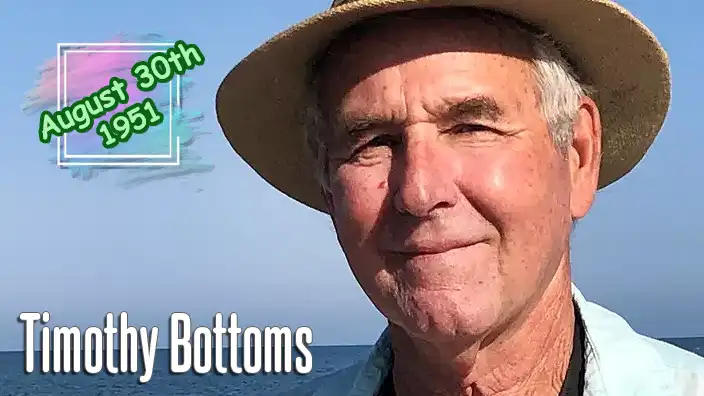
August 30, 1951, in Santa Barbara, California
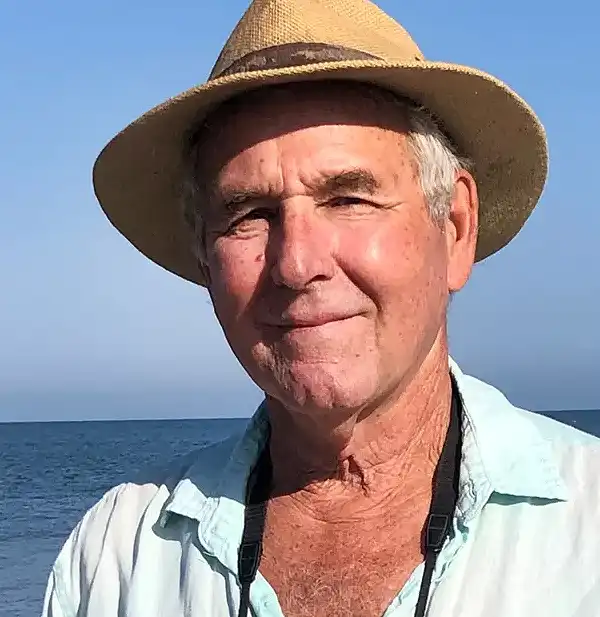
Timothy James Bottoms was born on August 30, 1951, in Santa Barbara, California, the eldest of four sons born to sculptor James "Bud" Bottoms and Betty Chapman Bottoms. Acting would become something of a family profession. His younger brothers Joseph Bottoms, Sam Bottoms and Ben Bottoms all became actors, creating one of those families in which announcing that you were going into show business probably produced considerably less parental alarm than usual.
Bottoms grew up in Santa Barbara and became interested in acting while still young. He participated in local theater and eventually joined the Santa Barbara Madrigal Society, touring Europe with the group. By his late teens he was moving toward professional acting, and Hollywood didn't make him wait very long before handing him material that many performers would have been happy to encounter halfway through an established career.
His first major film role was an extraordinary one. Bottoms starred in Dalton Trumbo's 1971 anti-war film Johnny Got His Gun, based on Trumbo's own 1939 novel. He played Joe Bonham, a young American soldier catastrophically wounded during World War I. Joe has lost his arms, legs and face and cannot see, hear or speak, yet remains fully conscious and capable of thought.
It was an extraordinarily demanding role for a young actor. Much of Joe's existence is presented through memories, dreams and internal thoughts as he gradually realizes the extent of his injuries. The film was directed by Trumbo himself and featured Jason Robards and Donald Sutherland among its supporting cast. It became a cult classic and one of cinema's bleakest examinations of warfare and the human cost hidden behind patriotic rhetoric.
Remarkably, Johnny Got His Gun wasn't even the 1971 performance that would most strongly establish Bottoms' reputation.
That distinction belonged to Peter Bogdanovich's The Last Picture Show, adapted from Larry McMurtry's novel. Bottoms played Sonny Crawford, a high school senior coming of age in the fading fictional Texas town of Anarene during the early 1950s. The film also starred Jeff Bridges, Cybill Shepherd, Cloris Leachman, Ellen Burstyn, Ben Johnson and Eileen Brennan.
Shot in black and white, The Last Picture Show presented small-town life without much nostalgic varnish. Its characters were lonely, restless, sexually confused and uncertain about futures that seemed considerably less exciting than the movies playing at the town's increasingly irrelevant picture house. Sonny sits near the center of that world, drifting between friendship, romance, responsibility and an affair with Ruth Popper, the unhappy older woman played by Leachman.
Bottoms' understated performance was essential to the film. Sonny isn't a conventional heroic protagonist who strides confidently toward adulthood. He observes, hesitates, makes mistakes and gradually discovers that the adults surrounding him aren't much more certain about life than he is. Bottoms' naturalistic style helped give the movie its melancholy emotional center.
The Last Picture Show became one of the most acclaimed American films of the 1970s. It received eight Academy Award nominations, including Best Picture, and won supporting acting Oscars for Ben Johnson and Cloris Leachman. Bridges and Burstyn were also nominated for their performances. For Bottoms, still barely into his twenties, the film immediately established him among a remarkable new generation of American actors.
His younger brother Sam Bottoms also appeared in the film, playing Billy, the intellectually disabled young man who sweeps the streets and spends much of his time around the pool hall and movie theater. It was Sam's film debut, meaning that two members of the Bottoms family managed to appear in an American classic before either had accumulated much opportunity to become accustomed to the business.
Timothy Bottoms followed that success with The Crazy World of Julius Vrooder and another role that became closely associated with his career: law student James T. Hart in the 1973 film The Paper Chase.
Based on John Jay Osborn Jr.'s novel, The Paper Chase follows Hart through his first year at Harvard Law School, where he encounters the formidable contracts professor Charles W. Kingsfield Jr., played by John Houseman. Kingsfield employs the Socratic method with such intimidating precision that generations of prospective law students have probably watched the film and briefly considered becoming dentists instead.
Bottoms' Hart is intelligent and ambitious but quickly discovers that being one of the smartest students in the room isn't particularly reassuring when nearly everybody else in the room was also accustomed to being the smartest student somewhere else. His determination to impress Kingsfield becomes an obsession, complicated further when he develops a relationship with Susan Fields, played by Lindsay Wagner, without initially realizing that she is Kingsfield's daughter.
The movie turned the pressures of elite legal education into compelling drama. Bottoms gave Hart a mixture of confidence, insecurity and stubborn determination, while Houseman's gloriously intimidating Kingsfield became one of cinema's great professors. Houseman won the Academy Award for Best Supporting Actor for the performance.
The Paper Chase developed a long cultural afterlife. A television adaptation followed in 1978, with Houseman returning as Professor Kingsfield, although James Stephens took over the role of Hart. Bottoms' film performance nevertheless remained closely associated with the character, particularly among law students and lawyers who discovered that professors capable of making students reconsider every decision since kindergarten weren't entirely fictional.
Bottoms remained busy throughout the 1970s. He starred opposite Susan George in the 1974 romantic drama The White Dawn, directed by Philip Kaufman. Set in the Arctic during the late 19th century, the film followed stranded American whalers taken in by an Inuit community and examined the collision between very different cultures.
In 1975 he appeared in The Other Side of the Mountain, based on the life of skier Jill Kinmont. Marilyn Hassett played Kinmont, an Olympic hopeful paralyzed in a skiing accident, while Bottoms portrayed Dick "Mad Dog" Buek, the daring skier and pilot who became an important figure in her life. The film became a substantial popular success and was followed by a sequel, although Bottoms did not return for the second picture.
He also starred in Operation Daybreak, the 1975 film dramatizing Operation Anthropoid, the World War II mission to assassinate Reinhard Heydrich, one of Nazi Germany's most powerful officials. Bottoms played Jan Kubiš, one of the Czechoslovak resistance fighters parachuted into occupied territory to carry out the operation. The role was far removed from the uncertain young men of The Last Picture Show and The Paper Chase and demonstrated his ability to move into historical drama and action.
Another notable project was The Story of David, a 1976 television production in which Bottoms played the young biblical David. Keith Michell portrayed David later in life. Bottoms' work during this period reflected the extraordinary variety available to a successful young actor: within a few years he had played a wounded World War I soldier, a small-town Texan, a Harvard law student, an Arctic whaler, a wartime resistance fighter and a biblical king. Typecasting was apparently having difficulty keeping up.
Bottoms continued working steadily in movies and television throughout the following decades, although the extraordinary cluster of critically celebrated films that launched his career inevitably remained his best-known work. His credits expanded through television movies, miniseries, independent films and guest appearances, making him one of those dependable actors whose résumé becomes surprisingly enormous when somebody finally decides to scroll through the entire thing.
In 1990, nearly two decades after The Last Picture Show, Bottoms reunited with several members of its cast for Texasville. Peter Bogdanovich again directed, adapting Larry McMurtry's sequel to his earlier novel. Jeff Bridges returned as Duane Jackson, Cybill Shepherd as Jacy Farrow, Cloris Leachman as Ruth Popper, and Bottoms once again played Sonny Crawford.
The sequel found the characters in the 1980s, considerably older but not necessarily blessed with corresponding quantities of wisdom. Returning to Sonny allowed Bottoms to revisit one of his defining characters after enough real time had passed for both actor and character to have genuinely aged. Texasville didn't achieve the enormous critical reputation of its predecessor, but it provided an unusual opportunity to see performers revisit characters nearly twenty years later.
Bottoms' career took a particularly unexpected turn in the early 2000s when he began portraying President George W. Bush.
He played Bush in the 2003 Showtime television movie DC 9/11: Time of Crisis, which dramatized the administration's response to the September 11 terrorist attacks. Bottoms had already portrayed a satirical version of Bush in Comedy Central's short-lived television series That's My Bush!, created by Trey Parker and Matt Stone of South Park fame.
The contrast was remarkable. That's My Bush! deliberately treated the presidency as though it were the setting for a ridiculous traditional sitcom, complete with familiar television formulas and increasingly absurd situations. Bottoms' Bush was an exaggerated comic character rather than an attempt at straightforward impersonation.
Then DC 9/11 asked him to portray the same president dramatically.
Very few actors can claim to have played the same sitting president both as the central character in a broad political sitcom and in a serious historical television drama. Bottoms therefore occupies a wonderfully peculiar corner of presidential screen history.
His resemblance to Bush certainly helped, but Bottoms' performances also reflected his long-established ability to play recognizable human behavior rather than simply relying on caricature. The roles introduced him to audiences who might never have seen Sonny Crawford wandering around Anarene or James Hart trembling under Professor Kingsfield's gaze.
Bottoms continued appearing in film and television during the 2000s and 2010s, including projects such as Elephant, Gus Van Sant's controversial 2003 drama inspired by school shootings. The film won the Palme d'Or at the Cannes Film Festival and further demonstrated Bottoms' willingness to participate in unconventional and challenging material decades after his early career.
His filmography also includes appearances in The Girl Next Door, Call of the Wild, Parasomnia and numerous independent productions. Television work has ranged across dramas, westerns and made-for-television films, providing the sort of longevity that is considerably harder to achieve than the spectacular early breakthrough that first made him famous.
The Bottoms family itself became an interesting Hollywood story. Timothy was followed into acting by brothers Joseph, Sam and Ben. Joseph Bottoms won a Golden Globe as a young performer and developed a substantial television career. Sam Bottoms, remembered for films including Apocalypse Now, worked steadily until his death from brain cancer in 2008. Ben Bottoms also acted before eventually moving into other work.
Timothy's father, Bud Bottoms, meanwhile, became known not merely as the father of four actors but as an artist and environmental activist in Santa Barbara. His work included the dolphin sculpture at the entrance to Santa Barbara's Stearns Wharf, while his environmental efforts focused particularly on protecting the local coastline.
For Timothy Bottoms, however, the first few years of his own career remain extraordinary by almost any standard. Many actors spend decades hoping to encounter one film that will still be discussed fifty years later. Bottoms appeared in Johnny Got His Gun, The Last Picture Show and The Paper Chase before he was 23.
Each required something different. Joe Bonham's story depended upon terror, memory and helplessness. Sonny Crawford required quiet observation and emotional uncertainty. James Hart demanded ambition, intelligence and gradually escalating academic panic. Bottoms didn't approach those characters as vehicles for movie-star charisma. His strength was making them feel vulnerable, believable and recognizably human.
That naturalistic quality placed him comfortably within the changing American cinema of the early 1970s, when filmmakers increasingly favored flawed characters, ambiguous stories and performances that felt less polished than the traditional Hollywood style. Bottoms looked and behaved like somebody who might genuinely inhabit the worlds depicted on screen rather than somebody who had arrived from a movie-star dressing room five minutes earlier.
On August 30, Timothy Bottoms celebrates another birthday after a career stretching across more than five decades. His résumé contains scores of film and television appearances, but his earliest work alone secured him a lasting place in American cinema.
He experienced the loneliness of The Last Picture Show, survived Professor Kingsfield in The Paper Chase, endured the unimaginable horrors of Johnny Got His Gun, returned to Texas nearly twenty years later, and somehow wound up playing George W. Bush twice in productions that couldn't possibly have been more different.
Not bad for a fellow who started acting professionally before he was old enough to rent a car without an argument.