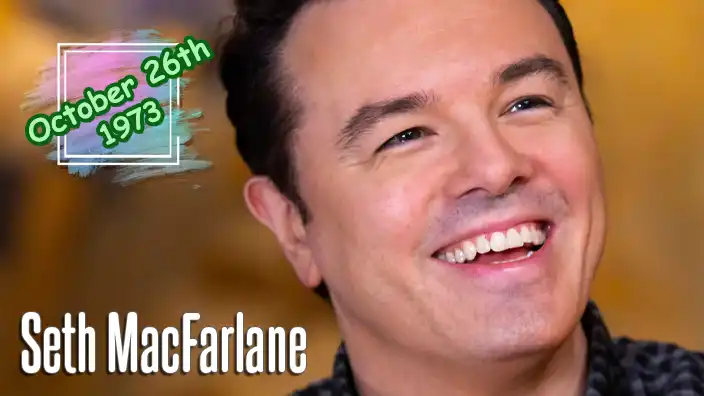
October 26, 1973, in Kent, Connecticut

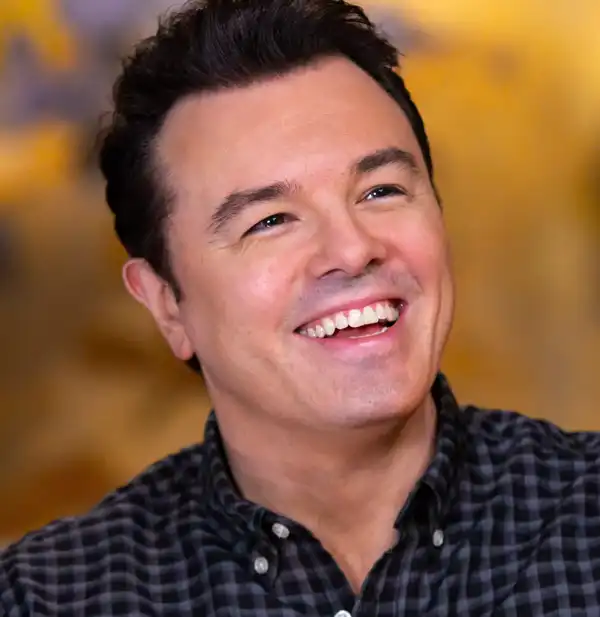
Seth Woodbury MacFarlane, born on October 26, 1973, in Kent, Connecticut, is an American animator, actor, writer, director, producer, comedian, and singer whose extraordinary creativity has helped shape modern television comedy. Best known as the creator of Family Guy, co-creator of American Dad!, and the creative force behind the Ted films and television series, MacFarlane has developed a distinctive entertainment style combining irreverent humor, elaborate musical sequences, popular culture references, and an impressive collection of character voices. His professional achievements extend far beyond animation, encompassing feature films, live-action science fiction, orchestral music, television production, and educational documentaries. Few entertainers can claim to have created a talking dog, voiced a sinister infant, directed a foul-mouthed teddy bear, and performed classic songs with a full orchestra, although MacFarlane has somehow managed to make all four activities appear perfectly reasonable.
Growing up in the small New England town of Kent, MacFarlane demonstrated an unusually early interest in drawing and animation. His parents, Ronald and Ann Perry MacFarlane, worked in education and encouraged their children's creative interests. His younger sister, Rachael MacFarlane, would also pursue a successful career in voice acting and singing. Seth began drawing cartoon characters when he was very young, developing a particular fascination with the animated television programs that entertained generations of American children. Characters such as Fred Flintstone and Woody Woodpecker captured his imagination, inspiring him to experiment with illustrations and develop his own humorous creations. While many children enjoyed watching cartoons, MacFarlane wanted to understand how they were made, which was probably an early warning that ordinary television viewing would never be enough to satisfy his curiosity.
By the time he was nine, MacFarlane was producing a comic strip titled Walter Crouton for a local newspaper, earning money from his illustrations while developing his understanding of visual storytelling. His childhood fascination with animation continued throughout his school years, and he eventually attended Kent School in Connecticut. During this period, he experimented with animated shorts, drawing techniques, and the storytelling possibilities offered by combining images, dialogue, and music. His early work revealed an enthusiasm for comedy that frequently challenged conventional expectations, an approach that would later become central to his professional reputation. Even as a youngster, MacFarlane seemed more interested in discovering what cartoon characters could get away with than in making them behave themselves.
Following high school, MacFarlane enrolled at the Rhode Island School of Design, commonly known as RISD, where he studied animation. The institution provided an opportunity to develop his artistic abilities while learning the technical and creative processes involved in professional filmmaking. His education included character design, storyboarding, animation production, and the relationship between visual images and spoken dialogue. He graduated in 1995, having completed a student film titled The Life of Larry, which introduced elements that would eventually develop into Family Guy. The animated short featured a middle-aged man named Larry, his family, and a talking dog named Steve, characters whose personalities and relationships provided an early foundation for MacFarlane's later television success.
A professor at RISD submitted The Life of Larry to Hanna-Barbera Productions, the legendary animation company responsible for numerous classic television cartoons. Impressed by MacFarlane's work, the studio offered him employment, and he moved to Los Angeles to begin his professional animation career. At Hanna-Barbera, he contributed writing, animation, and storyboard work to programs including Johnny Bravo, Cow and Chicken, and Dexter's Laboratory. He also worked on Disney's animated series Jungle Cubs. These assignments introduced him to the practical realities of television animation, including production deadlines, collaborative writing, character development, and the challenge of producing humor that could survive the scrutiny of network executives. It was an important apprenticeship, although his eventual comedy style would suggest that he had not entirely embraced the idea of keeping cartoons suitable for every member of the family.
MacFarlane continued developing his original characters, producing another animated short titled Larry & Steve in 1996. The project attracted attention from television executives at Fox, who recognized the potential for a new animated comedy aimed at adult audiences. MacFarlane subsequently developed the concept into Family Guy, replacing Larry with Peter Griffin and transforming Steve into Brian, an intelligent talking dog with a fondness for alcohol, literature, and occasionally questionable romantic decisions. Fox commissioned the series, and MacFarlane became one of the youngest creators and executive producers of a prime-time animated television program. His opportunity arrived at a time when animated sitcoms had already demonstrated substantial commercial potential, but Family Guy would establish a comedic identity that was unmistakably its own.
Family Guy premiered on Fox on January 31, 1999, immediately following Super Bowl XXXIII. The series introduced audiences to the Griffin family of Quahog, Rhode Island, including the frequently irresponsible Peter Griffin, his long-suffering wife Lois, their children Meg, Chris, and Stewie, and the family's unusually articulate dog, Brian. MacFarlane provided the voices of several principal characters, including Peter, Stewie, Brian, and the eccentric neighbor Glenn Quagmire. His remarkable vocal range allowed him to create distinct personalities whose voices became instantly recognizable to viewers. Peter's exaggerated New England accent, Stewie's theatrical British-influenced delivery, and Brian's comparatively restrained speaking style demonstrated MacFarlane's ability to develop characters through vocal performance as well as writing and animation.
The show's humor quickly distinguished it from other animated sitcoms through its frequent use of cutaway gags, unexpected cultural references, absurd situations, and musical numbers. Rather than relying entirely on conventional storytelling, Family Guy regularly interrupted its plots with elaborate jokes involving historical figures, celebrities, television programs, films, and seemingly unrelated incidents. Its comedy could move from an ordinary family argument to a musical production, a surreal flashback, or an outrageous parody within seconds. The approach attracted an enthusiastic audience, particularly among younger viewers who appreciated its unpredictable style and willingness to challenge traditional television conventions. It also attracted criticism from viewers and commentators who considered some of its jokes offensive, excessively provocative, or dependent upon shock value. MacFarlane's response to such criticism generally reflected his belief that comedy should have considerable freedom to explore uncomfortable subjects.
Despite its growing following, Family Guy initially struggled with scheduling changes and inconsistent television ratings. Fox canceled the series in 2002 after three seasons, apparently concluding that its commercial prospects were insufficient to justify continuation. However, the show's popularity expanded significantly through reruns on Adult Swim and strong DVD sales, introducing its characters to audiences who had missed the original broadcasts. The unexpected demand persuaded Fox to revive Family Guy in 2005, an unusual development in television history. The program's return became an important example of how dedicated fans, home entertainment sales, and alternative broadcasting platforms could influence network decisions. For MacFarlane, it was a remarkable professional reversal: his canceled television series had effectively returned from the dead, presumably because even the Grim Reaper could not endure another argument with Peter Griffin.
The revival transformed Family Guy into one of Fox's most recognizable animated franchises. Its continuing success produced hundreds of episodes, extensive merchandise, video games, special presentations, and numerous award nominations. The series became particularly well known for its elaborate musical sequences, celebrity guest appearances, and willingness to parody popular entertainment. MacFarlane's appreciation for classic Hollywood musicals, Broadway productions, and orchestral arrangements frequently appeared in episodes featuring surprisingly sophisticated songs. These sequences demonstrated that the show's deliberately ridiculous humor was often supported by considerable musical knowledge and technical craftsmanship. Beneath the outrageous jokes and animated disasters, there was frequently a full orchestra working considerably harder than Peter Griffin ever had.
In 2005, MacFarlane expanded his television portfolio with American Dad!, an animated sitcom he co-created with Mike Barker and Matt Weitzman. The series centered on Stan Smith, a CIA agent living with his family in the fictional community of Langley Falls, Virginia. MacFarlane provided the voices of Stan and Roger, an extraterrestrial who lives with the Smith family and frequently adopts elaborate disguises and alternate identities. The show's supporting characters included Stan's wife Francine, their children Hayley and Steve, and Klaus, a goldfish with the mind of a human. Although American Dad! shared certain stylistic similarities with Family Guy, it developed a distinctive approach emphasizing character-driven stories, political satire, absurd situations, and the increasingly unpredictable behavior of Roger. The alien's endless collection of disguises became a particularly important comedic device, allowing writers to introduce almost any personality imaginable without requiring a reasonable explanation.
American Dad! developed a loyal audience and demonstrated MacFarlane's ability to support more than one successful animated television franchise. The program originally aired on Fox before moving to TBS in 2014, where it continued producing new episodes for more than a decade. In 2026, the series returned to Fox's Animation Domination lineup, reconnecting it with the network where it originally premiered. Its longevity reflected the strength of its central characters and the flexibility of its comedic premise. While Family Guy frequently emphasized rapid-fire jokes and cultural references, American Dad! increasingly relied on elaborate stories built around the unusual personalities of its characters. Roger, in particular, developed into one of television animation's most unpredictable creations, largely because being an alien apparently removes any obligation to behave sensibly.
MacFarlane continued expanding his animated television projects with The Cleveland Show, which premiered in 2009. Co-created with Richard Appel and Mike Henry, the series followed Cleveland Brown, a supporting character from Family Guy, as he moved to Virginia and established a new family life. The program ran for four seasons before concluding in 2013, after which Cleveland returned to Family Guy. Although the spin-off did not achieve the same longevity as its parent series, it demonstrated the commercial potential of MacFarlane's fictional television universe. The project also allowed writers and performers to explore different family relationships and comedic situations while maintaining connections with familiar characters. In MacFarlane's animated world, even moving to another state was not necessarily enough to escape the Griffin family's influence.
His ambitions expanded into feature filmmaking with Ted, released in 2012. MacFarlane co-wrote, directed, produced, and provided the voice and motion-capture performance for the title character, a teddy bear magically brought to life by a childhood wish. The film starred Mark Wahlberg as John Bennett, an adult whose closest friend remained the thoroughly inappropriate talking bear he had received as a child. Mila Kunis portrayed John's girlfriend, Lori Collins, whose patience was repeatedly challenged by the unusual friendship. Combining computer-generated animation with live-action performances, Ted became an enormous commercial success, earning more than $500 million worldwide. Its popularity demonstrated that MacFarlane's style of adult comedy could attract substantial theatrical audiences beyond his established television following.
The central joke of Ted depended upon a deliberately absurd contrast between childhood innocence and thoroughly adult behavior. The teddy bear possessed the cuddly appearance of a beloved children's toy but spoke and behaved like an irresponsible adult with very few social restrictions. MacFarlane's vocal performance gave the character a distinctive Boston accent and an unexpectedly believable personality, allowing audiences to accept the ridiculous premise long enough to become invested in the story. The film's success led to Ted 2 in 2015, again featuring Wahlberg and MacFarlane, with Amanda Seyfried joining the principal cast. The sequel explored Ted's attempt to establish legal recognition as a person, raising philosophical questions about identity and civil rights while ensuring that nobody became too thoughtful before the next inappropriate joke arrived.
Between the two Ted films, MacFarlane wrote, directed, produced, and starred in the 2014 Western comedy A Million Ways to Die in the West. The film featured an ensemble cast including Charlize Theron, Amanda Seyfried, Liam Neeson, Giovanni Ribisi, and Neil Patrick Harris. MacFarlane portrayed Albert Stark, a sheep farmer whose lack of enthusiasm for dangerous frontier life placed him at odds with the traditional image of the fearless Western hero. The comedy satirized familiar Western movie conventions while emphasizing the genuine hazards of nineteenth-century frontier existence. Although the film received mixed critical reviews, it demonstrated MacFarlane's interest in experimenting with different genres and performing a leading live-action role. It also raised the perfectly reasonable question of why anyone would voluntarily live in a place where practically everything, including the local doctor, seemed capable of killing them.
In 2013, MacFarlane hosted the 85th Academy Awards, bringing his combination of musical performance, comedy, and celebrity satire to one of Hollywood's most prominent entertainment events. His hosting performance included elaborate musical numbers and jokes that generated both praise and controversy. That same year, he received an Academy Award nomination for Best Original Song for "Everybody Needs a Best Friend," a composition from Ted written with Walter Murphy. The nomination demonstrated the serious musical craftsmanship underlying a film whose principal character was a badly behaved stuffed animal. Although MacFarlane did not win the Oscar, the recognition added another significant achievement to a career already spanning animation, acting, directing, and television production.
Music has remained one of MacFarlane's most important creative interests, extending far beyond the comedic songs associated with his television programs. A devoted admirer of Frank Sinatra, Dean Martin, and the Great American Songbook, he developed a successful parallel career as a traditional pop and jazz vocalist. His debut studio album, Music Is Better Than Words, was released in 2011 and featured orchestral arrangements inspired by the classic American popular music tradition. Subsequent recordings included Holiday for Swing!, No One Ever Tells You, In Full Swing, Once in a While, and Great Songs from Stage & Screen. His musical performances demonstrated a smooth baritone voice and an appreciation for sophisticated arrangements, traditional recording techniques, and songs associated with earlier generations of American entertainers.
MacFarlane's musical career has included Grammy Award nominations and performances with respected orchestras and musicians. He has appeared at prestigious venues including Carnegie Hall and London's Royal Albert Hall, performing material that might surprise audiences familiar only with his animated comedy. His vocal style reflects an admiration for traditional crooners, while his recordings emphasize the importance of live instrumental performances and carefully crafted arrangements. The contrast between his musical and comedic careers is particularly striking. One moment, MacFarlane can be delivering a polished interpretation of a romantic standard accompanied by an orchestra; the next, he can be voicing a cartoon character making an appalling decision. Both performances require considerable timing, although only one is likely to receive an approving nod from the conductor.
In 2017, MacFarlane introduced another major television project with The Orville, a live-action science-fiction series that he created, produced, and starred in as Captain Ed Mercer. Set aboard a fictional exploratory spacecraft, the program combined space adventure, comedy, interpersonal relationships, and serious discussions of social and ethical questions. The series reflected MacFarlane's longstanding admiration for Star Trek, particularly its optimistic vision of humanity's future and its emphasis on exploration, cooperation, and moral dilemmas. Unlike his more provocative animated comedies, The Orville frequently approached difficult subjects through thoughtful dramatic storytelling. The program initially aired on Fox before moving to Hulu, where its third season was released under the title The Orville: New Horizons in 2022.
The Orville demonstrated MacFarlane's ability to develop science-fiction stories that balanced entertainment with serious ideas. Its episodes explored subjects including artificial intelligence, cultural differences, personal identity, prejudice, and the responsibilities of advanced civilizations. Although humor remained an important element, the series increasingly emphasized dramatic storytelling and character development. MacFarlane's portrayal of Captain Mercer provided a comparatively restrained performance, revealing a different side of his acting abilities. The program also featured elaborate visual effects, original musical compositions, and carefully developed fictional cultures. For viewers who had primarily associated MacFarlane with talking animals and outrageous animated jokes, The Orville offered convincing evidence that his creative interests extended well beyond making audiences laugh at inappropriate moments.
His fascination with science and space exploration also influenced his involvement in Cosmos: A Spacetime Odyssey, the acclaimed documentary series presented by astrophysicist Neil deGrasse Tyson in 2014. MacFarlane served as an executive producer and helped bring the project to television, supporting a modern continuation of the original Cosmos series presented by Carl Sagan in 1980. The program explored astronomy, physics, evolution, scientific discovery, and humanity's place in the universe through sophisticated visual effects and accessible explanations. Its success introduced scientific concepts to a broad international audience and earned numerous award nominations and honors. MacFarlane also supported the preservation of Sagan's scientific papers through a donation that helped establish the Carl Sagan and Ann Druyan Archive at the Library of Congress. It was an unusual but revealing contribution from an entertainer whose other productions regularly feature characters demonstrating a remarkable lack of scientific understanding.
MacFarlane continued developing the Ted franchise for streaming television with the live-action prequel series Ted, which premiered on Peacock in January 2024. Set during the 1990s, the program explored the earlier adventures of Ted and a teenage John Bennett, portrayed by Max Burkholder. MacFarlane returned as the voice of Ted and participated extensively in the series' writing, directing, and production. The program became a major streaming success, encouraging Peacock to commission a second season, which premiered in March 2026. Its success demonstrated that the character remained popular beyond the original films and could support an extended television narrative. MacFarlane also expanded plans for an animated Ted series, continuing the franchise's development in a format particularly suited to his animation background.
His production company, Fuzzy Door, has become an important vehicle for developing television and film projects across several genres. In addition to MacFarlane's established animated comedies and science-fiction productions, the company has participated in new entertainment projects involving comedy, drama, and adaptations of existing material. Its work has included the 2025 comedy film The Naked Gun, starring Liam Neeson, and the 2026 television adaptation of The 'Burbs, featuring Keke Palmer. These projects demonstrate MacFarlane's increasing involvement as a producer supporting other performers, writers, and creative teams. Rather than concentrating exclusively on projects in which he personally appears, he has developed a broader entertainment business capable of producing a variety of television and film content.
Throughout his career, MacFarlane has received significant recognition from the entertainment industry, including multiple Primetime Emmy Awards for his voice performances and creative work. In 2020, he was inducted into the Television Academy Hall of Fame, acknowledging his contributions to television entertainment and animation. His achievements have been particularly significant in the development of adult-oriented animated comedy, a field in which his programs helped demonstrate the commercial possibilities of unconventional storytelling and long-running character franchises. His success has also illustrated the importance of creative versatility in an entertainment industry where television, film, streaming, music, and digital media increasingly overlap.
MacFarlane's public persona reflects an unusual combination of traditional entertainment interests and contemporary comedic experimentation. He admires classic orchestral music, old Hollywood musicals, vintage television, and the craftsmanship associated with earlier generations of performers, yet his animated productions frequently challenge conventional social expectations and television standards. This contrast has become one of the defining characteristics of his career. He can appreciate the elegance of a carefully arranged Sinatra recording while simultaneously creating comedy that would probably cause several traditional television executives to require immediate medical attention. His work demonstrates that admiration for the past and enthusiasm for unconventional modern entertainment do not necessarily have to be mutually exclusive.
Seth MacFarlane's influence on American entertainment extends across animation, feature films, television comedy, music, and science programming. From his early childhood drawings in Connecticut to the international success of Family Guy, American Dad!, Ted, and The Orville, he has built a career defined by imagination, technical skill, musical knowledge, and an unmistakable willingness to take creative risks. His characters have entertained millions of viewers, his films have achieved substantial commercial success, and his musical performances have introduced audiences to another side of his considerable talents. Whether he is directing a feature film, singing with an orchestra, producing a documentary about the universe, or providing the voice of a cartoon baby plotting world domination, MacFarlane has demonstrated that creative ambition rarely benefits from being confined to a single genre. And considering how many memorable characters he has already invented, it is probably just as well that he works in animation. Trying to accommodate all those personalities in an ordinary office would be an administrative nightmare.