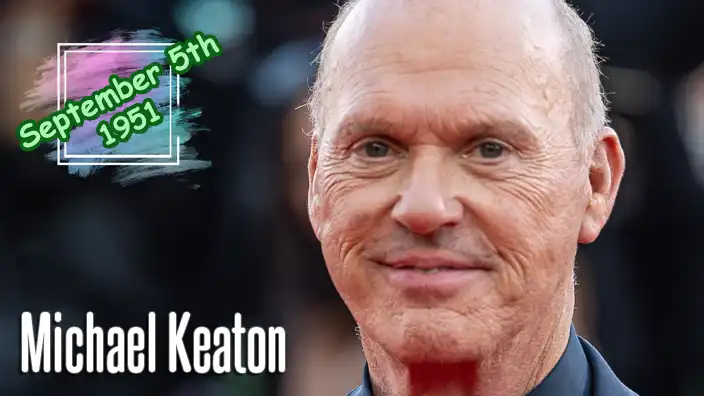
September 5, 1951, in Coraopolis, Pennsylvania
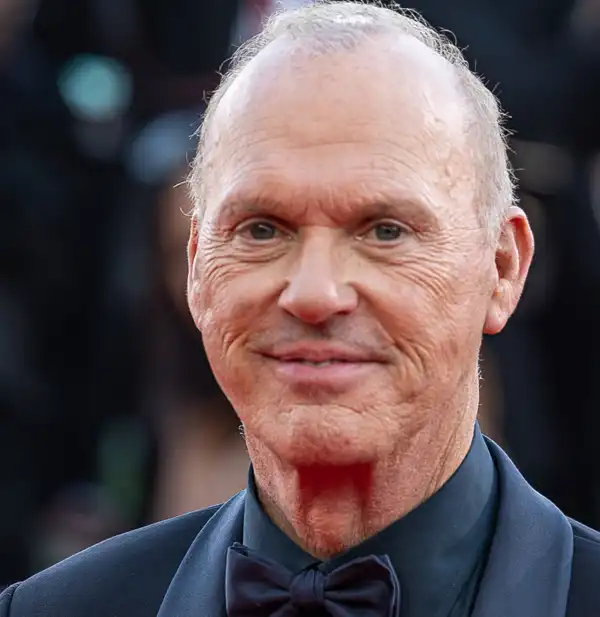
Michael John Douglas was born on September 5, 1951, in Coraopolis, Pennsylvania, near Pittsburgh. The youngest of seven children in a large working-class family, he grew up in the Pittsburgh area and later studied speech at Kent State University in Ohio before leaving college and returning home. Long before audiences associated him with Gotham City, striped suits or actors suffering theatrical nervous breakdowns, Keaton was developing the quick timing and restless energy that would eventually make comedy his first route into show business.
One of his earliest jobs in television came in a particularly wholesome corner of the business. Keaton worked behind the scenes on Mister Rogers' Neighborhood, the beloved children's program created and hosted by Fred Rogers, and also made small appearances on the show. The future Batman therefore spent part of his early career in Mister Rogers' neighborhood, which may be the only conceivable route from cardigans and comfortable sneakers to Gotham City and the Batmobile.
Keaton eventually moved to Los Angeles and pursued comedy, including stand-up performances and television work, but encountered a practical problem when establishing himself professionally. The Screen Actors Guild already had an actor registered under his birth name, Michael Douglas, and that particular Michael Douglas—the son of Kirk Douglas—was building a substantial career of his own. Michael John Douglas therefore adopted the surname Keaton. Despite persistent stories connecting the choice to silent-film comedian Buster Keaton or actress Diane Keaton, he has explained that he simply needed another name and settled upon one that worked.
Television brought appearances on programs including Maude and The Mary Tyler Moore Hour, but his major movie breakthrough arrived in Ron Howard's 1982 comedy Night Shift. Keaton played Bill Blazejowski, a wildly energetic morgue attendant and aspiring entrepreneur with an apparently inexhaustible supply of business ideas. Acting opposite Henry Winkler, Keaton attacked the role with such manic enthusiasm that he became one of the film's principal attractions. Hollywood noticed, and suddenly the energetic young comic actor from Pennsylvania was being offered considerably larger roles.
The following year he starred in Mr. Mom, playing Jack Butler, an unemployed automobile engineer who becomes a stay-at-home father while his wife returns to work. The comedy became a major success and helped establish Keaton as a leading man, while films including Johnny Dangerously, Gung Ho and The Dream Team reinforced his reputation as a comic actor. By the middle of the 1980s, audiences had a fairly clear idea of what a Michael Keaton movie was supposed to be. Then Tim Burton gave him a job playing a thoroughly revolting dead man and changed everything.
In 1988, Keaton starred in Burton's Beetlejuice as the title character—or Betelgeuse, as his name appears within the story. He played a grotesque, fast-talking “bio-exorcist” recruited to frighten living people out of a house occupied by ghosts. Although Keaton actually appears in a relatively small portion of the movie, he dominates its memory. His Beetlejuice is loud, filthy, unpredictable and seemingly incapable of encountering a social boundary without immediately vaulting over it. The performance became one of Keaton's most famous creations and began an enormously important creative partnership with Burton.
Their next collaboration produced considerably more controversy. Warner Bros. was preparing a major adaptation of Batman, with Burton directing, and the announcement that Michael Keaton would play Bruce Wayne and Batman was greeted with outrage from many comic-book fans. Keaton was the comedian from Mr. Mom. How could he possibly portray the dark, intimidating Caped Crusader? Thousands of complaints reportedly reached the studio before audiences had seen so much as a completed scene. It was an impressive amount of fury directed at a movie nobody had watched yet, proving that some entertainment traditions existed long before social media.
Then Batman opened in 1989, and Keaton's restrained performance proved almost exactly the opposite of what his critics had feared. Rather than playing Bruce Wayne as a conventional muscular action hero, he portrayed him as an eccentric, psychologically complicated man whose quiet behavior concealed something much darker. Opposite Jack Nicholson's spectacularly flamboyant Joker, Keaton deliberately underplayed Bruce Wayne and allowed Batman's mystery to provide much of the character's power. The film became an enormous commercial success and cultural phenomenon, while Keaton helped redefine how superheroes could be portrayed on screen.
He returned in Burton's Batman Returns in 1992, this time opposite Michelle Pfeiffer's Catwoman and Danny DeVito's Penguin. The sequel was darker, stranger and even more unmistakably Burton's vision of Gotham City. Keaton was expected to return for a third film but ultimately left the franchise after Burton ceased directing. Val Kilmer replaced him in Batman Forever, while Keaton moved on rather than allowing the cape and cowl to determine the rest of his career.
During the 1990s, he appeared in an unusually varied collection of films including Pacific Heights, My Life, Kenneth Branagh's adaptation of Much Ado About Nothing, The Paper, Multiplicity and Quentin Tarantino's Jackie Brown. Multiplicity gave Keaton an especially entertaining acting challenge as a construction worker who has himself cloned to create more time for work and family, only for additional copies to complicate matters spectacularly. Keaton played several variations of the same character, turning what could have been a simple gimmick into an impressive display of comic characterization.
His role as FBI agent Ray Nicolette in Jackie Brown produced another unusual piece of movie history when Keaton played the same character again in Steven Soderbergh's Out of Sight. Both films were adapted from novels by Elmore Leonard, allowing the character to wander between productions made by different studios. Keaton continued working steadily through the 2000s and also developed a substantial voice-acting résumé, including Chick Hicks in Pixar's Cars and Ken in Toy Story 3. Even when he wasn't physically on screen, he remained remarkably good at finding characters who were difficult to forget.
By the early 2010s, however, Keaton was no longer the enormous box-office presence he had been during the Batman years. Then came one of Hollywood's great career revivals. Director Alejandro González Iñárritu cast him as Riggan Thomson in the 2014 film Birdman or (The Unexpected Virtue of Ignorance). Riggan is an actor once famous for playing a superhero called Birdman who desperately wants to prove himself as a serious artist by mounting a Broadway production. Casting Michael Keaton, a performer whose own career had forever been associated with Batman, added an unavoidable extra dimension to the story.
Yet Birdman was far more than an elaborate joke about Keaton's past. He delivered a complicated performance as a man struggling with ego, aging, artistic ambition, family relationships and the enormous shadow cast by the role that once made him famous. Keaton won the Golden Globe for Best Actor in a Motion Picture – Musical or Comedy and received his first Academy Award nomination for Best Actor. He narrowly lost the Oscar to Eddie Redmayne for The Theory of Everything, while Birdman itself won Best Picture.
Keaton's resurgence continued immediately with Spotlight in 2015, in which he portrayed Walter “Robby” Robinson, the editor who led The Boston Globe's Spotlight investigative team. The film dramatized the newspaper's investigation into widespread sexual abuse by Catholic priests and institutional efforts to conceal it. Spotlight won the Academy Award for Best Picture, giving Keaton the unusual distinction of appearing in consecutive Best Picture winners following Birdman the previous year.
He then took on another complicated real-life figure in The Founder, playing Ray Kroc, the businessman whose involvement with brothers Richard and Maurice McDonald transformed their restaurant concept into the global McDonald's corporation. Keaton avoided presenting Kroc as either a straightforward hero or a cartoon villain. Instead, he captured the ambition, persistence, charm and ruthlessness that helped create a business empire while leaving audiences to decide how much admiration the methods deserved.
In 2017, Keaton entered yet another superhero universe when he played Adrian Toomes, better known as the Vulture, in Spider-Man: Homecoming. Decades after helping establish the modern cinematic Batman, he was now attempting to kill Spider-Man, which is either professional versatility or superhero career advancement viewed from a particularly peculiar angle. His Toomes was also notably grounded for a comic-book villain: a working man whose resentment and determination gradually turned him into a dangerous adversary.
Television subsequently brought Keaton some of the strongest reviews of his later career. In the 2021 Hulu limited series Dopesick, he starred as Dr. Samuel Finnix, a fictional physician whose patients and community become caught in America's devastating opioid epidemic. Keaton's deeply dramatic performance earned him a Primetime Emmy Award, a Golden Globe and a Screen Actors Guild Award, once again demonstrating just how far his career had traveled from the frantic comic characters that originally made him famous.
Then, more than 30 years after Batman Returns, Keaton climbed back into the Batcave. He reprised Bruce Wayne and Batman in the 2023 film The Flash, with his return becoming one of the production's principal attractions. For audiences who had first encountered the character through Tim Burton's films, seeing Keaton beneath the cowl again carried enormous nostalgic weight. Rather than merely imitating his younger performance, however, he approached Bruce Wayne as a man who had aged and changed during the decades that had passed.
Another famous character was waiting in the wings. In 2024, Keaton reunited with Tim Burton for Beetlejuice Beetlejuice, returning to the role 36 years after the original film. Winona Ryder and Catherine O'Hara also returned, while Jenna Ortega joined the cast as a new generation entered the wonderfully peculiar world of the Deetz family. Keaton had now completed two highly improbable circles, returning as both Batman and Beetlejuice decades after leaving the characters behind.
There are actors who spend their careers trying to escape the roles that made them famous. Keaton managed something considerably more interesting: he escaped them, built an entirely different career and then returned when the timing and material interested him. Along the way his performances stretched from broad comedy to Shakespeare, psychological drama, investigative journalism, corporate biography, superhero spectacle, animation and serious television.
His career also provides a useful reminder of how misleading Hollywood labels can be. In the early 1980s Michael Keaton was considered a comedian. In 1989, people complained that a comedian couldn't possibly play Batman. Twenty-five years later, he was nominated for an Academy Award for playing an actor haunted by having once been a superhero. Somewhere along that road, the joke came rather wonderfully full circle.
On September 5, Michael Keaton's birthday celebrates an actor who survived typecasting, changing Hollywood fashions, furious Batman fans and Beetlejuice's wardrobe while repeatedly demonstrating that the most interesting performers are often those who refuse to remain where audiences first put them. Not bad for a fellow who once worked in Mister Rogers' Neighborhood.
And should anybody still question whether Mr. Mom could really be Batman, that argument was settled sometime around the summer of 1989.