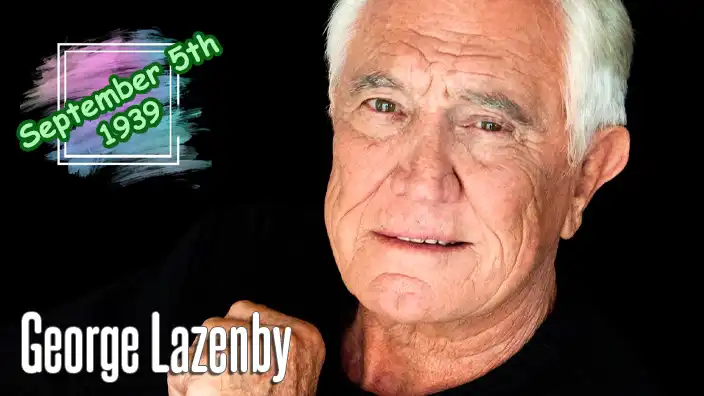
September 5, 1939, in Goulburn, Australia
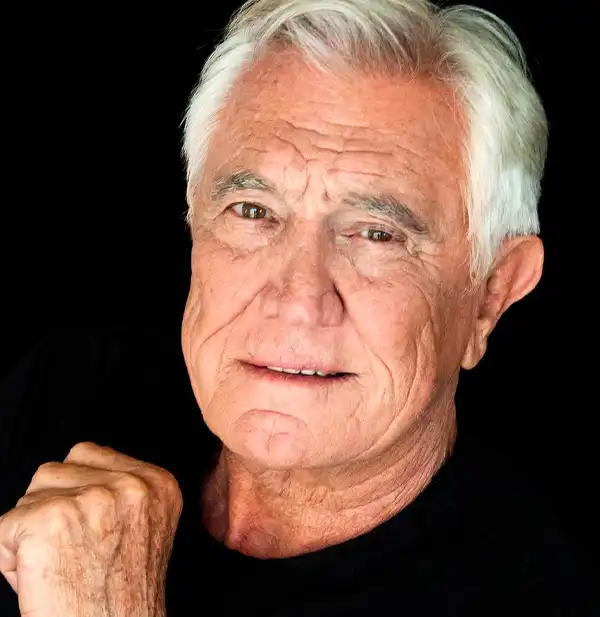
George Robert Lazenby was born on September 5, 1939, in Goulburn, New South Wales, Australia. Long before he wore a tuxedo, drove an Aston Martin and introduced himself with one of cinema's most famous surnames, Lazenby's life seemed to be heading in an entirely different direction. He worked as a car mechanic and salesman before eventually leaving Australia for Britain, where his appearance and confidence helped him establish a successful career as a model.
During the 1960s, Lazenby became one of London's better-paid male models and appeared in advertising campaigns, including a well-known series of commercials for Fry's chocolate. He was handsome, athletic and comfortable in front of a camera, but he was not an experienced dramatic actor. Under normal circumstances, the next logical step might have been a few small television parts followed by progressively larger roles. Instead, Lazenby decided he should become James Bond.
The opportunity existed because Sean Connery had announced his departure from the series following You Only Live Twice in 1967. Connery had transformed Ian Fleming's secret agent into an international movie phenomenon through films including Dr. No, From Russia with Love, Goldfinger and Thunderball. Producers Albert R. Broccoli and Harry Saltzman therefore faced the unenviable task of finding another actor whom audiences would accept as 007.
Lazenby wanted the role despite having almost none of the qualifications normally expected for such an assignment. He studied Connery's appearance, obtained a Rolex watch and had a suit made by Anthony Sinclair, Connery's tailor. He then set about convincing the Bond producers that he was an established actor. It was an audacious performance before he had technically been hired to perform anything.
His screen test proved considerably more important than his résumé. Lazenby's physical confidence impressed director Peter R. Hunt, who was preparing On Her Majesty's Secret Service. During testing, Lazenby demonstrated that he could handle the action required of Bond, and his natural self-assurance helped overcome concerns about his lack of acting experience. Against extraordinary odds, the Australian model was selected to replace Sean Connery as James Bond.
It remains one of the most remarkable casting stories in movie history. Actors train for years hoping for a significant film role. Lazenby effectively arrived at the front door of one of the world's biggest movie franchises, persuaded everyone that he belonged there and was handed the keys to the Aston Martin.
Released in 1969, On Her Majesty's Secret Service was the sixth film in the official Eon Productions Bond series. The story follows Bond's pursuit of Ernst Stavro Blofeld, played by Telly Savalas, whose latest scheme involves biological warfare. Along the way Bond meets Contessa Teresa “Tracy” di Vicenzo, played by Diana Rigg, and their relationship becomes the emotional center of the film.
Lazenby's Bond differed noticeably from Connery's. He was younger and more physically vulnerable, and On Her Majesty's Secret Service allowed the character to display an emotional dimension rarely seen in the earlier films. Bond falls genuinely in love with Tracy and eventually marries her, something almost unimaginable for the carefree womanizer audiences thought they understood.
The film contains plenty of traditional Bond ingredients—spectacular Alpine locations, skiing, car chases, beautiful women, Blofeld's mountaintop headquarters and an elaborate plot threatening international catastrophe—but its emotional story makes it unusual within the series. The ending, in particular, remains one of the most powerful moments in the entire Bond franchise.
Lazenby's relative inexperience occasionally showed, but director Peter Hunt surrounded him with accomplished performers and concentrated on his strengths. Diana Rigg, already internationally famous from The Avengers, gave Tracy intelligence, humor and independence, while Savalas created a cool and imposing Blofeld. Lazenby handled much of the physical action convincingly, lending the fight sequences a raw quality that helped distinguish his Bond from Connery's.
There was also a deliberate attempt to acknowledge the enormous casting change. Early in the film, after Tracy escapes from Bond following an action sequence, Lazenby looks toward the camera and remarks, “This never happened to the other fellow.” It was an unusually cheeky breaking of the fourth wall and an unmistakable reference to Connery.
John Barry supplied one of the series' most celebrated musical scores, including the instrumental title theme and “We Have All the Time in the World,” performed by Louis Armstrong. The latter became particularly associated with Bond and Tracy's romance and acquired even greater emotional significance as the years passed.
Yet while Lazenby was making the movie that should have launched years of guaranteed international stardom, he was already questioning whether he wanted to continue as James Bond.
The late 1960s were changing popular culture rapidly. Lazenby became convinced that the tuxedo-wearing secret agent belonged to an earlier era and that films such as Easy Rider represented the future. His manager, Ronan O'Rahilly, reportedly encouraged the belief that Bond would become outdated during the more rebellious 1970s. Lazenby therefore rejected the opportunity to continue in the role.
From a historical perspective, this was not one of show business's more accurate predictions.
James Bond did, in fact, survive the 1970s. And the 1980s. And the 1990s. And several decades after that.
Lazenby's decision meant On Her Majesty's Secret Service became his first and only official appearance as 007. Sean Connery returned for Diamonds Are Forever in 1971 before Roger Moore took over with Live and Let Die in 1973 and remained Bond for seven films.
For years, Lazenby's single outing was sometimes treated as an oddity in the franchise. The movie had performed well commercially but did not initially enjoy the towering reputation of several Connery adventures. Lazenby's performance was inevitably compared with the actor he replaced, an almost impossible standard for somebody making his first major film.
Time, however, has been extremely kind to On Her Majesty's Secret Service.
The film's reputation steadily improved, particularly among Bond enthusiasts and critics who appreciated its relatively faithful treatment of Ian Fleming's novel, Peter Hunt's energetic direction, Barry's score, the chemistry between Bond and Tracy and the unusually human portrayal of 007. It is now frequently ranked among the finest films in the series.
Later Bond filmmakers have also acknowledged its influence. The emotional vulnerability introduced in On Her Majesty's Secret Service can be seen in later interpretations of the character, particularly during Daniel Craig's tenure. “We Have All the Time in the World” was even brought back into the Bond universe in No Time to Die, creating a direct emotional connection with the 1969 film.
After leaving Bond, Lazenby continued acting but never again possessed a role remotely comparable in international visibility. During the 1970s he worked in films made in several countries, including Hong Kong productions at a time when martial-arts cinema was expanding rapidly around the world.
One particularly intriguing possibility never came to fruition. Lazenby was associated with projects involving Bruce Lee and had been discussing work with the martial-arts superstar shortly before Lee's sudden death in 1973. Lazenby subsequently appeared in the Golden Harvest film The Man from Hong Kong alongside Jimmy Wang Yu, released in 1975.
His later credits included films and television productions across Australia, Europe and the United States. He appeared in Gettysburg and had television roles in series including Superboy, while also making appearances that played upon his permanent association with secret-agent mythology. Whatever else he did, audiences remained fascinated by the man who had been James Bond once—and only once.
That fascination eventually became part of Lazenby's public identity. Rather than pretending Bond had been merely another job, he increasingly embraced his unusual place in the franchise. He appeared at conventions, participated in Bond-related events and spoke candidly in interviews about the decisions that had shaped his career.
His extraordinary journey was explored in the 2017 documentary-drama Becoming Bond, which combined an extended interview with Lazenby and dramatized recreations of his life. The production emphasized just how improbable his story really was: an Australian mechanic became a model, bluffed his way toward an audition, replaced the world's most famous movie spy and then abandoned the role.
Lazenby's personal life has also attracted considerable attention over the decades. He was married twice and became the father of several children. His second marriage was to former professional tennis player Pam Shriver, with whom he had three children before their marriage ended.
In 2024, after decades of public appearances, Lazenby announced that he was retiring from acting and making convention appearances, explaining that getting older had made extensive travel more difficult. By then he had spent more than half a century occupying one of cinema's most unusual positions: the only actor whose official tenure as James Bond consisted of a single film.
That solitary appearance has become less of a curiosity as On Her Majesty's Secret Service has been reassessed. Lazenby may not have possessed Connery's polished confidence or Roger Moore's effortless wit, but his relative youth and vulnerability suited a Bond who experiences something far more dangerous than Blofeld's henchmen: genuine emotional attachment.
There is also something strangely appropriate about the brevity of Lazenby's Bond career. His 007 arrives, falls in love, suffers devastating loss and disappears from the series. There is no opportunity for the character to reset comfortably in another adventure. The result gives his Bond a unique identity among the actors who have played the role.
Whether leaving Bond was a brilliant assertion of independence or one of Hollywood's greatest career miscalculations has been debated for decades. Lazenby himself has discussed the decision with a mixture of explanation, humor and hindsight. What cannot be disputed is that he made the choice when almost every aspiring actor on Earth would have done precisely the opposite.
On September 5, George Lazenby's birthday celebrates an Australian who took one of the most unlikely routes imaginable to international movie stardom. He had almost no acting career when he became James Bond, followed one of cinema's most popular leading men, made a film whose reputation has grown enormously with age and then walked away from one of the most coveted roles in the world.
George Lazenby may have been James Bond only once, but more than half a century later we're still talking about it.
Perhaps one really was enough.