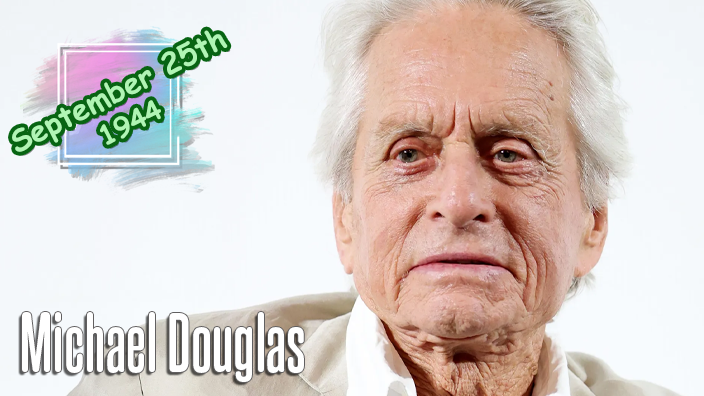
September 25, 1944, in New Brunswick, New Jersey
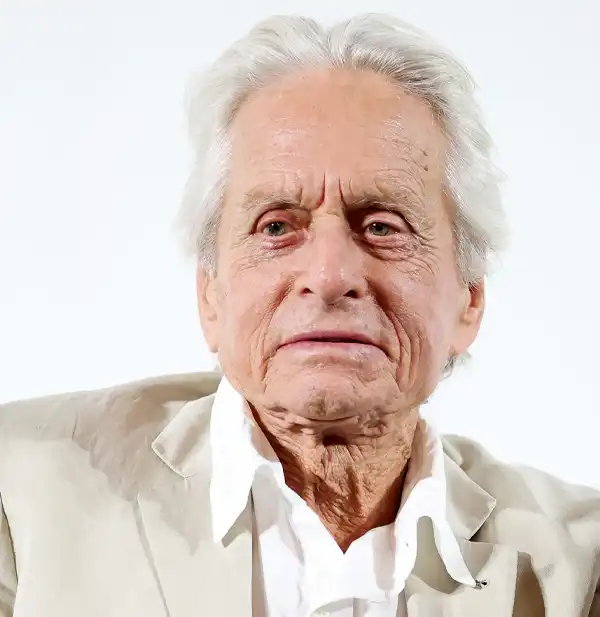
Michael Kirk Douglas was born on September 25, 1944, in New Brunswick, New Jersey, the eldest son of actor Kirk Douglas and actress Diana Dill. His parents divorced when Michael was young, and his childhood was divided between the worlds surrounding his mother and his increasingly famous father. Kirk Douglas became one of Hollywood's dominant stars through films including Champion, Paths of Glory, Spartacus and Lust for Life, creating an imposing example for any son contemplating the same profession.
Douglas attended several schools before enrolling at the University of California, Santa Barbara, where he studied drama. He subsequently continued his acting education at the American Place Theatre in New York. Although the Douglas name could certainly open doors, possessing a famous father also meant that every performance invited comparison with a man already established as one of the most recognizable actors in the world.
His early film appearances included Hail, Hero! in 1969, for which he received a Golden Globe nomination as a promising newcomer. Yet Douglas's first major success came through television rather than film when he joined Karl Malden in the police drama The Streets of San Francisco.
Beginning in 1972, Douglas played Inspector Steve Keller, the younger partner of Malden's veteran Detective Lieutenant Mike Stone. The series followed the pair investigating crimes around San Francisco and became a popular fixture of American television. Working alongside the experienced Malden gave Douglas an extended apprenticeship in front of the camera, and his performance earned Emmy nominations.
Douglas left The Streets of San Francisco before its final season, but not because work had dried up. He had already taken an enormous professional gamble behind the camera.
Douglas had acquired the rights to Ken Kesey's novel One Flew Over the Cuckoo's Nest from his father, who had starred in a Broadway adaptation and spent years attempting to get a film version made. Michael Douglas teamed with producer Saul Zaentz and finally brought the project to the screen with director Miloš Forman.
Released in 1975, One Flew Over the Cuckoo's Nest starred Jack Nicholson as Randle McMurphy and Louise Fletcher as Nurse Ratched. The film became both a commercial and critical triumph, winning the five major Academy Awards: Best Picture, Best Director, Best Actor, Best Actress and Best Adapted Screenplay.
As one of its producers, Michael Douglas received the Academy Award for Best Picture.
It created the unusual situation in which Douglas became an Oscar winner before he had established himself as a major movie star. It also demonstrated that his understanding of filmmaking extended beyond acting. While many performers spend years trying to get somebody to hand them a great role, Douglas had already helped get an entire great movie made.
His film career continued to develop through the late 1970s and early 1980s. He starred in the medical thriller Coma, appeared alongside Jane Fonda and Jack Lemmon in The China Syndrome and took roles in films including Running and It's My Turn. The China Syndrome, released shortly before the Three Mile Island nuclear accident, attracted particular attention for its story involving safety problems at a nuclear power plant.
Then Douglas discovered that archaeology could be much more exciting if someone occasionally fired a gun.
In 1984, he starred with Kathleen Turner and Danny DeVito in Romancing the Stone. Douglas played Jack Colton, an adventurous bird smuggler who becomes involved with romance novelist Joan Wilder, played by Turner, as she travels to Colombia and becomes entangled in a search for a valuable emerald.
Douglas also produced the film, which became a major success. The chemistry between Douglas and Turner was central to its appeal, combining adventure, romance and comedy in a story that cheerfully placed an ordinary novelist into increasingly extraordinary danger.
Douglas, Turner and DeVito reunited the following year for The Jewel of the Nile. Although the sequel did not receive the same critical enthusiasm, the two films helped establish Douglas as a bankable leading man capable of carrying major Hollywood productions.
Then 1987 happened.
For Michael Douglas, it was an extraordinary year.
He starred first in Fatal Attraction, playing Dan Gallagher, a married New York attorney who has a weekend affair with book editor Alex Forrest, played by Glenn Close. Dan expects the encounter to end quietly. Alex has other plans.
Very many other plans.
Directed by Adrian Lyne, Fatal Attraction transformed an act of marital infidelity into an increasingly terrifying psychological thriller. Close's performance as Alex became one of the most discussed of the decade, while Douglas played a man watching his comfortable professional and family life collapse as the consequences of his decisions become increasingly dangerous.
The film became a major box-office success and a cultural phenomenon. It generated debates about marriage, infidelity, gender and the portrayal of mental illness while contributing the phrase "bunny boiler" to popular language through one particularly notorious scene that did absolutely nothing for rabbit owners seeking relaxing entertainment.
Douglas's character was hardly an innocent victim. Dan creates the situation through his own choices, and much of the film's tension comes from watching someone desperately attempt to preserve a respectable life after behaving decidedly otherwise. Douglas was particularly effective at playing characters whose polished exterior concealed rather substantial flaws.
That quality became even more important in his other major film of 1987.
Oliver Stone cast Douglas as Gordon Gekko in Wall Street, a drama examining ambition, money and corruption in the financial world of the 1980s. Charlie Sheen played Bud Fox, a young stockbroker desperate to succeed, while Douglas's Gekko represented the enormously wealthy corporate raider who becomes both mentor and corrupter.
Gekko was charismatic, intelligent, ruthless and utterly convinced that money justified almost everything required to acquire more of it. His famous declaration that "greed, for lack of a better word, is good" became one of cinema's defining lines of the decade, although the character delivering it was intended as a warning rather than a career counselor.
That distinction occasionally became lost.
Douglas later expressed amusement and bewilderment that people working in finance told him Gordon Gekko had inspired them to enter the profession. Oliver Stone had created the character partly as a criticism of Wall Street excess, yet Gekko's expensive suits, confidence and unapologetic appetite for wealth made him unexpectedly attractive to some viewers.
Douglas's performance won the Academy Award for Best Actor.
He had now won Oscars on both sides of the camera: Best Picture as a producer of One Flew Over the Cuckoo's Nest and Best Actor for Wall Street. More importantly, Gordon Gekko permanently altered Douglas's screen image.
During the late 1980s and 1990s, he became particularly associated with sophisticated men whose apparently successful lives concealed dangerous weaknesses. His characters were frequently wealthy, intelligent and confident, but the polished surfaces rarely remained intact for long.
In 1989, Douglas reunited with Kathleen Turner and Danny DeVito for The War of the Roses, with DeVito directing. This time there were no Colombian adventures or romantic escapes. Douglas and Turner played Oliver and Barbara Rose, a wealthy married couple whose relationship deteriorates into increasingly vicious warfare over their home and possessions.
The film turned divorce into extremely dark comedy and allowed Douglas and Turner to dismantle the romantic chemistry audiences remembered from Romancing the Stone. By the conclusion, the Roses had transformed marital disagreement into something resembling a military campaign conducted with chandeliers and household appliances.
Douglas entered the 1990s with Basic Instinct, directed by Paul Verhoeven and co-starring Sharon Stone. Douglas played San Francisco detective Nick Curran, who investigates novelist Catherine Tramell after a murder resembling one described in her fiction.
The film became one of the decade's most controversial and commercially successful thrillers. Sharon Stone's performance transformed her into an international star, while Douglas once again played a morally compromised man increasingly drawn toward someone who might represent an extremely poor decision.
At this point, audiences could reasonably have begun shouting advice at Michael Douglas characters from the back of movie theaters.
He followed with Falling Down in 1993, one of the darker performances of his career. Douglas played William Foster, known through much of the film by the name on his license plate, D-Fens. Trapped in Los Angeles traffic on a brutally hot day, Foster abandons his car and begins walking across the city toward his daughter's home.
His journey becomes increasingly violent as frustration, anger and resentment overwhelm him. The character initially appears to be an ordinary man pushed beyond endurance, but the film gradually reveals that Foster's perception of himself as a reasonable victim bears little resemblance to reality.
Douglas deliberately altered his familiar appearance for the role, wearing a short haircut, glasses and conservative clothing that made Foster look like an anonymous office worker. The performance remains one of his most unsettling because Douglas uses the ordinary quality of the character rather than movie-star glamour to make him disturbing.
He returned to corporate danger in 1994 with Disclosure, starring opposite Demi Moore in a story involving sexual harassment, office politics and technology. The following year brought The American President, directed by Rob Reiner and written by Aaron Sorkin.
Douglas played widowed President Andrew Shepherd, who begins a relationship with environmental lobbyist Sydney Ellen Wade, played by Annette Bening. The film blended romance, comedy and political drama and allowed Douglas to portray a fundamentally decent authority figure rather than another successful man discovering that his personal decisions were about to destroy the furniture.
In 1997, David Fincher directed Douglas in The Game. He played Nicholas Van Orton, a wealthy San Francisco investment banker whose brother, played by Sean Penn, gives him access to a mysterious entertainment experience. Nicholas soon loses the ability to determine where the game ends and reality begins.
The role was almost tailor-made for Douglas's established screen persona: a rich, controlled and emotionally isolated man whose confidence is systematically dismantled. Fincher's increasingly elaborate thriller stripped Nicholas of his money, security and certainty until very little remained of the man introduced at the beginning.
Douglas continued working steadily into the new century. In Steven Soderbergh's Traffic, he played Robert Wakefield, a conservative judge appointed to lead the United States government's campaign against illegal drugs while discovering that his own daughter is struggling with addiction.
The film's intersecting stories examined drug trafficking from several perspectives and won four Academy Awards. Douglas's personal life was also undergoing a significant change around the same time.
In November 2000, he married Welsh actress Catherine Zeta-Jones.
The couple share an unusual coincidence: both were born on September 25, exactly 25 years apart. Birthday planning in the Douglas household therefore possesses an efficiency rarely encountered in marriage. Nobody can forget the date without simultaneously incriminating themselves.
Douglas and Zeta-Jones have two children together, Dylan and Carys. Douglas also has a son, Cameron, from his previous marriage to Diandra Luker.
He continued mixing mainstream entertainment with character-driven films. Projects included Wonder Boys, Don't Say a Word, The Sentinel, King of California and Solitary Man. In several of these films, Douglas increasingly embraced characters who were aging, compromised or confronting the consequences of earlier decisions.
He returned to Gordon Gekko in Oliver Stone's Wall Street: Money Never Sleeps in 2010. More than two decades had passed since Gekko declared greed good, and the financial world had experienced enough real-life upheaval to make the character's return particularly timely.
The same year brought a far more serious challenge in Douglas's personal life. He was diagnosed with cancer and underwent intensive treatment involving radiation and chemotherapy. Douglas initially said he had throat cancer, but later revealed that the cancer had actually been at the base of his tongue and that doctors had advised describing it differently publicly because of concerns that treatment might require disfiguring surgery.
Douglas subsequently announced that treatment had been successful. His experience led him to speak publicly about cancer, medical care and the importance of monitoring symptoms.
One of his most acclaimed later performances came in 2013 with HBO's Behind the Candelabra. Directed by Steven Soderbergh, the film starred Douglas as flamboyant pianist and entertainer Liberace, with Matt Damon playing Scott Thorson.
The role required a considerable transformation. Douglas captured Liberace's voice, mannerisms, theatricality and complicated private personality without simply turning him into an impersonation. The performance won Douglas the Primetime Emmy Award for Outstanding Lead Actor in a Miniseries or Movie as well as a Golden Globe.
After decades of dramas, thrillers and morally questionable businessmen, Douglas then entered the Marvel Cinematic Universe.
He first appeared as Dr. Hank Pym in Ant-Man in 2015. Within Marvel mythology, Pym is the scientist who developed technology allowing people and objects to shrink and enlarge. Paul Rudd played Scott Lang, who becomes the new Ant-Man under Pym's reluctant guidance.
Douglas brought his established screen authority to a universe involving shrinking superheroes, quantum realms and conversations with ants. He returned as Pym in Ant-Man and the Wasp, Avengers: Endgame and Ant-Man and the Wasp: Quantumania, introducing him to yet another generation of moviegoers.
His later television career included The Kominsky Method, created by Chuck Lorre. Douglas played Sandy Kominsky, an aging actor and acting coach confronting friendship, mortality, relationships and the indignities accompanying later life.
Alan Arkin co-starred as Sandy's friend and agent Norman Newlander, and the interplay between the two veteran actors gave the series much of its humor. Douglas won the Golden Globe for Best Actor in a Television Series – Musical or Comedy for the role, demonstrating that several decades after Gordon Gekko, he could still find a character capable of adding something substantial to an already remarkable résumé.
Douglas has also devoted considerable time to humanitarian and public-service causes. He became a United Nations Messenger of Peace in 1998, focusing particularly on nuclear disarmament, arms control and related issues. His advocacy has continued alongside his acting and producing career.
His relationship with his father remained an important element of his life until Kirk Douglas died in 2020. Inevitably, comparisons between father and son followed Michael throughout his career, but the two men ultimately developed very different screen identities.
Kirk Douglas became famous for intense physical performances and characters driven by enormous force of personality. Michael Douglas developed a specialty in contemporary men operating inside institutions of wealth, business and power—men whose confidence frequently concealed weaknesses waiting for circumstances to expose them.
There is considerable irony in the fact that Michael's first Academy Award came from a project his father had wanted to make. Kirk Douglas had played McMurphy onstage and owned the rights to One Flew Over the Cuckoo's Nest before transferring them to Michael. The son then produced the film, watched Jack Nicholson play the role Kirk had hoped to perform onscreen and took home the Best Picture Oscar.
Families are complicated enough without Academy Awards becoming involved.
Michael Douglas's career now stretches across television, production, film and streaming television, encompassing police dramas, romantic adventures, psychological thrillers, political comedy, financial corruption, superhero movies and character-driven comedy.
Few actors have created as many memorable variations on the successful man discovering that control is largely an illusion. Gordon Gekko believed money could control everything. Dan Gallagher thought an affair could remain neatly contained. Nicholas Van Orton believed his wealth insulated him from uncertainty. William Foster thought everyone else was the problem.
Douglas repeatedly found the cracks in powerful men and made those cracks more interesting than the power itself.
He also accomplished something that cannot have been easy. He entered acting as Kirk Douglas's son and eventually reached the point where "Michael Douglas" required no explanation whatsoever.
Two Academy Awards, multiple Golden Globes, an Emmy, decades of successful films and television, and a collection of characters extending from Gordon Gekko to Hank Pym took care of that.
And after surviving Fatal Attraction, perhaps an army of Marvel villains really isn't terribly intimidating.