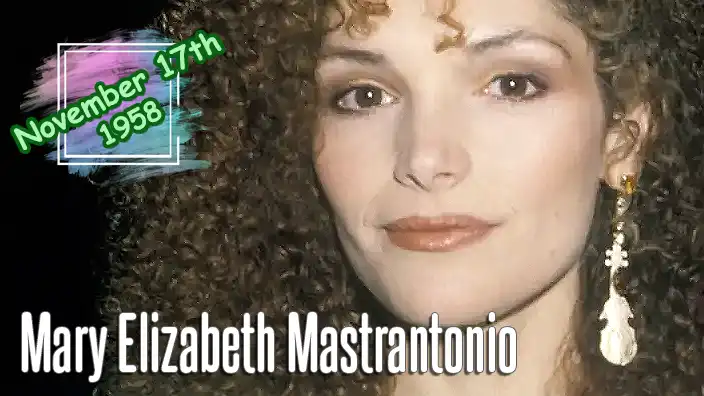
November 17, 1958, in Lombard, Illinois


Mary Elizabeth Mastrantonio is an accomplished American actress and singer whose distinguished career spans Hollywood films, Broadway musicals, and popular television dramas. Born on November 17, 1958, in Lombard, Illinois, she became widely recognized for her powerful performances in Scarface, The Color of Money, and The Abyss. Known for portraying intelligent, determined, and emotionally complex women, Mastrantonio developed a reputation for delivering performances that combined strength with vulnerability. Her career has included collaborations with some of Hollywood's most respected directors and actors, while her musical theater background has demonstrated talents extending far beyond the movie screen. Whether confronting a dangerous criminal, challenging a legendary pool hustler, or struggling to survive beneath the ocean, Mastrantonio has consistently brought conviction and authenticity to her roles.
Growing up in the Chicago suburbs, Mary Elizabeth Mastrantonio was raised in an Italian-American family. Her parents, Frank and Mary Dominica Mastrantonio, encouraged an appreciation for music and performance, interests that would eventually shape her professional career. She attended the University of Illinois at Urbana-Champaign, where she became involved in theatrical productions and developed her singing and acting abilities. Her early experiences onstage helped establish the discipline and versatility that would later become important features of her professional work. Although many aspiring performers dream of becoming Hollywood stars, Mastrantonio initially pursued opportunities in musical theater, where success requires the ability to act, sing, and occasionally dance without looking as though someone has accidentally stepped on your foot.
Mastrantonio began establishing herself professionally in New York theater, appearing in productions that showcased her strong singing voice and dramatic abilities. One of her early Broadway credits was the 1980 revival of West Side Story, in which she appeared as a replacement performer in the role of Maria. The demanding musical, featuring music by Leonard Bernstein and lyrics by Stephen Sondheim, provided an excellent opportunity to demonstrate her vocal range and theatrical training. Performing in such a celebrated production required considerable discipline, particularly because audiences already had strong expectations about the characters and songs. Her stage experience would become a valuable foundation for the dramatic film roles that followed, giving her the confidence to portray characters whose emotions were often expressed through subtle gestures rather than elaborate dialogue.
Her major film breakthrough arrived in 1983 when she portrayed Gina Montana in director Brian De Palma's crime drama Scarface. Starring Al Pacino as the ambitious and increasingly ruthless Cuban immigrant Tony Montana, the film explored organized crime, wealth, violence, and the destructive consequences of unchecked ambition. Mastrantonio played Tony's younger sister, Gina, whose relationship with her possessive brother became an important element of the story. Although surrounded by larger-than-life personalities and explosive confrontations, she delivered a memorable performance that conveyed Gina's desire for independence and her growing frustration with Tony's controlling behavior. Sharing the screen with Pacino, whose character rarely expressed himself quietly when shouting was available, required considerable dramatic confidence.
Scarface initially received mixed reviews but eventually developed a substantial following, becoming one of the most recognizable crime films of the 1980s. Mastrantonio's portrayal of Gina Montana remains an important part of the film's emotional storyline, particularly because her character represents the personal relationships damaged by Tony's increasingly dangerous lifestyle. The role introduced Mastrantonio to international audiences and demonstrated her ability to hold her own alongside established Hollywood performers. It also provided a memorable lesson in the importance of choosing one's relatives carefully, although Gina unfortunately had very little influence over that particular arrangement.
Following Scarface, Mastrantonio continued developing her film career with a performance in The Color of Money, directed by Martin Scorsese and released in 1986. The sports drama starred Paul Newman as veteran pool hustler Eddie Felson and Tom Cruise as Vincent Lauria, a talented but inexperienced young player. Mastrantonio portrayed Carmen, Vincent's sharp-witted and ambitious girlfriend, who became involved in the complicated relationship between the two men. Her character was far more than a romantic companion, demonstrating considerable intelligence and an understanding of the financial opportunities surrounding professional pool hustling. Carmen frequently recognized situations that Vincent overlooked, proving that the person holding the pool cue was not necessarily the smartest individual in the room.
Her performance in The Color of Money earned Mastrantonio an Academy Award nomination for Best Supporting Actress and a Golden Globe nomination in the same category. The recognition established her as one of Hollywood's promising dramatic performers and brought considerable attention to her ability to portray independent, complicated women. Working alongside Paul Newman and Tom Cruise under Martin Scorsese's direction was an important career achievement, particularly for an actress still establishing herself in major motion pictures. Newman ultimately won the Academy Award for Best Actor for his performance, while Mastrantonio's nomination confirmed that her contribution had been recognized among the film's most significant achievements.
In 1987, Mastrantonio appeared in Slam Dance, a neo-noir thriller starring Tom Hulce, before taking on one of the most physically demanding roles of her career in James Cameron's science-fiction adventure The Abyss (1989). The film followed a team of underwater oil workers who become involved in a dangerous military mission and encounter mysterious phenomena deep beneath the ocean. Mastrantonio portrayed Dr. Lindsey Brigman, an engineer whose technical expertise, determination, and difficult relationship with her estranged husband, Virgil "Bud" Brigman, played by Ed Harris, became central to the story. Lindsey was intelligent, resourceful, and unwilling to tolerate foolishness, particularly when the foolishness involved military personnel making dangerous decisions thousands of feet below the surface.
Filming The Abyss presented extraordinary challenges for the cast and crew, with extensive underwater sequences requiring specialized training, complicated equipment, and physically exhausting working conditions. Much of the production took place in enormous water tanks constructed for the film, and the demanding schedule became a well-documented part of its production history. Mastrantonio and her fellow performers endured long hours in challenging environments while attempting to deliver convincing dramatic performances. The experience demonstrated her commitment to demanding roles, although it probably did very little to encourage enthusiasm for recreational scuba diving. Despite its difficult production, The Abyss became an important achievement in visual effects filmmaking and earned the Academy Award for Best Visual Effects.
Mastrantonio's portrayal of Lindsey Brigman was particularly significant because the character was an accomplished engineer whose expertise directly influenced the film's events. Rather than serving simply as someone who needed rescuing, Lindsey frequently challenged the decisions of others and contributed essential technical knowledge to the mission. Her relationship with Bud provided much of the story's emotional foundation, combining professional disagreements, unresolved marital tensions, and extraordinary circumstances. Their arguments were certainly memorable, although most married couples can probably agree that discussing relationship difficulties is considerably easier when neither partner is wearing diving equipment.
In 1990, Mastrantonio starred alongside Kevin Costner in The Guardian—more accurately, her major 1990 release was Class Action the following year, in which she portrayed Maggie Ward, a talented attorney who finds herself opposing her father, played by Gene Hackman, in a complicated legal dispute. The courtroom drama explored professional ethics, family relationships, and the difficulties of separating personal feelings from legal responsibilities. Mastrantonio delivered a compelling performance as a determined lawyer seeking to establish her own professional identity while confronting the influence of her father. The film provided another opportunity to portray a strong, intelligent woman navigating a male-dominated profession, a recurring theme throughout her film career.
Another major role arrived in 1991 when Mastrantonio portrayed Maid Marian in Robin Hood: Prince of Thieves, starring Kevin Costner as the legendary English outlaw. The adventure film featured Morgan Freeman, Alan Rickman, and Christian Slater, with Mastrantonio's Marian presented as a capable and independent woman rather than a helpless noblewoman waiting for rescue. Her character challenged Robin Hood, defended herself when necessary, and played an active role in the story's conflicts. The film became a major international box-office success, introducing Mastrantonio to audiences who may not have been familiar with her earlier dramatic performances. It also gave her the opportunity to exchange modern American crime dramas for medieval England, where the clothing was considerably less comfortable and disagreements were frequently settled with swords.
During the early 1990s, Mastrantonio appeared in several additional films, including White Sands (1992), Consenting Adults (1992), and Three Wishes (1995). These productions allowed her to explore suspense, psychological drama, and fantasy while continuing to work with established actors and directors. Her performances frequently emphasized emotional realism, even when the surrounding stories involved unusual or extraordinary circumstances. Unlike performers who build careers around a single recognizable character type, Mastrantonio demonstrated an interest in varied material, moving between courtroom dramas, historical adventures, crime thrillers, and imaginative storytelling.
In 1992, Mastrantonio married Irish filmmaker Pat O'Connor, known for directing films including A Month in the Country and Circle of Friends. The couple have two sons, and Mastrantonio subsequently balanced professional commitments with family life. She has generally maintained a relatively private personal life, avoiding much of the constant publicity associated with Hollywood celebrity culture. Her career choices have reflected an interest in meaningful roles rather than simply maintaining a continuous presence in major theatrical releases. In an industry where some performers seem determined to appear in every available magazine, television interview, and breakfast cereal advertisement, Mastrantonio has preferred a considerably quieter approach.
Her theatrical career remained an important part of her professional identity. In 2003, she appeared on Broadway as Aldonza in the revival of Man of La Mancha, starring Brian Stokes Mitchell as Don Quixote. Her performance earned a Tony Award nomination for Best Actress in a Musical, demonstrating the strength of her singing and dramatic abilities. The production required her to portray a complex character whose emotional journey included vulnerability, hardship, and transformation. Returning to Broadway after establishing a successful film career also highlighted her continued commitment to live theater, where performers must deliver their work directly to an audience without the benefit of multiple takes or an editor quietly removing the occasional mistake.
As television drama became increasingly sophisticated, Mastrantonio expanded her career into prominent small-screen roles. She portrayed Anne Cassidy in the crime series Without a Trace and appeared as Captain Zoe Callas in Law & Order: Criminal Intent. These roles allowed her to explore characters involved in law enforcement and criminal investigations, frequently portraying experienced professionals who relied on intelligence, judgment, and determination. Her commanding screen presence made her particularly well suited to characters occupying positions of authority, while her ability to convey subtle emotions helped distinguish her performances from conventional television stereotypes.
Mastrantonio also appeared in the fantasy drama Grimm, portraying Kelly Burkhardt, the mother of the show's central character, Nick Burkhardt. Her character played an important role in the series' mythology, combining maternal concern with the dangerous responsibilities associated with the supernatural world. The performance introduced her to another generation of television viewers and demonstrated her willingness to embrace fantasy storytelling alongside more traditional dramatic material. She later portrayed Madeline Burke in the television thriller Limitless, continuing her association with intelligent and authoritative characters whose decisions could significantly influence the direction of a story.
In 2017, Mastrantonio joined the cast of the Netflix crime drama The Punisher, portraying Marion James, a senior CIA official involved in the complicated intelligence operations surrounding the series' central storyline. The role returned her to a world of dangerous conspiracies, questionable loyalties, and morally complicated decisions. Her performance demonstrated the same controlled intensity that had characterized her earlier dramatic work, while allowing her to participate in a modern superhero-related production. Unlike many characters in comic-book adaptations, Marion James did not require an elaborate costume or extraordinary physical abilities to command attention. A serious expression and a sufficiently complicated government operation were more than enough.
Throughout her career, Mary Elizabeth Mastrantonio has received recognition for her ability to combine emotional depth with powerful characterization. Her Academy Award nomination for The Color of Money, Golden Globe nomination, and Tony Award nomination reflect achievements across both film and theater. Although she has never relied on constant publicity to sustain her reputation, her work continues to be appreciated by audiences who value compelling performances and distinctive characters. Her filmography also provides an interesting record of Hollywood's changing storytelling styles, from the intense crime dramas of the 1980s to the elaborate science-fiction adventures and sophisticated television productions of later decades.
One of Mastrantonio's most notable qualities is her ability to portray strong female characters without sacrificing emotional complexity. Gina Montana, Carmen, Lindsey Brigman, Maggie Ward, and Maid Marian are very different women, yet each demonstrates independence, intelligence, and a willingness to challenge the circumstances surrounding her. These characters frequently find themselves confronting powerful men, dangerous situations, or difficult personal choices, but Mastrantonio avoids reducing them to simple stereotypes. Her performances suggest that genuine strength includes vulnerability, uncertainty, and the courage to make difficult decisions, qualities that have contributed to the lasting appeal of her work.
Mary Elizabeth Mastrantonio's career represents an impressive combination of dramatic acting, musical talent, and professional versatility. From her early Broadway performances to her acclaimed work in Scarface, The Color of Money, The Abyss, and Robin Hood: Prince of Thieves, she has demonstrated an ability to bring intelligence and authenticity to a remarkable variety of roles. Her continued work in television and theater has reinforced her reputation as a respected performer whose contributions extend across multiple generations of entertainment. Whether facing Al Pacino's explosive temper, navigating the dangerous depths of the ocean, or standing her ground against the Sheriff of Nottingham, Mastrantonio has consistently demonstrated that determination and talent can overcome almost anything. Although, given the choice, she might reasonably prefer a production that involves neither underwater filming nor medieval weaponry.
References & Sources