October is the month that puts on a costume and then rakes the yard in it. Mornings bite, afternoons apologize, and your porch slowly turns into a pumpkin showroom. Every grocery aisle smells like cinnamon, your rake files for overtime, and somewhere a skeleton lawn ornament has better posture than you. Football’s loud, apples are crisp, and the thermostat negotiations begin in earnest.
Week-long celebrations in October are perfectly spooky-sensible: seven cozy days to lean into harvest fairs, chili pots, leaf-peeping, and the sacred household “candy tax.” It’s the sweet spot between bonfires and blankets—traditions with a little mischief, projects you can actually finish before dark, and plenty of room for hot cider and tall tales. Light the jack-o’-lantern, cue the crackle, and let the week glow.
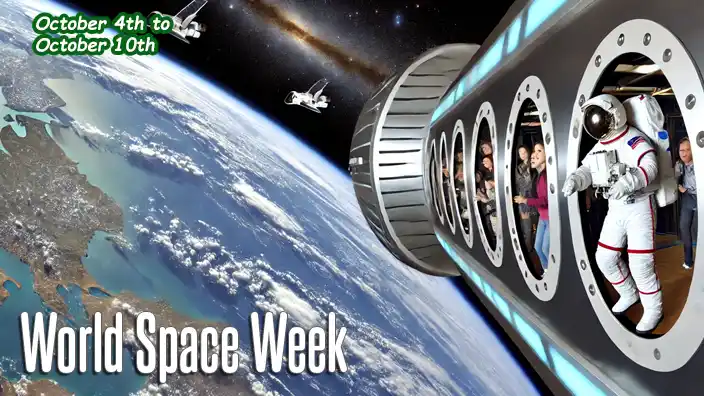
Life in space is like camping, but with way better views and significantly worse bathroom options. Sure, you get to float around like a superhero, but don’t get too excited—it only takes one stray glob of toothpaste to turn you into a human comet. Your daily routine? It’s a mix of zero-gravity gymnastics, freeze-dried cuisine that makes instant noodles look gourmet, and trying not to lose your socks to the black hole that is the ventilation system. And let’s not forget the constant reminder that in the vacuum of space, no one can hear you scream… when you realize you forgot where you put your space burrito.
Celebrated: Annually, from October 4th to October 10th
Celebrate World Space Week from October 4th to 10th. Dive into the history, achievements, and future of space exploration with events, facts, and activities for all ages.
Dog walking is the ultimate test of multitasking skills – you're a navigator, a poop-scooper, and a squirrel-spotter all rolled into one. It's a world where 'heel' often means 'hurry up, human!' and where every bush is a sniff-worthy newsstand. You quickly learn that a dog's idea of a 'quick walk' involves sniffing every blade of grass and greeting every fellow canine like long-lost relatives at a family reunion. It's a comedy show where you're both the audience and the reluctant participant, dodging excited tail wags and the occasional, unexpected mud puddle. But at the end of the day, nothing beats the joy of your dog's contented, post-walk nap – sprawled across your freshly cleaned couch, of course.
Celebrated: Annually, during the First Week of October
Explore the joys of Walk Your Dog Week! Discover health benefits, bonding tips, and fun facts for a paws-itively great time with your furry friend.
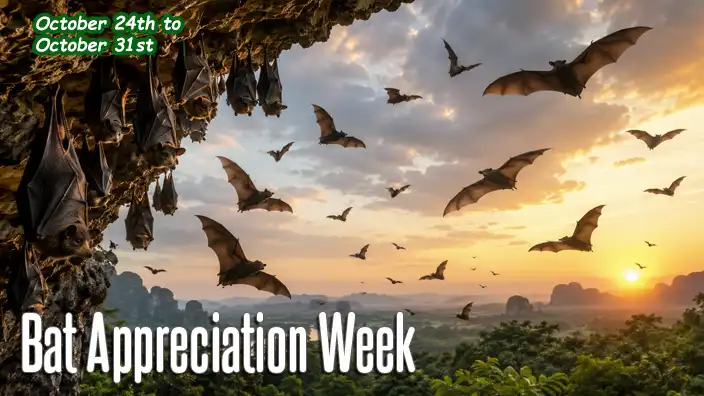
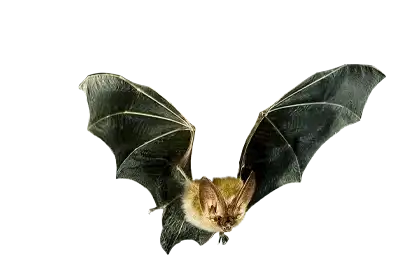
Bats may have spent centuries being cast as the villains of the animal kingdom, but the truth is they are more likely to save your tomato plants than turn into vampires. While most of us are asleep, bats are hard at work eating insects, pollinating flowers, and keeping ecosystems running smoothly. Bat Appreciation Week is the perfect time to give these nighttime professionals the recognition they deserve—because if anyone has earned the right to work the night shift, it's the creature that can catch mosquitoes in the dark without bumping into a single tree.
Celebrated: Annually, October 24th - October 31st
They fly all night, eat thousands of insects, and still get a bad reputation. Discover fascinating bat facts and celebrate Bat Appreciation Week with us
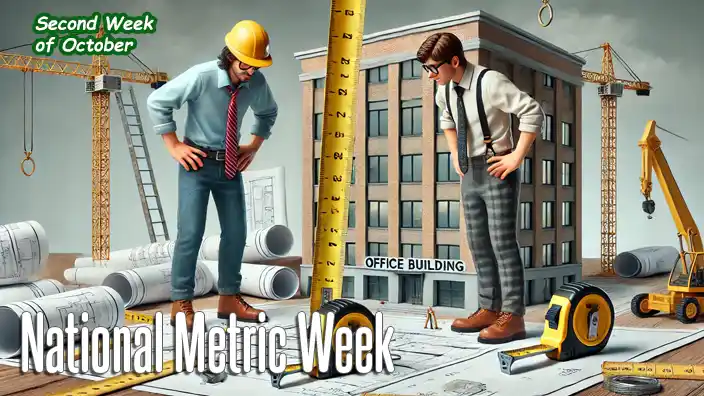
When it comes to measuring things, the world is split between those who use the metric system and those still clinging to imperial units like they’re vintage vinyl records. While one group glides smoothly through life with decimals and base-10 conversions, the other is busy trying to remember how many feet are in a mile (5,280, by the way, because obviously). Need to convert inches to feet? Just divide by 12. Want to measure something in centimeters? Easy peasy—just move the decimal point. Meanwhile, the imperial folks are over there converting ounces to pounds and gallons to quarts like they’re auditioning for a math-themed episode of "Survivor." It's like one group has a sleek, modern smartphone, and the other is still using a rotary phone—but hey, they’re both still talking, right?
Celebrated: Annually, during the Week of October 10th
Celebrate National Metric Week and discover the global standard of measurement. Learn about the history and simplicity of the metric system and its impact on science and daily life.
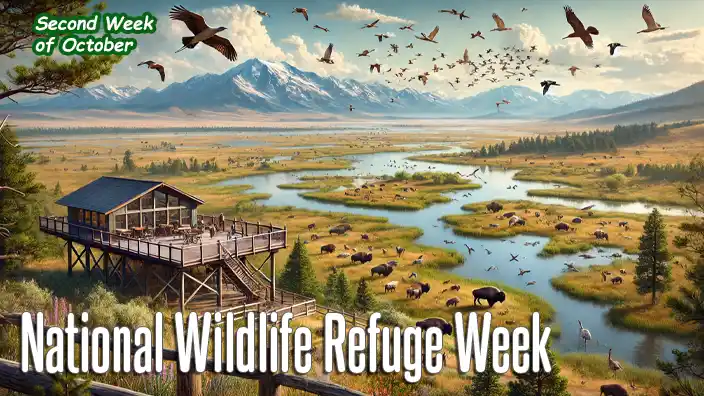
Wildlife refuges are like nature’s version of a luxury resort for animals, minus the room service but with all the amenities. Need a safe spot to raise your baby birds? Check. Looking for a peaceful marsh to laze around in without worrying about humans or predators? Done. It’s like the ultimate animal Airbnb, where the neighbors are a little quieter, the views are a lot better, and the biggest inconvenience is that the bison might hog the trail. You know things are going well when the local deer start looking at you like you’re the one trespassing on their turf!
Celebrated: Annually, during the Second Week of October
Celebrate National Wildlife Refuge Week and explore the 568 refuges across the U.S. that provide safe havens for diverse wildlife and a retreat for nature lovers.
If patience were a sport, customer service professionals would be Olympic champions with a gold medal in “explaining the obvious without sounding sarcastic.” Customer Service Week is your annual reminder that the person helping you reset your password for the third time today is not only skilled but possibly fueled entirely by coffee, determination, and sheer willpower. Treat them kindly—they’ve seen things.
Celebrated: Annually, on the First Full Week of October
Celebrate Customer Service Week by recognizing the hardworking professionals who keep customers happy and businesses running smoothly.
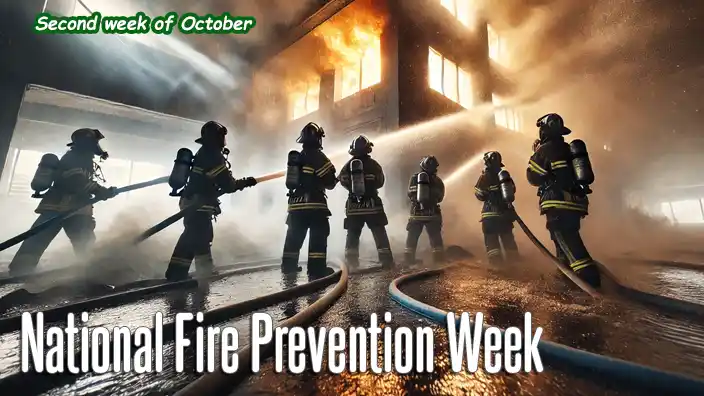
When it comes to fire prevention, the goal is simple: keep your house from turning into a campfire. It’s really about making sure that small things—like candles, toasters, and your habit of frying bacon on high heat—don’t lead to big problems. Because nothing says "oops" like realizing you’ve left the oven on after deciding to “quickly” take a nap. The good news? Fire prevention is mostly common sense: blow out candles, test your smoke alarms, and maybe stop pretending your microwave is a backup oven for Thanksgiving dinner.
Celebrated: Annually, during the second week of October
Join us for National Fire Prevention Week! Learn the history, essential safety tips, and how to conduct home fire drills to keep your family safe.
Diwali may be known as the Festival of Lights, but it’s not just about flicking a switch and calling it a day. Families prepare for weeks, homes are scrubbed top to bottom, trays of sweets appear in every kitchen, and fireworks turn the night sky into a celebration of color. It’s joyful, noisy, and delicious — and behind all the sparkle is a reminder that light, in every form, has the power to chase away the dark.
Celebrated: Annually, on the new moon of Kartik, usually in late October or early November.
Discover the Festival of Lights: Diwali’s rituals, five-day traditions, sweets, fireworks, and celebrations that bring joy worldwide.
Peace for one hour? That’s like baking a cake and only eating the crumbs! If we can manage to...
There was a time when wearing pink to school might earn you a raised eyebrow, a snicker, or a...
Picture this: you're rummaging through a drawer, looking for a pen, but instead, you find a flip...
There’s nothing light about Good Friday—after all, it commemorates the darkest day in Christian...
Mental health is not just a personal matter—it's a global issue that affects millions of lives...
Having a hole in your bucket is nature’s way of saying, “You tried.” It’s the DIY version of a practical...
On September 14, 1814, lawyer Francis Scott Key was inspired to write the poem that eventually became the lyrics of the United States national anthem, “The Star-Spangled Banner.” During the War of 1812, British forces had captured Washington, D.C., and burned several major public buildings before turning their attention toward Baltimore. Key became involved after his friend, physician William Beanes, was taken prisoner by the British. He helped negotiate Beanes' release, but because the Americans had learned details of the planned attack, they were required to remain with the British fleet until the assault on Baltimore was completed.
From aboard a vessel in the Patapsco River, Key watched as British ships bombarded Fort McHenry through the night of September 13 and into the morning of September 14. When daylight came, the enormous American flag flying above the fort was still visible, showing that the defenders had held their position and the British attack had failed. Moved by the sight, Key began writing verses that became a four-stanza poem titled “Defence of Fort M'Henry.” It was soon published and sung to the melody of “To Anacreon in Heaven,” a British song composed by John Stafford Smith. Over time, Key's poem became better known by the title of its opening imagery, “The Star-Spangled Banner.”
Key, born August 1, 1779, in Maryland, was a prominent lawyer who later served as U.S. attorney for the District of Columbia. His song became increasingly associated with patriotic and official occasions, and President Woodrow Wilson directed that it be played at appropriate military and naval ceremonies in 1916. Congress formally designated “The Star-Spangled Banner” as the national anthem, with President Herbert Hoover signing the measure into law on March 3, 1931. Key did not live to see what became of his composition; he died on January 11, 1843, decades before his hastily written verses became the official musical symbol of the United States.
On September 14, 1964, Kellogg's introduced the toaster pastry that would become Pop-Tarts, although the company was not the first to announce the idea. Rival Post had already publicized plans for a shelf-stable, fruit-filled pastry called Country Squares but revealed the concept before the product was ready for widespread sale. Kellogg's recognized the opportunity and moved quickly, turning to William “Bill” Post, then working at the Hekman Biscuit Company in Michigan, to help develop a pastry that could survive both the supermarket shelf and a trip through the family toaster. Post and his team experimented with dough, fillings and production methods, with his children reportedly serving as enthusiastic taste testers along the way.
Kellogg's initially considered calling its creation Fruit Scones before settling on the far more memorable Pop-Tarts, a name that played nicely with the popularity of Pop Art during the 1960s. The original unfrosted pastries appeared in four flavors—strawberry, blueberry, brown sugar cinnamon and apple currant—and the early test market was enormously successful. Demand quickly outran supply, forcing Kellogg's to publish advertisements apologizing to customers because it had run out. Frosting arrived a few years later after the company developed a version capable of surviving toaster temperatures without melting into a sugary disaster, followed by sprinkles, additional flavors and Milton the Toaster, an animated mascot who helped promote the increasingly popular breakfast treat.
What began as a hurried response to a competitor became one of Kellogg's most recognizable products. William Post is frequently described as the inventor of Pop-Tarts, although he always emphasized that their creation was a team effort, and Kellogg's has also credited company executive William “Doc” Thompson and the people involved in developing the product. Over the following decades, Pop-Tarts expanded far beyond those original four flavors and became as much a snack as a breakfast food. Billions are now sold annually—a remarkable outcome for something that began with a few people looking at two pieces of dough with filling between them and essentially asking, “Do you reckon we can put this in a toaster?”
On September 14, 1974, Eric Clapton reached No. 1 on the Billboard Hot 100 with “I Shot the Sheriff,” a song written and recorded the previous year by Bob Marley and the Wailers for their album Burnin'. It became the only No. 1 single of Clapton's career in the United States, but the man singing it had been surprisingly uncomfortable about releasing it. Clapton admired Marley's original and understood reggae well enough to worry that his own recording didn't capture what made the music special. He later recalled thinking that his version shouldn't even be included on his album 461 Ocean Boulevard, much less released as a single, because he felt it wasn't fair to Marley and that his interpretation had given the song too much of a white rock feel. His American bandmates were considerably more enthusiastic, and eventually Clapton allowed himself to be persuaded.
His concern became even more understandable when the record took off. Marley's version had already been released, but Clapton's recording suddenly carried the song onto mainstream American radio and all the way to the top of the chart. Clapton subsequently spoke with Marley and was relieved to discover that the songwriter appeared pleased with what he had done. Marley later recalled that Clapton had asked him about the meaning of the song, while Clapton remembered struggling to understand parts of Marley's explanation. Whatever uncertainty remained about the interpretation, there seemed to be no lasting uncertainty about Marley's acceptance of the cover.
The irony was that the recording Clapton worried might unfairly overshadow Bob Marley ultimately helped bring enormous attention to him. Island Records founder Chris Blackwell later described Clapton's cover as a major breakthrough for Marley, because one of rock's biggest stars had effectively pointed his enormous audience toward the Jamaican songwriter whose work he admired. The official Bob Marley history similarly credits Clapton's recording with significantly increasing Marley's international profile. So while September 14, 1974, marks Eric Clapton reaching No. 1, the longer story belongs to both musicians: Clapton received the biggest American single of his career from a Bob Marley song, while millions of listeners who heard Clapton's version were given a reason to discover the man who had written it in the first place.
On September 14, 1982, Princess Grace of Monaco died at the age of 52, one day after suffering serious injuries when the car she was driving left a steep mountain road above Monaco. Her youngest daughter, Princess Stéphanie, was traveling with her and survived. Before becoming European royalty, Princess Grace had been Grace Kelly of Philadelphia, one of Hollywood's most celebrated stars of the 1950s. In a remarkably brief film career, she became known for an elegant screen presence that made her particularly memorable in Alfred Hitchcock's Dial M for Murder, Rear Window and To Catch a Thief. She also starred opposite Gary Cooper in High Noon and won the Academy Award for Best Actress for her performance alongside Bing Crosby in The Country Girl.
Born in Philadelphia on November 12, 1929, Kelly studied acting at the American Academy of Dramatic Arts in New York and supported herself through modeling and television work while pursuing stage roles. After appearing on Broadway and making her way into motion pictures, her rise was extraordinarily rapid. By the middle of the 1950s she was one of Hollywood's leading actresses, working with stars including James Stewart, Cary Grant, Clark Gable, Ava Gardner and Frank Sinatra. Yet at the height of that success, Kelly walked away from Hollywood. After meeting Prince Rainier III of Monaco in 1955, she married him in an elaborate ceremony the following April and became Princess Grace. Her final feature film, the musical High Society, was released in 1956, bringing an acting career of only a few years to a close.
Princess Grace and Prince Rainier had three children—Caroline, Albert and Stéphanie—and she spent the remainder of her life carrying out royal and charitable duties in Monaco. On September 13, 1982, while driving home with Stéphanie, Grace lost control of her Rover on the winding road near Monaco and the vehicle plunged down a steep slope. Early reports attributed the crash to a stroke suffered while she was driving, although the precise circumstances surrounding the accident have remained the subject of discussion. Stéphanie escaped with injuries, but Grace suffered devastating trauma and died the following day. Her death prompted mourning far beyond the tiny principality she had made her home, closing an extraordinary life that had taken her from Philadelphia to Broadway, from Hollywood stardom and an Academy Award to becoming one of the world's most recognizable princesses.
On September 14, 1994, Major League Baseball officially canceled the remainder of its season, including the postseason and World Series, after a players' strike that had begun on August 12 showed no sign of ending. It was an extraordinary moment for America's pastime: for the first time since 1904, there would be no World Series, and for the first time since the championship series began in 1903, its cancellation resulted from a labor dispute. At the center of the conflict were long-running disagreements between team owners and the Major League Baseball Players Association over salaries, revenue sharing, free agency and the owners' desire for a salary cap. Acting commissioner Bud Selig finally called off the remainder of the season with hundreds of regular-season games already lost.
The cancellation was particularly painful because the 1994 season had been producing some remarkable baseball. The Montreal Expos owned the best record in the majors at 74–40 and appeared capable of making the deepest postseason run in franchise history, while the New York Yankees led the American League East at 70–43. Individual achievements disappeared with the schedule as well. San Francisco's Matt Williams had already hit 43 home runs and Seattle's Ken Griffey Jr. had 40, giving both a chance to challenge Roger Maris' then-record of 61 in a season. Perhaps the most tantalizing unfinished story belonged to San Diego Padres great Tony Gwynn, who was batting .394 when play stopped and pursuing something no major leaguer had accomplished since Ted Williams hit .406 in 1941.
The dispute continued through the winter and into the following spring, with replacement players even appearing during 1995 spring training before a federal court injunction helped bring the strike to an end on April 2. Regular major-league players returned and the 1995 season eventually began, but the damage was considerable. Attendance suffered, fans expressed anger at both players and owners, and many people within baseball later described the canceled World Series as a lasting scar on the sport. There was no champion, no postseason heroics and no opportunity to discover whether Montreal could complete its remarkable season, whether Gwynn could reach .400, or whether Williams or Griffey could catch Maris. The 1994 season simply stopped—and baseball was left forever wondering how one of its most promising years might have ended.