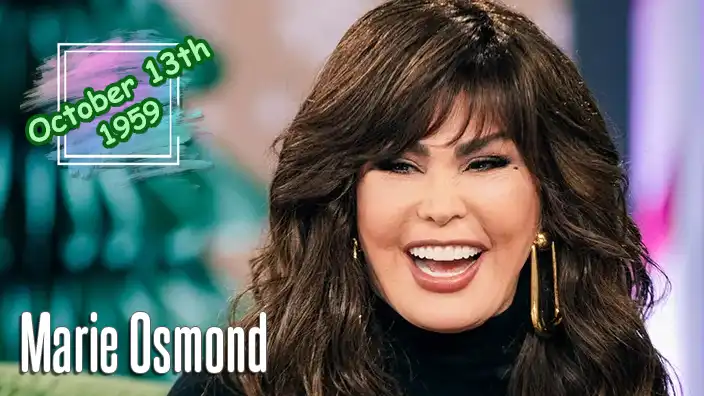
October 13, 1959, in Ogden, Utah
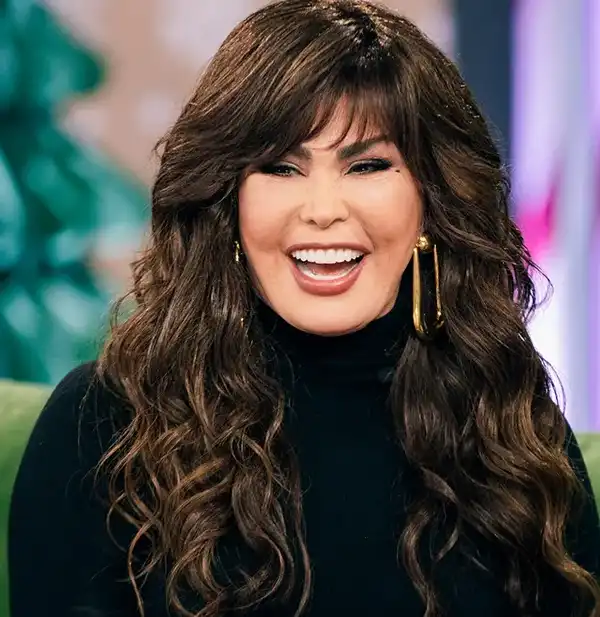
Olive Marie Osmond was born on October 13, 1959, in Ogden, Utah, into a family where musical talent was practically a household requirement. The daughter of George Virl Osmond and Olive May Davis Osmond, she was the eighth of nine children and the only girl among eight brothers. Her siblings included Alan, Wayne, Merrill, Jay, Donny, and Jimmy, who would become familiar names in American popular entertainment, along with her older brothers Virl and Tom. Growing up in such a large family meant Marie was surrounded by music, rehearsals, television appearances, and enough brotherly activity to make an ordinary household seem positively peaceful. Her parents emphasized family unity, discipline, faith, and hard work, values that would remain important throughout her professional and personal life.
Marie Osmond's introduction to show business came remarkably early. Her older brothers had already attracted national attention through appearances on The Andy Williams Show, and Marie made her television debut on the program as a small child. Andy Williams jokingly introduced her as the youngest Osmond brother, an amusing distinction for the family's only daughter. Although she occasionally performed with her siblings, Marie was not a regular member of the Osmond Brothers singing group. Instead, she gradually developed her own musical interests, particularly in country music, which distinguished her from the pop-oriented recordings that were making her brothers internationally famous. While Donny and the others were busy charming teenage audiences, Marie was discovering that Nashville-style storytelling and heartfelt country melodies offered an appealing direction for her own career.
Her remarkable solo breakthrough arrived in 1973 with the release of "Paper Roses," a country-pop recording originally made famous by Anita Bryant in 1960. Marie's interpretation became an immediate commercial success, reaching number one on Billboard's Hot Country Singles chart and number five on the Billboard Hot 100. The recording established her as a major young country music performer and demonstrated that she could achieve success independently of her brothers. Her debut album, also titled Paper Roses, topped Billboard's country albums chart and introduced audiences to a performer whose warm vocal style combined traditional country influences with mainstream pop appeal. It was an impressive beginning, particularly for someone whose previous professional experience had largely involved trying to make herself heard in a household containing eight brothers.
Following the success of "Paper Roses," Marie continued recording country-oriented material, releasing albums including In My Little Corner of the World in 1974 and Who's Sorry Now in 1975. Her recordings reflected the polished country-pop style that was becoming increasingly popular during the 1970s, combining accessible melodies with themes of romance, disappointment, and emotional resilience. Although her famous surname undoubtedly attracted public attention, her commercial success demonstrated an independent ability to connect with listeners. Marie's musical direction also helped broaden the Osmond family's appeal, introducing the group to audiences who might not otherwise have followed their pop recordings. Her success established a professional identity that would remain distinct from, although frequently associated with, the larger Osmond entertainment enterprise.
Marie Osmond's television career entered an extraordinary new phase when she joined her brother Donny as co-host of the ABC variety series Donny & Marie, which premiered in January 1976. The program combined musical performances, comedy sketches, celebrity guests, elaborate costumes, and the cheerful sibling banter that quickly became its defining characteristic. One of its most recognizable features was the musical contrast between Marie's country preferences and Donny's rock-and-roll influences, captured in their familiar declaration that she was a little bit country while he was a little bit rock and roll. The show's wholesome humor and family-friendly entertainment made it particularly popular with American audiences, and its international distribution introduced the siblings to viewers around the world. Their chemistry was unmistakable, although one suspects that years of growing up together had provided considerably more rehearsal time than most television producers could possibly arrange.
The success of Donny & Marie made Marie one of the most recognizable young television personalities of the decade. The series attracted prominent celebrity guests and featured increasingly ambitious production numbers, demonstrating the popularity of traditional television variety entertainment during an era when audiences still gathered around a single household television set. Marie proved equally comfortable singing, dancing, performing comedy, and exchanging good-natured insults with her brother. The program also required an enormous amount of preparation, with demanding rehearsal schedules and frequent costume changes. While viewers saw an apparently effortless combination of music and laughter, the production demanded considerable discipline from its young stars. The series continued until 1979, leaving behind an enduring association between the Osmond siblings and American television entertainment.
During the height of their television popularity, Donny and Marie also recorded music together, producing successful duets including "I'm Leaving It All Up to You," "Morning Side of the Mountain," and "Deep Purple." Their contrasting vocal styles complemented each other, creating recordings that appealed to the same broad audience that enjoyed their television appearances. The pair became prominent figures in the entertainment industry, appearing on magazine covers, promotional merchandise, and numerous television specials. Their popularity also inspired dolls, toys, and other collectibles, reflecting the commercial opportunities associated with successful television personalities during the 1970s. Marie's growing public profile demonstrated her ability to balance an independent recording career with a highly visible family partnership, although keeping track of which Osmond was appearing where must occasionally have required a particularly large calendar.
As the original Donny & Marie series concluded, Marie began exploring opportunities beyond the familiar variety-show format. She starred in the television film The Gift of Love in 1978, appearing alongside Timothy Bottoms and James Woods in a romantic drama inspired by O. Henry's celebrated short story "The Gift of the Magi." The production demonstrated her interest in dramatic acting and offered audiences an opportunity to see her perform outside the musical environment that had established her reputation. She subsequently appeared in Side by Side: The True Story of the Osmond Family in 1982, portraying her own mother, Olive Osmond. Playing a parent in a dramatization of one's own family history presented an unusual acting assignment, particularly when the performer already possessed firsthand knowledge of the household's considerable musical activity.
Marie continued her television career during the early 1980s, hosting the variety series Marie and appearing in additional entertainment programs. She also served as a presenter on Ripley's Believe It or Not!, joining a program devoted to unusual achievements, extraordinary people, and fascinating curiosities. The role suited her friendly presentation style and demonstrated her ability to communicate comfortably with audiences beyond musical performances. Although television variety programming was changing as new entertainment formats emerged, Marie continued adapting to the industry's evolving demands. Her experience as a singer, dancer, comedian, and presenter provided a versatility that would become increasingly valuable as her career developed.
Her country music career experienced a major resurgence during the mid-1980s when she returned to recording with renewed determination. In 1985, she released "Meet Me in Montana," a duet with country singer Dan Seals that reached number one on Billboard's Hot Country Singles chart. The song became one of her most successful recordings and introduced her to a new generation of country music listeners. That same year, her solo recording "There's No Stopping Your Heart" also reached number one, demonstrating that her commercial appeal extended well beyond her teenage success. In 1986, she enjoyed another chart-topping duet with Paul Davis, "You're Still New to Me." These achievements confirmed Marie's position as a respected country recording artist rather than simply a television personality who occasionally sang country songs.
Her collaboration with Dan Seals earned the pair the Country Music Association Award for Vocal Duo of the Year in 1986, a significant recognition from the country music industry. The honor acknowledged the success of "Meet Me in Montana" and helped reinforce Marie's musical credibility within a genre that had initially seemed an unusual direction for a member of the Osmond family. Her recordings during this period included the albums There's No Stopping Your Heart and I Only Wanted You, featuring material that combined contemporary country production with her familiar expressive vocal style. The resurgence demonstrated her ability to adapt to changing musical tastes while preserving the qualities that had first attracted listeners to "Paper Roses." Evidently, those paper flowers had considerably more staying power than anyone initially expected.
Marie also established herself as a stage performer, appearing in major theatrical productions that demanded a different combination of musical and dramatic skills. She starred as Maria in a touring production of The Sound of Music, bringing her vocal abilities to one of musical theater's most beloved roles. She later appeared as Anna Leonowens in the Broadway revival of The King and I, demonstrating her versatility as an actress and singer. These productions required extensive rehearsals, precise choreography, and the ability to sustain demanding performances night after night. For someone accustomed to live television and concert appearances, the transition to musical theater was a natural progression, although Broadway audiences are generally less forgiving when performers forget their lines and cannot simply ask Donny to improvise something amusing.
The Osmond siblings reunited professionally in the late 1990s for another television venture, Donny & Marie, a syndicated daytime talk show that aired from 1998 to 2000. Unlike their earlier variety program, the new series emphasized celebrity interviews, lifestyle discussions, musical performances, and informal conversations. The format allowed the pair to demonstrate how their personalities and professional relationship had evolved since their teenage television success. Their familiar sibling humor remained central to the program, but the discussions reflected the broader experiences they had accumulated as performers, parents, and established entertainment personalities. The series also introduced their partnership to viewers who had not experienced the original 1970s program, proving that some family combinations remain entertaining long after the original matching costumes have been retired.
In 2007, Marie joined the fifth season of ABC's Dancing with the Stars, partnering with professional dancer Jonathan Roberts. Her participation attracted considerable public attention, particularly when she fainted following a samba performance during a live broadcast. She quickly recovered, explaining that she had experienced a breathing-related episode, and continued competing in the program. Her determination and willingness to embrace the demanding competition earned considerable audience support, and she ultimately finished in third place. The experience introduced her to another generation of television viewers and demonstrated that she remained willing to accept new professional challenges. It also provided a useful reminder that dancing under television lights can be exhausting, particularly when millions of people are watching and the judges have opinions about everything from posture to facial expressions.
Marie and Donny subsequently began an enormously successful Las Vegas residency at the Flamingo Hotel in 2008. Originally planned as a limited engagement, the production became a long-running attraction, continuing until November 2019. The show combined their familiar hits, comedy routines, elaborate production numbers, and the affectionate sibling rivalry that had delighted audiences for decades. Their performances attracted visitors from around the world, establishing the pair as major figures in Las Vegas entertainment. The residency received numerous awards and became an important chapter in their careers, demonstrating the enduring appeal of their musical partnership. After so many years of performing together, the siblings had clearly perfected the art of making their disagreements entertaining enough that audiences would happily purchase tickets to witness them.
Beyond music and television, Marie developed a successful career as an entrepreneur, particularly through her work designing collectible dolls. Beginning in the early 1990s, she created the Marie Osmond Fine Porcelain Collector Dolls line, combining her interest in art, design, and craftsmanship with a growing market for collectible figures. Her creations became popular among collectors, and she developed a reputation for detailed designs and expressive faces. Her involvement extended beyond simply lending her name to the products, reflecting a genuine interest in their artistic development. Marie also became associated with Mattel's Barbie brand, having been selected as the first celebrity represented by a Barbie doll. For someone who had already appeared on television, records, and countless magazine covers, becoming a doll was perhaps the inevitable next stage of celebrity recognition.
Her entrepreneurial activities expanded into additional products and commercial partnerships, including a long association with Nutrisystem. Marie became a familiar spokesperson for the weight-management company, discussing her personal experiences with nutrition, exercise, and maintaining healthy habits. Her public appearances and promotional work reflected the increasingly diverse professional opportunities available to established entertainers, particularly those whose personalities had become familiar and trusted by audiences. Although celebrity endorsements can sometimes seem disconnected from a performer's original career, Marie's ability to communicate openly and conversationally helped make these activities another recognizable part of her public identity.
Marie has also enjoyed success as an author, publishing several books that explore her personal experiences, family relationships, and the challenges of balancing public success with private responsibilities. Her 2001 memoir, Behind the Smile: My Journey Out of Postpartum Depression, written with Marcia Wilkie, discussed her experiences with severe postpartum depression and helped encourage broader public conversation about maternal mental health. Her willingness to discuss a difficult personal experience was particularly significant during a period when postpartum depression was less openly addressed in mainstream entertainment. She later published Might as Well Laugh About It Now in 2009 and The Key Is Love: My Mother's Wisdom, A Daughter's Gratitude in 2013, offering readers reflections on family, resilience, and lessons learned throughout her life.
One of Marie's most enduring contributions outside entertainment has been her involvement with Children's Miracle Network Hospitals, which she co-founded with actor John Schneider in 1983. The organization raises funds to support children's hospitals, helping provide medical treatment, equipment, research, and essential services for young patients and their families. Over the decades, its fundraising activities have generated billions of dollars for participating hospitals, making it one of the most recognizable charitable networks supporting pediatric healthcare. Marie has remained closely associated with the organization, participating in fundraising campaigns, public appearances, and promotional activities. Her commitment to children's healthcare reflects a substantial philanthropic legacy alongside her accomplishments in music and television.
Her charitable activities have also included support for American military personnel and their families. Marie performed for service members through United Service Organizations events and participated in entertainment programs associated with Bob Hope, continuing a long tradition of American performers bringing music and comedy to military audiences. Her contributions were recognized with the Secretary of Defense Medal for Outstanding Public Service, an important civilian honor acknowledging exceptional support for the armed forces. These activities demonstrated her willingness to use her professional experience to entertain and encourage people serving far from home, where a familiar song or friendly conversation can provide a welcome reminder of ordinary life.
Marie Osmond's personal life has included considerable happiness as well as profound challenges. She married basketball player Stephen Craig in 1982, and the couple welcomed a son before divorcing in 1985. She subsequently married music producer Brian Blosil in 1986, and their family grew to include seven children, five of whom were adopted. Their marriage ended in 2007. In 2011, Marie and Stephen Craig remarried, creating an unusual and heartwarming second chapter in their relationship. Marie has frequently spoken about the importance of her children, grandchildren, and family connections, emphasizing that her greatest personal satisfaction comes from relationships rather than professional recognition. Remarrying one's first husband is certainly an unusual romantic development, although it does have the advantage of eliminating the need for lengthy introductions to the in-laws.
Her family also experienced heartbreaking loss when her son Michael died in 2010. Marie subsequently spoke publicly about grief, emotional resilience, and the importance of supporting people experiencing mental health difficulties. Her willingness to discuss painful experiences contributed to her reputation as an entertainer who did not attempt to present public success as protection against ordinary human suffering. Although her television appearances have frequently emphasized humor and optimism, her personal experiences have given additional depth to her discussions about family, compassion, and perseverance. She has continued encouraging open conversations about emotional well-being while maintaining appropriate boundaries around her family's private life.
Marie returned to daytime television as a co-host of CBS's The Talk in September 2019, joining a panel that discussed entertainment, current events, family relationships, and everyday experiences. Her conversational style and extensive entertainment background made her a recognizable addition to the program. She remained with the series for one season, departing in 2020 to pursue other professional opportunities and spend more time with her family. Her television work continued through appearances in holiday films and other productions, including projects for Lifetime. IMDb documents her extensive credits as an actress, producer, writer, soundtrack performer, and television personality, illustrating the breadth of her career beyond her best-known musical performances.
Her recording career also continued into the twenty-first century. In 2016, she released Music Is Medicine, an album featuring country and contemporary pop influences that returned her to Billboard's country album rankings. The project reflected her continuing enthusiasm for recording new material rather than relying exclusively on the songs that first established her reputation. In December 2021, she released Unexpected, an ambitious collection featuring orchestral arrangements, classical crossover material, and performances in several languages. The album reached number one on Billboard's Classical Crossover Albums chart, demonstrating a different dimension of her vocal abilities. For an artist whose recording career began with a country ballad about paper flowers, moving into classical crossover music was an impressive demonstration of artistic curiosity.
Marie has continued performing in concert, including appearances with symphony orchestras and holiday productions that showcase her broad musical repertoire. These performances have allowed her to explore traditional standards, country favorites, Broadway selections, and orchestral arrangements within a single concert program. Her versatility reflects decades of experience across multiple entertainment formats, from television variety shows and country music recordings to theatrical productions and contemporary concert performances. Rather than allowing her professional identity to remain permanently associated with a single television series or hit recording, she has repeatedly pursued new opportunities while maintaining a recognizable connection with her longtime audience.
Marie Osmond's influence on American entertainment extends well beyond the extraordinary popularity of the original Donny & Marie television series. Her accomplishments as a country singer, television presenter, actress, author, entrepreneur, and philanthropist reflect an unusual combination of versatility, determination, and public appeal. She successfully established an independent musical career despite growing up within one of America's most recognizable entertainment families, returned to the country charts after her early success, and continued developing new professional interests across several decades. Her charitable contributions, particularly through Children's Miracle Network Hospitals, have also created an enduring legacy outside show business.
From a childhood appearance on The Andy Williams Show to chart-topping country recordings, Broadway performances, television hosting, and international concert appearances, Marie Osmond has built a career defined by adaptability and a willingness to embrace change. Her music and television appearances have entertained generations of audiences, while her personal experiences and philanthropic activities have demonstrated that a successful public career can coexist with meaningful commitments beyond the spotlight. And although the world may always remember her as a little bit country, Marie has spent her life proving that she is considerably more than just a little bit talented. The Osmond brothers may have had the numerical advantage, but their only sister certainly made her presence known.