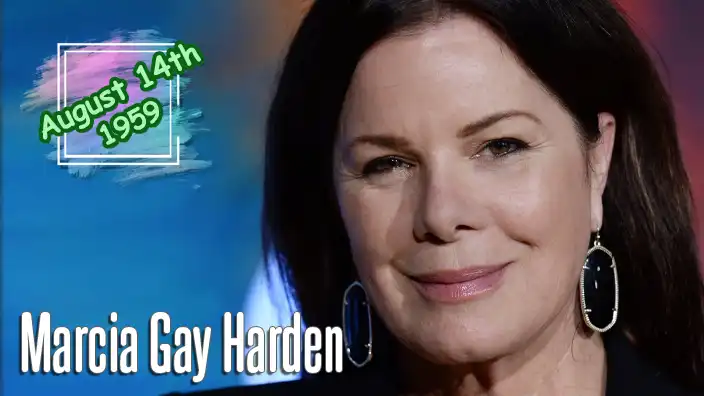
August 14, 1959, in La Jolla, California
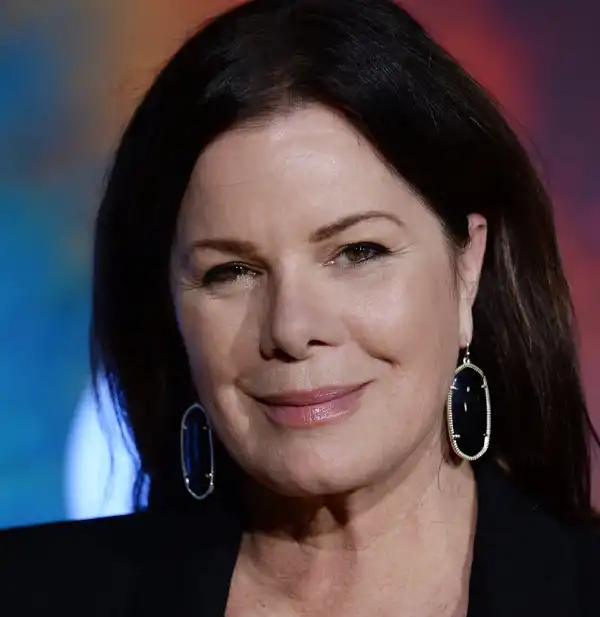
Marcia Gay Harden was born on August 14, 1959, in La Jolla, California, the third of five children born to Beverly Bushfield Harden and Thad Harold Harden. Her father was a U.S. Navy officer, which meant that the Harden household did not remain rooted in California for very long. The family moved frequently because of his military assignments, and Marcia spent portions of her childhood living in places including Japan, Germany and Greece. The constant movement exposed her to different cultures at an age when many children were still becoming acquainted with the other side of their hometown, and it was while living in Greece and attending theater performances in Athens that she began developing an interest in acting.
The international childhood also gave Harden an adaptability that would prove useful in a profession where stability is generally regarded as a pleasant rumor. She began her college education at American universities in Europe before returning to the United States and enrolling at the University of Texas at Austin. There she studied theater and earned a Bachelor of Arts degree in 1980. Harden subsequently continued her professional training at New York University's Tisch School of the Arts, earning a Master of Fine Arts in acting in 1988. Long before the Academy Awards knew her name, she had therefore spent years learning her craft in the decidedly less glamorous environment of classrooms, rehearsals and stage work.
Her early professional career developed gradually. Harden appeared in the relatively obscure 1986 film The Imagemaker and worked in television while continuing to establish herself as a stage performer. The breakthrough that brought her to wider attention arrived in 1990 when Joel and Ethan Coen cast her as Verna Bernbaum in Miller's Crossing. The stylish gangster film starred Gabriel Byrne, Albert Finney and John Turturro, but Harden made a strong impression as a complicated woman caught amid shifting loyalties, violence and organized crime. It was exactly the sort of morally ambiguous character she would repeatedly prove adept at playing: someone whose emotions could not conveniently be summarized before the commercial break.
Rather than becoming an instant movie star after Miller's Crossing, Harden did what working actors generally do when the mythology of Hollywood isn't paying attention: she kept working. She appeared in films and television productions throughout the 1990s, taking roles that varied enormously in size and style. She portrayed Ava Gardner in the 1992 television miniseries Sinatra, appeared in Used People, Safe Passage, The Spitfire Grill and Flubber, and worked opposite actors ranging from Robin Williams to Anthony Hopkins. Her résumé grew steadily, even if the sort of enormous commercial breakthrough that turns an actor into a household name remained elusive.
At the same time, Harden maintained a serious theatrical career. In 1993, she appeared on Broadway in Tony Kushner's landmark play Angels in America, portraying Harper Pitt, the troubled wife of a closeted Mormon lawyer. The production was one of the defining theatrical events of its era, and Harden earned a Tony Award nomination for her performance. It established something that would remain important throughout her career: Harden was not simply a film actress who occasionally wandered onto a stage. Theater was a substantial part of her professional identity, and Broadway would eventually provide her with one of the biggest honors of her career.
Her film career moved into another gear at the beginning of the new century. In 2000 she appeared in Clint Eastwood's Space Cowboys, but another film released that year would change the trajectory of her career. Ed Harris had spent years developing Pollock, a biographical drama about American abstract expressionist painter Jackson Pollock. Harris directed the film and played Pollock himself, while Harden was cast as Lee Krasner, the accomplished painter who became Pollock's wife and whose own artistic life was inevitably complicated by marriage to one of the most celebrated and self-destructive figures in modern American art.
Playing Krasner required considerably more than portraying the supportive wife of a difficult genius. Krasner was herself a serious artist, and Harden gave the character ambition, intelligence, anger, loyalty and a growing exhaustion with Pollock's destructive behavior. Her performance prevented Krasner from disappearing behind her famous husband, something particularly important given that the real Lee Krasner spent much of her life fighting precisely that problem. Harden created a woman who could love Pollock while being furious with him, support his work while protecting her own identity and endure his volatility without becoming merely a cinematic martyr.
The performance earned Harden the Academy Award for Best Supporting Actress at the 73rd Academy Awards in 2001. She defeated a formidable field that included Judi Dench, Kate Hudson, Frances McDormand and Julie Walters. The victory was especially striking because Harden had not received the same level of awards-season attention as several of her competitors. She walked into the ceremony as something of an outsider and walked out carrying an Oscar.
One might imagine that winning an Academy Award immediately results in Hollywood executives forming an orderly line outside the winner's home carrying scripts, contracts and tasteful baskets of expensive fruit. Harden later made clear that the reality was considerably less magical. She has joked about expecting a tremendous career and salary boost after Pollock, only to discover that an Oscar does not necessarily come with a permanently upgraded bank account or Martin Scorsese waiting on an emerald lawn. Her experience provided a useful corrective to the assumption that one extraordinary night automatically eliminates the uncertainty of an acting career.
What the Oscar did establish beyond dispute was Harden's ability to inhabit complicated supporting roles. She continued working prolifically, appearing in Gaudi Afternoon, King of Texas, Casa de los Babys and other productions before delivering another acclaimed performance in Clint Eastwood's 2003 drama Mystic River. Based on Dennis Lehane's novel, the film centered on three childhood friends whose lives become entangled again following the murder of a young woman. Harden played Celeste Boyle, wife of Tim Robbins' deeply traumatized Dave Boyle.
Celeste is trapped in an agonizing position. She loves her husband but becomes increasingly frightened by his behavior and uncertain about his explanation of where he was on the night of the murder. Harden plays that uncertainty without reducing the character to simple suspicion. Celeste is frightened, confused and desperate to understand a man whose childhood trauma has never released its hold on him. Her doubts eventually contribute to the tragedy at the heart of the film, making her role essential despite the movie's formidable ensemble cast.
Harden's performance earned her a second Academy Award nomination for Best Supporting Actress. Only a few years after her unexpected victory for Pollock, she had demonstrated that the first nomination was no fortunate accident. IMDb continues to identify Mystic River and Pollock among the performances for which she is best known.
Her ability to shift between sympathetic and deeply unsettling characters became particularly evident in 2007. That year she appeared in Sean Penn's Into the Wild, based on the life of Christopher McCandless, playing Billie McCandless, Christopher's mother. The role required Harden to portray a parent trying to understand the disappearance and choices of a son who had deliberately removed himself from his former life. The film gave her relatively limited screen time compared with its central character, but Harden's performance contributed significantly to the emotional weight of the family left behind.
Then there was The Mist.
Frank Darabont's adaptation of Stephen King's novella placed a group of frightened townspeople inside a supermarket while mysterious and deadly creatures occupied the mist outside. Harden played Mrs. Carmody, a religious fanatic who interprets the catastrophe as divine judgment and gradually gains influence over the terrified survivors. The monsters outside the store are considerable, but Mrs. Carmody steadily makes a strong case that the most dangerous creature in the building may have arrived before the mist did.
Harden approached the character with complete seriousness, which is precisely why Mrs. Carmody became so memorable. Rather than playing her as a cartoon villain, she portrayed someone absolutely convinced of her own righteousness. As fear spreads, Carmody's certainty becomes increasingly attractive to people desperate for explanations. Harden transforms the character from an irritating eccentric into a genuinely dangerous leader, illustrating how quickly panic can make extremism sound reassuring when it promises frightened people that somebody understands what is happening.
That same willingness to inhabit unpleasant or difficult characters has been one of Harden's greatest strengths. She has rarely seemed concerned with whether audiences necessarily like the person she is playing. Her characters are frequently contradictory, wounded, abrasive, frightened or morally uncertain. Harden's job is not to ask viewers to invite them to dinner; it is to make them believable.
Theater again provided a major career milestone in 2009 when Harden starred on Broadway in Yasmina Reza's God of Carnage. The play begins with two sets of parents meeting politely to discuss a playground altercation between their sons. Civility lasts approximately as long as civility generally lasts in a play titled God of Carnage. The adults gradually descend into arguments, accusations, resentment and spectacularly bad behavior.
Harden played Veronica, one of the parents attempting to maintain a veneer of reason and social responsibility as the evening deteriorates. The production featured an exceptional cast that included James Gandolfini, Hope Davis and Jeff Daniels, yet Harden received particular acclaim. She won the 2009 Tony Award for Best Actress in a Play, adding Broadway's highest competitive honor to the Academy Award already occupying space at home.
Winning both an Oscar and a Tony placed Harden among a comparatively select group of performers who have received major recognition in both film and theater. More importantly, the awards represented two very different forms of acting. Film allows close-ups, multiple takes and editing; theater requires an actor to build a performance live in front of an audience from beginning to end. Harden had demonstrated command of both.
Television has provided yet another substantial portion of her career. Harden has appeared in an enormous variety of programs, sometimes as a guest performer and sometimes in recurring or starring roles. Her television work has included Damages, Law & Order: Special Victims Unit, The Newsroom, Trophy Wife, Code Black, How to Get Away with Murder and The Morning Show. The sheer variety of those productions illustrates how difficult she is to place into a single category.
On Aaron Sorkin's The Newsroom, Harden played attorney Rebecca Halliday, which required her to negotiate the famously dense, rapid-fire dialogue associated with Sorkin's writing. She has recalled being advised by Jeff Daniels that she needed to arrive at rehearsal already knowing the dialogue thoroughly. For an actress trained in theater, the challenge appears to have been more invitation than warning.
In the medical drama Code Black, Harden took a central role as Dr. Leanne Rorish, an emergency physician working in an overwhelmed Los Angeles emergency department. The series gave her another formidable professional woman to play, but Leanne was shaped by profound personal tragedy as well as medical skill. Harden remained with the program through its three-season run from 2015 to 2018, bringing emotional authority to a series deliberately constructed around constant pressure and crisis.
She subsequently reached another broad television audience with So Help Me Todd, which premiered in 2022. Harden starred as Margaret Wright, a highly successful attorney whose meticulous professional life becomes considerably less orderly when she hires her talented but undisciplined son Todd, played by Skylar Astin, as an investigator at her law firm. The premise allowed Harden to combine drama and comedy, often within the same scene, while exploring the relationship between a mother who values structure and a son who appears to regard structure as a provocative suggestion.
The series gave Harden a chance to display a lighter comic rhythm than many of her best-known films. Margaret could be intimidating and controlled in the courtroom while becoming exasperated by Todd's methods, and the relationship worked because both characters were competent in entirely different ways. IMDb credits Harden not only as the star of the series but also as a producer on several episodes. So Help Me Todd ran for two seasons, ending in 2024 after 31 episodes featuring Harden as Margaret.
Harden has also accumulated numerous roles in more commercial productions without abandoning the character-driven work that established her reputation. Her credits include Meet Joe Black, Space Cowboys, Mona Lisa Smile, Bad News Bears, The Hoax, Whip It, Parkland and the Fifty Shades film series, in which she played Dr. Grace Trevelyan Grey, the adoptive mother of Christian Grey. One imagines that after The Mist and Mystic River, surviving the Grey family required only moderate professional preparation.
Her career has also included voice work, television movies and appearances in projects ranging from independent dramas to major studio releases. IMDb lists well over a hundred acting credits, a remarkable body of work made more impressive by the fact that Harden has rarely seemed content to repeat precisely the same character.
Beyond acting, Harden became an author with the 2018 memoir The Seasons of My Mother: A Memoir of Love, Family, and Flowers. The book explores her relationship with her mother, Beverly, whose life was increasingly affected by Alzheimer's disease. Rather than writing a conventional celebrity autobiography centered on career triumphs, Harden focused on memory, family and the experience of watching a parent gradually change under the effects of dementia.
The subject was deeply personal. Harden became an advocate for Alzheimer's awareness and caregiving, speaking publicly about her family's experience and the emotional challenges of caring for someone living with the disease. Her mother's love of Japanese flower arranging became an important motif in the memoir, connecting memories of the family's years abroad with Harden's effort to preserve the person her mother had been as memory itself began to disappear.
Family has remained an important part of Harden's life away from the screen. She married filmmaker and prop master Thaddaeus Scheel in 1996 after the two worked together on The Spitfire Grill. They had three children: daughter Eulala and twins Hudson and Julitta. The marriage ended in divorce in 2012. IMDb notes one mildly astonishing family coincidence: Harden's father, brother and former husband were all named Thaddaeus. At that point, shouting “Thaddaeus!” at a family gathering was presumably less a method of identifying someone than an invitation for several men to turn around.
Harden has frequently spoken about acting as a craft rather than merely celebrity, and her career reflects that distinction. She possesses an Academy Award, a Tony Award and decades of prominent credits, but she has continued moving freely between leading roles and supporting parts, television and film, commercial productions and theater. There has never been much evidence that she considers one medium beneath another if the character offers something worth playing.
That may explain why Harden's performances so often feel larger than the amount of screen time she receives. Lee Krasner in Pollock could easily have been presented primarily in relation to her famous husband, but Harden made her an artist with her own ambitions. Celeste in Mystic River could have existed merely to move the plot toward its terrible conclusion, but Harden made her fear understandable. Mrs. Carmody in The Mist could have been a shrieking horror-film stereotype, but Harden gave her the frightening certainty of someone who believes completely in what she is saying.
Her career is filled with women who are not conveniently one thing.
They may be strong and frightened, loving and angry, competent and overwhelmed, sympathetic and infuriating. Harden has repeatedly found the contradictions inside those characters and resisted the temptation to smooth them away.
That approach has given her an unusually durable career. She was already an established stage and film actress before Pollock brought her an Academy Award, and the Oscar did not become the conclusion of her story. Mystic River brought another nomination. God of Carnage brought a Tony. The Mist gave horror audiences a character they could passionately despise. Code Black and So Help Me Todd introduced her to new generations of television viewers.
More than three decades after Miller's Crossing, Harden continues to work across film, television and theater. Her résumé contains prestigious dramas, broad comedies, horror, legal television, medical television, independent films, blockbusters and Broadway. She has played artists, doctors, lawyers, mothers, grieving wives and at least one woman capable of making an entire supermarket full of people considerably more frightening than the monsters waiting outside.
There is a useful lesson in Marcia Gay Harden's career. Winning an Oscar may produce a wonderful evening, but longevity comes from being able to walk onto the next set, meet an entirely different character and begin again. Harden has been doing exactly that for decades.
And if the character happens to be complicated, difficult and carrying several decades of emotional baggage, so much the better. She probably already knows where to put it.