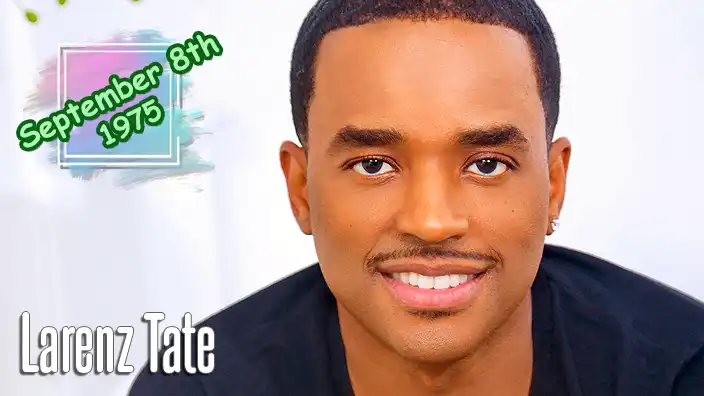
September 8, 1975, in Chicago, Illinois

Larenz Tate was born on September 8, 1975, in Chicago, Illinois, to Larry and Peggy Tate. The youngest of three brothers, he grew up alongside Larron and Lahmard, both of whom would also become actors. His family moved to California during the 1980s, where his parents encouraged the boys to attend drama classes at the Inner City Cultural Center. At first, the brothers were not especially enthusiastic about acting, but watching fellow student Malcolm-Jamal Warner achieve success on The Cosby Show helped convince them that performing could become a genuine career. It was a useful lesson: sometimes the best way to get a young man interested in drama is to show him that somebody else is getting paid for it.
Tate made his television debut in a 1985 episode of The Twilight Zone. During the following years, he appeared in series such as 21 Jump Street, Matlock, The Wonder Years, and The Fresh Prince of Bel-Air. He also appeared in the 1989 miniseries The Women of Brewster Place, starring Oprah Winfrey. These early roles gave him experience across different kinds of television, from family comedy to serious drama, and helped establish him as a promising young performer.
One of his first substantial television opportunities came with The Royal Family, a sitcom starring Redd Foxx and Della Reese. Tate played Curtis Royal, the grandson in a multigenerational household. The series was affected by Foxx's death in 1991 and ended after one season, but it provided Tate with valuable experience working alongside established performers. He later appeared in South Central, a short-lived 1994 drama-comedy about a family living in Los Angeles. Although the series did not last long, it further demonstrated his ability to portray young characters facing difficult social circumstances.
Tate's major breakthrough came in 1993 with the Hughes brothers' Menace II Society. He played Kevin “O-Dog” Anderson, a volatile and violent teenager whose behavior makes him one of the film's most disturbing characters. The story follows Caine Lawson, played by Tyrin Turner, as he struggles with the realities of life in the Watts and Crenshaw neighborhoods of Los Angeles. Tate's performance was fearless, energetic, and deeply unsettling, capturing a young man who treats violence with a casualness that makes him all the more frightening.
The Hughes brothers initially had reservations about casting Tate because of his youthful appearance and previous television work. He reportedly auditioned several times before convincing them that he could embody the character. The result became one of the defining performances of his early career. Menace II Society earned critical attention for its portrayal of urban violence and the limited choices facing its characters, while Tate's O-Dog became an enduring figure in American cinema. It was a role that made audiences take notice, even if nobody would have wanted to find themselves sitting next to O-Dog on a long bus journey.
Rather than allowing the success of Menace II Society to confine him to similar roles, Tate immediately demonstrated his range. In The Inkwell (1994), he played Drew Tate, an awkward teenager spending the summer with his family in Martha's Vineyard. The coming-of-age drama explored family relationships, class differences, and adolescent romance, offering a much gentler character than O-Dog. Tate's performance showed that he could handle vulnerability and humor as effectively as menace, an important step in establishing himself as a versatile leading actor.
In 1995, Tate reunited with directors Allen and Albert Hughes for Dead Presidents. He portrayed Anthony Curtis, a young man who serves in the Vietnam War and returns home to find that civilian life offers few opportunities. Struggling with unemployment, trauma, and financial pressures, Anthony becomes involved in a plan to rob an armored car. The film required Tate to portray a character's transformation from hopeful teenager to disillusioned veteran, and his performance gave the story much of its emotional weight. It remains one of his most significant dramatic roles.
Two years later, Tate took on a very different kind of leading man in Love Jones. Released in 1997, the romantic drama paired him with Nia Long as Darius Lovehall, a poet and aspiring writer who develops a complicated relationship with photographer Nina Mosley. Set against Chicago's arts and music scene, the film explored romance, ambition, and the difficulty of balancing independence with emotional commitment. Tate's performance was confident, charming, and expressive, and the film became a lasting favorite among audiences who appreciated its mature portrayal of Black love and creative culture.
Love Jones earned Tate an NAACP Image Award nomination for Outstanding Actor in a Motion Picture. Over the years, the film has developed a devoted following, with its poetry, soundtrack, and memorable dialogue continuing to resonate with viewers. For many fans, Darius Lovehall remains one of Tate's most beloved characters. It also proved that an actor who had convincingly portrayed O-Dog could be equally persuasive as a romantic poet, which is quite a range of possible dinner companions.
Tate continued expanding his filmography with The Postman in 1997, directed by and starring Kevin Costner. The following year, he portrayed singer Frankie Lymon in Why Do Fools Fall in Love, a biographical drama examining the young musician's career and complicated relationships. The film co-starred Halle Berry, Vivica A. Fox, and Lela Rochon, and required Tate to portray a real-life entertainer whose success was accompanied by personal difficulties. His performance earned recognition at the Acapulco Black Film Festival, further strengthening his reputation as a leading actor.
During the early 2000s, Tate appeared in a mixture of action films, dramas, and independent productions. His credits included Love Come Down, Biker Boyz, and A Man Apart, the latter starring Vin Diesel. In 2004, he portrayed music producer Quincy Jones in Ray, the acclaimed biographical film starring Jamie Foxx as Ray Charles. Although Tate's role was relatively small, it placed him within an ensemble that received a Screen Actors Guild Award nomination for Outstanding Performance by a Cast in a Motion Picture.
Tate also appeared in the 2004 ensemble drama Crash, playing Peter Waters, the younger brother of Detective Graham Waters, portrayed by Don Cheadle. The film examines racial prejudice and interconnected lives in Los Angeles through a series of overlapping stories. Tate's character is involved in one of the film's most consequential and tragic encounters. Crash won the Academy Award for Best Picture and received the Screen Actors Guild Award for Outstanding Performance by a Cast in a Motion Picture, an honor shared by Tate and his fellow performers.
His later film work included Waist Deep (2006), in which he played the criminal Lucky, and Girls Trip (2017), where he portrayed Julian Stevens, a former college acquaintance and romantic interest of Regina Hall's character. The comedy, which also starred Queen Latifah, Jada Pinkett Smith, and Tiffany Haddish, became a major box-office success. Tate's role allowed him to return to a warmer, more romantic screen persona, demonstrating that he could move comfortably between intense drama and crowd-pleasing comedy.
Television became an increasingly important part of Tate's career. He appeared in the critically acclaimed series Rescue Me, playing firefighter Bart “Black Shawn” Johnston. The role placed him within a drama that explored the lives of New York City firefighters and the emotional consequences of their work. He also appeared in House of Lies, the medical drama Rush, and the mystery series Game of Silence. These projects allowed him to work with different ensembles and explore characters whose lives were shaped by professional pressure, personal ambition, and difficult choices.
In 2014, Tate starred in the television film Gun Hill, portraying twin brothers with very different lives. One brother is a criminal, while the other is a police officer, creating a story built around identity, family, and moral conflict. The dual performance gave Tate an opportunity to distinguish two characters within the same production and earned him a Black Reel Television Award for Outstanding Actor in a Television Movie or Limited Series. It was a demanding assignment, although at least the casting department only had to find one actor.
A major new chapter began in 2017 when Tate joined the Starz crime drama Power as Rashad Tate. Initially introduced as a New York City councilman, Rashad is a politically ambitious figure whose relationships with James “Ghost” St. Patrick and other characters become increasingly complicated. Tate brought charisma, calculation, and a sharp sense of humor to the role, creating a politician who could appear charming one moment and ruthlessly self-interested the next. His performance quickly made Rashad one of the series' most memorable supporting characters.
As Power developed, Rashad Tate became more deeply involved in the political and criminal maneuvering surrounding Ghost's ambitions. His pursuit of higher office and willingness to make questionable alliances gave Tate the actor plenty of opportunities to explore the character's contradictions. Rashad could be persuasive, entertaining, and occasionally sympathetic, but he was rarely a man whose promises should be accepted without reading the small print. The role introduced Tate to a new generation of viewers and generated a considerable amount of online discussion and humor.
Following the conclusion of the original series in 2020, Tate reprised the character in Power Book II: Ghost. The spin-off continued the story of Tariq St. Patrick and the wider world of the Power franchise, with Rashad remaining involved in political maneuvering and the consequences of his earlier decisions. Tate's recurring appearances through the show's run, which concluded in 2024, helped connect the new series to its predecessor. The character's popularity also demonstrated the value of a strong supporting performance in a long-running television universe.
Beyond acting, Tate has worked with his brothers through TateMen Entertainment, a production company established to develop film and television projects. The brothers have spoken about the importance of creating opportunities and telling stories that reflect a wider range of experiences. Their collaboration reflects a family connection that has remained an important part of Tate's professional life, from their early drama classes to their later work as established performers.
Tate has been married to Tomasina Parrott since 2006, and the couple have four sons. He has generally kept his family life relatively private, choosing to maintain a distinction between his public career and his responsibilities at home. In interviews, he has emphasized the importance of family and maintaining a sense of normality despite the demands of the entertainment industry. It is a sensible approach for someone whose fictional characters have spent so much time making life unnecessarily complicated.
His career has also included a number of music-related projects and performances, reflecting his long association with films in which music plays an important role. From the jazz and poetry atmosphere of Love Jones to his portrayal of Frankie Lymon and Quincy Jones, Tate has repeatedly found himself working at the intersection of acting and music. These roles have allowed him to explore the lives of performers and creative people while contributing to films whose soundtracks remain an important part of their appeal.
In 2026, Tate appeared as Motown founder Berry Gordy in Michael, the biographical film about Michael Jackson. The role added another major music-industry figure to his filmography and continued his involvement in stories about influential entertainers. Portraying Gordy required him to represent a businessman whose record label played a central role in the development of popular music, a very different kind of authority figure from the politically ambitious Rashad Tate.
What distinguishes Larenz Tate is his ability to move between characters who occupy opposite ends of the emotional and moral spectrum. O-Dog's frightening unpredictability, Anthony Curtis's disillusionment, Darius Lovehall's romantic confidence, and Rashad Tate's political ambition are all markedly different personalities. Yet Tate brings a recognizable intensity and commitment to each role, making his characters compelling even when their decisions are difficult to admire.
As Larenz Tate celebrates his birthday on September 8, his career spans more than four decades of television and film. From a young performer inspired by a fellow drama student's success to an established actor with acclaimed films, major television roles, and production ventures, he has continued to adapt to changing opportunities. Whether audiences remember him as O-Dog, Darius Lovehall, or Councilman Tate, his work has left a lasting impression—and he has shown that a career built on versatility is far more interesting than playing the same fellow every time.