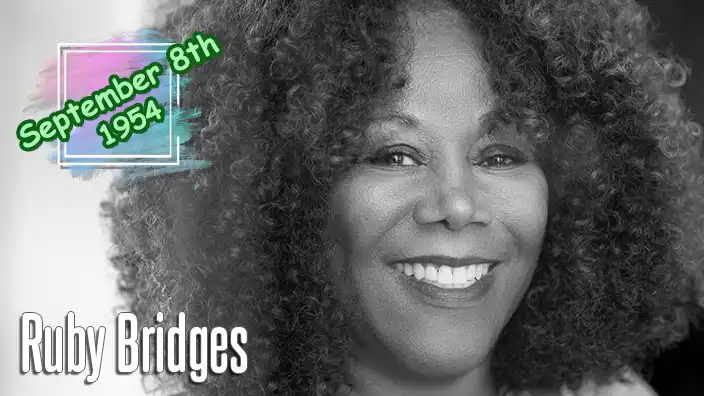
Ruby Nell Bridges was born on September 8, 1954, in Tylertown, Mississippi, to Abon and Lucille Bridges. She was the eldest of five children in a family that worked hard to build a better future. Her birth came in the same year that the United States Supreme Court delivered its landmark decision in Brown v. Board of Education, declaring racial segregation in public schools unconstitutional. Neither Ruby nor her parents could have known that, only six years later, she would become one of the children whose courage helped turn that ruling into reality.
The Bridges family moved from Mississippi to New Orleans, Louisiana, while Ruby was still young. Her father found work as a gas station attendant, while her mother took jobs to help support the household. Like many African American families in the South, they faced the restrictions of segregation in schools and other public facilities. Ruby attended a segregated kindergarten, even though a school reserved for white children was much closer to her home. The Supreme Court had ruled against school segregation in 1954, but many Southern communities continued resisting the decision, and progress was painfully slow.
In 1960, federal courts ordered New Orleans to begin desegregating its public schools. The school district required Black children seeking admission to formerly white schools to take entrance examinations, which were designed to make integration difficult. Ruby was among the small number of children who passed. Her parents then faced a difficult decision. Abon worried about the hostility and danger his daughter might encounter, while Lucille believed that attending the school would give Ruby better educational opportunities and help open doors for other children. With encouragement from the NAACP, the family agreed that Ruby would attend William Frantz Elementary School.
On November 14, 1960, six-year-old Ruby arrived at William Frantz Elementary accompanied by her mother and four federal marshals. Outside the school, an angry crowd of segregationist protesters shouted insults and threats. Some white parents withdrew their children rather than allow them to attend school with a Black child. Ruby, dressed for her first day of first grade, walked through the hostility without fully understanding why so many adults were angry. She later recalled that she initially thought the crowd might be connected to Mardi Gras. It was a child's innocent interpretation of a scene that exposed the cruelty of the adults surrounding her.
Ruby was not the only Black child integrating New Orleans schools that day. Three other girls—Leona Tate, Gail Etienne, and Tessie Prevost—entered McDonogh No. 19 Elementary School. Ruby, however, was the only Black student assigned to William Frantz, and she became the first African American child to integrate that school. Her experience became one of the most recognizable moments of the civil rights movement, but it was part of a wider struggle involving families, lawyers, teachers, and community members who worked to end legally enforced segregation.
The first day at William Frantz was largely spent in the principal's office because of the protests and the withdrawal of students. When Ruby began attending classes, she found herself alone with her teacher, Barbara Henry, a white educator from Boston who had agreed to teach her. Other teachers had refused to accept a Black student, but Henry welcomed Ruby and treated her as a child who deserved an education. For much of that first school year, the classroom contained only the two of them. It was an extraordinary arrangement for a first grader, although Ruby still had lessons, assignments, and the ordinary business of learning to read and write.
Henry became an important source of stability during a frightening period. She taught Ruby the same curriculum she would have taught a full class and worked to make the classroom feel welcoming. Ruby later spoke warmly of her teacher, remembering that Henry's kindness helped her understand that people should not be judged simply by their appearance. Their relationship became an enduring example of the difference one teacher can make in a child's life, particularly when the surrounding community is failing to provide the support that child deserves.
The hostility outside the school continued for months. Federal marshals escorted Ruby to and from the building, and protesters sometimes threatened her directly. One woman displayed a Black doll in a coffin, while others shouted abuse as Ruby passed. The threats were serious enough that Ruby was instructed not to eat food offered by strangers. Despite the intimidation, she continued attending school and did not miss a day during that first year. Her persistence was remarkable, especially considering that she was only six years old and had not chosen to become a public figure.
The consequences of integration extended beyond Ruby's school day. Her father lost his job, and some local businesses refused to serve her family. Her grandparents, who had worked as sharecroppers in Mississippi, were forced from the land they had farmed for many years. The family experienced financial and social pressure because of their decision to support Ruby's education. At the same time, other people offered assistance, including neighbors who helped with childcare, supporters who provided food or employment opportunities, and individuals from outside the South who sent money and encouragement.
One of the people deeply affected by Ruby's experience was child psychiatrist Robert Coles. After witnessing the events surrounding school integration, he began working with Ruby and her family, providing counseling and support. Coles was impressed by her resilience and by the role her family and faith played in helping her cope with the hostility. His work with Ruby would later contribute to his writing about children, social conflict, and moral courage. He remained connected to her story for many years and eventually helped bring it to a wider audience through a children's book.
Ruby's first-grade year was difficult, but conditions gradually changed. Some white families began sending their children back to William Frantz, and the school slowly became more integrated. Ruby continued her education and eventually graduated from a desegregated high school. Her childhood experience had made her a national symbol, but she also wanted the opportunity to live an ordinary life. After leaving school, she worked as a travel agent and spent many years outside the public spotlight.
In 1984, Ruby married Malcolm Hall, and the couple went on to have four sons. She devoted much of her time to raising her family while continuing her professional life. Her personal connection to William Frantz Elementary later became important again when members of her family attended the school. The institution that had once been the center of such hostility became a place where she could work to improve opportunities for another generation of children.
Ruby's story gained renewed national attention in the 1990s. In 1995, Robert Coles published The Story of Ruby Bridges, illustrated by George Ford. The book introduced her experience to young readers and helped teachers explain school desegregation through the perspective of a child. Its success encouraged Ruby to become more involved in public speaking and educational advocacy. She recognized that her experience could help children understand the history of civil rights and the importance of treating others with dignity.
In 1998, Disney released the television film Ruby Bridges, starring Chaz Monet as young Ruby and Lela Rochon as her mother, Lucille. The film dramatized the family's experiences during the desegregation of William Frantz Elementary and brought the story to a wider audience. Ruby served as a consultant, helping the filmmakers represent the events accurately. The production also introduced viewers to the courage of her parents, the support of Barbara Henry, and the wider community struggle that surrounded her first year of school.
Ruby established the Ruby Bridges Foundation in 1999 to promote tolerance, respect, and understanding through education. The organization has worked with schools, children, and community leaders to encourage dialogue across racial and cultural differences. Its programs emphasize the importance of young people recognizing their ability to make positive changes. Ruby's approach has consistently focused on education as a means of challenging prejudice, reflecting the central role that schooling played in her own life.
Her work as an author has continued alongside her advocacy. In 1999, she published Through My Eyes, an autobiographical account of her childhood experience that combined her memories with historical photographs and documents. The book received the Carter G. Woodson Book Award and the Jane Addams Children's Book Award. It gave readers an opportunity to understand the events of 1960 from Ruby's own perspective rather than solely through the accounts of adults who had witnessed them.
In 2020, Ruby published This Is Your Time, a book that connects her childhood experiences with the continuing importance of civic participation and equality. She followed it with I Am Ruby Bridges in 2022, a picture book written for younger children, and Dear Ruby, Hear Our Hearts in 2024, which responds to letters from children. Her 2025 book, Ruby Bridges: A Talk with My Teacher, reflects upon her relationship with Barbara Henry and the importance of educators who create welcoming classrooms. Through these publications, she has continued to make history accessible to children who may be encountering the subject for the first time.
Ruby has also worked to preserve the physical history of school desegregation. William Frantz Elementary was damaged during Hurricane Katrina in 2005, and its future became uncertain. Ruby supported efforts to preserve and restore the building, which had been added to the National Register of Historic Places that year. The school was eventually restored and reopened, allowing it to continue serving students while retaining its historical significance. A statue of Ruby in the school courtyard commemorates her role in its history.
One of the most famous artistic representations of Ruby's experience is Norman Rockwell's painting The Problem We All Live With. Published in Look magazine in January 1964, the painting depicts a young Black girl walking beside federal marshals, with racial slurs and evidence of hostility visible on the wall behind her. Rockwell chose to show the scene from the child's height, emphasizing the contrast between Ruby's small figure and the enormous social conflict surrounding her. The painting became one of the most powerful images associated with the civil rights movement and helped preserve the memory of her historic walk.
In 2011, Ruby visited the White House and met President Barack Obama, where the Rockwell painting was temporarily displayed. The meeting brought together the woman who had helped integrate a Southern elementary school and the first African American president of the United States. Their conversation highlighted the historical connection between the civil rights struggles of the 1960s and the changes that followed. Ruby's story had become part of the nation's shared history, but she continued to emphasize that progress required ongoing effort rather than simply celebrating past achievements.
Her contributions have been recognized through numerous honors. In 2000, she was made an honorary Deputy U.S. Marshal, acknowledging the federal officers who had protected her during her first year at William Frantz. In 2001, President Bill Clinton awarded her the Presidential Citizens Medal. She has also received the NAACP Martin Luther King Award and honorary degrees from several universities, including Connecticut College and Tulane University. In 2024, she was inducted into the National Women's Hall of Fame, recognizing her lifelong contribution to civil rights and education.
Ruby's influence has extended into schools across the United States through Ruby Bridges Walk to School Day, observed on November 14. The initiative began with students in California who were inspired by her story and wanted to encourage conversations about courage, inclusion, and the importance of education. Schools now organize walks and related activities to commemorate the anniversary of her first day at William Frantz. The event allows children to connect a historical moment with their own experiences of friendship, fairness, and standing up for others.
In August 2026, Ruby participated in the ninth Ruby Bridges Reading Festival at the National Civil Rights Museum in Memphis, Tennessee. The annual event celebrates literacy and encourages children and families to engage with books that promote empathy, understanding, and civic responsibility. Her continued involvement in educational programs demonstrates that her work has never been limited to recounting what happened in 1960; she remains actively engaged in helping young people understand how they can contribute to their communities.
Ruby has frequently emphasized that children are not born with prejudice and that adults have a responsibility to teach respect rather than hatred. Her message is rooted in her own experience of being targeted by people who had never met her and knew nothing about her beyond the color of her skin. She encourages young people to form friendships across differences and to recognize that courage can involve everyday choices, such as refusing to participate in bullying or speaking up when someone is treated unfairly.
The historical significance of Ruby Bridges lies not only in the fact that she entered a previously segregated school, but in what her experience revealed about the struggle to enforce constitutional rights. The Supreme Court's decision in Brown v. Board of Education had established that segregated public schools were unconstitutional, yet legal rulings alone did not immediately change local practices. Ruby's walk demonstrated the determination required to make those rights meaningful, as well as the sacrifices made by families who challenged entrenched discrimination.
Her story also reminds us that the civil rights movement was not carried forward solely by famous speeches or large demonstrations. It involved ordinary families making difficult decisions, teachers choosing to welcome students, lawyers pursuing legal challenges, and children attending school despite hostility. Ruby became an internationally recognized figure, but her courage was supported by many people whose names are less familiar. The collective effort behind her experience is an important part of understanding how social change occurs.
As Ruby Bridges celebrates her birthday on September 8, she remains an active author, speaker, and advocate for educational equality. Her childhood courage helped open doors that had been deliberately closed to generations of Black children, while her adult work has encouraged new generations to recognize the importance of fairness and mutual respect. The six-year-old who walked into William Frantz Elementary in 1960 could not have known how far her influence would reach. More than six decades later, her story continues to teach a simple but demanding lesson: progress depends on people who are willing to do what is right, even when doing so is difficult.