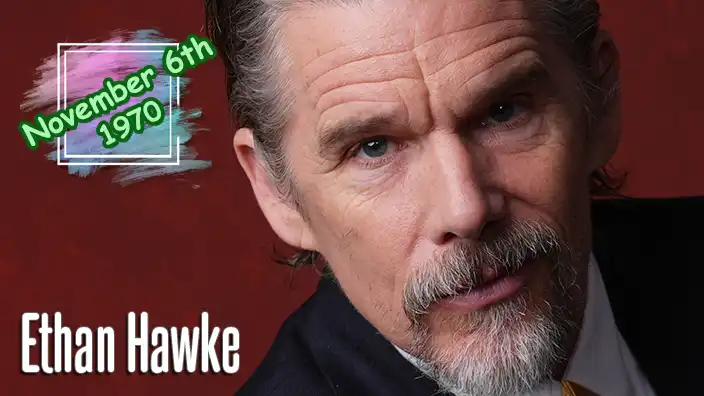
November 6, 1970, in Austin, Texas

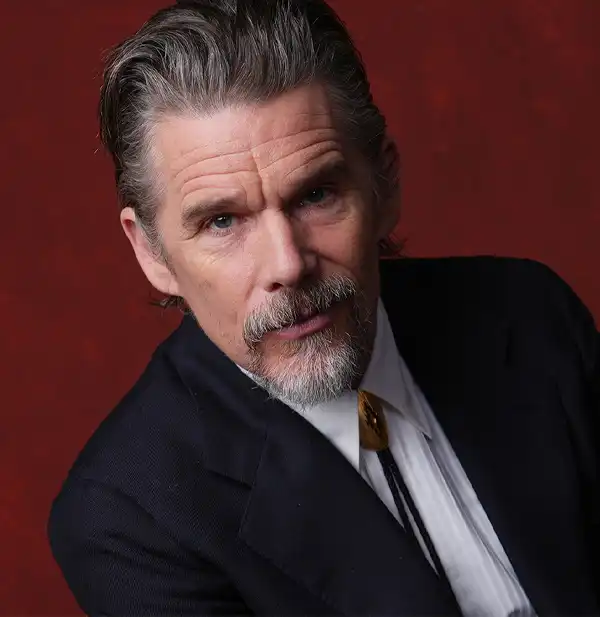
Ethan Green Hawke was born on November 6, 1970, in Austin, Texas, to James Steven Hawke and Leslie Carole Green. His parents were students at the University of Texas when he was born, and their marriage ended while Ethan was still very young. He subsequently grew up primarily with his mother, spending portions of his childhood in different locations before settling in New Jersey. His upbringing exposed him to literature, education, and the arts, interests that would eventually influence his career as an actor, novelist, screenwriter, and director. He attended the Hun School of Princeton, where he participated in theatrical productions and developed a growing enthusiasm for acting. Unlike many youngsters who dream of becoming movie stars because they enjoy the attention, Hawke appeared genuinely fascinated by storytelling and the complicated business of understanding human behavior. Of course, the prospect of occasionally being paid to pretend to be someone else probably didn't hurt.
Hawke's professional acting career began when he was cast in the 1985 science-fiction adventure Explorers, directed by Joe Dante. He starred alongside River Phoenix and Jason Presson as three boys who construct a homemade spacecraft and embark on an extraordinary adventure. Although the film was not a major commercial success during its original release, it subsequently developed a cult following, particularly among audiences who appreciated its imaginative premise and youthful enthusiasm. For Hawke, the experience provided an introduction to professional filmmaking and the realities of working on a movie set. Unfortunately, his first feature-film adventure involved traveling into space, which meant that almost every subsequent role would require considerably less impressive transportation.
His breakthrough arrived in 1989 with Peter Weir's acclaimed drama Dead Poets Society, starring Robin Williams as John Keating, an unconventional English teacher at a conservative boys' preparatory school. Hawke portrayed Todd Anderson, a shy and insecure student who gradually discovers his own voice through Keating's encouragement. The film explored individuality, friendship, conformity, and the importance of pursuing personal passions, with Williams delivering one of his most celebrated dramatic performances. Hawke's portrayal of Todd was particularly effective because he communicated much of the character's anxiety and emotional development through subtle expressions rather than lengthy speeches. The film became an international success and won the Academy Award for Best Original Screenplay, establishing Hawke as one of Hollywood's most promising young actors. It also ensured that generations of students would associate standing on classroom desks with literary inspiration rather than an immediate trip to the principal's office.
Following the success of Dead Poets Society, Hawke continued developing his career with a variety of film projects rather than relying exclusively on conventional teenage roles. He appeared in White Fang (1991), an adventure based on Jack London's novel, portraying a young man who forms a bond with a wolfdog in the Alaskan wilderness. He also starred in Mystery Date (1991) and Alive (1993), the latter dramatizing the extraordinary survival ordeal of passengers aboard a plane that crashed in the Andes Mountains in 1972. These productions demonstrated his willingness to explore different genres, from romantic comedy to historical survival drama. His performances often emphasized ordinary individuals confronting situations they were poorly prepared to handle, a recurring theme that would become familiar throughout his career. Hollywood apparently decided that Hawke looked particularly convincing when life had become considerably more complicated than anticipated.
In 1994, Hawke starred in Ben Stiller's directorial debut Reality Bites, alongside Winona Ryder, Janeane Garofalo, and Stiller himself. The romantic comedy-drama examined the frustrations, ambitions, and relationships of young adults attempting to establish themselves after college. Hawke portrayed Troy Dyer, an intelligent but directionless musician whose cynical attitude and complicated romantic feelings made him a recognizable figure of Generation X. Although the film received mixed reviews upon release, it subsequently became an influential cultural reference point for the decade, capturing the uncertainty experienced by young people entering adulthood during a period of changing social and economic expectations. Hawke's performance helped establish his reputation as an actor particularly comfortable portraying thoughtful, rebellious characters who possessed strong opinions about society but occasionally struggled to organize their own lives.
One of the most significant artistic partnerships of Hawke's career began with Richard Linklater's romantic drama Before Sunrise in 1995. Hawke played Jesse, an American traveler who meets Céline, a French student portrayed by Julie Delpy, aboard a train traveling through Europe. After an unexpected conversation, the two decide to spend an evening wandering through Vienna before Jesse must catch a flight home. Rather than relying on dramatic action or elaborate romantic misunderstandings, the film develops its story through conversations about love, relationships, philosophy, family, and personal identity. Hawke and Delpy created an unusually natural screen partnership, making their characters' developing connection feel spontaneous and believable. The film became a critical favorite and established a distinctive approach to romantic storytelling in which the greatest adventure was discovering whether two people could talk to each other for an entire night without running out of things to say.
Hawke's collaboration with Linklater and Delpy eventually developed into one of cinema's most admired romantic trilogies. Before Sunset (2004) reunited Jesse and Céline nine years after their original encounter, this time in Paris, where they reflected upon the lives they had built and the choices they had made. Hawke and Delpy shared screenplay credit with Linklater, and the film earned an Academy Award nomination for Best Adapted Screenplay. The trilogy concluded with Before Midnight (2013), which examined the complexities of a long-term relationship as Jesse and Céline navigated parenthood, personal disappointments, and conflicting expectations. Once again, the three collaborators received an Oscar nomination for their screenplay. Together, the films offered an unusually honest portrayal of romance evolving across decades, demonstrating that falling in love is relatively straightforward compared with maintaining a relationship while discussing household responsibilities, career frustrations, and whose turn it is to apologize.
During the late 1990s, Hawke continued balancing independent cinema with major studio productions. He appeared in the science-fiction thriller Gattaca (1997), directed by Andrew Niccol, portraying Vincent Freeman, a man attempting to overcome genetic discrimination in a society where biological characteristics determine professional opportunities. The film also starred Uma Thurman and Jude Law and explored questions about identity, ambition, and the ethical consequences of genetic engineering. Although Gattaca was not a major box-office success, it later developed a substantial following and became widely discussed for its thoughtful treatment of scientific and social issues. Hawke's restrained performance helped make Vincent's determination convincing, presenting a protagonist whose greatest strength was not extraordinary physical ability but an unwillingness to accept limitations imposed by others.
Hawke also appeared in Great Expectations (1998), a modern adaptation of Charles Dickens's classic novel, and Snow Falling on Cedars (1999), a drama examining prejudice and personal relationships in a Pacific Northwest community following World War II. These films reinforced his interest in literary adaptations and emotionally complex stories, reflecting an artistic curiosity that extended beyond conventional Hollywood entertainment. His performances frequently explored characters struggling with guilt, ambition, social expectations, or unresolved romantic attachments. While some leading men built careers around explosions and spectacular car chases, Hawke seemed perfectly content to spend an entire film examining why someone had made a regrettable decision fifteen years earlier.
A major turning point arrived with Antoine Fuqua's crime thriller Training Day in 2001. Hawke portrayed Jake Hoyt, an idealistic Los Angeles police officer assigned to spend a day with veteran narcotics detective Alonzo Harris, played by Denzel Washington. What initially appears to be a routine evaluation becomes an increasingly dangerous examination of corruption, intimidation, and moral compromise. Washington's commanding performance dominated much of the film, but Hawke provided an essential counterbalance through his portrayal of Jake's growing fear, confusion, and determination to maintain his integrity. The relationship between the two characters created the film's central tension, with Jake gradually realizing that his supposed mentor was considerably more dangerous than the criminals he was expected to investigate.
Training Day became a critical and commercial success, earning Washington the Academy Award for Best Actor and Hawke his first Oscar nomination, for Best Supporting Actor. The recognition demonstrated Hawke's ability to deliver a compelling performance opposite one of Hollywood's most formidable leading men. His portrayal of Jake Hoyt combined vulnerability with determination, allowing audiences to experience the character's increasingly desperate situation without reducing him to a helpless victim. The film remains one of Hawke's most recognizable mainstream successes, although it probably did little to encourage prospective police recruits who were already nervous about their first day on the job. Some workplace orientations involve filling out paperwork and meeting colleagues; Jake Hoyt's involved discovering that the employee handbook had apparently been written by a criminal mastermind.
Beyond acting, Hawke developed a parallel career as a novelist. His first book, The Hottest State, was published in 1996 and explored the emotional difficulties of a young actor navigating love and personal uncertainty. He followed it with Ash Wednesday in 2002, a novel examining relationships, commitment, and the challenges of adulthood. His writing reflected many of the themes present in his films, particularly the difficulties people encounter when attempting to reconcile romantic ideals with practical realities. Rather than treating literature as a temporary celebrity diversion, Hawke pursued writing as a serious creative discipline. His literary interests would later expand into graphic novels and nonfiction, demonstrating a commitment to storytelling that was not restricted to standing in front of a camera.
Hawke made his feature-film directing debut with Chelsea Walls in 2001, an independent drama examining the interconnected lives of artists living in New York City's Chelsea Hotel. The film featured an ensemble cast and reflected his fascination with creative communities, personal relationships, and the uncertain circumstances that often accompany artistic ambition. He subsequently directed The Hottest State (2006), adapting his own novel into a romantic drama starring Mark Webber and Catalina Sandino Moreno. These projects allowed Hawke to explore filmmaking from a different perspective, assuming responsibility for the overall interpretation of a story rather than concentrating exclusively on one character. Directing also required him to manage actors, production schedules, and creative disagreements, proving that the person behind the camera occasionally has considerably more headaches than the person standing in front of it.
His film career continued with a diverse collection of productions, including Before the Devil Knows You're Dead (2007), directed by Sidney Lumet, and the science-fiction action film Daybreakers (2009). In Lumet's crime drama, Hawke portrayed Hank Hanson, a financially troubled man who becomes involved in a disastrous robbery planned by his brother, played by Philip Seymour Hoffman. The film examined greed, desperation, and the destructive consequences of poor decisions, allowing Hawke to portray a deeply flawed character whose attempts to escape financial difficulties only created greater problems. Daybreakers, meanwhile, placed him in a futuristic world dominated by vampires, demonstrating that his willingness to explore philosophical questions did not prevent him from occasionally participating in a film where the principal occupational hazard involved being bitten.
In 2012, Hawke starred in Scott Derrickson's supernatural horror film Sinister, portraying Ellison Oswalt, a true-crime writer who discovers disturbing home movies while investigating an unsolved murder. The film became a commercial success and introduced Hawke to horror audiences, showcasing his ability to communicate mounting psychological terror. Unlike action heroes who respond to frightening circumstances by reaching for increasingly powerful weapons, Hawke's character spends much of the film attempting to understand what is happening while making a series of decisions that audiences might reasonably question. The performance demonstrated that his talent for portraying anxious, intellectually curious characters translated remarkably well into horror, particularly when the character's curiosity should probably have been replaced by an immediate decision to move house.
Hawke reunited with Richard Linklater for Boyhood (2014), an ambitious coming-of-age drama filmed intermittently over twelve years. The production followed the childhood and adolescence of Mason Evans Jr., played by Ellar Coltrane, while Hawke portrayed his father, Mason Evans Sr. By using the same actors throughout the extended production period, Linklater created an unusually authentic depiction of growing older, changing relationships, and the passage of time. Hawke's character begins as an inconsistent and somewhat immature parent but gradually develops greater responsibility and emotional awareness. The film received widespread critical acclaim and earned Hawke another Academy Award nomination for Best Supporting Actor, along with nominations for several other major awards.
The unusual production of Boyhood represented a significant achievement in independent filmmaking because it required long-term commitment from everyone involved. Rather than relying on makeup or different performers to portray the passage of time, the filmmakers allowed their actors to change naturally across the years. Hawke's performance became an essential part of the film's emotional development, illustrating how parenthood can transform a person's priorities and understanding of responsibility. The project also reinforced his longstanding creative relationship with Linklater, whose filmmaking approach encouraged natural dialogue, collaborative storytelling, and close observation of everyday life. It was an extraordinary commitment to a film production, particularly considering that most actors become impatient when a director asks for one additional take.
Hawke delivered another highly acclaimed performance in First Reformed (2017), written and directed by Paul Schrader. He portrayed Reverend Ernst Toller, a Protestant minister struggling with grief, spiritual uncertainty, and growing concern about environmental destruction. The film explored complicated questions about faith, personal responsibility, and despair, requiring Hawke to communicate much of his character's emotional conflict through restrained expressions and internal reflection. His performance received widespread critical praise and earned him numerous awards from film critics' organizations, including recognition from the New York Film Critics Circle. Although he did not receive an Academy Award nomination for the role, many critics considered it among the finest performances of his career. The film demonstrated his willingness to explore challenging subjects without providing audiences with simple answers or reassuring conclusions.
His work as a director also continued to develop. In 2014, he directed the documentary Seymour: An Introduction, a portrait of pianist and teacher Seymour Bernstein that explored the relationship between artistic achievement, personal fulfillment, and the pressures of professional success. Hawke subsequently directed Blaze (2018), a biographical drama about Texas singer-songwriter Blaze Foley, examining the musician's troubled life and enduring influence. Both productions reflected Hawke's interest in creative individuals whose achievements were not always measured by commercial success. Rather than concentrating exclusively on celebrated figures, he demonstrated a fascination with artists who pursued their work because they believed in its importance, even when the financial rewards were uncertain or practically nonexistent.
In 2020, Hawke starred in the historical television miniseries The Good Lord Bird, based on James McBride's novel. He portrayed abolitionist John Brown, whose militant opposition to slavery contributed to the growing tensions preceding the American Civil War. Hawke also served as a co-creator and executive producer of the series, demonstrating his increasing involvement in developing projects from their earliest stages. His portrayal of Brown combined religious conviction, eccentricity, intensity, and moral complexity, creating a character who was simultaneously charismatic and deeply unsettling. The performance earned critical acclaim and a Golden Globe nomination, further demonstrating Hawke's ability to portray controversial historical figures without reducing them to simplistic heroes or villains.
Hawke reached another generation of audiences through his portrayal of Arthur Harrow in Marvel Studios' television series Moon Knight (2022), starring Oscar Isaac. As the mysterious leader of a religious cult devoted to the Egyptian goddess Ammit, Hawke created an antagonist whose calm manner concealed dangerous convictions. The role introduced him to the Marvel Cinematic Universe and allowed him to explore a different kind of villain, one who preferred philosophical arguments and psychological manipulation to conventional displays of physical aggression. His performance demonstrated that a convincing antagonist does not necessarily need to shout or threaten people constantly. Sometimes, a quiet voice and an unsettling sense of certainty can be considerably more disturbing.
That same year, Hawke appeared in Scott Derrickson's horror thriller The Black Phone, portraying a terrifying child abductor known as the Grabber. The film, based on a short story by Joe Hill, became a major commercial success and earned praise for Hawke's disturbing performance. Frequently appearing behind an elaborate mask, he relied heavily on his voice, movements, and unpredictable behavior to establish the character's menace. The role represented a striking departure from the sensitive romantic leads and introspective protagonists associated with much of his earlier career. Audiences who remembered Jesse wandering through Vienna discussing philosophy with Céline might have found the transformation particularly alarming. Evidently, several decades of thoughtful conversation had not prevented Hawke from developing an exceptionally convincing sinister laugh.
In 2023, Hawke appeared in Pedro Almodóvar's short Western film Strange Way of Life, opposite Pedro Pascal, portraying a sheriff confronted by an unexpected reunion with a former lover. The production explored themes of love, regret, and personal responsibility within the familiar setting of the American West. Hawke also continued his directorial work with Wildcat (2023), a biographical drama about American writer Flannery O'Connor, starring his daughter Maya Hawke. The film examined O'Connor's creative imagination, religious beliefs, and struggles with illness, blending biographical material with dramatizations of her literary work. Directing his daughter offered Hawke an opportunity to combine professional collaboration with family relationships, although one imagines that discussions about artistic interpretation occasionally continued beyond the usual working day.
His literary and creative pursuits have remained an important part of his professional identity. In addition to his novels, Hawke published Rules for a Knight in 2015, a reflective work presenting lessons about character, courage, and personal responsibility through a fictional medieval framework. He also collaborated with illustrator Greg Ruth on the graphic novels Indeh: A Story of the Apache Wars (2016) and Meadowlark: A Coming-of-Age Crime Story (2021). These projects demonstrated his interest in exploring history, morality, and human relationships through different storytelling formats. Hawke has frequently spoken about the importance of artistic expression and the value of creative work, emphasizing that success should not be measured exclusively through box-office receipts, awards, or public recognition.
In his personal life, Hawke married actress Uma Thurman in 1998, and they had two children, Maya and Levon, before their divorce was finalized in 2005. Maya Hawke subsequently established her own acting and musical career, becoming widely recognized for her role in the Netflix series Stranger Things. Hawke married Ryan Shawhughes in 2008, and they have two daughters together. Although his relationships have attracted public attention, Hawke has generally maintained a distinction between his family life and his professional work. His experiences as a parent have also informed his creative interests, particularly in films exploring the complicated relationships between fathers and children. Boyhood offered one particularly memorable example of those themes, although thankfully most family relationships do not require a twelve-year filming schedule to understand.
Hawke's later screen work has included the science-fiction thriller Leave the World Behind (2023), in which he appeared alongside Julia Roberts, Mahershala Ali, and Myha'la. The film explored social anxiety, technological dependence, and the breakdown of ordinary life during a mysterious national emergency. In 2025, he starred in Richard Linklater's Blue Moon, portraying celebrated American lyricist Lorenz Hart during a pivotal evening in his professional and personal life. The production reunited Hawke with one of his most important creative collaborators and allowed him to explore another emotionally complicated artist. His portrayal of Hart earned significant critical recognition, including the Silver Bear for Best Leading Performance at the Berlin International Film Festival, further reinforcing his reputation for bringing unusual depth to challenging characters.
Across his career, Hawke has received five Academy Award nominations: two for acting in Training Day and Boyhood, two for screenwriting in Before Sunset and Before Midnight, and another for his leading performance in Blue Moon. His achievements are particularly notable because they span multiple creative disciplines, reflecting a career built around artistic exploration rather than a single successful formula. He has worked in mainstream blockbusters, independent dramas, romantic films, horror productions, historical television, theater, literature, and directing. Few performers move so comfortably between genres while maintaining such a recognizable commitment to thoughtful storytelling.
Ethan Hawke's enduring appeal comes from his willingness to portray characters who are imperfect, uncertain, and deeply human. Whether playing a shy student in Dead Poets Society, a romantic traveler in Before Sunrise, an inexperienced police officer in Training Day, or a troubled minister in First Reformed, he consistently explores the emotional contradictions that make people interesting. His collaborations with Richard Linklater have produced some of contemporary cinema's most distinctive films, while his work as a writer and director demonstrates an artistic curiosity that continues to evolve. Hawke has never seemed particularly interested in becoming Hollywood's most conventional leading man, preferring instead to pursue stories that challenge him and his audiences. And considering the number of complicated characters he has portrayed, one suspects that a straightforward role involving a perfectly happy man with absolutely no personal problems might leave him wondering where the rest of the script had gone.
IMDb – Ethan Hawke Biography and Filmography: Personal information, acting credits, directing work, awards, and professional achievements. Ethan Hawke on IMDb. Academy of Motion Picture Arts and Sciences – 2002 Academy Awards: Official record of Hawke's Best Supporting Actor nomination for Training Day. 2002 Academy Awards. Academy of Motion Picture Arts and Sciences – 2015 Academy Awards: Official record of his Best Supporting Actor nomination for Boyhood. 2015 Academy Awards. Academy of Motion Picture Arts and Sciences – 2005 Academy Awards: Official record of the Best Adapted Screenplay nomination for Before Sunset. 2005 Academy Awards. Academy of Motion Picture Arts and Sciences – 2014 Academy Awards: Official record of the Best Adapted Screenplay nomination for Before Midnight. 2014 Academy Awards. Encyclopaedia Britannica – Ethan Hawke: Biographical background, major film roles, writing, directing, and career achievements. Ethan Hawke Biography. Internet Broadway Database – Ethan Hawke: Broadway production history and theatrical credits. Ethan Hawke on IBDB. Berlin International Film Festival – Blue Moon: Festival information and recognition for Hawke's performance as Lorenz Hart. Berlinale Official Website.References & Sources