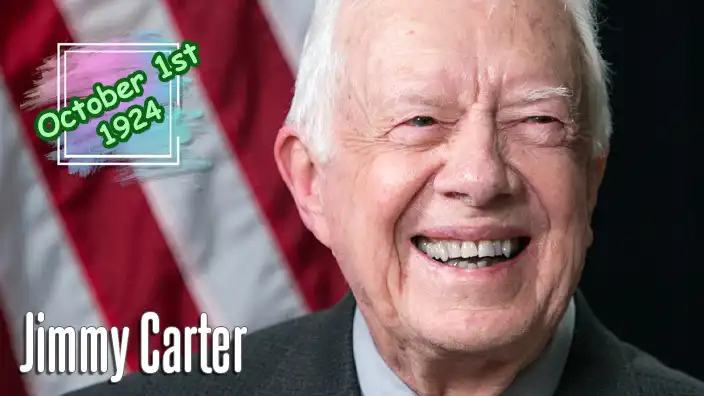
October 1, 1924, in Plains, Georgia
 December 29, 2024, in Plains, Georgia,
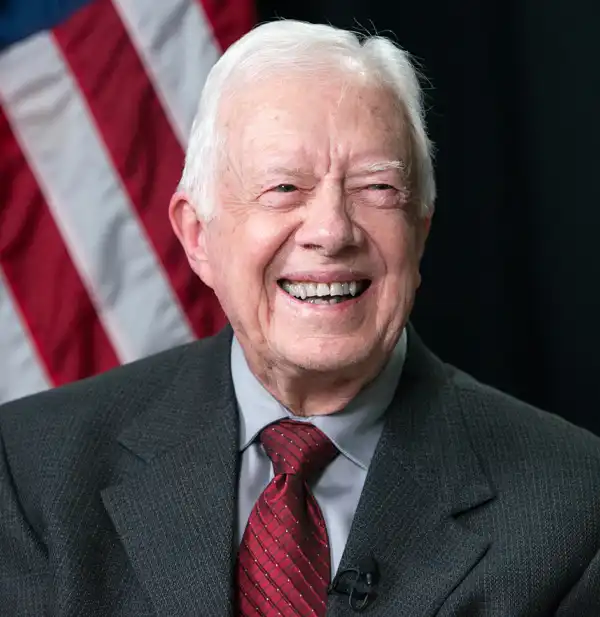
James Earl Carter Jr., better known simply as Jimmy Carter, was born on October 1, 1924, in Plains, Georgia, a small farming community that remained closely connected to him throughout his life. His father, James Earl Carter Sr., was a farmer and businessman, while his mother, Lillian Gordy Carter, was a registered nurse. Carter grew up in nearby Archery amid the agriculture, racial divisions, religious traditions and hard work of the rural South. Peanuts would later become permanently associated with his public image, although the Carter family farms also produced crops including corn, cotton and sugarcane. Long before presidential motorcades arrived in Plains, Carter learned about farming, business and community life in a place small enough that becoming president of the United States must have seemed a particularly ambitious career plan.
Carter did not initially set out to become a politician. He attended Georgia Southwestern College and the Georgia Institute of Technology before entering the United States Naval Academy. He graduated from Annapolis in 1946 and married Rosalynn Smith that same year, beginning a partnership that would accompany virtually every important chapter of his public life. Carter entered the submarine service after an initial period aboard surface ships and eventually served as an engineering officer, electronics officer and executive officer. His technical abilities brought him to the attention of Captain Hyman G. Rickover, the demanding driving force behind the development of the Navy's nuclear-powered submarine program. Carter was selected for that program and studied reactor technology and nuclear physics while preparing for duty associated with USS Seawolf, one of America's earliest nuclear submarines.
One remarkable episode from Carter's naval career occurred in 1952 after an accident at Canada's Chalk River nuclear facility. Carter was among the U.S. Navy personnel involved in work connected with dismantling the damaged reactor. The assignment required careful preparation because workers could spend only limited periods in areas of significant radiation. His nuclear training might have led to a long naval career, but the death of his father in 1953 changed Carter's direction. He resigned from active naval service, returned to Georgia and took responsibility for the family business. The future commander in chief had therefore already been a submariner, engineer and nuclear-power specialist before politics seriously entered the picture. The U.S. Navy later honored that history by naming the Seawolf-class submarine USS Jimmy Carter (SSN-23) for him.
Returning to Plains was not immediately easy. Carter had left a promising naval career, and the family agricultural business required considerable attention. He and Rosalynn worked together to develop the farm and warehouse operation, and Carter gradually became involved in local civic affairs. He served on county boards before winning election to the Georgia State Senate in 1962. After an unsuccessful attempt to win the governorship in 1966, he tried again four years later and succeeded. As governor, Carter became known nationally as one of a generation of Southern politicians confronting the region's changing political and racial landscape. In his 1971 inaugural address, he declared that the era of racial discrimination was over and called for equal access to education, employment and justice.
Carter's emergence as a presidential candidate was initially something of a puzzle to much of the country. When he began seeking the Democratic presidential nomination for the 1976 election, he was a former governor from Georgia without the national profile enjoyed by many established Washington politicians. That outsider status, however, became part of his appeal in the aftermath of the Watergate scandal and President Richard Nixon's resignation. Carter presented himself as an honest, religiously devout Southerner who was not deeply embedded in Washington politics. He secured the Democratic nomination, chose Minnesota Senator Walter Mondale as his running mate and defeated incumbent President Gerald Ford in the general election. On January 20, 1977, Jimmy Carter became the 39th president of the United States.
The Carter presidency unfolded during an exceptionally difficult period. The United States faced inflation, unemployment concerns, energy shortages and rising oil prices, while international affairs brought challenges ranging from relations with the Soviet Union to upheaval in Iran. Carter emphasized energy conservation and sought to reduce American dependence on foreign oil, famously addressing the country about the need for changes in energy consumption. His administration also made human rights a prominent element of American foreign policy. Carter's years in office remain the subject of extensive historical debate, with assessments weighing significant diplomatic and policy achievements against economic problems, political difficulties and international crises that damaged public confidence in his administration.
Among Carter's most consequential achievements in foreign affairs was the 1978 Camp David summit involving Egyptian President Anwar Sadat and Israeli Prime Minister Menachem Begin. Carter brought the two leaders to the presidential retreat in Maryland and personally participated in difficult negotiations lasting nearly two weeks. The resulting Camp David Accords established frameworks that led to the 1979 Egypt-Israel peace treaty. The Norwegian Nobel Committee later specifically cited Carter's mediation at Camp David when discussing his contributions to peace. The agreement fundamentally altered relations between Egypt and Israel and became one of the defining accomplishments of Carter's presidency.
Other events proved far less cooperative. In November 1979, Iranian militants seized the United States Embassy in Tehran and took American diplomats and citizens hostage. The Iran hostage crisis continued through the remainder of Carter's presidency, and an attempted military rescue in April 1980 ended disastrously in the Iranian desert. Meanwhile, the Soviet Union's invasion of Afghanistan in December 1979 further intensified Cold War tensions. Carter responded with measures including economic sanctions and the American boycott of the 1980 Summer Olympics in Moscow. Domestically, persistent inflation and economic dissatisfaction added to his political difficulties. Carter was defeated by Republican Ronald Reagan in the 1980 presidential election, and the American hostages in Iran were released on January 20, 1981, the day Carter left office.
For many presidents, leaving the White House begins a quieter chapter involving a library, memoirs, speeches and considerably fewer people asking where the nuclear codes are. Carter chose a different route. In 1982, Jimmy and Rosalynn Carter founded The Carter Center in partnership with Emory University. The organization became involved in conflict resolution, election observation, human rights, public health and efforts against diseases affecting some of the world's poorest communities. Carter traveled extensively, met political leaders, participated in diplomatic efforts and observed elections in numerous countries. His willingness to remain directly involved in international affairs made his post-presidential career unusually active.
The Carter Center also became a major force in global health. One of its best-known campaigns targeted Guinea worm disease, a debilitating parasitic infection once affecting millions of people across Africa and Asia. Through partnerships involving governments, health organizations and local communities, the campaign helped drive the disease toward eradication. The work illustrated Carter's approach after the presidency: identify a problem that could realistically be attacked, assemble people capable of attacking it, and then remain involved for years rather than simply lending his name to the letterhead. The Center's activities expanded into numerous health and humanitarian programs while continuing its work in democracy, human rights and conflict mediation.
Carter also became closely associated with Habitat for Humanity, though he did not found the organization. Beginning in the 1980s, Jimmy and Rosalynn Carter became highly visible volunteers and advocates, participating personally in home-building projects through what became known as the Jimmy & Rosalynn Carter Work Project. Photographs of a former president carrying lumber or wielding construction tools became familiar images. It was an unusual second act for a former commander in chief and one that reinforced Carter's preference for practical service. The presidential résumé had acquired another occupation: construction volunteer.
In 2002, Carter received the Nobel Peace Prize. The Norwegian Nobel Committee honored him for decades of work seeking peaceful solutions to international conflicts, advancing democracy and human rights, and encouraging economic and social development. The committee specifically recognized both his presidential diplomacy and the extensive work he undertook afterward through The Carter Center. The award arrived more than two decades after he left the White House, demonstrating just how substantial his post-presidential career had become. In his Nobel lecture, Carter spoke about human rights, inequality, conflict and the responsibility of people and nations to choose cooperation over violence.
Carter was also a remarkably prolific author. He wrote books about politics, faith, diplomacy, the Middle East, aging, family life and his experiences growing up in rural Georgia, as well as poetry and personal reflections. He taught Sunday school for decades at Maranatha Baptist Church in Plains, where visitors sometimes traveled considerable distances simply to hear a former president discuss scripture in a small-town church. His deep Christian faith was a constant feature of his public and private life, although his interpretations and political positions sometimes placed him at odds with other prominent American religious figures.
Popular culture also preserved Carter in ways that extended beyond politics. He appeared as himself in numerous documentaries, television programs and historical productions, resulting in an extensive IMDb listing that might look surprisingly respectable for a nuclear engineer and peanut farmer who never actually set out to become an actor. Documentary appearances explored his presidency, humanitarian activities, religious faith and later life, while archival footage made him a familiar presence in productions examining American politics and twentieth-century history. IMDb consequently lists Carter with screen credits alongside the considerably more conventional entry of "39th President of the United States."
Music was another important part of Carter's cultural identity. He developed friendships with performers including Willie Nelson and members of the Allman Brothers Band, and musicians played an important role in fundraising during his rise in national politics. His enthusiasm for blues, jazz, gospel, country and rock music became the subject of the documentary Jimmy Carter: Rock & Roll President. It was an improbable combination on paper: a deeply religious Southern politician, nuclear-trained submariner and peanut farmer befriending some of the era's biggest rock musicians. Somehow, with Jimmy Carter, improbable combinations became fairly routine.
Rosalynn Carter remained central to his life throughout these decades. Their marriage began in 1946 and continued until her death in November 2023. Together they raised four children—Jack, Chip, Jeff and Amy—and worked alongside one another in business, politics, humanitarian projects and The Carter Center. Jimmy Carter died peacefully at his home in Plains, Georgia, on December 29, 2024. His funeral observances took him from Georgia to Washington and eventually back to the small community where his life had begun.
Jimmy Carter's public life encompassed careers that would individually have been enough to fill several biographies: naval officer, nuclear-submarine specialist, farmer, businessman, state senator, governor, president, diplomat, humanitarian, author, teacher and volunteer builder. His presidency included achievements as well as serious difficulties, and historians continue to examine both. His decades after the White House added an extraordinary second chapter centered on diplomacy, democracy, disease prevention and humanitarian work. The boy from Plains eventually returned to Plains, but between those two points he traveled an awfully long way—and managed to leave a few houses, peace agreements and considerably fewer Guinea worms behind him.