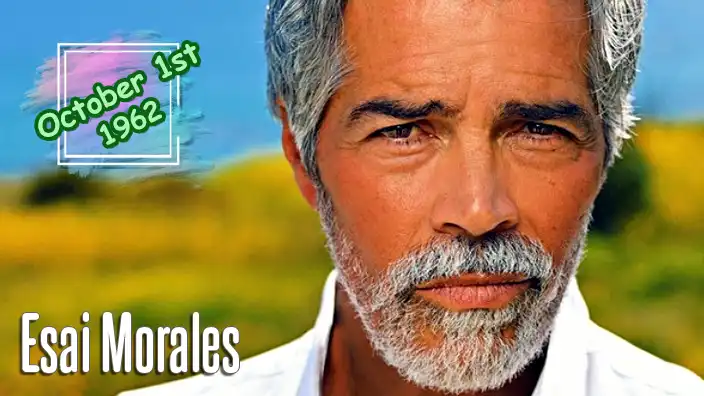
October 1, 1962, in Brooklyn, New York

Esai Manuel Morales was born on October 1, 1962, in Brooklyn, New York, to parents of Puerto Rican heritage. Raised in New York City, Morales developed an interest in acting while still young and attended Manhattan's High School for the Performing Arts, the celebrated school that helped train generations of actors, dancers and musicians. His education gave him a serious theatrical foundation, and rather than beginning his career with television commercials or minor Hollywood appearances, Morales first worked on the New York stage. His early performances included El Hermano at the Ensemble Theatre Studio and Shakespeare's The Tempest as part of New York's Shakespeare in the Park.
Morales made his feature-film debut in Bad Boys in 1983, playing Paco Moreno opposite Sean Penn. This was not the later Will Smith and Martin Lawrence comedy franchise but a grim juvenile-crime drama about young men caught in cycles of violence. Morales immediately demonstrated the intensity that would become one of his trademarks. He could project anger without turning a character into a caricature and vulnerability without making him seem weak, qualities that would prove particularly valuable when Hollywood began handing him increasingly complicated men to portray.
His career changed dramatically with the 1987 biographical film La Bamba, the story of pioneering rock-and-roll singer Ritchie Valens. Lou Diamond Phillips played Valens, while Morales portrayed his troubled older half-brother, Roberto "Bob" Morales. Bob could have been merely the angry brother lurking around the edges of the story, but Morales turned him into one of the movie's most memorable characters. His performance combined resentment, affection, jealousy, insecurity and grief, giving audiences a deeply flawed man who nevertheless loved his younger brother. The film became a major success and established Morales as a recognizable screen actor.
There was an interesting bit of casting history behind La Bamba. Morales originally auditioned to play Ritchie Valens, while Lou Diamond Phillips initially auditioned for Bob. The eventual decision to reverse that arrangement worked rather well for everyone concerned. Phillips became closely identified with Valens, while Morales received the kind of emotionally explosive supporting role that allowed him to make an enormous impression. It is one of those Hollywood casting decisions that seems obvious only after somebody has made it.
Morales continued working steadily through the late 1980s and 1990s, appearing in films including Bloodhounds of Broadway, Freejack, Rapa Nui, My Family, The Disappearance of Garcia Lorca and The Wonderful Ice Cream Suit. His work ranged across drama, science fiction, historical stories and independent productions, while television provided an equally varied collection of roles. He appeared in such programs as Miami Vice, Fame, The Outer Limits and Tales from the Crypt, steadily building one of those careers in which audiences might not always remember where they first encountered the actor, but they certainly recognized him when he appeared again.
Morales received another major opportunity when he joined NYPD Blue as Lieutenant Tony Rodriguez. Appearing extensively between 2001 and 2004, Rodriguez became a significant character during the later years of the long-running police drama. The role allowed Morales to work within an established ensemble while portraying an authority figure very different from some of the volatile young men of his earlier career. IMDb credits him with 66 episodes of the series, making NYPD Blue one of his most substantial television commitments.
Television continued to provide Morales with an impressive variety of characters. He appeared in Resurrection Blvd., American Family, Vanished, Burn Notice, Jericho, Law & Order: Special Victims Unit, Fairly Legal, Criminal Minds and Major Crimes. In the science-fiction series Caprica, a prequel to Battlestar Galactica, he played Joseph Adama, a civil-liberties lawyer and the father of William Adama. Morales brought considerable emotional weight to a character dealing with family, cultural identity, organized crime and personal loss, once again demonstrating his particular ability to play men whose respectable exterior is sitting on top of considerably more complicated machinery.
He even reached the White House—fictionally, which requires considerably less campaigning—when he played President Julian Navarro in HBO's political comedy The Brink. Morales has frequently been cast as men with authority, whether police officers, lawyers, military figures or political leaders. His screen presence lends itself naturally to characters who appear to know something everyone else in the room doesn't, although whether that information is reassuring depends very much on the production.
Another memorable television role arrived with the DC Comics series Titans. Morales played Slade Wilson, better known as Deathstroke, during the show's second season in 2019. The character is one of DC's best-known mercenaries and assassins, and Morales brought an appropriately controlled menace to the role. Rather than playing Deathstroke as someone constantly announcing how dangerous he was, Morales generally allowed the character's stillness and confidence to do the work. IMDb credits him with appearances in ten episodes of the series.
Morales also appeared in NCIS: Los Angeles as NCIS Deputy Director Louis Ochoa and took on a recurring role in the Netflix crime drama Ozark. In Ozark, he portrayed Camino Del Rio, commonly known as Del, a representative of the Navarro drug cartel whose arrival helped establish exactly how dangerous Marty Byrde's new circumstances had become. Del was polished, intelligent and frighteningly calm, which placed the role firmly in Morales territory. A character does not necessarily need to shout when everyone else in the room already understands that irritating him would be a remarkably poor life choice.
Then came Gabriel.
Morales joined one of cinema's biggest action franchises as the principal human antagonist in Mission: Impossible – Dead Reckoning Part One, released in 2023. Gabriel is an enigmatic figure from Ethan Hunt's past who serves the interests of the Entity, an extraordinarily powerful artificial intelligence capable of manipulating digital information. Opposite Tom Cruise's famously physical performance as Hunt, Morales made Gabriel deliberately controlled and unnervingly composed. While Ethan runs, jumps, crashes motorcycles and occasionally throws himself from things sensible people would prefer to remain standing upon, Gabriel often seems content simply to wait for the chaos to arrive. IMDb identifies the role among Morales' best-known screen performances.
Gabriel returned in 2025's Mission: Impossible – The Final Reckoning, extending Morales' involvement across the concluding chapters of the Entity storyline. The role introduced him to an enormous international audience decades after La Bamba had first made him widely recognizable. It was an impressive late-career surge for an actor who had already accumulated a substantial body of film and television work. IMDb's credits for Morales now extend across well over a hundred acting roles, along with work as a producer and director.
Away from individual performances, Morales has spent years advocating for greater opportunities for Latino performers and artists. In 1997, he co-founded the National Hispanic Foundation for the Arts with fellow performers including Jimmy Smits and Sonia Braga. The organization was created to increase Latino participation and representation in entertainment, media and related industries while also supporting emerging artists through scholarships and other programs. His involvement reflects concerns Morales has discussed throughout his career about the limited range of roles historically available to Latino actors in mainstream American entertainment.
Morales has maintained his connection to the theater as well. His stage work has included productions of Oscar Wilde's Salome with Al Pacino, The Tempest with Raúl Juliá, Tamer of Horses and The Exonerated. IMDb also records his appearances in New York Off-Broadway productions, including a staging of Miguel Piñero's Short Eyes. The stage experience helps explain some of the qualities that have remained consistent throughout his screen career: careful use of voice, physical control and an ability to command attention without necessarily having the most dialogue in a scene.
One particularly appropriate piece of trivia for a website that celebrates words is that Morales has an unexpected relationship with crossword puzzles. According to IMDb, his first name, ESAI, appears frequently in crosswords because four-letter words consisting mostly of vowels—and ending in a vowel—are unusually useful to puzzle constructors. After decades of appearing in movies and television, Morales has therefore achieved another peculiar form of immortality: he is very handy when a crossword setter has painted himself into a corner.
That longevity is perhaps the most impressive feature of Morales' career. La Bamba could easily have become the performance by which he was permanently defined, but he continued moving through film, theater and television, taking leading roles, supporting roles and recurring characters across remarkably different genres. Viewers from one generation may immediately remember Bob Morales, another may know Lieutenant Rodriguez from NYPD Blue, while younger audiences may recognize Deathstroke, Del from Ozark or Gabriel from Mission: Impossible.
Esai Morales has built his career not around a single character but around versatility. He can play sympathetic, threatening, respectable, corrupt, wounded or thoroughly dangerous, sometimes managing several of those before the closing credits. From the New York stage to La Bamba, NYPD Blue, Caprica, Ozark, Titans and the enormous machinery of Mission: Impossible, he has remained a dependable presence for more than four decades. And should the acting ever become tiresome, there is apparently always the crossword business.