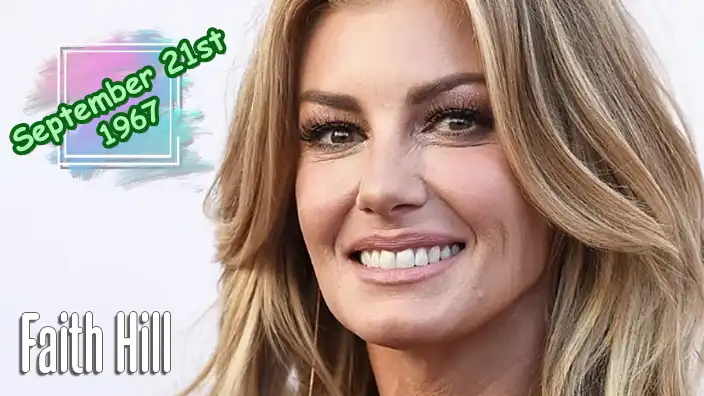
September 21, 1967, in Ridgeland, Mississippi
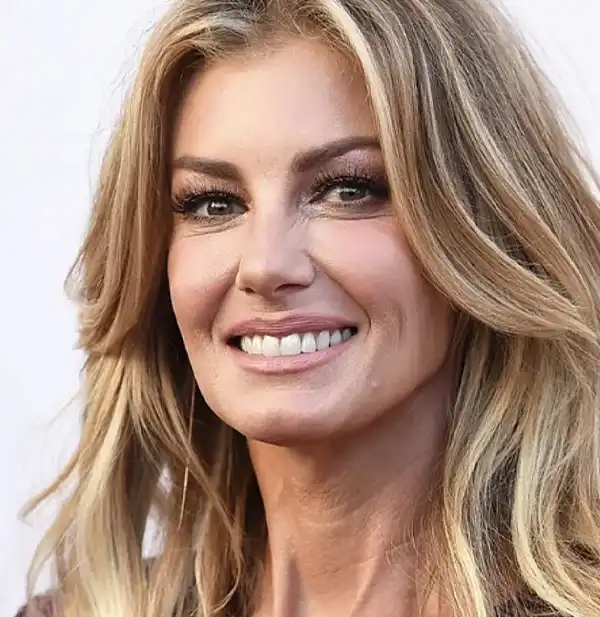
Audrey Faith Perry was born on September 21, 1967, in Ridgeland, Mississippi, and was adopted as an infant by Edna and Ted Perry, who raised her with their two biological sons in the nearby community of Star. Long before she became Faith Hill, she was singing wherever opportunities presented themselves, including churches and local events. Music was not merely a childhood diversion. Hill became convinced early that performing was what she wanted to do, and eventually she made the decision countless aspiring country singers have made before and since: pack up, head for Nashville and discover whether determination can somehow be converted into a recording contract.
Nashville, naturally, did not greet her at the city limits with balloons and a record executive holding a pen. Hill worked ordinary jobs while trying to establish herself in the music business, including selling merchandise and working as a receptionist at a music publishing company. The Recording Academy notes another early occupation that seems particularly distant from the glamorous career that followed: she once worked at McDonald's. There is something wonderfully democratic about discovering that a future five-time Grammy winner once had to deal with the same questions about fries as everybody else.
Her fortunes changed after she was heard singing informally while working in Nashville. Talent has a habit of eventually becoming inconveniently noticeable, and Hill began attracting industry attention. She worked as a demo singer before signing with Warner Bros. Records and preparing her debut album. After years of hoping for an opportunity, she was finally going to discover whether the voice that had taken her from Mississippi to Nashville could survive the leap from dream to profession.
The answer arrived emphatically with Take Me as I Am in 1993. The album introduced Hill to country audiences and included her version of "Wild One," which became a major hit. The song reached the top of Billboard's country chart and remained there for several weeks, immediately establishing Hill as far more than another hopeful newcomer. Her rendition of Janis Joplin's "Piece of My Heart" also became a country hit, demonstrating both the power of her voice and her willingness to reach beyond conventional Nashville material.
Her second album, It Matters to Me, followed in 1995 and reinforced that success. Its title track became another signature song, while the album produced several successful singles. By this point Hill had established herself as one of country's leading female performers, combining a powerful voice with the kind of polished stage presence that television loved. Yet one of the most important developments in both her personal life and musical career was about to arrive through another country singer whose career was rising alongside hers.
Faith Hill and Tim McGraw toured together on the Spontaneous Combustion Tour in 1996. The professional relationship became personal, and they married later that year. Their marriage created one of country music's most recognizable partnerships, but what made it particularly successful professionally was that both performers maintained substantial independent careers. They were not a musical act created as a couple. They were two successful solo artists who also happened to sound extremely good together.
That became obvious with "It's Your Love," released as a Tim McGraw single featuring Hill. The romantic duet became a huge country hit and helped establish the pair as one of the genre's signature couples. More collaborations followed, including "Just to Hear You Say That You Love Me," "Let's Make Love," "I Need You" and "Like We Never Loved at All." Their chemistry did not require a great deal of theatrical convincing, given that audiences were perfectly aware they were married. When Hill and McGraw sang a love song together, nobody had to spend much time wondering whether the performers had met before rehearsal.
Hill's 1998 album Faith marked an important expansion of her audience. The album included "This Kiss," one of the defining songs of her career. Bright, infectious and nearly impossible to hear without mentally supplying the chorus, "This Kiss" became a major crossover success. The Recording Academy notes that Faith became her first album to reach the Top 10 of the Billboard 200, while "This Kiss" became her first Top 10 hit on the broader pop chart. Country audiences already knew Faith Hill very well; now much of the rest of America was catching up.
The crossover became enormous with Breathe, released in 1999. The title track became one of the biggest songs of Hill's career, blending country foundations with polished pop production and a vocal performance designed for very large rooms. "The Way You Love Me" became another crossover success, while the album established Hill as a performer capable of moving comfortably between country radio and mainstream pop without sounding as though she had simply changed costumes halfway through the show.
Breathe became a defining album not only commercially but critically. At the 43rd Grammy Awards, Hill enjoyed an extraordinary night, winning three awards: Best Country Album for Breathe, Best Female Country Vocal Performance for the title song and Best Country Collaboration with Vocals for "Let's Make Love" with Tim McGraw. Three Grammys in one evening is the sort of night when repeatedly walking back to the stage begins to create logistical concerns about where exactly one is supposed to put everything.
The success of Breathe positioned Hill among the most prominent crossover country artists of her generation. She appeared on magazine covers, performed on major television broadcasts and reached listeners who might rarely have ventured near a country radio station. Yet her crossover success occasionally created debate within country music about how far an artist could move toward pop before leaving the genre behind. It is a discussion Nashville has conducted in one form or another for generations, usually whenever somebody becomes extremely successful.
Hill continued exploring pop-oriented production with Cry in 2002. The title track earned her another Grammy Award, this time for Best Female Country Vocal Performance. The album demonstrated that Hill was willing to experiment rather than repeatedly reproduce Breathe, although its pop direction generated mixed reactions among some country listeners. Hill's career had reached the interesting stage where virtually any artistic decision would be examined as evidence either that she was evolving brilliantly or abandoning civilization. Such is the reward for becoming enormously famous.
She answered some of those questions very directly with Fireflies in 2005. The album included "Mississippi Girl," a spirited declaration that international fame, glamorous appearances and enormous success had not erased the woman who had grown up in Mississippi. The song cheerfully acknowledged the strange distance between her beginnings and celebrity while insisting that the fundamentals remained intact. It was difficult to misunderstand the message.
Fireflies also produced "Like We Never Loved at All," another duet with Tim McGraw. Their performance earned Hill her fifth Grammy Award, winning Best Country Collaboration with Vocals in 2006. With that victory, her Grammy career stood at five wins, while the Recording Academy records 17 nominations overall. Those honors covered solo vocal performances, an album and collaborations, neatly reflecting the different dimensions of her career.
Hill and McGraw also turned their musical partnership into enormously successful concert tours. Their Soul2Soul tours placed both performers on equal footing, allowing each to showcase individual hits while joining together for duets. The concept worked because neither performer existed merely as the other's supporting act. Audiences received two major country stars and the additional attraction of seeing them perform together.
Behind the celebrity image was also a family life that Hill and McGraw worked to protect. They raised three daughters while maintaining two demanding careers, and Hill has repeatedly spoken about the importance of placing family first. The Recording Academy quotes her explaining that maintaining balance begins with taking care of her family, after which other parts of life tend to fall into place. That philosophy became particularly significant because Hill's career unfolded during a period when country stars were increasingly expected to function not merely as recording artists but as touring acts, television personalities, media figures and international celebrities.
Hill also became known for major televised performances. She sang the national anthem at Super Bowl XXXIV in 2000 and later became a familiar voice to football audiences through her performance of the opening theme for NBC's Sunday Night Football. For several seasons beginning in 2007, Hill performed "Waiting All Day for Sunday Night," based on Joan Jett's "I Hate Myself for Loving You." It became so closely associated with Sunday evening football that millions of viewers who did not necessarily follow country music still knew exactly who Faith Hill was.
Her willingness to step outside music eventually extended to acting. Hill appeared in the 2004 film The Stepford Wives, alongside Nicole Kidman, Matthew Broderick, Bette Midler and Glenn Close. Years later, she took on a much more substantial dramatic challenge opposite McGraw in the television series 1883, a prequel to Yellowstone. Hill played Margaret Dutton, while McGraw portrayed James Dutton, members of the pioneering Dutton family making a brutal westward journey.
1883 required Hill to leave the polished world of concert stages considerably behind. Margaret Dutton faced hardship, violence, hunger, dangerous travel and the general realization that crossing nineteenth-century America was considerably less picturesque than modern tourism brochures might suggest. Hill's performance allowed audiences accustomed to seeing her with a microphone to encounter her in sustained dramatic work, while working opposite McGraw gave the fictional marriage an established chemistry that could not easily be manufactured.
Hill's career has also included significant charitable activity. After Hurricane Katrina devastated communities along the Gulf Coast in 2005, Hill and McGraw personally delivered relief supplies to the region and later used their performances to support recovery efforts. Both had strong Southern connections, making the devastation particularly personal. The Recording Academy has also documented their participation in fundraising and charitable events benefiting communities and people within the music industry.
Perhaps the most interesting feature of Faith Hill's career is how naturally it has moved through several versions of country music stardom. She began as a traditional Nashville newcomer hoping somebody would listen to her demo, became a successful country singer, evolved into an international crossover star, formed one of country music's most successful performing partnerships and later moved into dramatic acting. Through each phase, that Mississippi background remained an important part of her public identity.
Her influence can also be seen in the generations of country singers who followed. By the late 1990s and early 2000s, Hill, Shania Twain and several other performers demonstrated that a country artist could achieve enormous mainstream success without necessarily surrendering a connection to Nashville. The pathway between country and pop became increasingly busy in the decades that followed, traveled by artists with different sounds and approaches but with proof already established that the audience could extend far beyond traditional genre boundaries.
Five Grammy Awards provide a convenient measurement of Faith Hill's accomplishments, but statistics alone do not explain why songs such as "This Kiss," "Breathe," "The Way You Love Me" and "Mississippi Girl" remain so strongly associated with an era of country music. Hill possessed the voice required for enormous ballads but also the personality needed to make those songs feel approachable. She could deliver the polished spectacle of a major arena performer without completely losing the impression of the Mississippi singer who once headed to Nashville hoping someone might give her a chance.
It turned out somebody did.
And once they handed Faith Hill a microphone, getting it back became increasingly unnecessary.